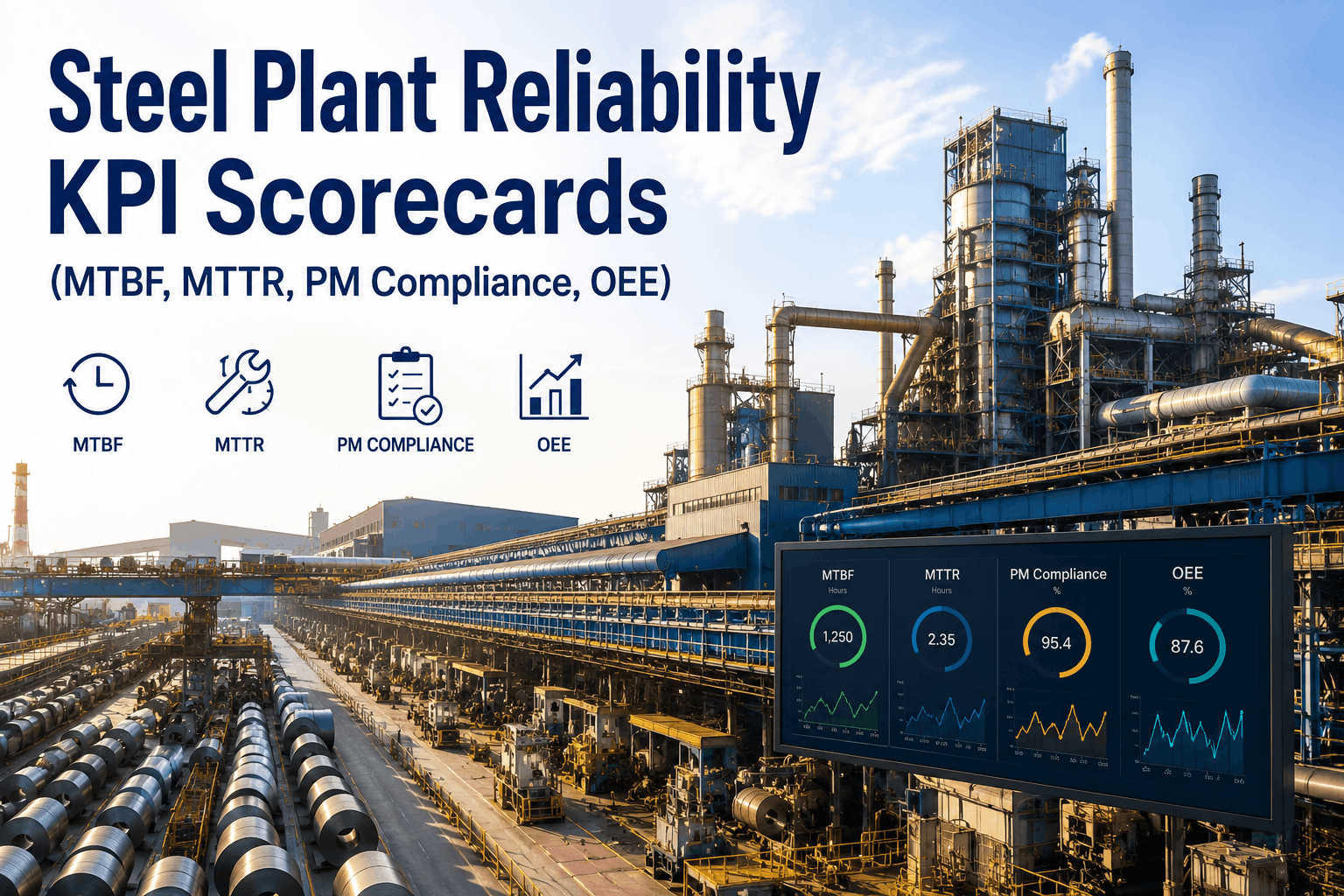
In the high-stakes, capital-intensive environment of 21st-century North American steelmaking, the difference between a top-quartile facility and a struggling one is often found in the quality of its maintenance data. For an integrated mill or a high-speed mini-mill, a single hour of unplanned downtime on a hot strip mill, caster, or blast furnace doesn't just represent a loss of production—it represents a cascading series of costs including wasted energy, lost yield, premium freight for delayed orders, and the high price of emergency "firefighting" repairs. Historically, maintenance was seen as a necessary evil, a cost center to be minimized. Today, in the era of Industry 4.0, world-class reliability is recognized as a strategic lever for profitability. However, many US-based brownfield facilities still struggle with "data silos," where critical metrics like MTBF (Mean Time Between Failures) and MTTR (Mean Time To Repair) are buried in paper logs or disconnected spreadsheets. A high-density, real-time Reliability KPI Scorecard solves this by integrating every work order, downtime event, and spare part consumption record from your CMMS directly into actionable executive dashboards. By benchmarking PM Compliance, OEE, and Planned-to-Unplanned ratios against North American industrial standards, maintenance leaders can transition from reactive crisis management to a proactive culture of data-driven excellence. Start Your Reliability Journey with OxMaint and gain the 100% transparency required to identify and eliminate the "bad actors" holding back your facility's performance.
Steel Plant Reliability KPI Scorecards & Real-Time Performance Dashboards
Standardize MTBF & MTTR Benchmarking · Automate PM Compliance Tracking · Optimize OEE (Overall Equipment Effectiveness) · Visualize Planned vs. Unplanned Ratios · Track Maintenance Cost per Ton · Monitor Asset Health Index · Deploy Real-Time CMMS Dashboards · Facilitate "Bad Actor" Identification & RCA
The Strategic "Big Four" Reliability Metrics
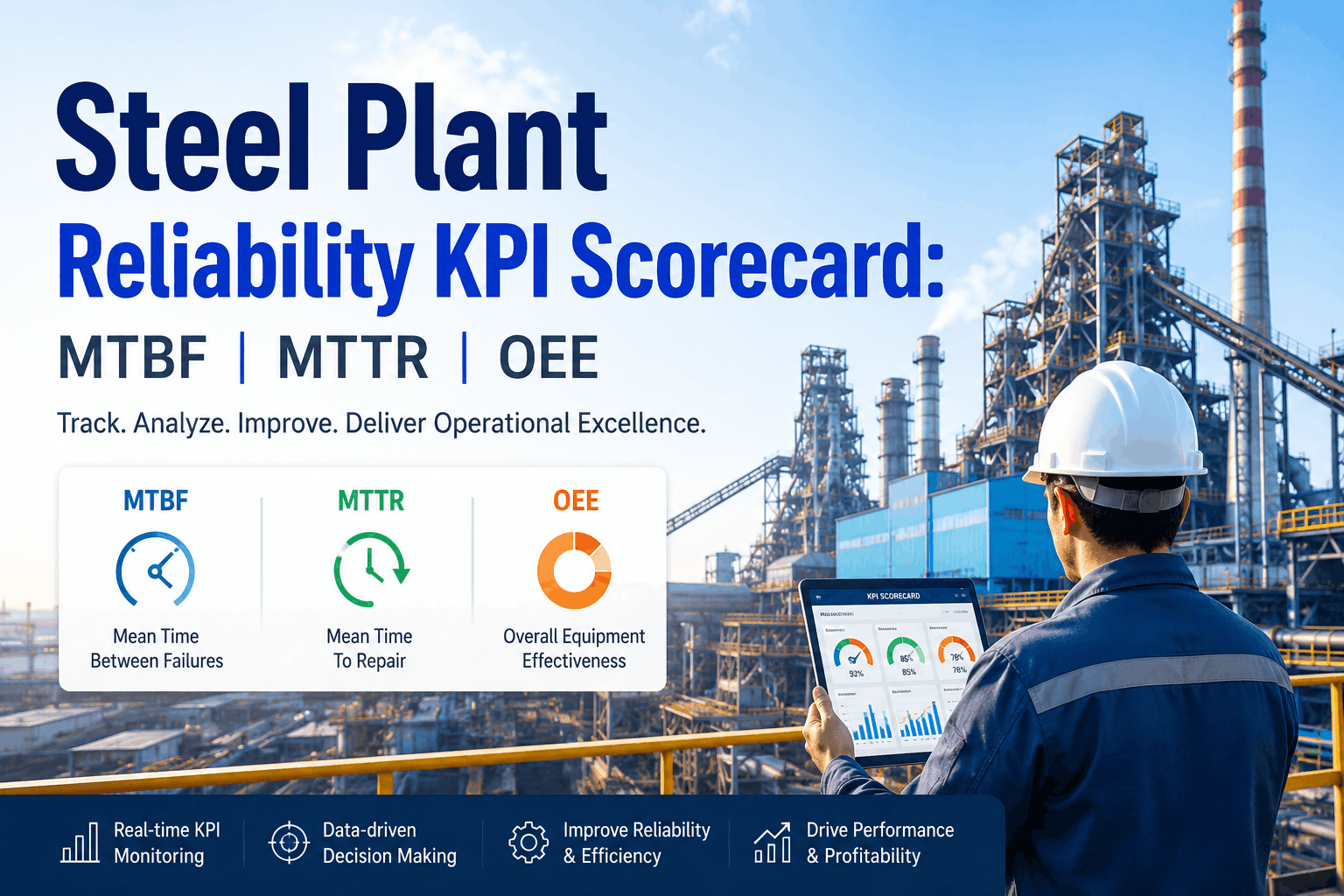
In the complex environment of an integrated steel facility, focusing on the wrong data is just as dangerous as having no data at all. OxMaint prioritizes the "Big Four" metrics that provide the highest correlation to operational uptime and long-term asset health.
MTBF (Mean Time Between Failures)
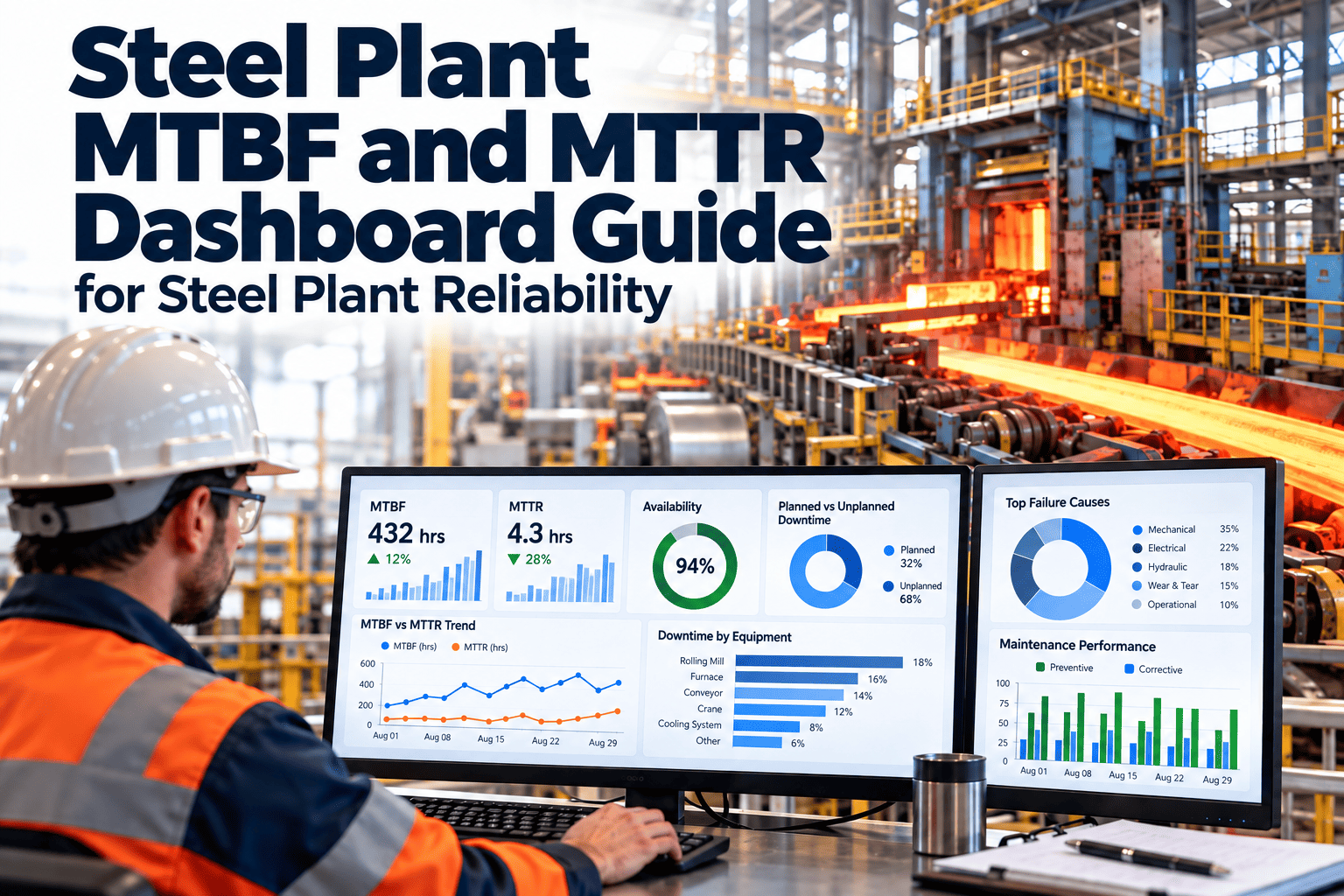
MTBF is the ultimate indicator of your inherent equipment reliability. It measures the average operating time between failures. A rising MTBF trend indicates that your preventive and predictive maintenance strategies are effectively extending the lifecycle of your critical assets. Steel Industry Benchmark: >350 hours for finishing mill drives.
MTTR (Mean Time To Repair)
MTTR measures your facility's maintainability and restoration efficiency. It encompasses the entire process from failure notification to asset restart. A lower MTTR indicates superior technician skills, better tool availability, and optimized spare parts staging. Target: < 3 hours for critical line-stop mechanical failures.
PM Compliance %
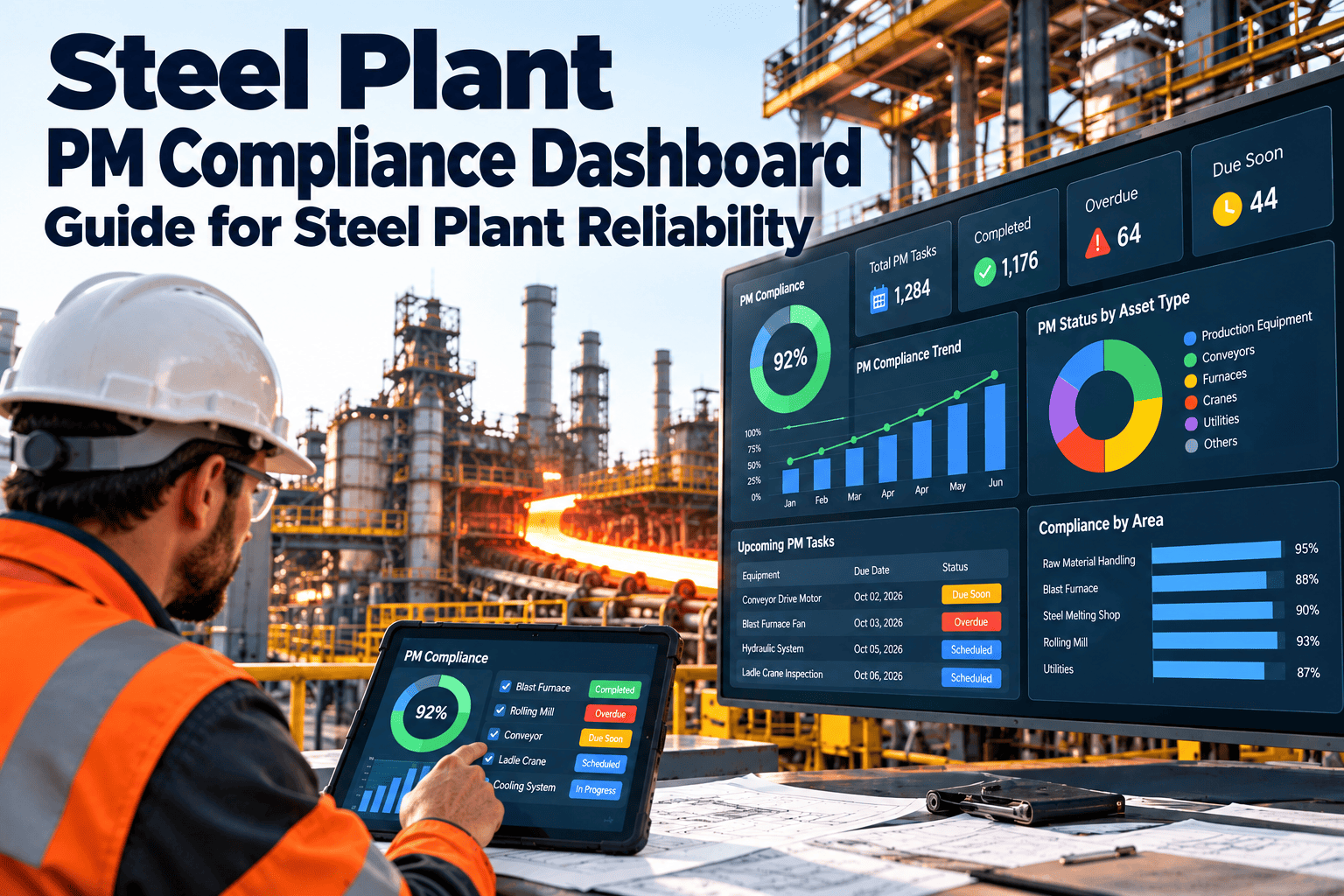
PM Compliance is the most critical leading indicator in maintenance. It tracks the ratio of scheduled preventive maintenance tasks completed within their tolerance window. Facilities that maintain >95% compliance consistently experience 50% fewer catastrophic failures than those with <80% compliance. Standard: 95% minimum for Class-A critical assets.
OEE (Overall Equipment Effectiveness)
OEE provides a holistic view of manufacturing productivity by multiplying Availability × Performance × Quality. In a steel mill, OEE helps identify hidden capacity losses from micro-stops and reduced-speed operation. Gold Standard: 80-85% for high-speed strip and bar rolling mills.
North American Steel Plant Performance Benchmarking
How does your facility compare to the top performers in the Ohio Valley or the US Great Lakes region? OxMaint provides integrated benchmarking that shows your current performance gaps against world-class industrial standards.
KPI Technical Matrix & CMMS Data Sources
Reliable KPIs require reliable data sources. OxMaint automates the aggregation of work order data, downtime logs, and inventory transactions to ensure that your scorecards are accurate and tamper-proof.
| Reliability KPI | Data Source (CMMS) | Calculation Logic | Target (Steel) | Reporting Freq |
|---|---|---|---|---|
| MTBF | Downtime Logs / Status Changes | Total Operating Time / # of Failures | > 300 Hours | Monthly Report |
| MTTR | Work Order Time Entries | Total Repair Time / # of Repairs | < 4.0 Hours | Weekly Dashboard |
| PM Compliance | Scheduled vs. Actual Logs | (Completed PMs / Scheduled PMs) × 100 | > 95% | Real-Time |
| Planned Ratio | Work Order Type Codes | Planned Labor Hours / Total Hours | > 80% | Monthly Trend |
| OEE | Production × Status Feeds | Availability × Performance × Quality | > 85% | Shift Daily |
| Maint Cost/Ton | MRO Spend + Labor Logs | Total Maintenance Cost / Total Tonnes | Variable | Quarterly Review |
| Wrench Time % | Labor Utilization Records | Active Repair Time / Clock Hours | > 45% | Bi-Weekly |
Six Steps to Implementing a KPI-Driven Reliability Program
Implementing a world-class scorecard isn't just about software—it's about process. OxMaint guides your team through the following roadmap to ensure long-term data integrity and cultural adoption.
Categorize every asset into Class A, B, or C. Focus your most aggressive KPI targets (like 95% PM Compliance) on the Class A assets that drive your facility's production.
Ensure every technician uses consistent codes for 'Planned,' 'Breakdown,' and 'Project' work. This is the foundation of accurate Planned-to-Unplanned ratio tracking.
Link your asset status directly to the CMMS. When a machine stops, the timer starts automatically, ensuring MTBF and MTTR data is 100% accurate without manual entry.
Move KPIs from monthly reports to live floor-level dashboards. Visibility drives accountability, ensuring that slips in PM compliance are addressed before the shift ends.
Use the KPI data to identify the bottom 5% of assets causing 80% of your downtime. Trigger Root Cause Analysis (RCA) work orders automatically for these recurring failures.
Review KPI trends in weekly reliability meetings. Use the data to justify capital expenditure for asset replacements or to optimize your PM intervals for better efficiency.
Turn Your Raw Maintenance Data Into a Strategic Profit Lever
OxMaint automatically aggregates your work order history, downtime logs, and spare parts consumption into real-time, executive-level KPI scorecards. Stop guessing which assets are failing your facility—start identifying and eliminating your "Bad Actors" with data-driven transparency. Build your first dashboard in under 10 minutes.
Financial Economics of KPI Optimization
In a high-tonnage steel plant, even micro-improvements in reliability metrics yield massive bottom-line impacts. OxMaint provides the tools to quantify these savings for executive-level ROI justification.
Before vs. After: Manual vs. Digital Scorecard Management
"Before we implemented OxMaint's reliability scorecards, our maintenance performance was purely subjective. We would have 'good months' and 'bad months' without ever knowing exactly why. By moving to automated MTBF and PM compliance tracking, we discovered that 70% of our downtime was coming from just three assets in the caster area. We applied Root Cause Analysis, redesigned the lubrication points, and our OEE improved from 72% to 86% in six months. The transparency provided by the system has completely changed our culture from reactive firefighting to data-driven proactive excellence."
Frequently Asked Questions
OxMaint utilizes the integrated 'Asset Status' module within the CMMS. When a machine is marked as 'Down' in the system, the timer starts automatically. Once the work order is completed and the asset is marked as 'Operational,' the system calculates the exact repair duration and updates the MTBF/MTTR trends for that asset class in real-time. This eliminates the 'human error' factor associated with manual log entries and ensures your data is 100% audit-ready for ISO certifications.
Yes. OxMaint's 'Alert Engine' allows you to configure threshold triggers for every metric in your scorecard. For example, if the PM Compliance for a critical ladle crane drops below 95%, an automated high-priority notification is sent to the Maintenance Manager and Reliability Engineer. This allows for immediate intervention and corrective action before a performance slip leads to a catastrophic equipment failure or safety incident.
ISO 55001 (Asset Management) and ISO 9001 (Quality) both require objective evidence of performance monitoring and continuous improvement processes. OxMaint provides a permanent, time-stamped digital audit trail of all reliability metrics. Our reporting suite generates the exact performance documentation required by third-party auditors, proving that your facility maintains a rigorous, data-driven approach to asset lifecycle management and operational reliability.
While Availability simply tracks whether the machine is running or not, OEE is a much more comprehensive metric for a steel mill. OEE factors in 'Performance' (is the hot mill running at its designed speed?) and 'Quality' (is the steel on-spec?). A mill might be available 90% of the time, but if it is running at 70% speed due to mechanical vibration issues, your OEE will reflect that massive hidden capacity loss, which is critical for making informed capital expenditure decisions.
The 'Bad Actor Report' in OxMaint ranks every asset in your facility (or across multiple facilities) based on a weighted score of failure frequency, total downtime cost, and MRO spend. This allows reliability engineers to focus their limited resources on the 5% of equipment that typically causes 80% of the maintenance headaches. By targeting these 'Bad Actors' for Root Cause Analysis (RCA), facilities can achieve rapid improvements in overall plant OEE.
Yes. By utilizing the 'Labor Tracking' module, managers can visualize 'Wrench Time'—the ratio of actual repair hours versus total clock hours. This helps identify structural bottlenecks in your maintenance process, such as excessive travel time or delays in spare parts staging. Improving wrench time from 35% to 50% is the equivalent of adding 40% more maintenance capacity to your facility without hiring a single additional person.
OxMaint's 'Enterprise Dashboard' allows corporate leadership to view and compare reliability metrics across multiple facilities on a single screen. This enables internal benchmarking, where you can identify the top-performing sites and investigate the specific maintenance practices and cultures that are driving those superior results. This transparency facilitates the sharing of best practices across the entire organization, helping to normalize high performance across all regions.
All scorecards and dashboards can be exported as high-resolution PDF reports, CSV files, or interactive web links for use in internal executive portals. Furthermore, OxMaint can be configured to automatically send 'Monthly Reliability Performance Reports' directly to specified executive inboxes on the first day of every month. This ensures that the leadership team remains fully informed on asset health and maintenance ROI without requiring manual data compilation by the reliability team.
Ready to Benchmark Your Facility's Reliability Performance?
Join the hundreds of North American industrial leaders using OxMaint to drive transparency, accountability, and world-class OEE. Your journey toward zero unplanned downtime starts with the first automated scorecard. Start your free trial today.


.png)
