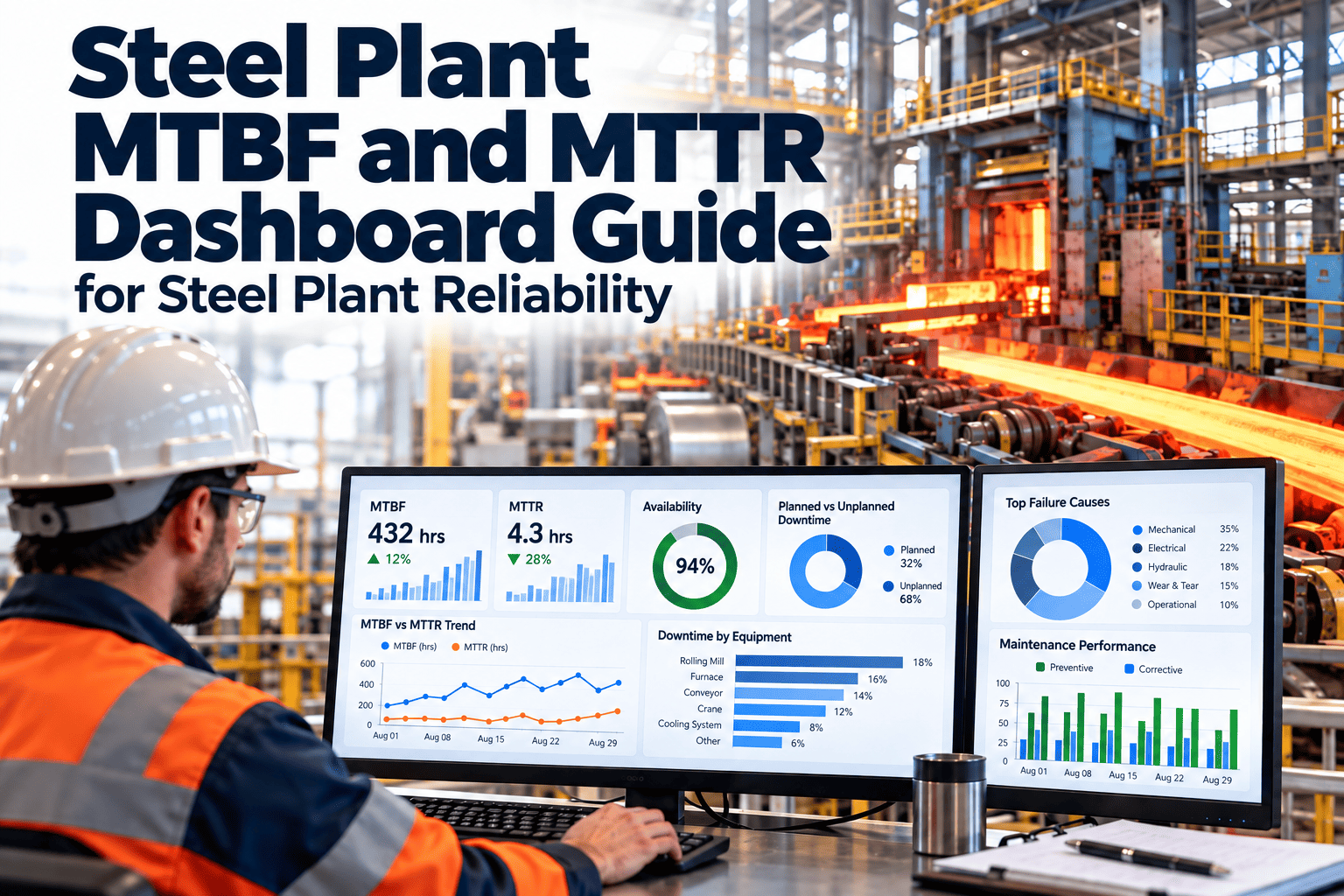
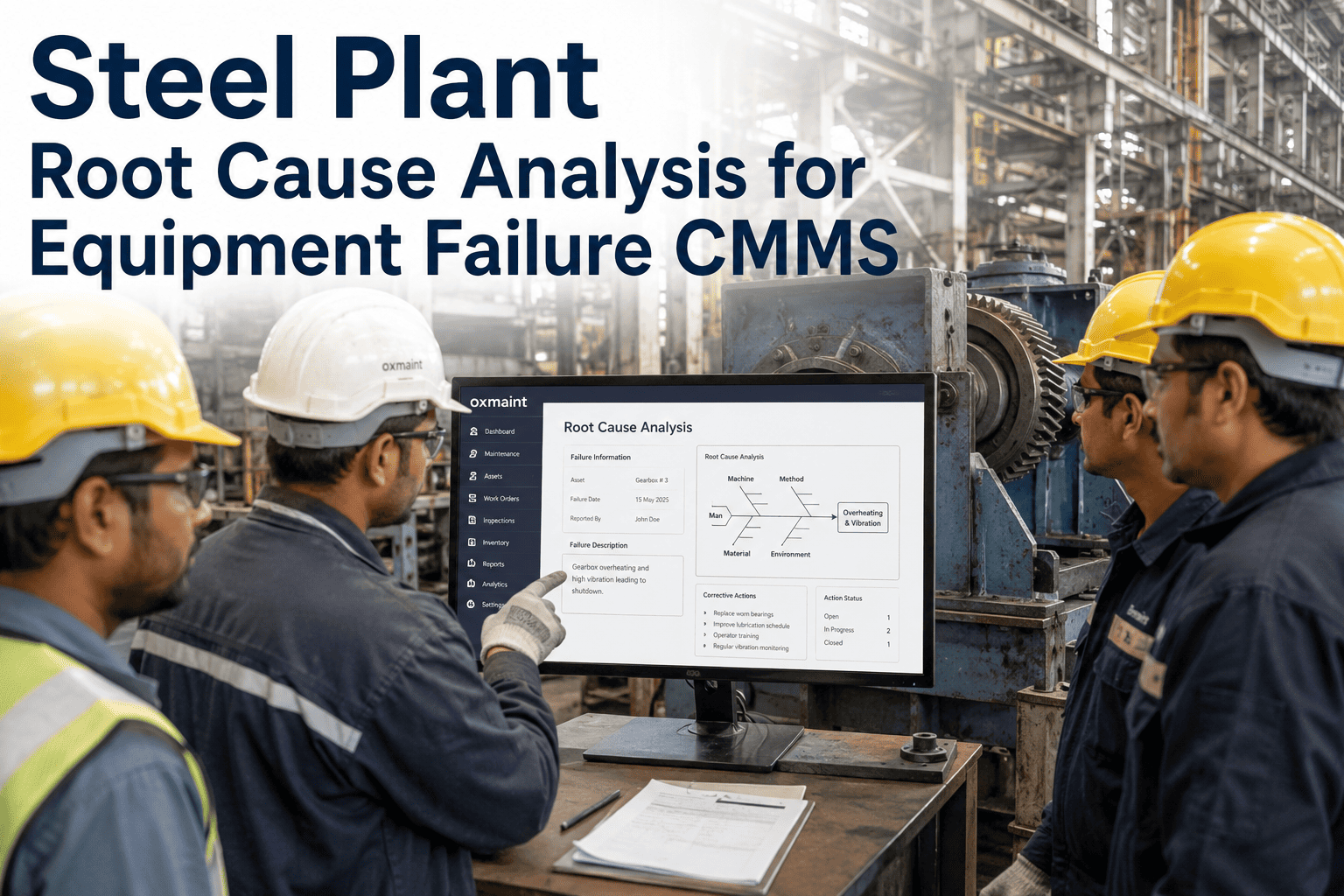
Most steel plant maintenance teams are running critical decisions — whether to replace a hot strip mill drive, extend a blast furnace campaign, or justify a reliability engineering headcount — on gut feel, spreadsheet approximations, and last quarter's downtime log. The gap between what the data says and what gets acted on is almost always a measurement problem: MTBF calculated at plant level hides the individual asset that accounts for 60% of your failures, OEE measured monthly obscures the shift-pattern that costs you 11% availability every Wednesday morning changeover, and MTTR figures from manual records understate actual repair time by 15–30%. OxMaint's benchmarking and reliability metrics module calculates OEE, MTBF, and MTTR automatically from live work order and sensor data — per asset, per area, per shift — and positions your plant against verified steel industry benchmarks, so your next investment decision starts with the right numbers.
OEE, MTBF & MTTR Benchmarking for Steel Plants
Industry-verified benchmarks for blast furnace, continuous caster, rolling mill, and BOF operations — with the OxMaint analytics layer that calculates every metric automatically and shows you exactly where your plant sits against top-quartile performers.
The Three Metrics That Define Steel Plant Reliability Performance
OEE, MTBF, and MTTR are not reporting metrics — they are operational control instruments. Each measures a different dimension of plant performance, and each drives a different improvement lever. Understanding precisely what each measures, how it is correctly calculated in a steel plant context, and what the industry benchmark range is for your asset class is the foundation of every effective reliability improvement programme.
The percentage of planned production time that is genuinely productive — equipment running, at designed speed, producing good product. In a steel plant, a 65% OEE means 35% of your planned operating time is consumed by breakdowns, speed reductions, grade transitions, or quality losses. World-class steel OEE is 78–85% — significantly below the generic 85% benchmark because planned maintenance shutdowns, refractory relines, and grade transition losses are structural features of integrated steelmaking, not evidence of poor management.
Asset reliability — how long a piece of equipment operates before experiencing an unplanned failure. MTBF is your primary indicator of whether your preventive maintenance programme is working: rising MTBF means PMs are effective and predictive maintenance is catching deterioration before failure. Declining MTBF signals an asset approaching end-of-life, a PM gap, or operating conditions that have changed beyond the maintenance programme's design basis. MTBF must be calculated per individual asset — not per asset class or production area — to be actionable.
Maintenance team effectiveness — how fast your team restores a failed asset from detection to operational status. MTTR captures repair speed, parts availability, technician skill depth, and procedure quality simultaneously. A plant where the same type of failure takes 2 hours one shift and 9 hours another shift has an MTTR problem that is really a parts staging, skill coverage, or procedure clarity problem. MTTR data from manual records consistently understates actual repair time by 15–30% because technicians log work order completion time rather than failure detection time — a critical distinction for accurate benchmarking.
Your Plant's OEE, MTBF, and MTTR Are Already in Your Work Order Data. OxMaint Extracts Them Automatically.
No spreadsheets. No manual calculation. No monthly report preparation. OxMaint calculates all three metrics per asset, per shift, per area — and positions your plant against steel industry benchmarks in real time, from the work order data your team already creates.
The 5 Measurement Mistakes That Corrupt Your MTBF and MTTR Numbers
Steel plants that calculate MTBF and MTTR from manual records, shift logs, or spreadsheets consistently produce numbers that look precise but drive incorrect decisions. These five structural errors are the most common — and the most consequential.
An area with 40 assets and an average MTBF of 3,200 hours may contain one asset with an MTBF of 380 hours — the single worst performer responsible for 60% of that area's unplanned downtime. That asset is completely invisible in the area-level average. Asset-level MTBF is the only figure that enables targeted action; area-level MTBF is a reporting metric, not a reliability management tool.
Many plants count only failures that completely stopped production — ignoring degraded operation, partial failures where equipment was "nursed along," and "corrected before failure" events that required unplanned intervention but didn't cause a production stop. This practice overstates MTBF by 20–40% and makes the predictive maintenance programme look less necessary than it actually is.
In steel plants with paper-based or manual work order systems, the MTTR clock typically starts when someone opens a work order — which may be 45–90 minutes after the failure was first detected. MTTR that excludes detection-to-response time understates actual repair time by 15–30% and makes MTTR look better than it is while hiding the response speed problem that often costs more time than the repair itself.
An aggregate MTTR of 4.8 hours for caster roll drive repairs hides a critical pattern: Day shift averages 2.6 hours (parts staged, senior tech available, supervisor present) while Night shift averages 7.4 hours (parts not staged, call-out required, skill gap). These aren't the same failure type — they're the same equipment failure with completely different response conditions. Unstratified MTTR doesn't tell you what to fix.
A monthly OEE figure is a post-mortem report, not an operational tool. By the time a 62% OEE for the month is calculated and presented in a management review, every downtime event and speed loss that drove it is weeks old — too late for corrective action, too aggregated for root cause analysis. OEE calculated per shift, per area, per production run is the only granularity that enables the rapid loss identification that drives improvement.
How OxMaint Calculates and Benchmarks Every Metric Automatically
The manual benchmarking cycle in most steel plants takes 3–5 days per month: pulling downtime logs, validating work order timestamps, standardising failure classification, and building the spreadsheet. OxMaint eliminates that cycle entirely — metrics are calculated continuously from the work order and sensor data that maintenance teams create in the normal course of their work.
Financial Value of Benchmark Gap Closure — Steel Plant ROI
Reliability benchmarking becomes a capital allocation tool when each gap is quantified in production value terms. OxMaint's benchmark gap analysis calculates the financial value of closing each metric gap — translating OEE points, MTBF hours, and MTTR minutes into tonnes and dollars that justify investment decisions.
The benchmarking conversation in steel plant maintenance has a structural problem that nobody talks about openly: most plants are benchmarking against numbers they cannot trust. When I review a plant's MTBF data and find that it comes from monthly shift logs, manually transferred to a spreadsheet, with failure events defined inconsistently across shifts and areas, I know before I do a single calculation that the number is wrong by at least 20–35%. The plant thinks it has a 3,400-hour MTBF on its caster roll drives. The real number is closer to 2,100 hours — but because nobody has been measuring from failure detection, and because partial failures don't make it into the count, the reported number is flattering and the true performance is hidden. I have seen this same pattern at plants in 11 countries across 21 years of reliability consulting. The first thing OxMaint does correctly that most manual systems do wrong is timestamp failure detection from the alarm event, not from work order creation. That single change alone typically moves measured MTTR up by 1.5–3 hours from what the manual records showed — which is uncomfortable to see but critical to act on. You cannot improve a number you are not accurately measuring.
Frequently Asked Questions
What is a realistic OEE target for an integrated steel plant, and why is it lower than the 85% world-class benchmark?
Realistic world-class OEE for an integrated steel plant is 78–85% for blast furnace and BOF operations and 74–82% for hot strip mill operations — lower than the generic 85% world-class figure because planned maintenance shutdowns, refractory relines, roll changes, and grade transition losses are structural features of integrated steelmaking, not improvement targets. A blast furnace that takes a planned 48-hour shutdown for tuyère maintenance every 90 days has a structural availability ceiling below 95%, regardless of maintenance programme quality. The recoverable OEE gap in steel is almost entirely in unplanned downtime — breakdowns, speed restrictions from equipment condition, and cobble losses — which is where predictive maintenance and condition monitoring deliver their primary value. Sign in to OxMaint to see your plant's OEE position against steel-specific benchmarks.
How does OxMaint calculate MTBF and MTTR automatically without additional data entry from maintenance teams?
OxMaint extracts MTBF and MTTR from the work order data that maintenance teams already create in their normal workflow — no additional data entry is required. MTTR is calculated as the interval between the failure detection timestamp (captured from OPC-UA alarm events where integrated, or from work order creation time where not) and the work order closure timestamp. MTBF is calculated from the interval between consecutive corrective work orders on the same asset tag. Both metrics update automatically each time a work order closes. For plants with SCADA integration, failure detection timestamps are captured automatically from alarm events — which is the critical improvement over manual systems. Book a demo to see the automatic MTBF/MTTR calculation on your asset data.
How many assets need to be in OxMaint before MTBF and MTTR calculations become statistically reliable?
MTBF and MTTR become statistically meaningful at different thresholds depending on failure frequency. For frequently-failing assets (MTBF under 2,000 hours), 6–8 failure events are sufficient for a reliable MTBF calculation — achievable in 3–4 months. For highly-reliable assets (MTBF above 8,000 hours), the calculation window must span 12–24 months to capture enough events. OxMaint handles this automatically by displaying confidence intervals alongside MTBF values — a low-confidence MTBF is shown with a wider range to indicate insufficient event count, preventing premature conclusions from sparse data. MTTR is reliable much faster than MTBF because repair events are more frequent than failure events — typically 8–12 repair records are sufficient for a representative MTTR figure. Start your free trial to begin accumulating reliability data from day one.
Can OxMaint's benchmark dashboard generate the reports needed for management reviews and capital justification presentations?
Yes — OxMaint's benchmarking module generates board-ready PDF reports that show your plant's OEE, MTBF, and MTTR position against peer benchmarks, the financial value of each gap, and the trend over the previous 4–12 weeks. Reports are configurable by area, asset class, and time window — a maintenance manager can generate an area-level MTBF trend report, and a VP of Operations can generate a plant-wide OEE benchmark position report from the same dataset. Capital justification reports show the production value of closing specific metric gaps — translating MTBF improvement from "hours between failures" to "tonnes and dollars per year" that finance teams and boards can act on directly. Book a demo to see the benchmark report format for your plant type.
How does OEE benchmarking connect to maintenance scheduling and permit-to-work processes in OxMaint?
OxMaint connects OEE loss data directly to the maintenance execution layer — a downtime event captured in the OEE module automatically creates or updates a corrective work order with the downtime duration, fault code, and production loss value pre-populated. The work order then moves through the full OxMaint workflow: permit-to-work if required, parts reservation, craft assignment, and execution tracking. When the work order closes, the MTTR and MTBF metrics update automatically. This closed loop — from OEE loss event to maintenance action to reliability metric update — is what converts OEE from a reporting dashboard into an operational improvement engine. Sign in to explore the OEE-to-work-order integration in your plant environment.
Stop Benchmarking Against Numbers You Cannot Trust. Start With Metrics That Calculate Themselves.
OxMaint calculates OEE, MTBF, and MTTR automatically from your work order and sensor data — per asset, per shift, per area — and positions every metric against verified steel industry benchmarks in real time. No spreadsheets. No manual report preparation. No aggregation that hides your worst performers. Just the accurate reliability numbers your plant needs to make better decisions about maintenance, capital, and production.