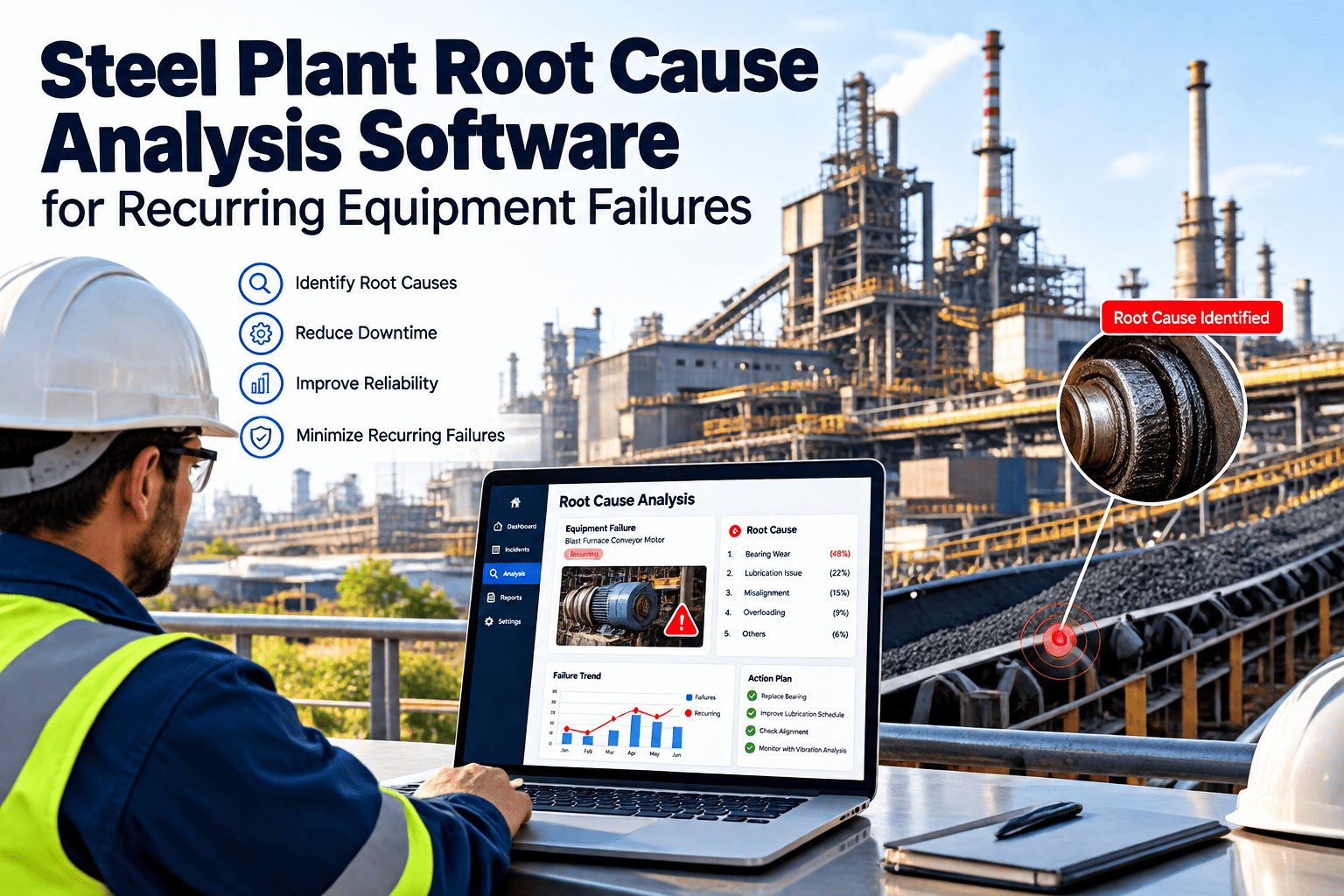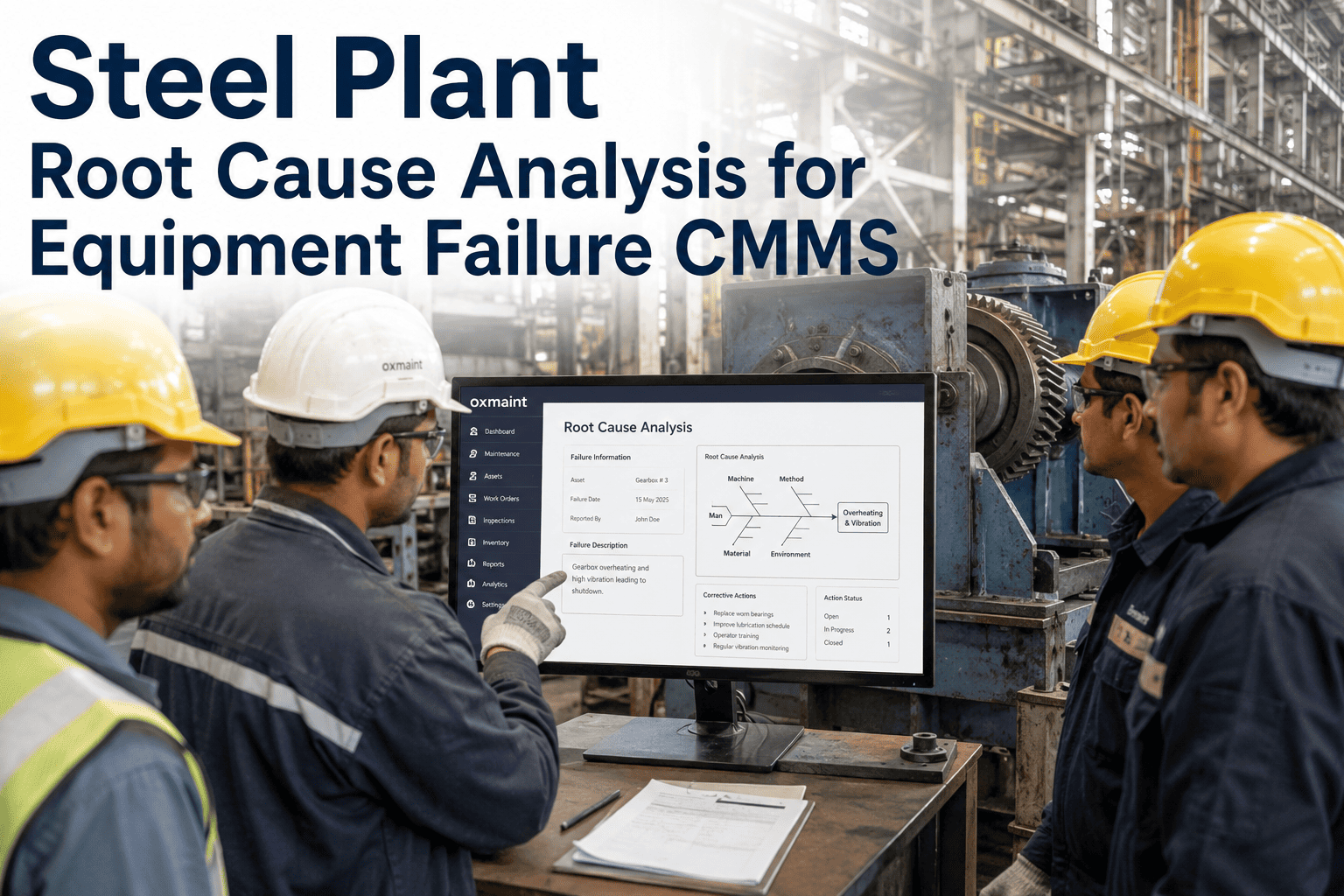
Steel plant root cause analysis for equipment failure is the disciplined process of identifying the underlying reason a critical asset — a blast furnace, rolling mill, or continuous caster — broke down, so that the failure is permanently eliminated rather than repeatedly repaired. Repeat equipment failures cost integrated steel mills far more than one-time breakdowns because the same root cause keeps regenerating unplanned downtime, scrap, and safety risk across the production line. This guide covers how reliability engineers structure RCA using 5 Whys, fishbone analysis, fault tree logic, and failure code discipline within a CMMS to turn reactive repairs into permanent fixes. You can put this methodology into practice today by activating structured failure logging and analytics when you Start Free Trial of OxMaint.
STEEL PLANT RCA GUIDE
Is the same equipment failure costing your steel plant millions in repeat downtime?
When a rolling mill bearing seizes or a caster breakout occurs, simply replacing the part guarantees the failure will return. Structured root cause analysis in a CMMS captures 5 Whys, fault-tree logic, and failure codes at the point of repair — so your reliability team eliminates the root cause permanently instead of logging the same breakdown next quarter.
THE COST OF INACTION
Why repeat equipment failures drain steel plant profitability
A single unplanned blast furnace shutdown can cost a steel plant over $1M per day in lost production, energy, and raw material degradation. But the hidden cost multiplier is the repeat failure — when a mill fixes the symptom (a broken shaft, a seized bearing, a failed hydraulic valve) without identifying the root cause. Industry benchmark data shows that 60–80% of equipment failures in heavy steel manufacturing are recurrent, meaning the same asset fails for the same underlying reason within 90 days of the initial repair.
RCA METHODOLOGY
Core root cause analysis techniques for steel plant equipment failure
Effective steel plant RCA requires a structured methodology that goes beyond "it broke, we replaced it." Reliability engineers use four proven techniques to drill down to the true physical, human, and systemic root causes of equipment failure. When these techniques are embedded directly into your CMMS work order workflow, failure analysis becomes a repeatable discipline rather than an afterthought.
5 Whys Analysis
Iterative interrogative technique that asks "why" five times to peel back symptoms. Example: a rolling mill motor overheated (Why? → cooling fan belt snapped → Why? → belt tension was wrong → Why? → maintenance tech used wrong torque spec → Why? → PM checklist lacks torque value → Why? → no standardized PM template in CMMS).
Fishbone (Ishikawa) Diagram
Categorizes potential failure causes into 6Ms: Man, Machine, Material, Method, Measurement, Environment. Ideal for complex steel plant failures like caster breakouts where multiple variables (mold flux quality, cooling water flow, casting speed, sensor calibration) interact simultaneously.
Fault Tree Analysis (FTA)
Top-down deductive logic using Boolean gates (AND/OR) to map every combination of component failures that could trigger a critical event. Essential for blast furnace failure RCA where a single shutdown can stem from interrelated gas system, refractory, and charging equipment faults.
Failure Code Discipline
Structured taxonomy of failure modes, causes, and remedies enforced in the CMMS. Instead of free-text "bearing failed," technicians select hierarchical codes (Component → Failure Mode → Cause → Remedy), enabling trend analytics that reveal systemic issues across the steel plant asset base.
WORKED EXAMPLE
Blast furnace shutdown RCA: a real-world steel plant scenario
Consider a 2.8MTPA integrated steel plant experiencing recurring unplanned shutdowns on Blast Furnace #2 due to hot blast main valve failures. Each event costs $850,000 in lost production and gas energy. Over 6 months, the plant logged 4 identical failures. Without structured RCA, maintenance teams simply replaced the valve actuator each time. Here is how a disciplined CMMS-driven RCA investigation unfolded:
Failure Detection & Logging in CMMS
Operators detect abnormal hot blast pressure fluctuation. CMMS automatically generates a critical work order. Technician logs failure code: Valve — Actuator — Stall — Electrical. Downtime clock starts: 18 hours projected.
5 Whys Investigation Triggered
Reliability engineer opens mandatory RCA work order template. 5 Whys chain: Actuator stalled → Positioner solenoid burned out → Coil insulation failed → Ambient temperature exceeded 95°C → Cooling fan had failed silently with no alarm → No predictive sensor on cooling fan motor.
Root Cause Confirmed & Corrective Action
Root cause: latent cooling fan failure undetected by maintenance. Corrective actions: install vibration sensor on fan motor (predictive maintenance), add weekly thermal inspection PM, update CMMS to auto-trigger work order when sensor anomaly detected. Result: zero recurrence in 14 months.
CMMS INTEGRATION
How OxMaint CMMS eliminates repeat equipment failures in steel plants
OxMaint is an AI-powered CMMS and EAM platform built specifically to transform reactive steel plant maintenance into proactive reliability. By embedding structured root cause analysis directly into every work order, OxMaint ensures that failure data is captured cleanly, trends are identified automatically, and corrective actions are tracked to completion. Here is how OxMaint maps to the four pillars of steel plant RCA:
Structured Failure Code Enforcement
OxMaint enforces hierarchical failure code selection (Asset → Component → Failure Mode → Cause → Remedy) on every completed work order. No more free-text "bearing broke" entries. Outcome: 100% clean failure data for trend analysis, enabling you to spot systemic issues across rolling mills, casters, and furnaces.
Built-in 5 Whys & Fishbone Templates
Every critical work order auto-loads configurable RCA templates — 5 Whys chains, fishbone diagrams, and fault tree starters — directly in the technician's mobile app. Outcome: reduce RCA completion time by 60% and ensure no investigation is skipped when a blast furnace or caster failure occurs.
AI-Driven Predictive Failure Alerts
OxMaint's predictive analytics engine monitors vibration, temperature, and pressure sensor data from your steel plant assets in real time. It detects anomaly patterns weeks before catastrophic failure. Outcome: cut unplanned downtime 30–50% by addressing root causes during scheduled maintenance windows, not mid-cast.
Corrective Action Tracking & Audit Readiness
OxMaint tracks every RCA corrective action to completion with assigned owners, due dates, and verification steps aligned to ISO 55000 asset management standards. Outcome: full audit trail for compliance, and confidence that identified root causes are actually fixed, not just documented.
COMPARISON
Spreadsheet RCA vs. CMMS-driven root cause analysis in steel plants
Many steel plants still attempt to manage equipment failure analysis in Excel spreadsheets or paper logs. The result is fragmented data, skipped investigations, and repeat failures that never get eliminated. Here is how a dedicated CMMS like OxMaint transforms the RCA process:
| RCA Capability | Spreadsheets / Paper Logs | OxMaint CMMS |
|---|---|---|
| Failure data capture | Free-text descriptions, inconsistent | Enforced hierarchical failure codes |
| RCA template availability | Separate files, rarely updated | Built into every critical work order |
| Cross-asset trend analysis | Manual pivot tables, weeks of effort | Real-time AI analytics dashboards |
| Corrective action tracking | Email threads, no accountability | Auto-tracked with owners & due dates |
| Mobile access for technicians | None — transcribed later | Full mobile app, offline-capable |
| Time to complete RCA | 5–10 days average | Within 24 hours of failure |
Stop logging the same equipment failure twice
See how OxMaint embeds structured root cause analysis into every steel plant work order — so repeat failures on blast furnaces, rolling mills, and casters are permanently eliminated. Book a 30-minute demo with our reliability engineering team today.
FREQUENTLY ASKED QUESTIONS
Steel plant root cause analysis: common questions
What is root cause analysis in a steel plant CMMS?
Root cause analysis in a steel plant CMMS is the structured process of identifying, documenting, and eliminating the underlying reason an equipment failure occurred — such as a rolling mill bearing failure or caster breakout — directly within the work order system. The CMMS enforces failure code discipline, provides 5 Whys and fishbone templates, and tracks corrective actions to completion so the same failure does not recur.
How does a CMMS prevent repeat equipment failures in steel manufacturing?
A CMMS prevents repeat failures by enforcing clean failure data capture at the point of repair, mandating RCA templates for critical breakdowns, and tracking corrective actions with assigned owners and due dates. When combined with predictive analytics — like OxMaint's AI anomaly detection — the system identifies root cause patterns across assets before they trigger another unplanned shutdown.
What are the best RCA techniques for blast furnace and rolling mill failures?
The most effective RCA techniques for steel plant equipment failures are 5 Whys for straightforward mechanical failures (e.g., a seized bearing), Fishbone (Ishikawa) analysis for multi-variable events like caster breakouts, and Fault Tree Analysis for complex systemic failures such as blast furnace shutdowns where gas, refractory, and charging systems interact. Failure code discipline should underpin all three.
How long does it take to implement RCA workflows in a CMMS for a steel plant?
A steel plant can implement structured RCA workflows in OxMaint within 2–4 weeks. The process involves configuring failure code taxonomies for your asset hierarchy (furnaces, mills, casters), customizing 5 Whys and fishbone templates, and training maintenance technicians on the mobile app. You can see a live configuration on your assets when you book a 30-minute demo.
How much does repeat equipment failure cost a steel plant annually?
Repeat equipment failures cost a mid-size integrated steel plant an average of $3–5M annually in lost production, energy waste, scrap material, and emergency labor. A single unplanned blast furnace shutdown can exceed $1.2M per day. Implementing CMMS-driven RCA typically reduces repeat failures by 70–90%, delivering payback within 3–6 months.
Eliminate repeat equipment failures with OxMaint
Join steel plants using OxMaint to embed structured root cause analysis into every work order — cutting unplanned downtime 30–50%, enforcing failure code discipline, and turning reactive repairs into permanent fixes.
Free 14-day trial · No credit card