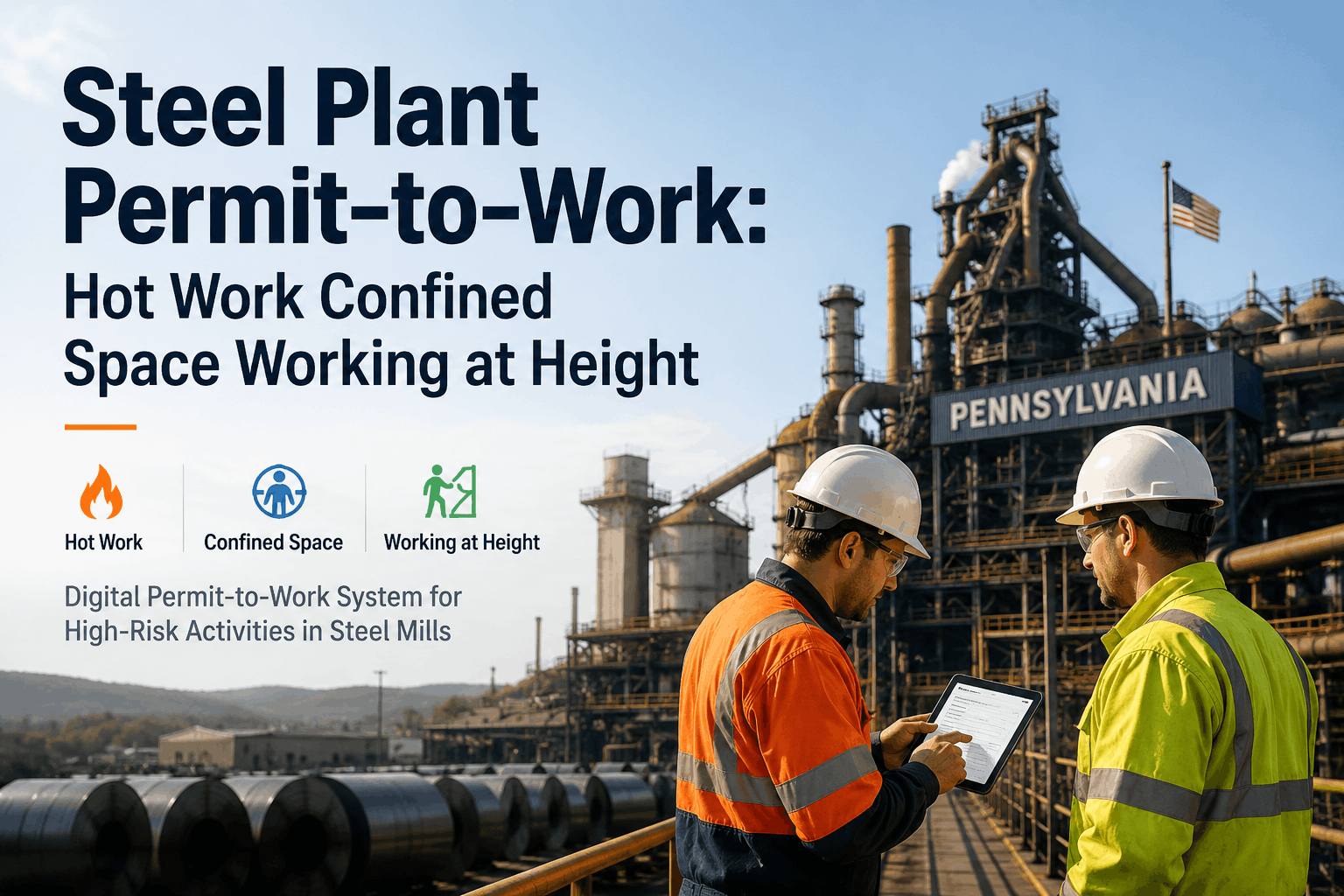
Steel plant operations carry a concentration of fatal hazard categories that is unmatched in almost any other industrial environment. Molten metal exposure, confined space entry, energised electrical systems at arc voltages, elevated work over active production areas, and the thermal radiation of operating furnaces and casters are all present simultaneously on the same shift. Managing safety compliance across this hazard profile — LOTO procedures, confined space permits, hot work authorisations, arc flash protection, and PPE verification — with paper-based permit books and manual tracking creates the documentation gaps that regulatory inspectors find and that accident investigators cite after incidents. This article examines the five safety management disciplines that define OSHA and ISO 45001 compliance in steel plants, and how a CMMS with integrated safety permit management replaces paper workflows with auditable digital records. Book a demo to see Oxmaint.ai's safety module for steel plant operations.
Steel Plant Safety Management: LOTO, Confined Space, Hot Work & PPE Compliance with CMMS
For safety managers, maintenance directors, and plant managers in integrated steel facilities — the shift from paper-based safety permits to digital tracking is not a technology upgrade. It is a risk reduction strategy that produces auditable records where paper produces liability exposure.
The Safety Compliance Challenge in Steel Plant Environments
The sheer number of concurrent high-hazard activities in an integrated steel plant creates a safety management complexity that manual systems cannot reliably sustain. On a single shift, there may be simultaneous confined space entries in the blast furnace and caster areas, multiple LOTO isolations on furnace and mill equipment, hot work permits across maintenance and construction activities, and fall protection requirements on crane runway and elevated platform work. Each of these permit types has its own authorisation chain, its own physical verification requirements, and its own closure procedure — and each carries its own regulatory documentation requirement that must be retrievable during an OSHA inspection or ISO 45001 certification audit.
The consequence of a missing or incomplete safety permit is not just regulatory — it is operational. A LOTO procedure that is not fully documented creates re-energisation risk during maintenance work. A confined space permit that does not record atmospheric testing creates the conditions for the same atmospheric hazard events that confined space regulations were written to prevent. The value of digital safety permit management is not administrative convenience — it is the systematic elimination of the documentation gaps that create both regulatory liability and actual injury risk.
Clause 8.1.3 of ISO 45001 requires organisations to establish, implement, and maintain processes for the management of change and for work in potentially hazardous areas — including documented permit-to-work systems for high-risk activities. Digital permit records with timestamps and authoriser identification provide the documentary evidence this clause demands.
OSHA's Control of Hazardous Energy standard requires written lockout/tagout procedures for every piece of equipment on which maintenance work may be performed. The OSHA 1910.146 confined space standard requires a written permit for every permit-required confined space entry. Both require records retention. Oxmaint.ai's safety module generates and stores both automatically.
Five Safety Compliance Domains in Steel Plant Operations
Each domain below carries distinct regulatory obligations, permit structures, and documentation requirements. Oxmaint.ai manages all five within a single integrated safety management workflow.
Lockout / Tagout Procedure Management
Every piece of equipment on which maintenance or servicing work may be performed requires a documented LOTO procedure that identifies every energy source, the isolation method for each, and the verification steps required before work begins. In a steel plant, a single machine may have multiple energy sources — electrical, hydraulic, pneumatic, thermal, and potential — each requiring a discrete isolation step recorded in sequence. Managing this at the facility level, across hundreds of unique equipment items, is impossible without a digital system that links each LOTO procedure to the specific equipment asset record and generates a dated, authorised permit for every isolation event.
Confined Space Entry Permits
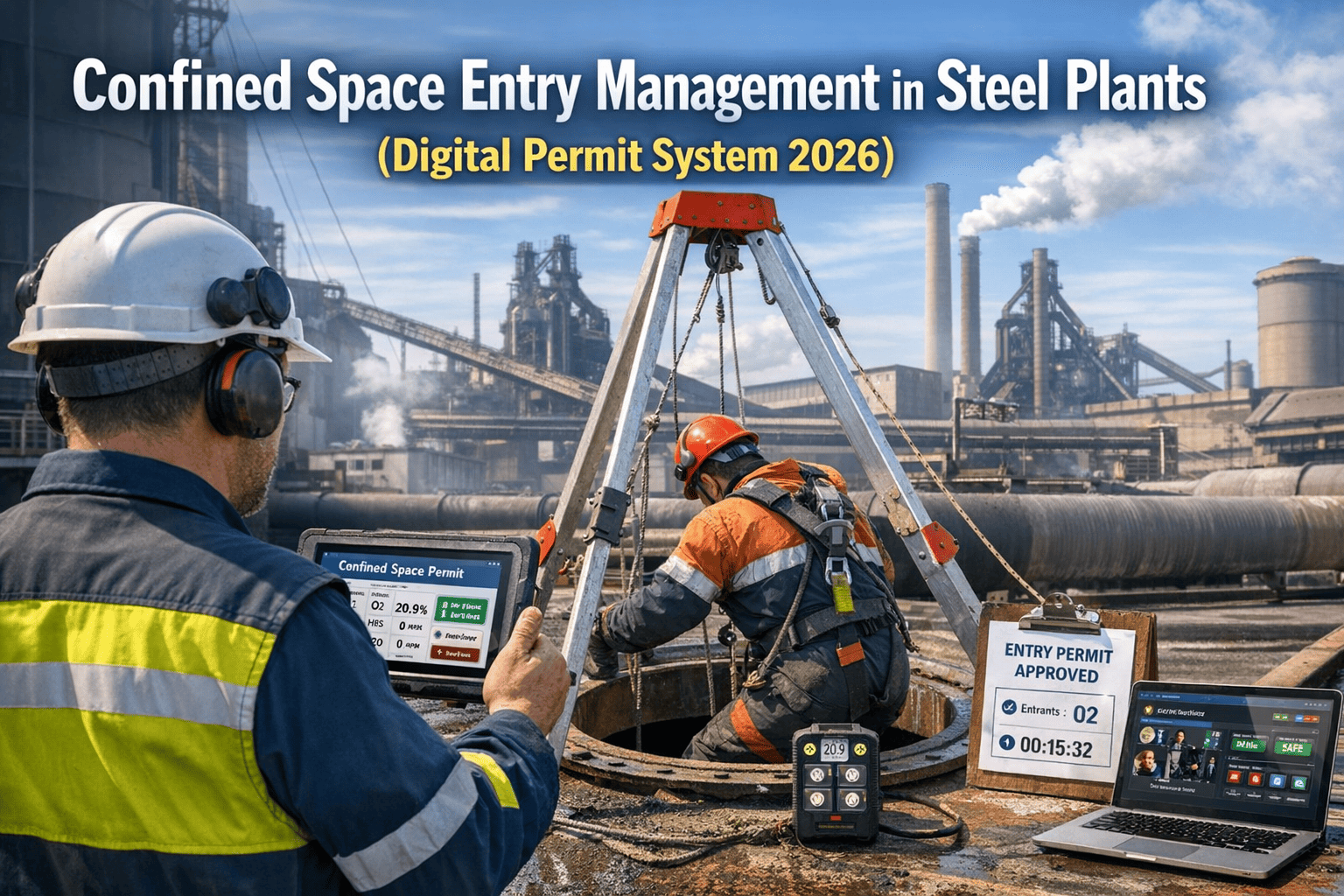
Steel plants contain numerous permit-required confined spaces — blast furnace interiors, torpedo car bodies, ladle storage pits, ducts and hoppers, waste heat recovery vessels, and underground drainage structures. Each entry into a permit-required confined space requires atmospheric testing for oxygen content, combustible gas, and toxic substances before entry, a trained attendant stationed outside, a rescue plan in place, and a permit with documented authorisation before the entrant crosses the plane of the opening. In steel plant environments, the additional hazard of residual heat from refractory and process materials means that temperature assessment is a mandatory additional entry condition beyond the standard OSHA requirement.
Hot Work Authorisation
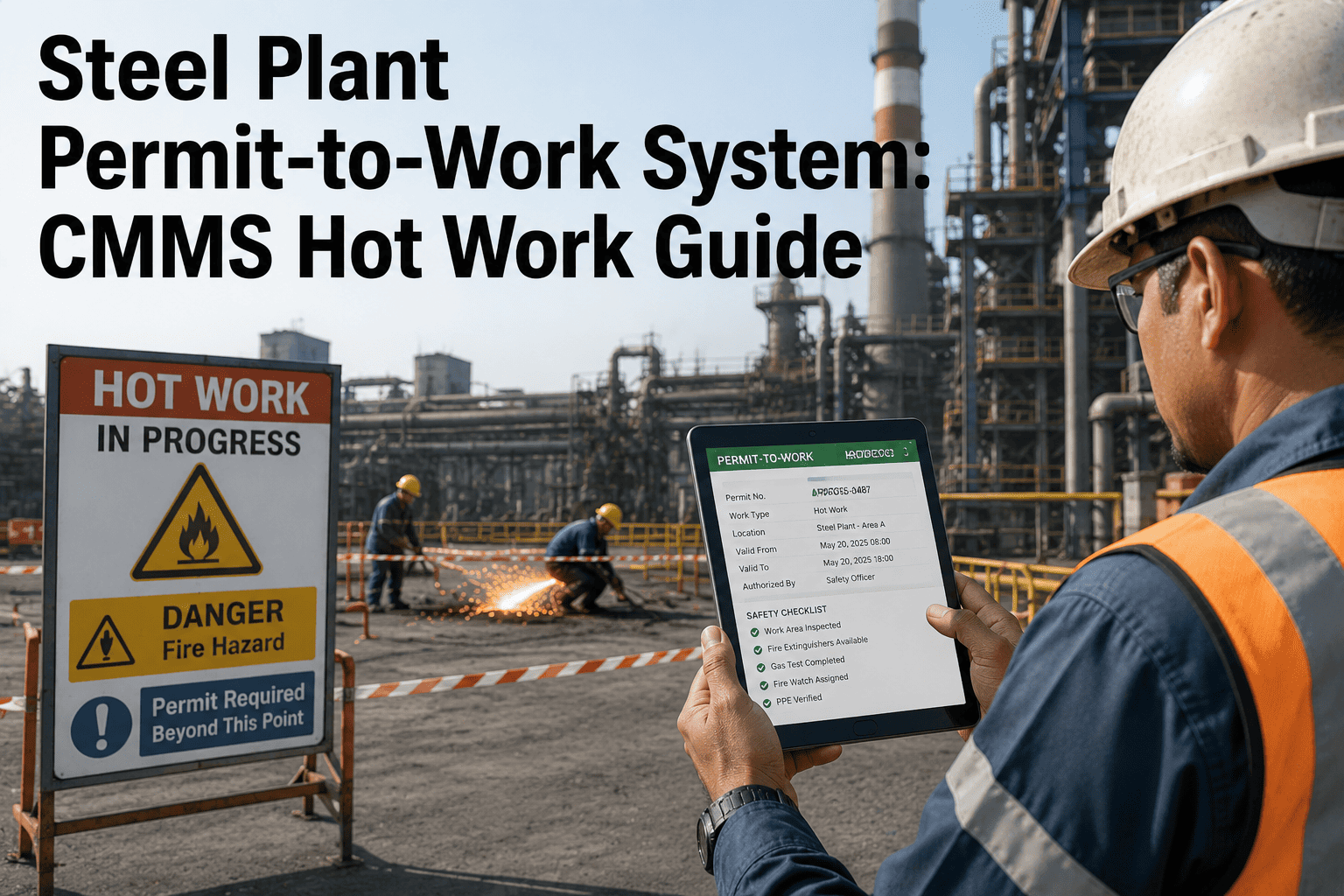
Welding, cutting, grinding, and any other spark-producing activity in a steel plant requires a hot work permit that assesses the fire risk of the work area, identifies combustible materials within the designated radius, confirms the availability of fire-fighting equipment, and assigns a fire watch for the activity period plus the post-work monitoring period (minimum 30 minutes after work completion per NFPA 51B requirements). In steel plants, the additional thermal load from adjacent process equipment means that the fire watch radius and monitoring period requirements exceed standard industrial hot work permit specifications and must be documented with facility-specific criteria.
Arc Flash & Electrical Safety Compliance
Arc flash hazard is present at every switchgear panel, motor control centre, and electrical distribution board in a steel plant — and the incident energy levels in steel plant electrical systems, with large transformer capacities and multiple generation sources, are among the highest found in any industrial environment. NFPA 70E requires that every piece of electrical equipment be labelled with its arc flash incident energy and the minimum PPE category required for energised work. Maintaining current arc flash labels, tracking PPE compliance for electrical work authorisations, and documenting energised work permits for tasks that cannot be performed in the de-energised state are the three core compliance obligations under this standard.
PPE Compliance & Inspection Records
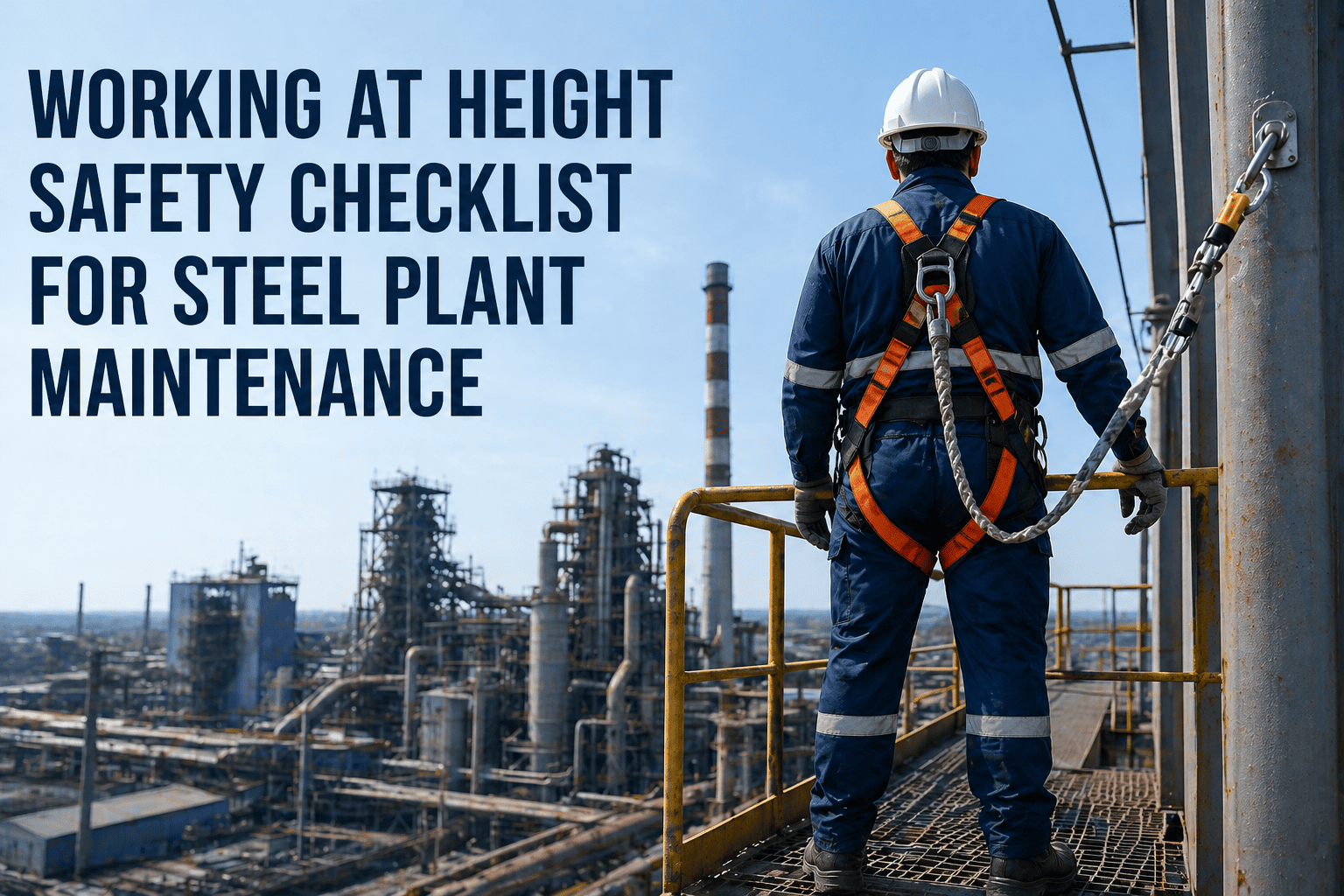
PPE in a steel plant goes significantly beyond hard hat and safety boots. Aluminised proximity suits near molten metal, face shields with rated IR protection for furnace work, arc-rated clothing for electrical tasks, respiratory protection for dust and fume exposure, and fall arrest systems for elevated work all require inspection records, replacement schedules, and evidence of training and fit-testing where applicable. OSHA 1910.132 requires employers to assess hazards, select appropriate PPE, and train workers before initial use — with records of the hazard assessment and training maintained. ISO 45001 additionally requires that PPE adequacy be reviewed whenever hazard profiles change through process or equipment modifications.
How Oxmaint.ai Digitises the Permit-to-Work Workflow
From hazard identification through permit closure — every step documented, timestamped, and retrievable. No paper. No verbal handovers. No compliance gaps.
Work Request Raised
Maintenance technician or supervisor raises a work request on mobile identifying the equipment, the work type, and the hazard category. The system automatically identifies the required permit types based on the equipment asset record and work classification.
Permit Generated & Authorised
The appropriate permit template — LOTO, confined space, hot work, or arc flash — is generated with the relevant checklist fields pre-populated from the equipment record. The authorising supervisor reviews and approves digitally with identity verification and timestamp.
Pre-Work Checks Recorded
The technician completes all required pre-work checks — energy isolation verification for LOTO, atmospheric testing for confined space, area clearance for hot work — and records each result on mobile. Photo evidence can be attached for physical isolation points and atmospheric test instrument readings.
Work Executed Under Active Permit
The permit is active and visible to the maintenance team, the safety officer, and the production supervisor simultaneously — all seeing the same real-time record. Any permit modification or extension requires re-authorisation with the same identity verification, creating an unambiguous change record.
Permit Closed & Record Archived
Closure requires confirmation that the work area has been cleared, all energy isolations removed in the correct sequence, and the equipment is safe for re-energisation. The completed permit record is automatically archived against the equipment asset with the closure timestamp and the responsible person's identity — creating the documentation OSHA and ISO 45001 require.
Replace Paper Permits With Auditable Digital Safety Records
Oxmaint.ai's safety module generates permit-to-work workflows for LOTO, confined space, hot work, and arc flash — with full authorisation chains, pre-work check records, and automatic archiving against each equipment asset. Everything your safety inspector needs to see, available in minutes rather than days.
Paper Permits vs. Oxmaint.ai Safety Management
The compliance gap between paper safety systems and a digital permit management platform is the gap between hope and evidence — and regulatory inspectors require evidence.
| Safety Area | Paper-Based System | Oxmaint.ai |
|---|---|---|
| LOTO Procedure Documentation | Paper procedures in binders — not linked to work orders, no evidence of use per maintenance event | Digital LOTO permit generated per work order with energy isolation checklist and authoriser identity recorded |
| Confined Space Permit Retention | Paper permits filed by date — retrievable in hours, often incomplete or missing for specific entries | Per-entry digital records stored against the confined space asset with atmospheric test data and entrant records |
| Hot Work Fire Watch Verification | Fire watch sign-off on paper permit — no timestamp, no post-work monitoring record separate from initial permit | Digital fire watch confirmation with separate post-work clearance timestamp and fire watch identity attribution |
| Regulatory Audit Response | Manual search through paper permit files — typically 2–5 days to compile for a major audit | Full safety permit history for any equipment, area, or time period exportable in minutes |
| Permit Compliance Visibility | No real-time visibility of which permits are active, overdue, or not yet closed | Live dashboard showing all active permits, approaching expiry, and overdue closures across the facility |
Scroll horizontally to compare on mobile
During our ISO 45001 recertification audit, the external auditor asked to see evidence of permit-to-work compliance for confined space entries over the past 12 months. With our previous paper system, that would have been three days of searching through permit books across three departments. With Oxmaint.ai, I filtered by permit type and date range and showed the auditor 247 complete confined space entry records in under five minutes. He commented it was the best-evidenced permit system he had reviewed in a steel plant. We passed with zero major non-conformances on safety documentation for the first time in three audit cycles.— EHS Manager, Integrated Steel Works, Southeast Asia
Frequently Asked Questions
Can Oxmaint.ai generate LOTO permit records that reference specific equipment energy isolation procedures?
Yes. Each piece of equipment in Oxmaint.ai can have its LOTO procedure stored as a structured checklist within the equipment asset record. When a maintenance work order requires LOTO, the system generates a permit pre-populated with the energy isolation steps from the equipment's stored procedure. The technician confirms each step as completed, the authorising supervisor approves digitally, and the completed record is archived against both the work order and the equipment asset. Start a free trial to configure LOTO procedures for your facility's equipment.
How does the platform handle confined space permit renewals and re-entry after breaks?
Confined space permits in Oxmaint.ai have configurable validity periods. When a permit approaches its expiry or when a significant break in work occurs, the system prompts for re-authorisation and requires a new atmospheric test entry before the permit can be extended. All extensions are recorded with a new timestamp and authoriser identity — creating the unambiguous audit trail that OSHA 1910.146 requires for permit duration management. Book a demo to see the confined space permit workflow.
Does Oxmaint.ai support ISO 45001 management review requirements for safety performance data?
Yes. ISO 45001 Clause 9.3 requires top management to review safety performance data at planned intervals. Oxmaint.ai's reporting module generates summary reports of permit activity by type, area, or time period — showing permit volumes, closure rates, overdue permit counts, and repeat permit types that may indicate systematic hazard management deficiencies. These reports can be exported directly into the management review evidence package without manual data compilation.
Can PPE inspection and replacement records be tracked per employee and per equipment item?
Yes. PPE items can be registered as assets within Oxmaint.ai with inspection intervals, service life limits, and assignment records per employee. Inspection checklists are configured per PPE type — aluminised suits require different inspection criteria than fall arrest harnesses — and the system generates inspection work orders at the configured interval. When a PPE item reaches its service life limit or fails inspection, a replacement work order is generated automatically. Start a free trial to configure your PPE compliance register.
How does Oxmaint.ai support arc flash compliance documentation?
Arc flash hazard analysis results — incident energy levels, arc flash boundary dimensions, and required PPE categories — are stored per electrical panel or equipment asset within Oxmaint.ai. Energised work permits reference the stored arc flash data for the specific equipment, pre-populating the required PPE category field. Label recertification dates are tracked with automatic alerts when the study approaches its recommended five-year review date per NFPA 70E requirements. Book a demo to see the electrical safety compliance module.
How quickly can a steel plant facility get the safety module operational in Oxmaint.ai?
Most facilities have their core safety permit workflows — LOTO, confined space, and hot work — operational within the first week of starting their free trial. The initial setup involves configuring permit templates for each hazard type, registering confined spaces and high-risk equipment, and setting up the authorisation workflow with the relevant role assignments. Existing permit records can be migrated as document attachments during the onboarding period to ensure the full history is available from day one.
Safety Compliance Is Not a Document Problem — It Is a System Problem
LOTO fatalities, confined space incidents, and arc flash events rarely occur because the written procedure did not exist. They occur because the system that should have ensured the procedure was followed on that specific occasion — with that specific technician, on that specific piece of equipment — failed to generate the evidence that it was. Oxmaint.ai is the system that closes that gap.