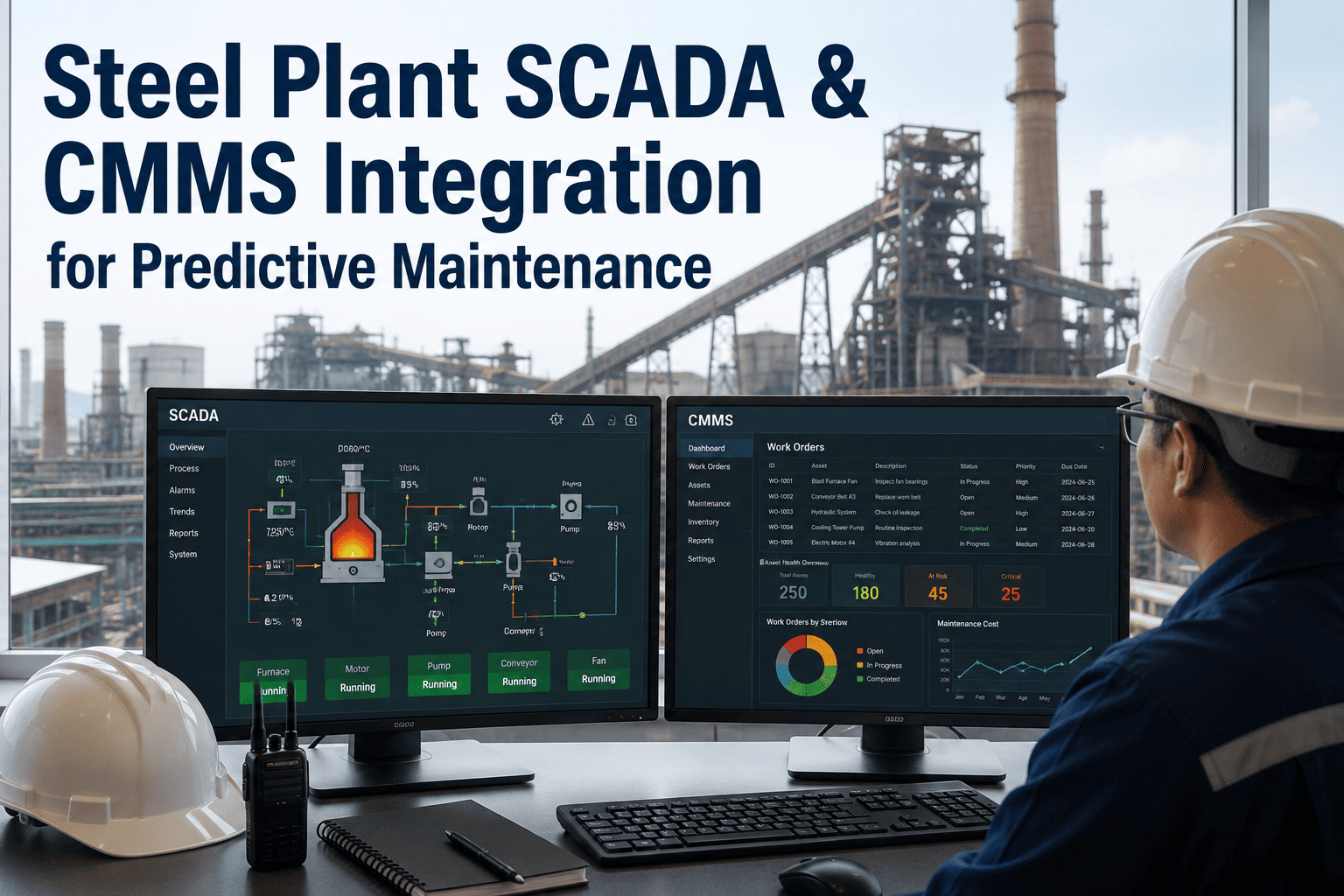
A blast furnace at a major integrated steel plant generates over 4,000 alarm events per shift — temperature excursions, pressure deviations, drive faults, and process upsets that each have a defined maintenance implication. Without a direct connection between the Level 2 automation layer and the CMMS, every one of those events requires a human to read a screen, judge its severity, open a browser, and manually create a work order. The result: 60–70% of actionable maintenance signals in steel plants are never converted into work orders, equipment runs to failure, and the first the maintenance team hears about a problem is when production calls. OxMaint's SCADA and Level 2 integration layer connects OPC-UA data sources, historian alarms, and DCS event streams directly to the work order engine — creating, prioritising, and assigning maintenance actions automatically from the plant-floor signals that already exist.
Steel Plant SCADA & Level 2 Integration with CMMS
When your OPC-UA historian generates an alarm, a work order should already exist. OxMaint closes the gap between plant-floor automation and maintenance execution — no manual bridge, no lost signals, no reactive chaos.
OPC-UA Read-Only Client
OxMaint connects as a read-only subscriber — consuming tag values and alarm states without write access. No PLC modifications, no DCS changes.
Historian Alarm Subscription
Subscribes to alarm and event stream from OSIsoft PI, AVEVA, or FactoryTalk Historian via OPC-AE or REST API.
DMZ-Safe Architecture
Lightweight data collector in plant DMZ with outbound-only encrypted HTTPS tunnel. No inbound ports to OT network.
Alarm-to-Work-Order Rules Engine
Configure trigger rules: tag threshold, sustain duration, asset mapping, priority, and assigned craft.
Your Historian Already Knows What Needs Maintenance. OxMaint Makes It Actionable.
Connect your OPC-UA server to OxMaint and convert every threshold violation into a tracked, assigned work order — automatically, without changing a single PLC or DCS configuration.
Sustain-Duration Filtering
A tag that crosses a threshold for 3 seconds is a transient, not a maintenance event. OxMaint requires configurable sustain duration before WO creation.
Parent-Child Asset Logic
When a large drive fails, it triggers 15–30 downstream alarms. OxMaint maps child alarms to a single parent work order.
Open WO Deduplication
If a work order is already open for a fault, new alarms enrich it rather than creating duplicates — 1 active WO per active fault.
Historian Trend Attachment
Every alarm-triggered work order carries a link to the historian trend — technician sees process context before arriving on site.
The OT and IT teams in steel plants both agree on the problem — the automation layer generates everything the maintenance team needs to be predictive, and none of it reaches them in time. The rule logic — which tags trigger work orders, which thresholds matter — is a maintenance knowledge problem, not a software problem. OxMaint's read-only OPC-UA architecture removes the OT security objection entirely. I have never seen an OT team block a read-only client on a proper DMZ.
Frequently Asked Questions
Does OxMaint require write access to our DCS or SCADA systems?
No. OxMaint operates exclusively as a read-only OPC-UA client. The collector runs in your plant DMZ with outbound-only encrypted connection. No inbound ports are opened to your OT network. Sign in to review the OT security architecture documentation.
How long does SCADA–CMMS integration take to implement?
Initial go-live takes 4–8 weeks: asset mapping (1-2 weeks), collector deployment (1-2 weeks), alarm rule configuration (2 weeks), parallel run (2 weeks). Full alarm rule maturity takes 3–4 months of tuning based on shift data. Book a demo to walk through your timeline.
Can OxMaint connect to OSIsoft PI and other historian platforms?
Yes. OxMaint supports OSIsoft PI (via PI Web API), AVEVA Historian (REST), FactoryTalk Historian, and direct OPC-UA 1.04 servers. Both live OPC-UA and historian-based integrations can run simultaneously. Start a free trial to configure your first historian connection.
How do we prevent alarm flooding from generating thousands of work orders?
OxMaint's alarm rationalisation includes sustain-duration filtering, dead-band configuration, parent-child asset grouping, open WO deduplication, and planned maintenance suppression. Properly configured, a 200-asset plant generates 8–15 actionable work orders per shift from thousands of alarms. Book a demo to walk through rationalisation rules.
Your SCADA Already Knows. Now Make It Act.
OxMaint's OPC-UA integration connects your Level 2 systems directly to the work order engine — so every threshold breach becomes a tracked, assigned, and closed maintenance action. No manual bridge. No missed signals.