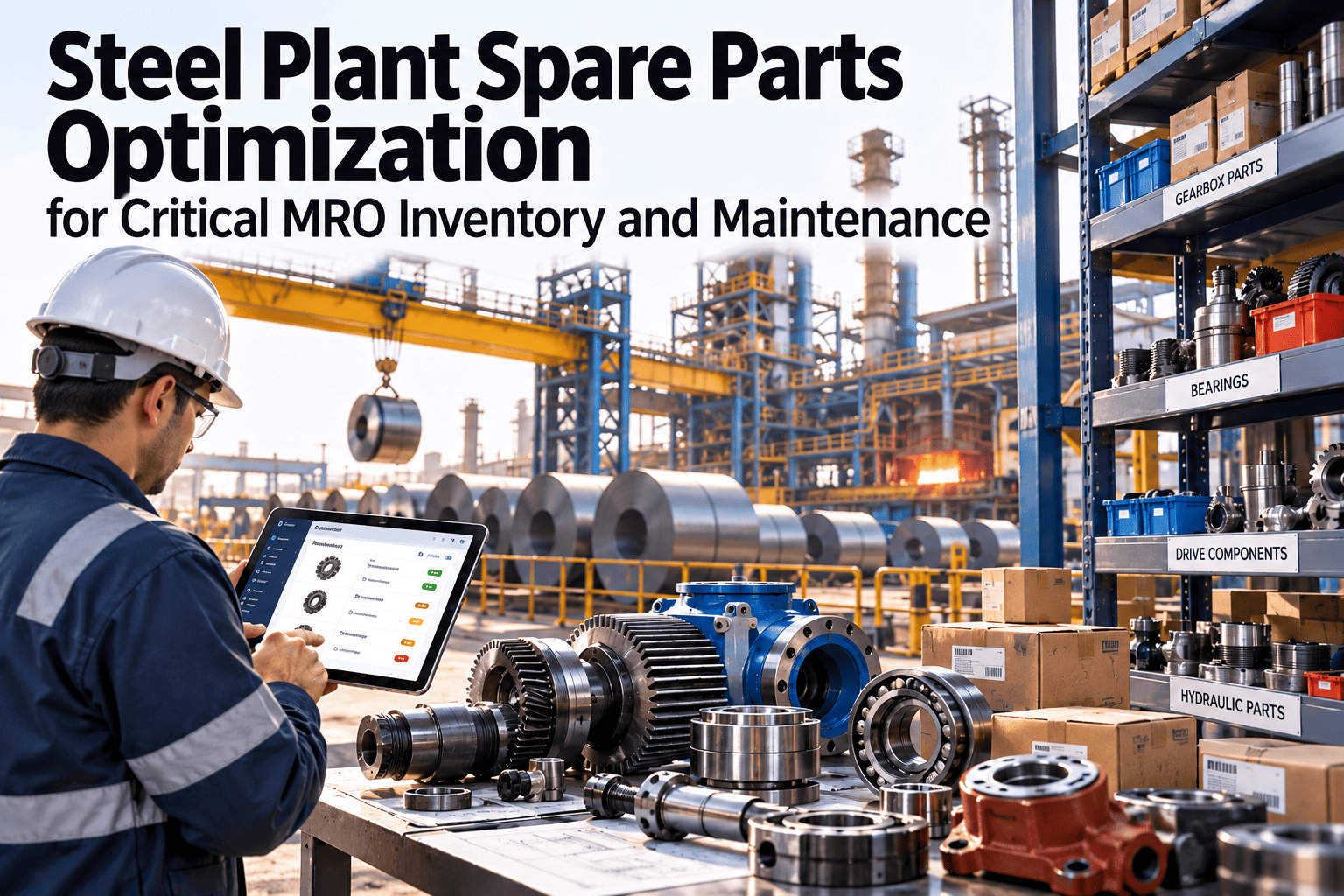
In a steel plant, not every spare part deserves the same level of attention. A blast furnace tuyere whose absence costs $500,000 per hour demands a fundamentally different stocking strategy than a conveyor idler roller that can wait for next-day delivery. Yet most steel plants manage their entire MRO inventory with the same flat logic: reorder when low, hope for the best. The result is a paradox — critical parts run out while warehouse shelves overflow with slow-moving stock that hasn't been touched in years.
Risk-based spare parts analysis eliminates this paradox by combining equipment criticality with supply chain risk to create a decision matrix that tells you exactly what to stock, how much to hold, and when to reorder. Plants using risk-segmented inventory strategies achieve 98% service levels while holding 23% less inventory (Bain 2024). A Brazilian steel plant applied AHP-based criticality analysis across 761 machines in 16 manufacturing units and found that parts assumed non-critical were actually vital, while others classified as critical had been wastefully overstocked. Oxmaint's CMMS automates this entire framework. See it in action.
98% Service Level. 23% Less Inventory. The Power of Criticality Analysis.
Stop treating all parts equally. A risk matrix separates the vital few from the trivial many — and saves millions.
The Three Pillars of Spare Parts Criticality
Effective criticality analysis evaluates spare parts across three independent dimensions. A part may score high on one axis and low on another — the combination determines your stocking policy:
Financial Value Analysis
How much does this part cost and how often is it consumed?
Operational Criticality
What happens when this part is unavailable?
Demand Predictability
How predictable is consumption for this part?
The Risk Matrix: Criticality × Supply Risk
Combining equipment criticality with supply chain risk creates a 2-axis heat map that dictates stocking policy for every spare part in your plant. This is the framework that top-performing steel plants use to balance availability against cost:
Multiple vendors, short lead time
Few vendors, 4-8 week lead
Single source, 12+ weeks, custom
Production stops
Min/max auto-reorder
2 weeks safety stock
Higher safety stock
Dual-source qualify
Always in stock, 100%
Consignment or pre-buy
Output reduced
EOQ-based reorder
Quarterly review
Buffer based on lead time
Vendor scorecard
Safety buffer + backup vendor
12-week rolling forecast
Workaround exists
No stock required
Order when needed
Kanban or VMI
Semi-annual review
Small buffer stock
Track lead time trends
Bain 2024 finding: Plants using risk-segmented stock achieve 98% service while holding 23% less inventory. The matrix eliminates both stockouts (top-right cells) and overstocking (bottom-left cells) simultaneously.
Critical Spare Parts for Steel Plant Equipment
Here's how the risk matrix applies to specific steel plant equipment. Each area has different failure modes, lead times, and consequences that determine the optimal stocking strategy:
Blast Furnace
Vital — Insurance StockBOF / EAF Steelmaking
Vital — Insurance StockContinuous Caster
Essential — Priority StockRolling Mill & Utilities
Essential — Standard/BufferAutomate Criticality-Based Inventory
Oxmaint links equipment criticality to parts stocking policies automatically. Set min/max by risk tier, auto-generate POs when stock drops, and track consumption against forecast — all from one platform.
How Oxmaint Implements Risk-Based Inventory
Oxmaint turns criticality analysis from a one-time spreadsheet exercise into a living, automated system that adapts as your plant evolves:
Asset Criticality Tagging
Tag every asset with a criticality tier (High/Medium/Low) in Oxmaint. The system inherits this to all linked spare parts automatically. When a new part is added to an equipment BOM, it receives the parent asset's criticality by default.
Supply Risk Scoring
Assign each part a supply risk score based on vendor count, lead time, and availability history. Oxmaint combines this with asset criticality to place every part on the risk matrix and auto-assign stocking policy.
Dynamic Min/Max Calculation
For each risk tier, Oxmaint calculates optimal min/max levels using consumption history, PM schedules, lead times, and target service level. Insurance parts get 100% availability; standard parts get EOQ-based buffers.
Auto Purchase Triggers
When stock hits minimum, Oxmaint generates a purchase request with correct vendor, part number, and quantity. Critical parts trigger immediate alerts; standard parts batch into weekly PO cycles. Zero manual checking.
Continuous Risk Recalibration
As consumption patterns change, vendors shift, or equipment is added/retired, Oxmaint flags parts for criticality review. Quarterly reports identify reclassification candidates — parts that should move up or down the matrix.
From Guesswork to Precision
Risk-based inventory isn't just theory — it's a proven framework that delivers 98% availability with 23% less capital. Oxmaint makes it operational, automated, and continuously improving.
Frequently Asked Questions
What is critical spare parts analysis?
It's a systematic method to evaluate every spare part across multiple criteria — financial value (ABC), operational criticality (VED), and demand predictability (XYZ) — then combine these with supply chain risk to determine the optimal stocking policy. In steel, AHP (Analytic Hierarchy Process) is the recommended methodology, evaluating factors like production impact, safety consequences, lead time, failure probability, and vendor reliability to assign each part a criticality score.
How does a risk matrix work for steel plant spare parts?
The matrix has two axes: equipment criticality (what happens if this part is missing) and supply chain risk (how hard is it to get). Parts in the top-right (high criticality + high supply risk) get insurance stocking at 100% availability. Bottom-left parts (low criticality + low risk) are ordered on-demand. Plants using this approach achieve 98% service levels with 23% less inventory (Bain 2024).
What are the most critical spare parts in a steel plant?
Blast furnace tuyeres, hot blast valves, and blower bearings are universally critical — their absence costs $500K+/hr. BOF/EAF lance tips, electrode arms, and refractory materials are vital for steelmaking continuity. Continuous caster mold plates and SEN nozzles are essential with long lead times. The key insight: criticality depends on both the part AND the equipment it serves. A bearing in a blast furnace blower is vital; the same bearing in a non-critical pump may be desirable.
How does CMMS software automate criticality-based inventory?
Oxmaint tags every asset with criticality, links assets to parts via BOMs, assigns supply risk scores, auto-calculates min/max levels per risk tier, generates purchase requests when stock drops, and flags parts for periodic reclassification. This transforms criticality from a one-time spreadsheet exercise into a living system that adapts as equipment, vendors, and consumption patterns change.
How often should spare parts criticality be reviewed?
Best practice is a quarterly review of safety stock levels and risk classifications, with full reassessment annually or whenever major changes occur (new equipment, vendor changes, production rate shifts). Bain 2024 reports that plants revisiting safety stock quarterly free up 8-12% in working capital while maintaining 97%+ service. Sensor-based auto-replenishment can cut reactive purchases by 42% (ARC 2025).