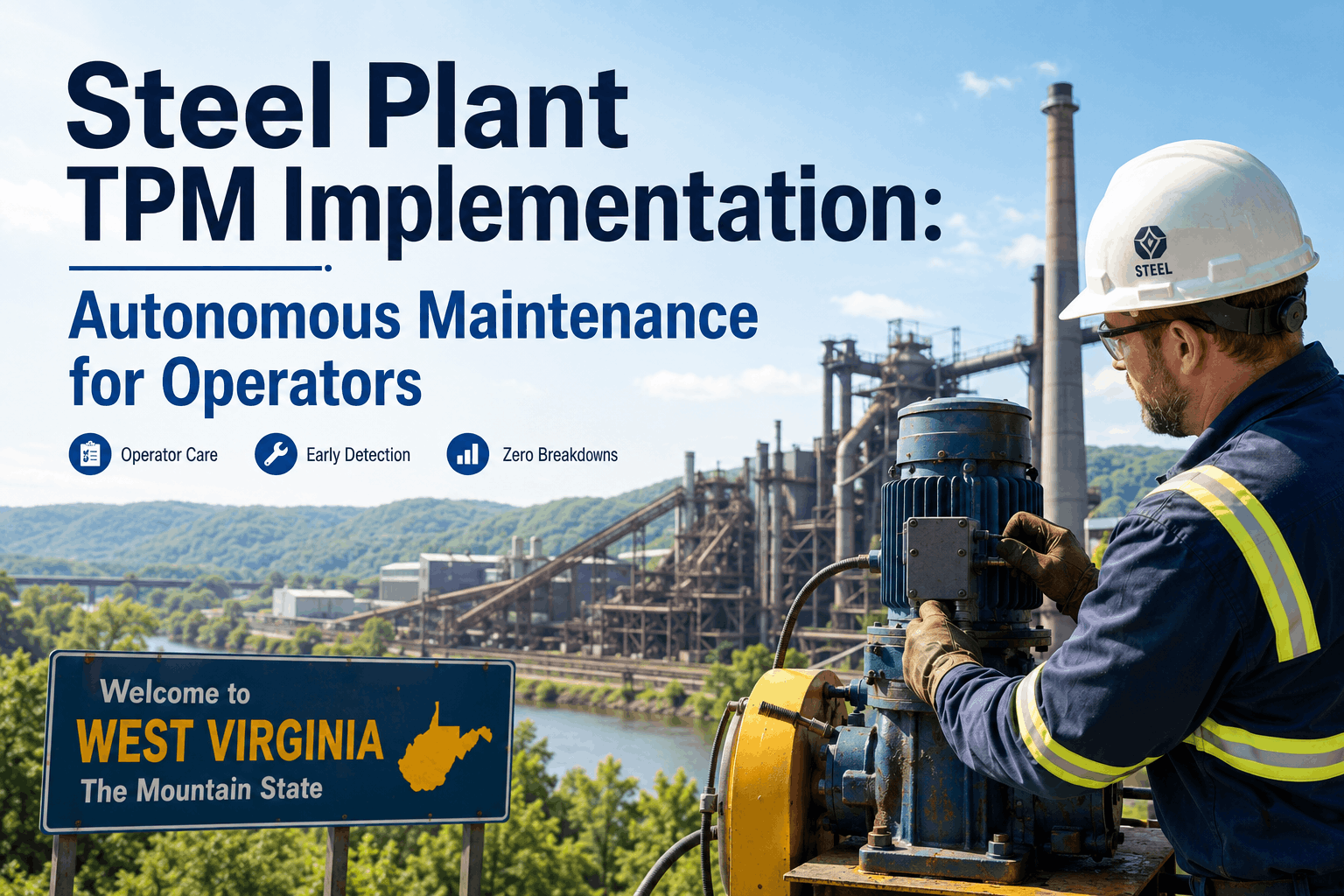
Steel Plant TPM Implementation: Autonomous Maintenance for Operators
By Alex Jordan on June 23, 2026
In a steel plant, the operators who run the equipment eight hours a day know its condition better than any maintenance technician. They hear the bearing sounds, feel the vibration, notice the temperature changes, and observe the subtle performance degradation that precedes equipment failure. Yet most plants have built a maintenance culture where operators report problems reactively — they run the equipment until something breaks, then call maintenance. Autonomous maintenance (AM) flips this model: it trains operators to perform basic care — cleaning, inspection, lubrication, and tightening — as part of their daily routine, turning them into the first line of equipment health defense. This approach, known as CILT (Clean, Inspect, Lubricate, Tighten), is the foundation of Total Productive Maintenance (TPM). When implemented effectively in a steel plant, autonomous maintenance reduces unplanned breakdowns by 40–60%, extends equipment life by 15–30%, improves operator engagement and equipment knowledge, and frees maintenance technicians to focus on higher-level predictive and corrective tasks instead of routine reactive repairs.
Empower Operators to Own Equipment Maintenance Through Daily CILT Routines
Autonomous maintenance training, digital CILT checklists, abnormality detection, and mobile work order reporting — turning operators into equipment health guardians and reducing unplanned downtime by 40–60%
Reduction in unplanned equipment breakdowns when autonomous maintenance is fully deployed across operating crews
15–30%
Extension of equipment service life through early detection of abnormalities and preventive minor repairs by trained operators
8–12 hrs
Average time saved per technician per week when operators handle routine maintenance and only call technicians for complex repairs
The Anatomy of CILT: How the Four AM Pillars Work Together
Autonomous maintenance operates through four integrated practices, each building on the previous one. Cleaning is the foundation — an operator systematically cleans equipment to a baseline standard established during initial AM training. This is not casual maintenance; it is structured cleaning that reveals the true condition of the equipment. A blast furnace operator cleaning the bearing housings on a tuyere arm discovers loose fasteners that vibration has loosened. A rolling mill operator cleaning the hydraulic manifold finds contaminated oil that would have caused actuator failure within days. Cleaning forces operators to interact with every surface and connection point, making them familiar with normal equipment state. Once baseline cleanliness is established, any deviation (rust forming where it wasn't, discoloration indicating heat, debris indicating wear) becomes abnormal and triggers investigation. Inspection is the second pillar — operators are trained on what to look for during a systematic inspection route: bearing temperature (touch-check with the back of a hand for obvious heat), audible changes in motor sound, visible leaks, fastener tightness, and position of mechanical linkages. Training focuses on the difference between normal and abnormal, making operators the first-line detectors of equipment degradation. Lubrication is the third pillar — operators perform oil top-ups, grease application, and coolant level checks on a defined schedule, keeping equipment protected against wear. Tightening is the fourth pillar — vibration loosens fasteners; operators systematically check critical fasteners (bearing caps, motor mounts, coupling bolts) and tighten them before looseness causes damage. Together, these four practices form a preventive maintenance routine that operators perform daily or every shift, eliminating the most common failure modes before they escalate.
Systematic cleaning removes debris, contamination, and accumulated grime that masks equipment condition. During initial AM implementation, a trained maintenance technician and the operator clean the equipment together to establish a baseline standard. The operator learns what "clean" means for this specific piece of equipment. Once baseline is established, operators clean on a defined schedule (daily for high-criticality equipment, every 2–3 days for others). Contamination or discoloration appearing after cleaning is abnormal and is reported as a defect requiring maintenance attention.
Inspection — Early Detection of Abnormalities
Frontline monitoring — catch degradation early
Operators perform systematic visual and tactile inspections: bearing temperature (feel with the back of hand), motor sound (listen for unusual noise or pitch change), leakage (look for oil or coolant under equipment), fastener tightness (visual check of fastener position), and mechanical linkage position (verify against reference markers). Digital CILT checklists on mobile devices guide operators through each inspection point, record findings, and flag deviations for maintenance. An operator reporting "motor temperature is 5°C hotter than yesterday" or "hydraulic pump sound is higher pitch" triggers maintenance investigation before failure occurs.
Lubrication — Preventive Wear Control
Daily routine — extends equipment life
Operators perform lubricant top-ups, grease application, and oil level checks on a defined schedule — daily for critical bearings, every 2–3 days for others. AM training includes proper lubrication technique: correct product for the application, correct quantity, and correct interval. A blast furnace operator performing daily grease application on the blast pipe carrier bearing prevents bearing starvation that would lead to overheating and failure. A rolling mill operator performing daily oil level checks on the stand motor prevents oil starvation and motor overheating. Lubricant analysis (particle count, viscosity, water content) is performed by technicians; operators report changes in oil appearance (darkening, haziness) that signal contamination.
Tightening — Fastener Maintenance and Vibration Control
Routine inspection — prevents looseness
Vibration on rotating equipment constantly works to loosen fasteners. Operators perform systematic tightness checks on critical fasteners (bearing caps, motor mounts, coupling bolts, hydraulic fittings) at defined intervals — typically daily for high-vibration equipment. A simple visual check of fastener position (relative to a reference mark scratched onto the mounting surface) takes seconds but catches looseness before it becomes a safety hazard or mechanical failure. For critical fasteners, operators apply a small amount of torque with a wrench to confirm tightness. Training includes proper torque application technique to prevent over-tightening and fastener breakage.
Abnormality Reporting and Digital CILT Workflows
Mobile integration — direct to CMMS
When an operator detects an abnormality during AM inspection, they report it through a mobile CILT app that captures: abnormality description (temperature rise, unusual noise, visible leak), equipment location, severity (green/yellow/red), and photographic evidence. The report automatically flows into CMMS and generates a maintenance work order if severity warrants immediate attention. The operator receives confirmation that their report was received and has visibility into the maintenance response. This feedback loop reinforces the value of AM: operators see that their early detection prevents bigger problems, increasing their engagement in the process.
Operator Training and Competency Development
Capability building — structured learning
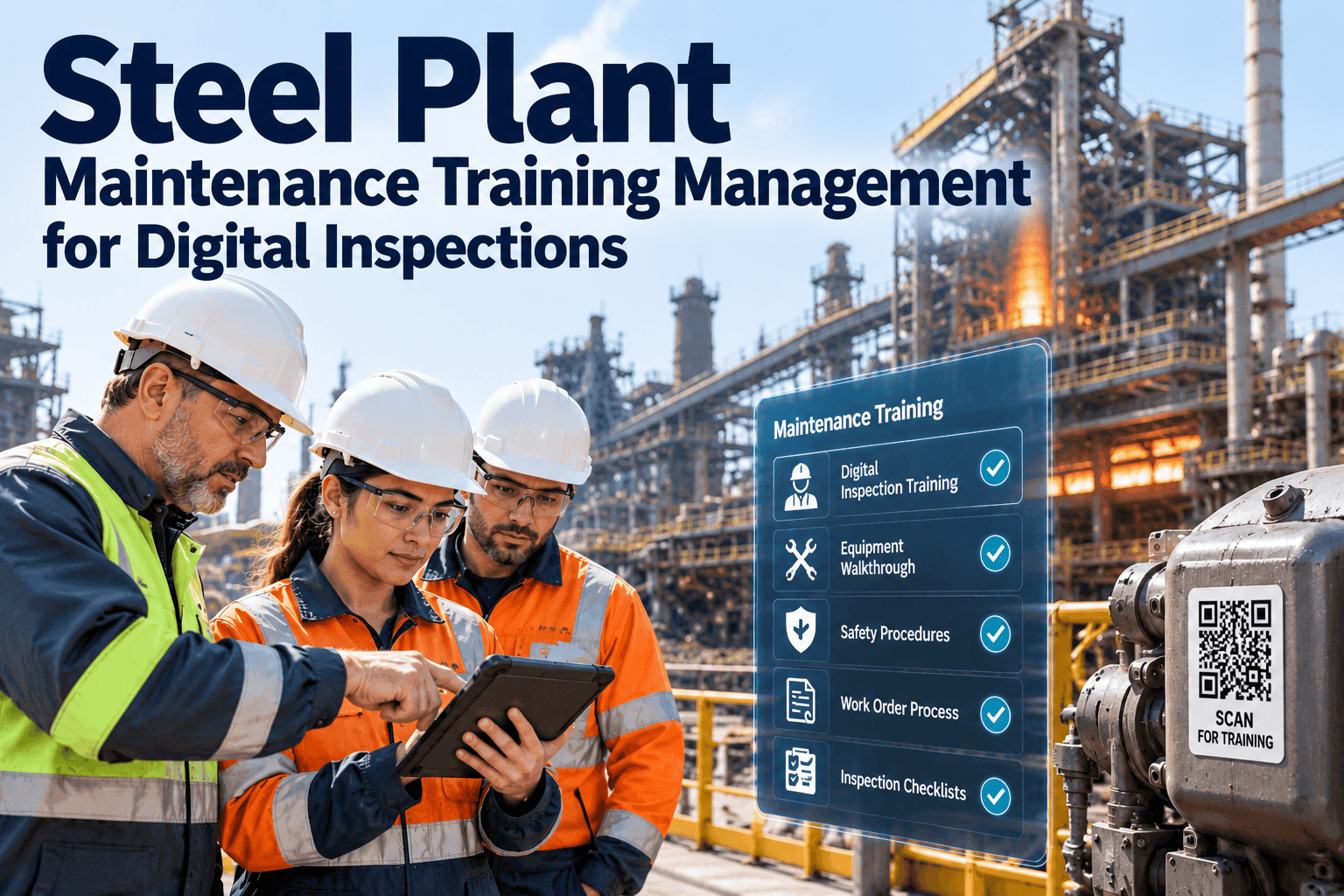
AM is not successful if operators lack training and knowledge. Initial training (typically 8–16 hours per operator per equipment type) covers equipment function, normal operating characteristics, identification of abnormalities, safety protocols, and proper technique for each CILT pillar. Competency is assessed through observation and practical demonstration. Ongoing training updates operators on new equipment, changes to maintenance schedules, and lessons learned from failure investigations. A CMMS tracks training completion and competency certifications, ensuring that only trained operators perform advanced AM tasks on safety-critical equipment.
TPM Autonomous Maintenance
Transform Operators Into Equipment Health Guardians.
CILT training, digital mobile checklists, abnormality detection, and work order integration empower operators to perform daily equipment maintenance and catch failures before they stop production. Reduce unplanned downtime 40–60% while building a maintenance-engaged operator culture.
Implementing Autonomous Maintenance: From Baseline Setup to Sustained Engagement
Successful autonomous maintenance implementation requires a phased approach that builds operator skills, establishes routines, and integrates AM into the daily production schedule. Phase 1 involves baseline setup: identifying the equipment scope for AM implementation, establishing baseline cleanliness and inspection standards, and training the first cohort of operators. For a rolling mill with 40+ pieces of rotating equipment, the baseline phase typically requires 4–6 weeks of structured effort. A trained maintenance technician and the operator spend 2–4 hours cleaning each piece of equipment together, establishing what "clean" means. Inspection routes are defined with reference points (marks on fasteners, reference photos, normal temperature ranges) that operators can check daily. A CILT checklist is created for each piece of equipment, specifying cleaning frequency, inspection points, lubrication schedule, and fastener tightness checks. Phase 2 involves scaling to the full operator crew: additional operators are trained, CILT routines are integrated into shift schedules, and digital CILT checklists are deployed on mobile devices. Phase 3 involves sustaining engagement: routine audits verify that AM tasks are being performed, feedback is provided to operators, and early wins are celebrated. Phase 4 involves continuous improvement: AM data is analyzed to identify which failure modes are being caught early, which equipment has improved reliability, and where additional training or additional AM tasks would deliver value.
Phase 1: Baseline AM Setup (4–6 weeks)
Establish CILT standards and initial operator training
Equipment scope
Identify 15–25 highest-priority pieces of rotating equipment per production area
Baseline cleaning
Deep cleaning to establish baseline condition; maintenance technician trains operator on "clean standard"
Inspection routes created
Photo reference guide, reference temperature ranges, fastener reference marks, and bearing sound baseline recording
Outcome
First cohort trained; daily AM checklist established; baseline condition documented for each equipment piece
Phase 2: Full Operator Crew Deployment (6–10 weeks)
Scale to all operators; integrate AM into shift routines
Operator training rollout
All operators in production area trained on CILT procedures; competency verified through observation
Digital CILT deployment
Mobile checklists on tablets; operators report abnormalities directly to CMMS; work orders auto-generated
Schedule integration
AM tasks incorporated into shift schedules; time allocated (typically 30–45 min per 8-hour shift) and communicated to supervisors
Outcome
All operators performing daily CILT; abnormalities being reported and tracked; first maintenance preventions from AM detections
Phase 3: Sustaining Engagement and Auditing (ongoing)
Verify completion, provide feedback, celebrate wins
AM completion audits
Weekly supervisor audit verifies CILT checklists are complete and observations are recorded in CMMS
Feedback and coaching
Operators receiving positive feedback for high-quality abnormality reports; areas needing skill development identified and addressed
Win celebration
Communicate equipment reliability improvements and prevented failures back to the operator team; recognition program for high-quality AM performers
Real-World Results: TPM Autonomous Maintenance at USA Steel Plants
Three USA steel plants implemented comprehensive autonomous maintenance programs and documented measurable improvements in equipment reliability and operator engagement. A 1.8 MTPA integrated mill in Indiana implemented TPM autonomous maintenance on all rolling mill stands over a 12-week period. Before AM, unplanned downtime averaged 12–15 hours per month from unexpected bearing failures, loose fasteners, and hydraulic system problems. After full AM deployment with digital CILT checklists and operator training, unplanned downtime dropped to 3–5 hours per month — a 70% reduction. The key insight: operators, working 8 hours a day on the equipment, were catching bearing temperature changes and fastener looseness that technicians visiting the equipment weekly missed. The early detection capability of daily operator inspection was more powerful than reactive maintenance. An electric arc furnace + caster operation in Ohio implemented AM for the continuous caster secondary cooling system, which had been a major source of downtime from nozzle blockage and coolant contamination. Operators were trained to perform daily spray header pressure tests and coolant sample collection. Within 6 months, coolant-related downtime dropped 85%. More significantly, coolant consumption was reduced 22% because early contamination detection allowed corrective action (partial oil change) instead of full system flush.
"Our operators now feel like equipment owners instead of machine operators. They know when something is wrong because they're checking it every day. The reduction in surprise breakdowns has been remarkable — we go weeks without unplanned downtime. And our technicians now have time to work on real maintenance instead of emergency firefighting."
— Operations Supervisor, Rolling Mill, Indiana, USA · 1.8 MTPA
Frequently Asked Questions
Q1Won't operators resist doing maintenance work — isn't that "maintenance's job"?▼
Initial resistance is common and is addressed through clear communication of the "why" (AM prevents breakdowns that interrupt their shift), hands-on training (operators learn through doing, not lectures), and positive reinforcement (celebrating early detections and prevented failures). Most operators embrace AM once they see the impact on reliability. The shift in culture is from "something's wrong, call maintenance" to "I care about equipment condition — here's what I detected early."
Q2How much time per shift should be allocated to autonomous maintenance tasks?▼
Typically 30–45 minutes per 8-hour shift for a rolling mill stand or blast furnace equipment area. This time is incorporated into shift schedules and is communicated to production management. The time investment is recovered through eliminated unplanned downtime, which typically exceeds 2–3 hours per month at industrial plants without AM. The ROI calculation: 30 minutes of daily preventive effort prevents 2–3 hours of unplanned downtime — a 4:1 return on time.
Q3What if an operator detects a problem but doesn't know how to fix it — doesn't that create unnecessary work for maintenance?▼
That's exactly the point of AM — operators detect problems early, before they escalate into major failures. The maintenance work order generated from early detection is typically smaller and less urgent than a failure-forced repair. A bearing showing elevated temperature detected during AM inspection can be scheduled for service during the next planned maintenance window. The same bearing failing catastrophically during production requires emergency repair with full downtime cost.
Q4How do we ensure operators perform AM tasks consistently and don't just skip them when they're busy?▼
Digital CILT checklists create an audit trail in CMMS showing which operators completed inspections and which findings were recorded. Supervisors perform weekly AM audits, reviewing completion rates and data quality. Peer accountability and positive recognition (celebrating high-quality AM performers) reinforce consistency. Most operators, once they see the benefit in reduced breakdowns, maintain AM discipline voluntarily.
Q5What kind of training do operators need, and how long does it take?▼
Initial AM training is 8–16 hours per operator per equipment type, typically delivered in 2–4 hour sessions. Training covers: equipment function, normal operating characteristics, abnormality identification, safety protocols, proper technique for cleaning/inspection/lubrication/tightening, and digital checklist usage. Training is delivered by a combination of maintenance technicians (equipment knowledge) and AM trainers (TPM methodology). Ongoing refresher training (2–4 hours annually) keeps skills sharp.
Q6Can operators perform AM on safety-critical equipment like blast furnaces or EAF systems?▼
Yes, but with enhanced safety protocols and additional training. AM on safety-critical equipment focuses on observable abnormalities (temperature, sound, leakage, fastener tightness) and excludes hands-on intervention (operators report problems but don't fix them). Enhanced training includes LOTO (lockout/tagout) concepts and confined space awareness. Maintenance technicians handle actual repairs on safety-critical assets.
Q7How does AM data integrate with our existing CMMS and SAP PM systems?▼
Operators report abnormalities through a mobile CILT app that integrates directly with CMMS. High-priority abnormalities automatically generate maintenance work orders in CMMS, which sync to SAP PM for scheduling and cost tracking. AM completion metrics (percentage of operators completing daily checklists, types of abnormalities detected) are captured in CMMS dashboards, providing management visibility into the health and engagement of the AM program.
Q8What is the cost of implementing autonomous maintenance at a multi-unit steel plant?▼
Typical implementation cost for a 1.5–2.0 MTPA facility is $60K–$120K, including training materials, mobile app deployment, CMMS integration, and initial equipment baseline setup. ROI is typically achieved within 3–6 months through reduced unplanned downtime alone. Additional benefits (extended equipment life, improved operator engagement) extend the economic value beyond the initial payback period.
TPM Autonomous Maintenance
Reduce Unplanned Downtime by 40–60% Through Operator-Driven Equipment Care.
-checklist.png)