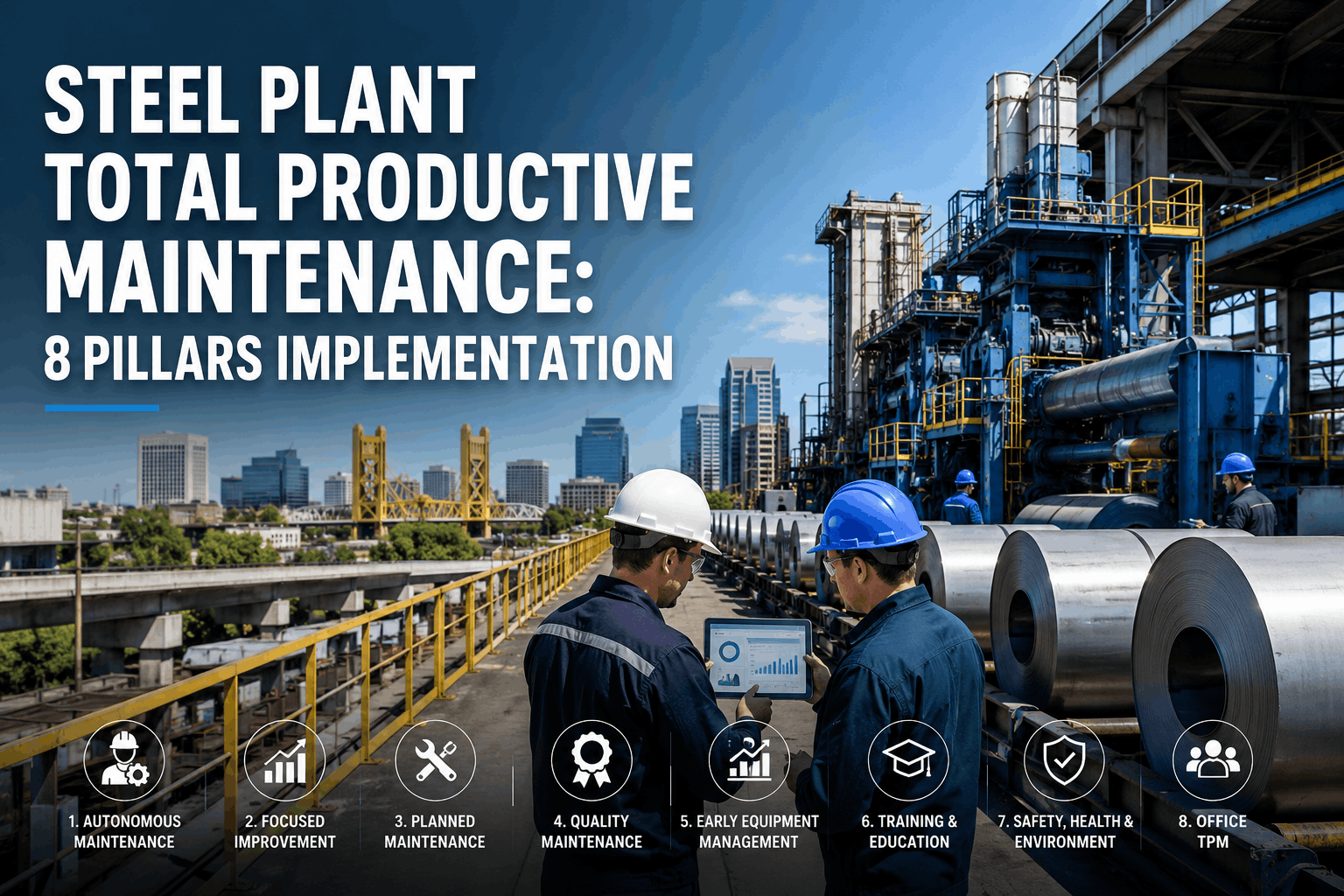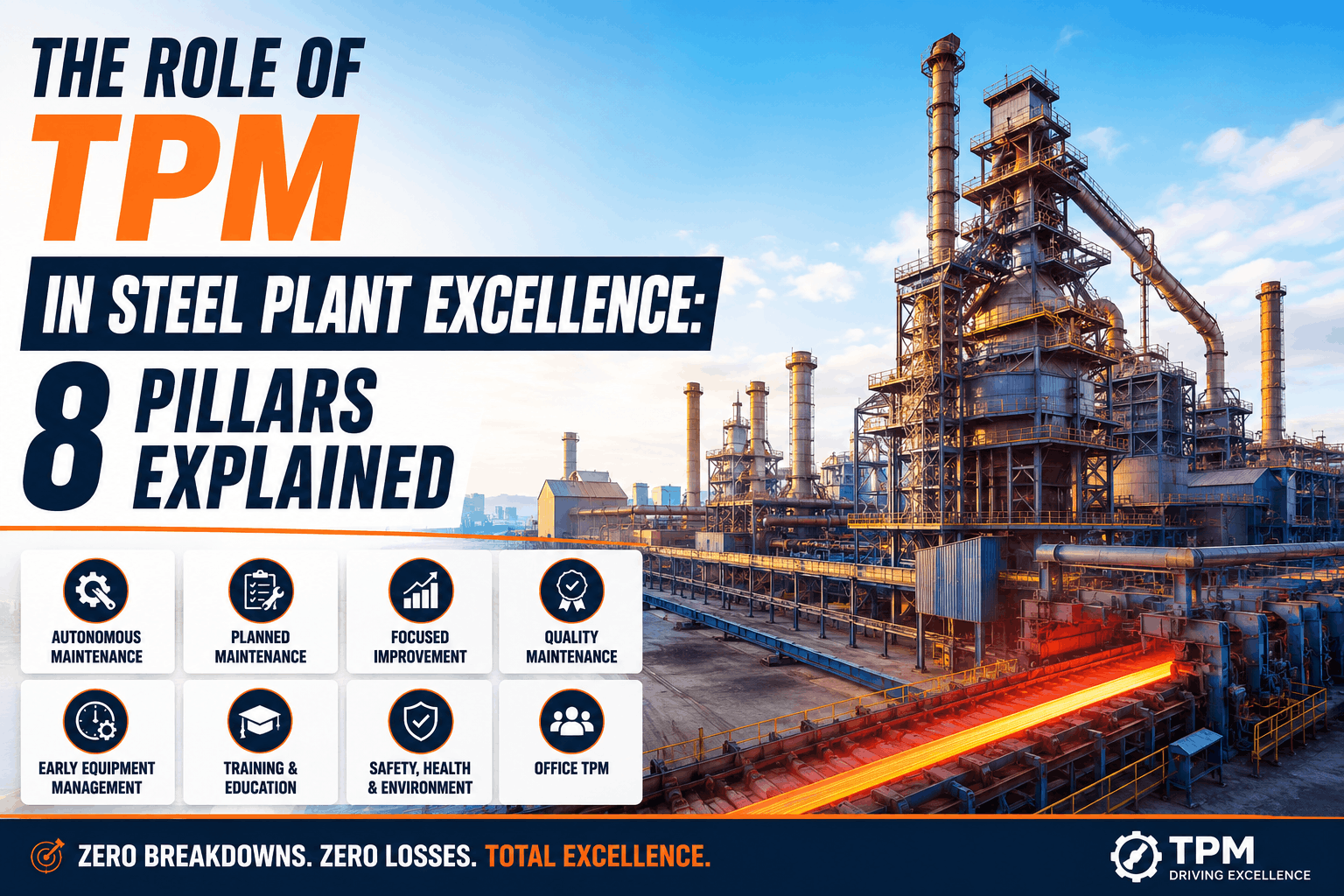
Total Productive Maintenance (TPM) is not a maintenance program—it is a comprehensive management philosophy that transforms how production workers, maintenance technicians, operators, and engineers interact with equipment to achieve maximum operational effectiveness. TPM's eight pillars create a structured framework for engaging every level of the organization in the elimination of losses, continuous improvement, and equipment reliability. Steel plants implementing TPM rigorously report 25–40% improvement in Overall Equipment Effectiveness, 40–60% reduction in unplanned downtime, 15–25% increase in labor productivity, and zero-accident ambitions that drive safety as an operational discipline rather than a compliance exercise. Yet TPM is not a single program you launch and complete. It is a cultural transformation requiring sustained management commitment, operator engagement, continuous training, and a shift from reactive problem-solving to proactive loss elimination. The eight pillars are interdependent—attempting to implement them in isolation leads to incomplete results and abandoned initiatives. Autonomous Maintenance cannot work without Training and Education. Focused Improvement needs a foundation of Planned Maintenance to work on. Quality Maintenance requires Early Equipment Management principles embedded from the design phase. The power of TPM lies in the integration of all eight pillars into a unified system that makes equipment effectiveness everyone's responsibility and everyone's priority.
The Eight Pillars of TPM: Steel Plant Application Framework
TPM was developed in Japan in the 1960s–1970s, formalized by Nippon Denso (now Denso), and has since become the international standard for continuous improvement in manufacturing. The eight pillars provide a comprehensive architecture where each pillar addresses a specific failure mode or loss category, and together they create a unified system for eliminating losses, extending equipment life, and creating a safety-conscious, improvement-focused culture. In steel plants specifically, TPM's application is complex because the equipment is diverse (blast furnaces, electric arc furnaces, continuous casters, rolling mills), the operating conditions are extreme (heat, pressure, corrosive atmosphere, heavy loads), and the cost of unplanned downtime is enormous ($260,000+ per hour for integrated operations). Steel plants that implement TPM fully typically achieve 70%+ improvement in overall equipment effectiveness and 40–50% reduction in maintenance costs within 3–4 years. This is not achieved through massive capital investment—it comes from systematically eliminating the waste that already exists in your operation. Book a Demo to see how OxMaint's CMMS manages TPM work orders, training records, autonomous maintenance checklists, and improvement tracking across your entire facility.
Pillar 1: Autonomous Maintenance—Operators Taking Care of Their Equipment
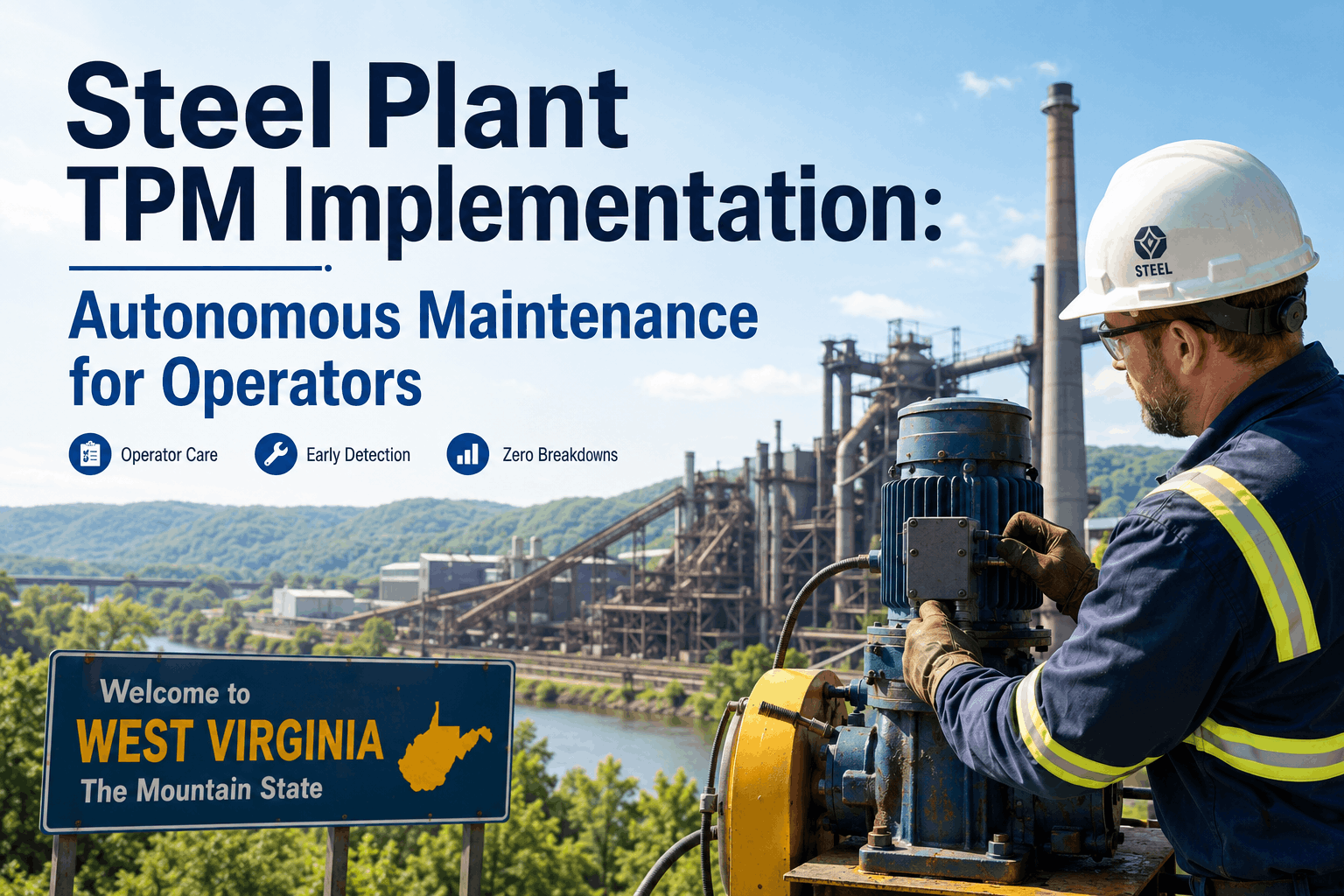
Autonomous Maintenance is the pillar that engages production operators in the ownership and basic care of their equipment. Historically, the separation between operations and maintenance created a cultural divide: operators ran equipment, maintenance fixed it, and the two groups rarely communicated proactively. TPM breaks this down by making operators responsible for daily equipment inspections, basic cleaning, lubrication, and early problem detection. In steel plants, autonomous maintenance might include: rolling mill operators daily inspecting their stands for loose bolts, excessive noise, or temperature anomalies; ladle crane operators checking their hoist before each shift; or EAF operators monitoring electrode alignment and wear. Autonomous maintenance is not asking operators to become maintenance technicians. It is asking them to apply their intimate knowledge of their equipment to catch developing problems before they become failures. Typical autonomous maintenance tasks require 10–15 minutes per day and are documented using checklists in OxMaint. Compliance tracking shows operators the importance management places on this work. When autonomous maintenance is executed consistently, technicians detect 60–70% fewer unexpected failures because problems are caught while they're still minor. Start Free Trial to digitize autonomous maintenance checklists and track operator compliance with real-time visibility.
Pillar 2: Planned Maintenance—Scheduled Work Discipline and Execution
Planned Maintenance is the foundation of TPM—the establishment of preventive maintenance schedules for every critical asset, execution of those schedules on time, and documentation of completed work. Planned Maintenance means no surprises: every maintenance activity is predicted, scheduled, resourced, and executed within a defined window. For a blast furnace, planned maintenance might include weekly hot stove maintenance, monthly tap hole care, and semi-annual refractory inspections. For rolling mills, it includes monthly bearing inspections, quarterly seal replacements, and annual hydraulic system overhauls. The discipline of executing planned maintenance at 85%+ compliance directly reduces unplanned downtime. When planned maintenance execution improves from 40% (typical reactive mill) to 85%, unplanned downtime typically drops 30–50% within 12 months. OxMaint schedules planned maintenance automatically based on equipment history, manufacturer recommendations, and industry standards. Work orders are assigned to technicians with all required information—parts lists, procedures, safety requirements, estimated duration. Completion confirmation is documented immediately. Planned maintenance execution becomes visible to management daily.
Pillars 7 & 8: Safety/Health/Environment and TPM in Administration
Pillar 7 integrates safety as an operational discipline into TPM, ensuring that increased equipment engagement is matched by zero-compromise safety execution. In steel plants, this means rigorous Lock-Out Tag-Out (LOTO) procedures on every maintenance event, permit-to-work management for hot work, and gas detection verification before entering confined spaces. A blast furnace or oxygen line maintenance event cannot proceed until LOTO is confirmed and safety protocols are followed—no shortcuts for schedule pressure. OxMaint's CMMS captures LOTO records per work order, creating an auditable trail that satisfies OSHA requirements and demonstrates your facility's commitment to safety as a priority equal to production. Pillar 8 extends TPM principles into administrative functions—production scheduling, spare parts procurement, maintenance planning, and information systems. If administrative processes are broken (schedules change constantly, parts arrive late, work orders are lost), shop floor TPM cannot succeed. Office TPM ensures that administrative systems support operational excellence rather than undermine it. The eight pillars are interdependent—each reinforces the others when properly executed. Book a Demo to see how OxMaint manages all eight pillars within an integrated CMMS system.
Five-Phase TPM Implementation Roadmap for Steel Plants
Most steel mills require 12–24 months to achieve basic TPM maturity across all eight pillars. Phase 1 (Months 1–3): Pilot autonomous maintenance and planned maintenance on one production line. Establish baseline equipment performance and define TPM roles. Phase 2 (Months 3–6): Roll out autonomous maintenance and planned maintenance to all equipment. Begin Kaizen events targeting the highest-loss areas. Phase 3 (Months 6–9): Activate quality maintenance and early equipment management for capital projects. Expand training program. Phase 4 (Months 9–15): Mature safety/environmental pillar with risk assessments and hazard controls. Phase 5 (Months 15–24): Sustain and improve all eight pillars. Establish continuous improvement culture where TPM becomes "how we work" rather than "the TPM program." OxMaint provides the CMMS backbone throughout all phases, making TPM discipline measurable and sustainable.
Measuring TPM Impact and Sustaining Continuous Improvement
TPM success is measured through specific KPIs: OEE (Overall Equipment Effectiveness) improvement, MTBF (Mean Time Between Failures) trending upward, MTTR (Mean Time to Repair) trending downward, PM compliance rate exceeding 85%, and safety metrics showing zero or near-zero unplanned incidents. Monthly reporting should track all eight pillars' health metrics: Autonomous Maintenance completion rates, Planned Maintenance compliance, Quality defect reduction, Kaizen event participation and completion, equipment design improvements implemented, training hours per employee, safety near-miss reporting, and administrative process cycle time improvements. When all eight pillars are executed at maturity, the compounding effect drives 25–40% OEE improvement and 40–60% unplanned downtime reduction. The timeline varies—some mills achieve these gains in 2–3 years, others require 4–5 years. The key differentiator is management commitment and consistency. TPM initiatives that lose executive attention or get modified halfway through typically show only 5–10% improvement before plateauing.
Launch TPM Pilot on Single Production Line or Equipment Area
Select one production line or piece of equipment for TPM pilot—ideally one with high losses and visible improvement potential. Implement all eight pillars on a small scale to learn what works and what requires adjustment before rolling out plant-wide. Pilot execution typically takes 3–4 months.
Establish Baseline Metrics and Define TPM Roles & Accountabilities
Measure current OEE, downtime, quality, and safety for your pilot area. Define who is responsible for each pillar execution—who leads autonomous maintenance, who manages planned maintenance, who facilitates Kaizen. Create a TPM leadership structure that includes production, maintenance, quality, and engineering.
Execute Kaizen Events on Highest-Loss Problem Categories
Don't wait for perfect TPM maturity before tackling losses. Run Kaizen events while building TPM discipline. Focus on the losses consuming the most time or money: changeover time reduction, breakdown elimination, or quality loss prevention. Quick wins build momentum.
Roll Out All Eight Pillars Across Full Facility on Proven Pilot Model
Once your pilot shows 10%+ OEE improvement and validates your TPM approach, replicate across all production areas. Customize for each equipment type while maintaining consistent TPM structure. Full facility rollout typically requires 6–9 months after pilot completion.
Sustain and Mature—Make TPM Culture Permanent
After initial implementation, shift focus to cultural sustainability and maturity. Continue monthly TPM KPI reviews. Celebrate improvement wins. Address team members who regress toward reactive behaviors. TPM is not a three-year program—it is "how we work" indefinitely. Management consistency determines whether TPM becomes permanent or fades.
Frequently Asked Questions: TPM Implementation in Steel Plants
How long does TPM implementation typically take for a steel plant?
Basic TPM maturity across all eight pillars takes 12–24 months. Pilot implementation on one line takes 3–4 months. Full facility rollout takes an additional 6–9 months. Sustained cultural maturity continues for 3+ years as improvement deepens and becomes permanent.
Can we implement TPM without a CMMS system?
Technically yes, but TPM without CMMS relies on manual tracking, spreadsheets, and paper checklists—which create compliance gaps, missing documentation, and inconsistent execution. CMMS makes TPM discipline scalable and auditable. Starting with OxMaint accelerates TPM maturity by 3–6 months.
Which TPM pillar should we prioritize first?
Start with Planned Maintenance (Pillar 2)—it provides the foundation all other pillars depend on. Simultaneously launch Autonomous Maintenance (Pillar 1) with operator engagement. Training (Pillar 6) must be embedded throughout, not saved for later.
How do we measure if TPM is working?
Track OEE, MTBF, MTTR, PM compliance rate, quality defect rates, safety incident frequency, and Kaizen participation monthly. OEE improvement of 1–2 points per month in the first year indicates healthy TPM adoption. Declining trends signal cultural slippage that requires management intervention.
What happens if TPM loses executive support or momentum?
TPM fades quickly without sustained management attention. If you see decreasing PM compliance, increasing Kaizen event cancellations, or operators reverting to reactive behaviors, you've lost momentum. Recovery requires explicit re-commitment from leadership and refocus on TPM KPIs.
Can we run Kaizen events (Pillar 4) before implementing all eight pillars?
Yes. Kaizen events targeting high-impact losses can start immediately while building TPM foundation. In fact, early Kaizen wins build momentum and demonstrate TPM value. Target changeovers, breakdowns, or quality loss categories where visible improvement is achievable within 30 days.
How does TPM relate to OSHA and safety compliance?
TPM's Safety/Environment pillar (Pillar 7) integrates safety discipline into daily operations. LOTO compliance, permit-to-work management, and hazard controls become operational routines, not compliance checkboxes. TPM typically improves safety performance 40–60% because safety becomes everyone's responsibility.
Can OxMaint help us implement all eight TPM pillars?
Yes. OxMaint manages Planned Maintenance scheduling, Autonomous Maintenance checklists, Kaizen tracking, Training records, Safety/LOTO documentation, and administrative process improvements. The platform provides the CMMS backbone that makes TPM discipline scalable, auditable, and sustainable.