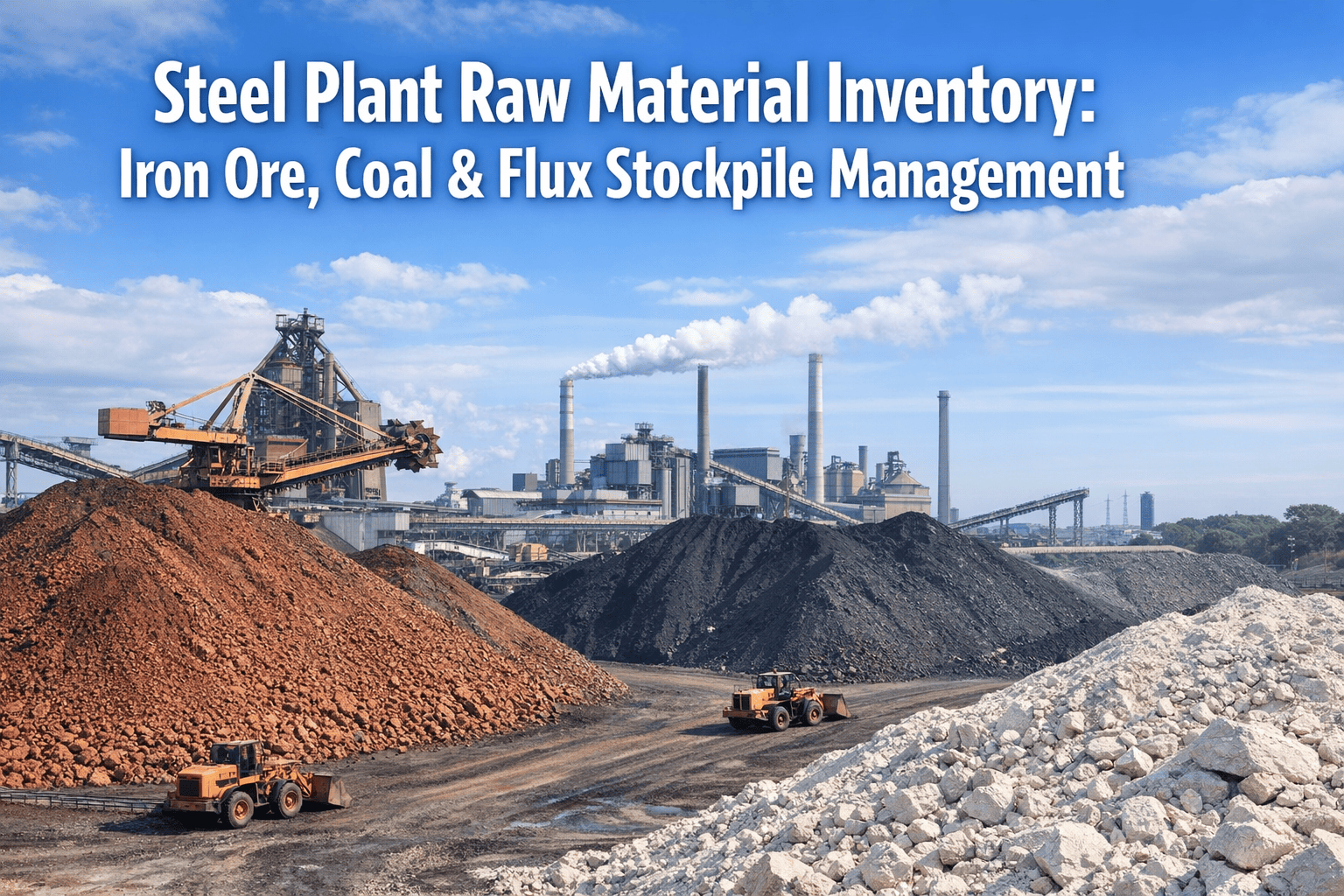
Iron ore rarely arrives in the same condition twice. Parcels from different mines, ports, and stockpile positions vary in Fe content, silica, alumina, moisture, and size, and every swing that reaches the sinter strand shows up later as unstable basicity, fuel rate changes, and blast furnace burden problems. Chemistry and blending models get most of the attention, yet many variability events start with equipment: a drifting weigh feeder, a stuck sampler, or an analyzer out of calibration. This guide explains how steel plants control raw material variability and how Oxmaint maintenance software keeps the equipment behind your iron ore blend reliable.
Steel Raw Material Variability Software: Iron Ore Blend Guide
Stable sinter starts with a stable blend, and a stable blend depends on equipment that weighs, samples, stacks, and reclaims exactly as designed. Treat that equipment as part of your quality system.
What raw material variability means for a steel plant
Variability is the spread of a property around its target, not the average value itself. Two blends with the same average Fe can behave very differently if one swings widely from hour to hour.
| Parameter | Why it varies | Downstream effect of swings |
|---|---|---|
| Total Fe | Different ore sources, grades, and stockpile positions | Changes blast furnace productivity and slag volume |
| SiO2 | Gangue content differs between deposits and ore types | Shifts sinter basicity, flux demand, and slag volume |
| Al2O3 | Clay-bearing and lateritic ores carry more alumina | Can weaken sinter and worsen reduction degradation and slag fluidity |
| Basicity (CaO/SiO2) | Follows silica swings and flux dosing accuracy | Affects sinter strength, reducibility, and furnace slag control |
| Moisture | Rain, stockpile drainage, and ore type | Distorts dry-basis dosing and changes bed permeability |
| Loss on ignition | Goethite and hydrated ores lose more mass on heating | Changes heat demand and sinter yield |
| Phosphorus and alkalis | Source geology | Raise steelmaking dephosphorization load and furnace scaffolding risk |
| Size distribution | Handling, degradation, and share of ultrafines | Changes granulation and strand permeability |
Where variability enters the iron ore chain
Variability is added or removed at every handling step. Mapping each step shows where control is possible and which equipment is responsible.
The operational impact of an unstable iron ore blend
Variability does not stay in the stockyard. Each process step passes it on, and operators downstream compensate with extra fuel, extra flux, and conservative settings that cost output.
Sinter plant
- Basicity and FeO swings make sinter quality harder to hold
- Moisture changes alter bed permeability and strand speed
- Operators add safety margins on fuel and flux to protect quality
Blast furnace
- Burden chemistry changes affect slag volume and slag basicity control
- Weak or variable sinter increases fines and hurts gas permeability
- Thermal control becomes harder, raising the risk of hot metal quality swings
Steelmaking
- Hot metal silicon and phosphorus swings change flux and oxygen practice
- Less predictable heats make end-point control more difficult
Plant level
- Higher fuel and flux consumption per tonne of hot metal
- Reduced confidence in raw material purchasing and blend planning data
How a blending bed reduces variability
Bed blending stacks ore in many thin layers along a pile and then reclaims across the full face, so each slice mixes material from the whole build period.
- More layers generally improve averaging, which depends on stacker travel and consistent flow.
- Common stacking methods include chevron, windrow, and combinations, each with different segregation behaviour.
- Pile ends are often less well blended, so reclaim practice and pile design need to allow for them.
- Full-face reclaiming is essential; a reclaimer that cuts unevenly defeats the layering.
- Blending reduces short-term swings but cannot correct a long-term shift in source quality, which needs purchasing and blend planning action.
Moisture: the variable that distorts every other number
Feeders and belt scales weigh wet material, but blend recipes are set on a dry basis. When actual moisture differs from the value the control system assumes, every dry ratio shifts.
Illustrative example
- A feeder doses 100 wet tonnes per hour and the system assumes 8% moisture, so it expects 92 dry tonnes.
- If actual moisture is 10%, the dry feed is 90 tonnes, about 2% less ore than the recipe intends.
- The flux and fuel ratios against that ore shift by the same margin, and sinter basicity moves with them.
Why variability is also a maintenance problem
Process teams see the symptom in the chemistry. The root cause is often an equipment fault that nobody connected to the quality result.
Equipment that controls iron ore blend quality
Each item below has a direct path from its failure to a variability event. Build maintenance tasks around those paths.
| Equipment | Typical failure or drift | Variability effect | Maintenance response |
|---|---|---|---|
| Stackers | Travel, slew, or boom drive faults | Fewer or uneven layers | Drive and brake inspections, travel limit checks |
| Bucket wheel or bridge reclaimers | Worn buckets, harrow faults, uneven travel | Partial face reclaim | Bucket and harrow inspection, drive condition checks |
| Belt weighers | Material build-up, idler misalignment, zero drift | Wrong tonnage and dosing | Scheduled zero and span checks, material tests |
| Weigh feeders | Load cell drift, belt wear, skirt leakage | Flux, fuel, and ore ratios off target | Calibration schedule, belt and skirt inspection |
| Mechanical samplers | Cutter wear, stuck gates, blocked chutes | Unrepresentative samples | Cutter inspection, function checks, chute cleaning |
| Online analyzers | Calibration drift, detector issues | Wrong chemistry signal for control | Calibration against lab results, vendor service |
| Moisture gauges | Fouling and drift | Wrong water addition and dry-basis error | Cleaning and verification against lab moisture |
| Mixing drums | Nozzle blockage, liner build-up | Uneven moisture and granulation | Nozzle checks, build-up removal |
| Proportioning bins | Hang-ups and rat-holing | Feed interruptions and ratio swings | Liner, vibrator, and air cannon inspection |
Keep the equipment behind your blend in spec
Schedule calibrations, sampler checks, and stockyard machine inspections in one system, and give your team a clear record every time a deviation is traced to equipment.
From quality deviation to work order
When chemistry or moisture moves outside its band, the fastest path to a fix is a defined routine that checks the equipment, not just the ore.
- MeasureSample, analyze, and record the result against the pile or shift
- CompareCheck the result against the agreed target band
- FlagRecord the deviation and the time it started
- Check equipmentReview calibration status and recent faults for the related machines
- ActRaise a corrective work order with priority set by impact
- VerifyClose only after a follow-up reading confirms the fix
Calibration and inspection checklist for blend equipment
Use this as a starting checklist. Set exact intervals from equipment manufacturer guidance, your metrology procedures, and past drift history.
Every shift
- Confirm samplers cycle and deliver sample increments
- Check belt weighers and weigh feeders for build-up and spillage
- Confirm mixing drum water flow and nozzle spray pattern
- Log analyzer and moisture gauge status alarms
Weekly
- Belt scale zero check
- Compare analyzer readings with lab results for the same period
- Inspect sampler cutter lips and chutes
- Inspect proportioning bin liners and flow aids
Monthly
- Weigh feeder span calibration
- Stacker and reclaimer drive, brake, and limit switch inspection
- Reclaimer bucket, harrow, and chain condition check
- Moisture gauge verification against lab moisture
Planned shutdown
- Belt scale material test or test chain calibration
- Analyzer vendor service and full calibration
- Sampler overhaul and bias check planning
- Mixing drum liner and build-up removal
Standards and practices worth referencing
Sampling, moisture determination, and weighing all have established standards. Aligning maintenance and calibration tasks with them makes quality data more defensible.
Reactive versus disciplined variability control
The difference between plants that control variability well and those that do not is rarely the blend model. It is usually discipline in the basics.
Reactive approach
- Calibrations done when someone notices a problem
- Sampler faults found only after lab results look wrong
- Stockyard machine faults repaired without checking pile quality
- No record linking quality deviations to equipment events
- Process and maintenance teams work from separate information
- Repairs wait for parts that were never stocked
Disciplined approach
- Calibrations scheduled and tracked with results recorded
- Sampler and analyzer checks built into routine rounds
- Stacker and reclaimer faults reviewed for blend impact
- Every deviation checked against equipment history
- Shared records support joint process and maintenance reviews
- Spares for samplers, feeders, and scales are held so repairs happen quickly
Five steps to a maintenance-backed variability program
You do not need a new plant to cut variability. Most gains come from making existing equipment reliable and connecting its records to quality results.
List the variability-critical equipment
Identify every scale, feeder, sampler, analyzer, gauge, and stockyard machine whose failure changes blend chemistry, moisture, or dosing.Set calibration and inspection routines
Define what is checked, how often, the acceptance limits, and who signs off, based on site procedures and manufacturer guidance.Move routines into a CMMS
Schedule every routine as a recurring work order so compliance is visible and nothing depends on memory or paper sheets.Agree a deviation response routine
Give process and maintenance teams one agreed path from a quality deviation to an equipment check and a corrective work order.Review results together each month
Compare variability KPIs with calibration compliance and equipment faults, then adjust intervals and priorities where the data points.KPIs for raw material variability management
Pair process variability measures with equipment reliability measures. Together they show whether variability is falling and why.
Blend Fe and SiO2 spread
Standard deviation per pile or per day of reclaimed blendSinter basicity spread
Standard deviation of CaO/SiO2 in sinter over each periodCalibration compliance
Calibrations done on time ÷ calibrations due, for scales, feeders, and analyzersSampler availability
Hours sampler was working ÷ hours material was flowingStockyard machine reliability
Unplanned stoppages of stackers and reclaimers per monthDeviations traced to equipment
Quality deviations with a confirmed equipment cause ÷ total deviationsHow Oxmaint fits into raw material variability control
Oxmaint is maintenance management software. It does not replace your blend model, lab system, or process control, but it keeps the equipment that feeds them reliable and documented.
Preventive maintenance and calibration scheduling
Schedule scale, feeder, sampler, and analyzer checks on fixed intervals so calibrations are not missed.Digital inspections on mobile
Technicians complete checklists at the equipment and record readings, observations, and photos.Corrective work orders
Raise and track work when a deviation is traced to equipment, and close it with a verification step.Asset records for material handling
Keep stackers, reclaimers, conveyors, and instruments in one hierarchy with full history.Compliance records and reports
Maintain an auditable calibration and inspection trail, and report compliance and backlog.Spare parts inventory
Track sampler cutters, belts, load cells, idlers, and nozzles so repairs are not delayed.Iron ore blend variability FAQs
Can a CMMS manage iron ore blend chemistry?
A CMMS does not calculate blends. It maintains the samplers, scales, feeders, and analyzers that produce and control blend data, and records their calibration and inspection history.
Which equipment matters most for sinter feed stability?
Weigh feeders for flux and fuel, belt weighers, mechanical samplers, online analyzers, moisture gauges, and stockyard stackers and reclaimers are the usual priorities.
How often should belt weighers be calibrated?
It depends on duty, accuracy class, and site procedures. Many plants combine frequent zero checks with periodic span checks and material tests.
How do I link quality deviations to equipment faults?
Record each deviation with its time and material stream, then check calibration and fault history for related equipment. Oxmaint keeps that history in one place.
Where should a steel plant start?
Start with calibration scheduling for flux and fuel feeders and sampler checks, since they affect basicity quickly. Book a demo to plan the setup.
Make blend stability a maintenance habit
Give your raw materials, sinter, and maintenance teams one reliable record of every calibration, inspection, and repair. See how Oxmaint supports your stockyard and proportioning equipment.