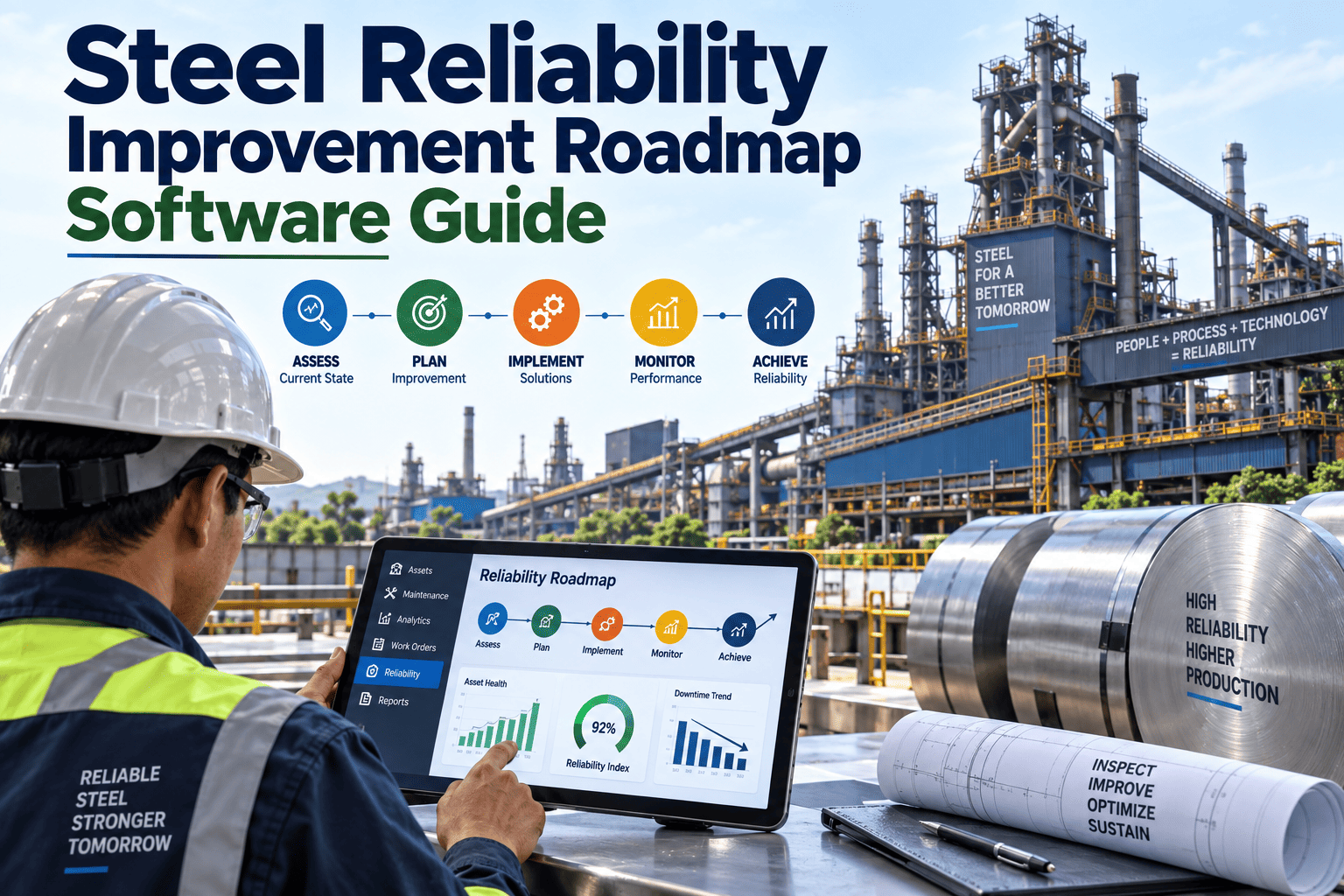
When a maintenance director asks "what is our plan for the next eighteen months," too many steel plants answer with a stack of RCA reports, a PM binder, and a capex wishlist that were never sequenced into one program. Root cause findings, redesigned PM strategies, and capital requests are each useful on their own, but scattered across spreadsheets and shift handovers they rarely move the needle on downtime. A reliability improvement roadmap turns these isolated fixes into a single staged plan that sequences what gets repaired first, which PM tasks get redesigned next, and which capex requests actually earn a place on the schedule. Plants that run one connected roadmap consistently outperform plants managing RCA, PM, and capex as three disconnected workstreams, and a connected CMMS is what keeps that sequence from drifting apart again.
Roadmap Guide
Steel Reliability Improvement Roadmap: Sequence RCA, PM, and Capex Into One Plan
A practical framework for staging root cause findings, redesigned PM strategies, and capital requests into a reliability roadmap your steel plant can actually execute — inside the CMMS your teams already use.
80/20
Planned-to-unplanned work ratio steel mills target within six months of a sequenced roadmap
94%
PM compliance reached when redesigned tasks roll out zone by zone against a published roadmap
71%
Drop in unplanned downtime events once RCA, PM, and capex are staged in sequence
40%
Longer mean time between failures on rolling mill drives after precision tasks join the roadmap
Why Steel Plants Need a Reliability Roadmap, Not Just a Backlog
A backlog tells you what is broken. A roadmap tells you what gets fixed, in what order, by whom, and paid for out of which budget cycle. Steel plants generate reliability data constantly — failure codes from the CMMS, 5-Whys findings from RCA workshops, vibration and thermal trends from condition monitoring — but that data only changes outcomes when it is sequenced into a plan that survives contact with next quarter's budget meeting. A roadmap is the structure that carries findings from a work order into a funded, scheduled action.
Sequencing Discipline
Every open RCA item is ranked by downtime cost and recurrence before it competes for a capex slot, so the highest-risk bad actor moves first.
Capex Justification
Capital requests are tied to a specific recurring failure and its dollar cost, which is the difference between an approved budget line and a deferred one.
PM Redesign Traceability
Every changed interval or new task can be traced back to the RCA finding that triggered it, so PM redesign stops feeling arbitrary to the floor.
Cross-Zone Visibility
Melt shop, caster, and rolling mill items sit on one shared timeline instead of three department spreadsheets that never talk to each other.
Budget Cycle Alignment
Capex items are slotted against the actual approval calendar, so a good fix is not rediscovered twelve months after the funding window closed.
Named Accountability
Every roadmap line carries an owner and a target date, replacing the informal ownership that lets good findings quietly stall.
The Three Inputs Every Roadmap Must Sequence
Every steel plant reliability roadmap draws from the same three streams of information. The skill is not generating more of each — most plants already have plenty of RCA reports, PM revision requests, and capex proposals sitting in inboxes. The skill is pulling all three into one register, scoring them on the same scale, and sequencing them against real crew capacity and real budget dates.
Roadmap Maturity: Where Does Your Plant Sit Today
Not every plant is ready to publish a full eighteen-month roadmap on day one. Maturity builds in stages, and naming the stage honestly is what makes the next step obvious to leadership instead of overwhelming.
Reliability Roadmap Maturity Scale
5
Optimized — Living Roadmap
RCA, PM redesign, and capex sit in one CMMS view, re-ranked quarterly against real KPI trend data rather than gut feel.
4
Managed — Staged Roadmap
A twelve to eighteen month plan exists with committed budget, named owners, and target dates for every major item.
3
Defined — Documented Backlog
RCA findings and capex requests are tracked individually but never scored or sequenced against each other.
2
Repeatable — Departmental Lists
Each function keeps its own spreadsheet of fixes and requests, with no shared timeline or single owner across zones.
1
Ad-hoc — Reactive Response
Fixes happen in whatever order failures occur. No roadmap exists, and capex is requested only after an outage.
What an Unsequenced Roadmap Actually Costs
The cost of an RCA finding is small at the moment it is written down. Left unsequenced, unfunded, and unowned, that same finding compounds into a repeat failure, then a bad actor, then a catastrophic outage. The gap between a documented finding and a funded, scheduled fix is where most of a steel plant's avoidable downtime cost actually lives.
Cost of a Reliability Finding Left Unsequenced
RCA Documented, No Roadmap Link
$15K
PM Redesigned, Awaiting Budget
$120K
Capex Missed the Budget Cycle
$450K
Bad Actor, Three Repeat Failures
$1.2M
Catastrophic Failure, No Roadmap
$3.5M+
A roadmap does not reduce the number of findings your plant generates. It reduces how long those findings sit unfunded and unowned.
Stop Losing Findings Between the RCA Room and the Budget Meeting
Oxmaint scores every open RCA item, PM redesign, and capex request on one scale, so leadership sees exactly what to fund next quarter.
Building the Roadmap: The Five-Phase Cycle
A working reliability roadmap is not written in a single planning session. It is assembled in five deliberate phases, each producing an artifact the next phase depends on, so the plan that reaches leadership is grounded in real data rather than the loudest complaint in the last maintenance meeting.
1
Findings Consolidation
Pull every open RCA record, overdue PM redesign, and deferred capex request out of local spreadsheets and into one register inside the CMMS.
Weeks 1 to 2
2
Risk and Impact Scoring
Score each item by downtime cost, safety exposure, and recurrence history, then rank all items into one priority list across every production zone.
Weeks 2 to 4
3
Sequencing and Ownership
Assign a named owner and a target date to each item, and slot capex requests against the plant's actual capital approval calendar.
Weeks 4 to 6
4
Roadmap Publication
Publish the staged plan to plant leadership and set a monthly review cadence tied directly to downtime and PM compliance trend data.
Weeks 6 to 8
5
Execution and Re-Sequencing
Track completion inside the CMMS and re-rank the remaining roadmap as new RCA findings and failure data arrive from the floor.
Ongoing
What a Reliability Manager Learned From Building a Roadmap
We had a very good RCA process and a very good PM redesign process, and neither one moved our downtime numbers, because the two never talked to each other and capex was a third conversation entirely. Building a single roadmap that scored RCA findings, PM redesign items, and capex requests on the same scale changed which fixes got funded first. We stopped rebuilding the same hydraulic pack every four months and started funding the coupling replacement the RCA had recommended a year earlier.
Reliability Manager, Integrated Steel Plant, 2.5 MTPA
62%
Reduction in repeat bad actor failures within the first roadmap cycle
9
Months from first RCA backlog review to a published, funded roadmap
Zero
Capex requests missed a budget window after roadmap sequencing began
Reactive Plants vs Roadmap-Driven Plants
The gap between a plant running on ad-hoc fixes and a plant running a published roadmap shows up clearly once the same metrics are compared side by side across a full operating year.
| Metric |
Reactive Plant |
Roadmap-Driven Plant |
| Planned-to-Unplanned Work Ratio |
40 / 60 |
80 / 20 |
| PM Compliance |
51% |
94% |
| Repeat Failure Rate on Bad Actors |
High, same asset yearly |
Low, closed-loop corrective action |
| Capex Approval Cycle Time |
Inconsistent, often missed |
Aligned to fixed budget calendar |
| Average Unplanned Outage Cost |
$400K plus per major event |
Reduced through earlier funded action |
Frequently Asked Questions
What is the difference between an RCA backlog and a reliability roadmap?
A backlog lists what is broken and why. A roadmap adds priority order, an owner, a target date, and a funding source to each item. You can
try building one inside your CMMS to see the difference on your own open findings.
How long does it take to build a first roadmap?
Most plants move from a raw findings register to a published, owner-assigned roadmap in six to eight weeks, following the five-phase cycle described above. A guided walkthrough is available if you
book a short call.
Does a roadmap replace our existing PM program?
No. The roadmap sequences which PM tasks get redesigned and when, using RCA findings as the trigger. Your PM program keeps running while the roadmap decides what changes next and in what order.
How do capex requests get sequenced inside the roadmap?
Each capex item is scored against downtime cost, safety risk, and recurrence, then slotted against your actual budget approval calendar so funded items are never rediscovered after the window closes.
Can one roadmap cover multiple production zones at the same time?
Yes. A single roadmap register can carry findings from the melt shop, caster, and rolling mill on one shared timeline, ranked against each other rather than managed as three separate lists.
Build Your First Steel Reliability Roadmap This Quarter
Oxmaint brings RCA findings, PM redesign, and capex requests into one sequenced, owner-assigned roadmap, built for the way steel plants actually plan and fund reliability work.