Reorder points on a steel plant's critical spares list are only as good as the lead time number behind them, and that number is usually a guess. A vendor quoted twelve weeks on a mill roll bearing eighteen months ago; today, after a casting backlog and a freight delay nobody logged, the real number might be twenty Sign Up Free Plants that manage spare lead time on static spreadsheets are setting reorder points against history that no longer exists — and finding out only when a critical spare doesn't arrive in time Book a Demo
MRO Inventory & Vendor Management
Your reorder points are only as accurate as your last vendor lead time update
Steel plants lose production days waiting on spares that were ordered "in time" — based on lead times nobody had reconfirmed in years. A CMMS that tracks actual vendor performance keeps reorder points honest.
The Core Problem
Lead time is a moving number treated like a fixed one
Most CMMS and ERP systems store a single lead time field per spare part — a number entered once, at purchase order setup, and rarely revisited. In practice, vendor lead time drifts constantly, driven by raw material availability, the vendor's own backlog, casting or forging capacity, and shipping conditions.
For a steel plant carrying thousands of SKUs across mechanical, electrical, and refractory spares, that drift compounds. A gearbox bearing with a "quoted" eight-week lead time that has quietly become fourteen weeks is a stockout waiting to happen — and it will happen on a critical rotating asset, not a shelf item nobody needs urgently.
Where Reorder Points Fail
Three ways stale lead time data breaks your reorder logic
Reorder point set on a quote, not a track record
The reorder point is calculated from the vendor's originally quoted lead time, never adjusted for the gap between quoted and actual delivery on the last five purchase orders.
No visibility into expedite history
When a plant repeatedly pays expedite fees to hit a deadline, that cost rarely feeds back into whether the standard lead time assumption should change.
Single-vendor dependency goes untracked
Critical spares sourced from one vendor with no logged alternate carry hidden risk that only surfaces when that vendor has a bad quarter.
Vendor Reliability Metrics
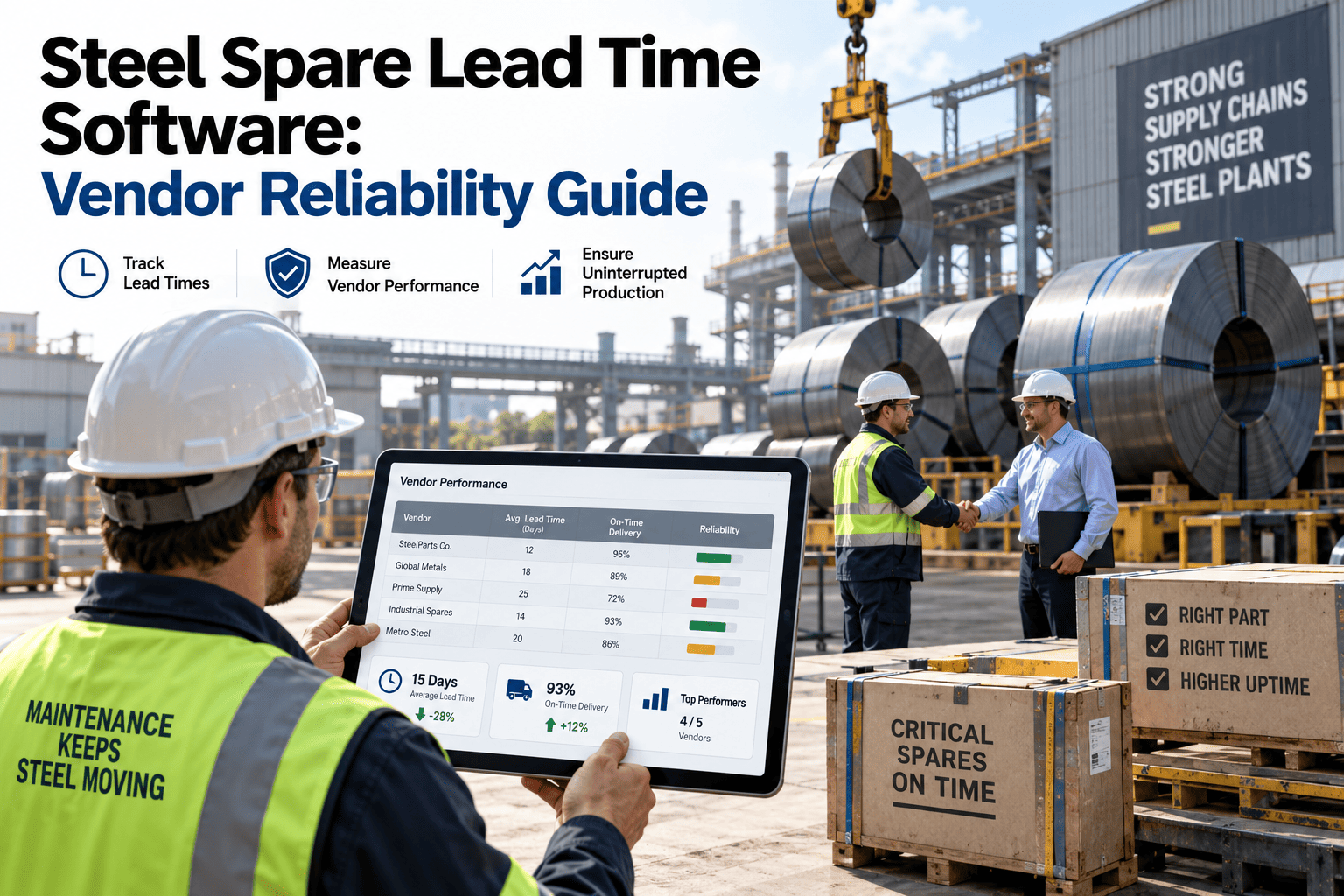
The vendor performance data a steel plant should actually be tracking
A reliable reorder point strategy depends on more than a lead time field. It depends on a running record of how a vendor actually performs against its own quotes, order after order.
| Metric | What It Measures | Why It Matters for Reorder Points |
|---|---|---|
| Quoted vs. actual lead time | Gap between promised delivery and receipt date, per PO | Reveals whether stated lead times are still trustworthy |
| On-time delivery rate | Percentage of orders received on or before the quoted date | Flags vendors trending toward chronic delay before a stockout occurs |
| Expedite frequency | How often rush shipping or premium freight was required | Signals the real buffer needed above quoted lead time |
| Order fill accuracy | Correct part, correct quantity, correct spec on first shipment | Wrong or incomplete shipments silently extend effective lead time |
| Price and lead time variance | How much quotes shift between RFQ and PO confirmation | Helps flag vendors whose quotes can't be planned against reliably |
Worked Example
A rolling mill's critical bearing spare — before and after tracking
Consider a hot strip mill carrying a critical backup bearing assembly for a work roll stand, quoted by the original vendor at ten weeks lead time when the part number was first set up three years ago. The reorder point was calculated against that ten-week figure and never revisited.
- Reorder point still assumes a ten-week lead time from three years ago
- Last four actual deliveries averaged fifteen weeks, with no record kept
- Planner has no visibility into the growing gap between quoted and actual
- Bearing stockout forces an unplanned mill stand shutdown while an expedite order is placed
- Every purchase order's actual receipt date is logged against the original quote
- System flags the vendor's real average lead time trending to fifteen weeks
- Reorder point automatically recalculated with a data-backed buffer
- Planner sees the drift and requalifies a second vendor before a stockout forces the decision
The difference is not a smarter formula. It is simply having the actual delivery history in one place instead of scattered across purchase orders, emails, and a planner's memory.
See your real vendor lead times, not your quoted ones
Book a walkthrough and we will show how OxMaint tracks purchase order history against actual receipts to keep your reorder points current.
Building The Discipline
How to build a vendor lead time tracking process
Log actual receipt dates against every PO
Every purchase order's quoted lead time and actual receipt date are captured in the CMMS, not left in email threads or paper packing slips.
Calculate a rolling average lead time per vendor and part
Instead of a static field, lead time becomes a rolling average of the last several actual deliveries, updated automatically as new orders close.
Flag drift beyond a set tolerance
When actual lead time exceeds quoted lead time by a configurable margin, the system flags the part and vendor for review before the next reorder cycle.
Recalculate reorder points from real data
Reorder points and safety stock levels adjust based on demonstrated vendor performance, not the original RFQ quote.
Qualify a second source for chronically unreliable vendors
Parts with consistent lead time drift or low on-time delivery rates are flagged for alternate vendor sourcing before they become a single point of failure.
Where OxMaint Fits
Managing spare lead time and vendor reliability inside OxMaint
OxMaint connects purchase order history, inventory levels, and reorder logic in one CMMS, so spare lead time management doesn't depend on a planner's spreadsheet or institutional memory.
Purchase order and receipt tracking
Every PO's quoted lead time and actual receipt date are logged automatically, building a real performance history per vendor and part.
Outcome: reorder points based on evidence, not quotesVendor performance dashboards
On-time delivery rate, expedite frequency, and lead time drift are visible per vendor, filterable by part category or criticality.
Outcome: chronic delays surface before a stockout doesAutomated reorder point alerts
When on-hand inventory crosses a dynamically calculated reorder point, OxMaint generates a purchase request routed to the right buyer.
Outcome: fewer emergency purchase ordersCritical spares and single-source risk flags
Parts tied to critical assets with only one qualified vendor are flagged for review, supporting alternate-source qualification before a shortage forces the issue.
Outcome: reduced single-vendor exposure on critical sparesFAQ
Frequently asked questions about spare lead time and vendor tracking
How often should reorder points be recalculated?
Reorder points for critical spares should be reviewed whenever new purchase order data comes in, not on a fixed annual schedule. A rolling average tied to actual receipts keeps the number current without manual review cycles.
What counts as a critical spare for lead time tracking?
Any part whose absence would stop production on a bottleneck asset — mill drives, furnace transformers, caster segments, critical bearings — warrants active lead time and vendor performance tracking, even if it is rarely ordered.
Does tracking vendor reliability replace supplier negotiations?
No. Tracking gives procurement teams the actual performance data to negotiate from, whether that means requesting a revised lead time commitment, qualifying a second vendor, or adjusting safety stock for a part that can't be sourced elsewhere.
How does this connect to preventive maintenance planning?
Accurate lead time data lets maintenance planners schedule parts-dependent preventive work with confidence that spares will arrive in time, instead of building in guesswork buffers that tie up working capital in excess inventory.
Can OxMaint integrate with our existing procurement or ERP system?
OxMaint can connect purchase order and receipt data from your procurement workflow so vendor performance tracking runs alongside your existing systems rather than replacing them. Book a demo at calendly.com/oxmaintapp/30min to review your setup.
Stop reordering spares against three-year-old quotes
Track actual vendor lead time, flag drift early, and keep reorder points grounded in real delivery history — not the original RFQ.
Free 14-day trial · No credit card