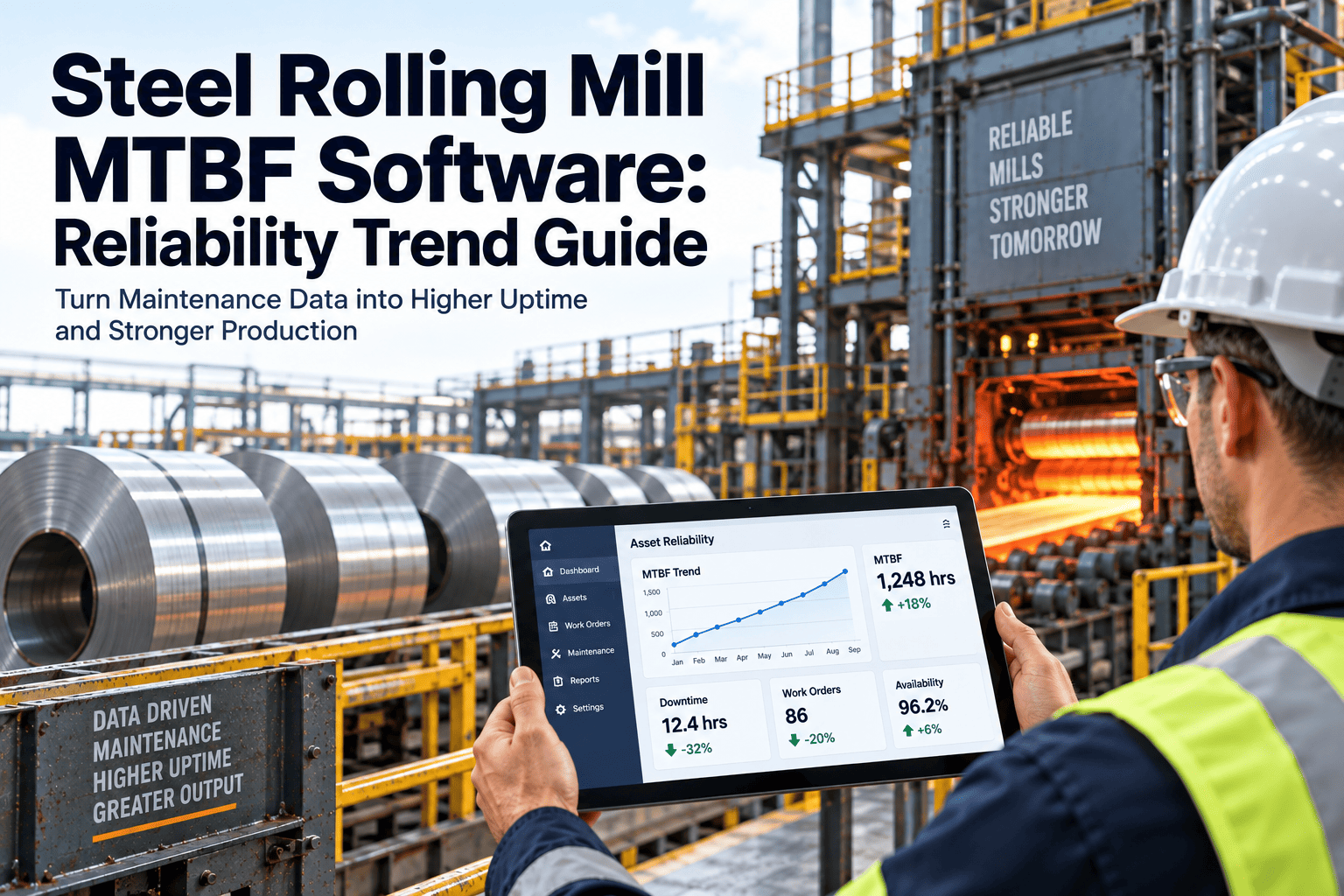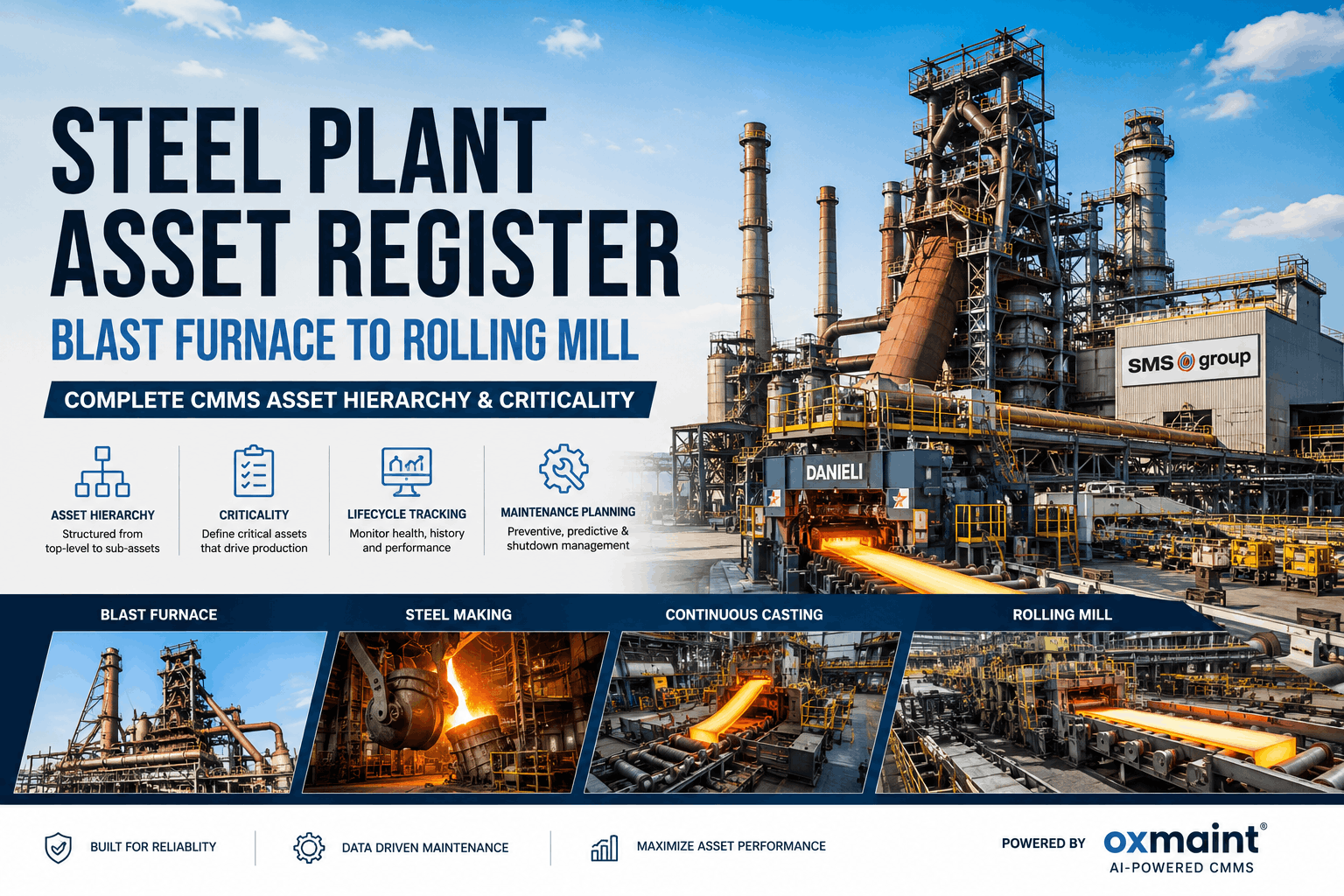
Reliability engineering for steel plants is the discipline of applying structured methods — Reliability-Centered Maintenance (RCM), Failure Modes and Effects Analysis (FMEA), and criticality analysis — to keep blast furnaces, rolling mills, and auxiliary systems running at peak availability. In an industry where a single hour of unplanned downtime on a hot strip mill can cost $200K–$500K, a formal reliability program shifts maintenance from reactive fire-fighting to predictive, data-driven decision-making. This steel plant reliability guide breaks down how to implement RCM on blast furnaces, run FMEA on rolling mill drives, build failure mode libraries, and operationalize every task through a CMMS. Ready to modernize your maintenance operation? Start Free Trial with OxMaint and turn reliability theory into measurable uptime.
Steel Reliability Engineering Guide
Can Your Blast Furnace Survive Another Reactive Maintenance Cycle?
Steel plants lose 5–15% of annual revenue to unplanned downtime. RCM and FMEA — operationalized through a CMMS — can recover 300–800 production hours per year and extend asset life by 20–40%.
Foundation
What Is Reliability Engineering for Steel Plants?
Reliability engineering in a steel plant is the systematic application of engineering principles, statistical analysis, and maintenance strategy to ensure that critical assets — blast furnaces, BOFs, continuous casters, rolling mills, and utility systems — perform their intended function under stated conditions for a specified period. Unlike general manufacturing, steel production involves extreme temperatures, heavy loads, abrasive environments, and continuous operations where a single equipment failure can cascade into a full plant shutdown.
A mature steel plant reliability program rests on three pillars: criticality analysis (ranking assets by risk and consequence of failure), RCM (selecting the right maintenance strategy for each failure mode), and FMEA (systematically identifying how assets fail and what to do about it). These methods are not academic exercises — they are the backbone of ISO 55000-aligned asset management and World Class Manufacturing (WCM) standards that top-tier steelmakers like ArcelorMittal, Nippon Steel, and Tata Steel use to stay competitive.
A typical integrated steel mill with 2,500–5,000 maintainable assets cannot manage reliability on spreadsheets. Without a CMMS to execute and track RCM-derived tasks, 60–70% of preventive maintenance plans are either skipped, duplicated, or performed at the wrong interval — wasting maintenance hours while still suffering unplanned failures.
RCM Methodology
RCM Analysis on Blast Furnaces: A Step-by-Step Approach
Reliability-Centered Maintenance (RCM) for a blast furnace addresses the most critical asset in an integrated steel plant. A blast furnace campaign can last 15–20 years, but a single unplanned shutdown due to refractory failure, cooler leak, or charging system malfunction can cost $2M–$5M per day in lost production and restart expenses. Here is how a structured RCM analysis is applied.
System Definition & Boundary Identification
Define the blast furnace system boundaries: shell, refractory lining, cooling system (stave coolers, tuyeres), charging apparatus (bell-less top), hot blast stoves, and gas cleaning plant. Document functional block diagrams and identify all maintainable components within each boundary.
Functional Failure Analysis
For each function (e.g., "contain molten metal and slag at 1,500°C," "deliver hot blast at 1,200°C and 2.5 bar"), identify functional failures: partial loss, complete loss, and degraded performance. A blast furnace may have 80–120 distinct functions across its subsystems.
Failure Mode & Effects Analysis (FMEA)
For each functional failure, identify specific failure modes — refractory erosion, cooler tube corrosion, tuyere burn-through, stove checker brick degradation — and document failure effects, including safety, environmental, and production consequences. Assign Severity (S), Occurrence (O), and Detection (D) ratings to calculate Risk Priority Numbers (RPN).
Criticality Assessment
Apply a criticality matrix scoring each failure mode on a 1–10 scale for safety risk, environmental impact, production loss, and repair cost. Failure modes with RPN > 200 or safety/environmental severity > 8 are classified as critical and require proactive maintenance strategies.
Maintenance Strategy Selection
Apply the RCM decision logic: for each critical failure mode, determine whether it is age-related (time-based PM), condition-related (condition-based monitoring / predictive), or random (run-to-failure with redundancy). Blast furnace cooling system leaks → ultrasonic thickness monitoring + thermography. Refractory wear → scheduled gunning/grouting campaigns based on wear models.
CMMS Task Integration
Translate RCM decisions into CMMS-based preventive maintenance (PM) triggers, condition-monitoring thresholds, and corrective work order templates. Each task links to the asset hierarchy, spare parts, labor skills, and procedures — ensuring the RCM analysis drives daily maintenance execution, not a binder on a shelf.
FMEA Application
FMEA for Rolling Mill Drives: Failure Modes That Cost Millions
Rolling mill drives — gearboxes, couplings, motors, and roll chocks — operate under shock loads, thermal stress, and contamination. An FMEA for a hot rolling mill main drive typically identifies 40–60 failure modes across the drivetrain. Below is a representative subset showing how FMEA outputs map to CMMS tasks.
| Asset / Component | Failure Mode | Effect | S | O | D | RPN | CMMS Task |
|---|---|---|---|---|---|---|---|
| Main gearbox | Bearing spalling | Vibration, gear damage, unplanned shutdown | 9 | 4 | 3 | 108 | Vibration analysis (monthly), oil analysis (quarterly) |
| Pinion stand | Gear tooth pitting | Noise, reduced rolling precision, cascade failure | 7 | 5 | 4 | 140 | Ultrasonic inspection (biannual), oil debris monitoring |
| Mill motor | Stator winding insulation degradation | Motor failure, mill stop, $350K repair | 8 | 3 | 5 | 120 | Megger testing (quarterly), thermal imaging (monthly) |
| Coupling (spindle) | Lubrication breakdown | Coupling seizure, spindle fracture | 8 | 6 | 4 | 192 | Auto-grease PM (weekly), coupling inspection (monthly) |
| Roll chock | Bearing lubrication starvation | Bearing seizure, roll surface damage, strip break | 9 | 5 | 3 | 135 | Oil flow sensor monitoring (real-time), chock temp alarm |
| Hydraulic AGC system | Servo valve contamination | Gauge control loss, off-spec strip, cobble risk | 7 | 6 | 3 | 126 | Fluid cleanliness sampling (monthly), filter delta-P alarm |
The RPN threshold for mandatory action is typically set at 125–150, meaning four of the six failure modes above require active CMMS-scheduled interventions. When these tasks are automated through a CMMS like OxMaint, compliance rates rise from a typical spreadsheet-driven 55–65% to 92–98%, directly reducing the occurrence of the failure modes that drive unplanned downtime.
Strategy Framework
Steel Plant RCM vs FMEA: When to Use Each Method
A common question from maintenance managers is whether to start with RCM or FMEA. The answer is both — but applied at different levels and stages. Understanding the distinction prevents wasted analysis effort and ensures the reliability program delivers actionable maintenance tasks.
- Scope: Component-level analysis of specific failure modes and effects
- Output: Risk Priority Number (S × O × D) ranking each failure mode
- Best for: New equipment commissioning, incident investigation, design changes
- Typical effort: 2–4 weeks per major system (e.g., rolling mill drive)
- Steel example: FMEA on a new walking-beam reheat furnace before startup
- Limitation: Does not prescribe the maintenance strategy — only identifies risks
- Scope: System-level analysis including functions, failures, and strategy selection
- Output: Maintenance task assignment (PM, PdM, RTF, redesign) per failure mode
- Best for: Mature assets with operating history, optimizing existing PM plans
- Typical effort: 8–16 weeks per major system (e.g., blast furnace)
- Steel example: RCM on a blast furnace cooling system to extend campaign life
- Limitation: Resource-intensive; requires cross-functional team and failure history data
The most effective steel reliability programs use FMEA as the entry point — identifying and ranking failure modes — and then apply RCM decision logic to determine the optimal maintenance strategy for high-risk items. Both methods feed their outputs into the CMMS, where maintenance tasks are scheduled, executed, and continuously refined based on actual failure data and work order history.
CMMS Integration
How OxMaint Operationalizes RCM & FMEA for Steel Plants
RCM analysis and FMEA worksheets are only valuable if they translate into daily maintenance action. OxMaint bridges the gap between reliability engineering theory and shop-floor execution — turning static analysis into living, dynamic maintenance plans that adapt to real asset conditions.
AI-Driven Failure Mode Library
OxMaint's AI engine analyzes work order history, failure codes, and asset data to auto-generate and continuously refine a steel-specific failure mode library. When a new asset is commissioned, the system suggests probable failure modes based on asset class — blast furnace, rolling mill, caster — reducing FMEA setup time by 60–70%.
Predictive Maintenance Triggers
Connect vibration sensors, oil analysis results, thermography data, and ultrasonic thickness measurements to OxMaint's condition-monitoring module. When thresholds breach — e.g., gearbox vibration RMS exceeds 7.1 mm/s — the system auto-generates a work order linked to the FMEA-identified failure mode, eliminating manual monitoring gaps.
RCM Task Scheduling & Compliance
Every RCM-derived task — PM, PdM, inspection, or run-to-failure documentation — is scheduled automatically in OxMaint with correct intervals, labor assignments, spare parts reservations, and digital procedure checklists. Real-time compliance dashboards show which tasks are on-time, overdue, or skipped, ensuring 92–98% plan adherence.
Maintenance Analytics & RCM Refinement
OxMaint's analytics module tracks MTBF, MTTR, availability, and OEE per asset — feeding real performance data back into the RCM analysis. Failure modes that never occur can be deprioritized; emerging failure patterns trigger new FMEA reviews. This closed-loop reliability cycle keeps your maintenance strategy aligned with actual asset behavior.
Real-World Impact
Case Example: Integrated Steel Mill Reliability Transformation
Consider a mid-sized integrated steel plant producing 2.5M tons/year of hot-rolled coil, with 3,200 maintainable assets across blast furnaces, a BOF shop, a continuous slab caster, and a hot strip mill. The plant was spending $18M/year on maintenance (4.2% of revenue) with 62% reactive work and 38% planned work. Unplanned downtime was consuming 1,400 production hours annually — equivalent to $280M in lost revenue opportunity.
- Maintenance on spreadsheets and paper work orders
- 62% reactive, 38% planned maintenance ratio
- 1,400 unplanned downtime hours per year
- No FMEA documentation for 80% of critical assets
- 55% PM compliance — nearly half of scheduled tasks skipped
- $18M annual maintenance spend with no ROI visibility
- AI-powered CMMS with digital work orders and mobile execution
- 28% reactive, 72% planned maintenance ratio
- 520 unplanned downtime hours — 63% reduction
- FMEA + RCM completed for top 200 critical assets
- 94% PM compliance with automated scheduling and reminders
- $13.2M maintenance spend — 27% cost reduction with full audit trail
The plant recovered 880 production hours worth approximately $176M in additional revenue, while reducing maintenance spend by $4.8M/year. The OxMaint implementation paid for itself in under 90 days. The reliability team now conducts quarterly RCM reviews using live MTBF and failure-mode data from the CMMS, ensuring the maintenance strategy evolves with actual asset conditions.
See OxMaint Run RCM Tasks on Your Steel Plant Assets
Book a 30-minute demo and watch how OxMaint maps your blast furnace and rolling mill failure modes to automated CMMS work orders — with live compliance dashboards and AI-driven maintenance recommendations.
Common Questions
Steel Plant Reliability Engineering: Frequently Asked Questions
What is the difference between RCM and FMEA in a steel plant?
FMEA (Failure Modes and Effects Analysis) identifies and ranks specific failure modes by Risk Priority Number (RPN = Severity × Occurrence × Detection) — answering "what can go wrong and how bad is it?" RCM (Reliability-Centered Maintenance) goes further by using a decision logic to assign the optimal maintenance strategy (preventive, predictive, run-to-failure, or redesign) for each failure mode identified. In steel plants, FMEA is typically the first step, and RCM builds on it to determine the maintenance tasks that are then scheduled in a CMMS like OxMaint.
How long does it take to implement RCM on a blast furnace?
A full RCM analysis on a blast furnace typically takes 8–16 weeks with a cross-functional team of 4–6 people (reliability engineers, operations, maintenance technicians, and metallurgists). The timeline depends on the availability of failure history data, the complexity of the system boundaries, and the maturity of existing documentation. Using a CMMS like OxMaint with pre-built steel failure mode libraries can reduce the analysis time by 40–50% by auto-populating known failure modes and providing historical work order data. Book a demo to see how OxMaint accelerates your RCM rollout.
How does a CMMS support FMEA and RCM in steel maintenance?
A CMMS turns FMEA and RCM analysis from static documents into executable maintenance plans. It stores the asset hierarchy, failure code library, and task templates; auto-schedules PM/PdM tasks at RCM-defined intervals; tracks compliance and captures actual failure data (MTBF, MTTR, failure codes) that feeds back into continuous RCM refinement. Without a CMMS, 60–70% of RCM-derived tasks are never consistently executed — making the analysis wasted effort. OxMaint's AI-powered CMMS specifically automates this closed-loop process for steel plant assets.
What are the most critical failure modes in a steel rolling mill?
The highest-risk failure modes in a rolling mill are bearing failures in roll chocks (leading to roll surface damage and cobble events), gearbox bearing and gear tooth degradation (causing vibration and cascade failures), spindle coupling lubrication breakdown (leading to coupling seizure), motor winding insulation degradation, and hydraulic AGC servo valve contamination (causing gauge control loss). FMEA typically assigns RPN scores of 120–200 to these modes, triggering mandatory condition-monitoring tasks such as vibration analysis, oil analysis, and thermography — all schedulable and trackable through OxMaint.
How much can a steel plant save by implementing reliability engineering with a CMMS?
Steel plants implementing RCM + FMEA operationalized through a CMMS typically reduce unplanned downtime by 30–50%, cut maintenance spending by 15–27%, and extend critical asset life by 20–40%. For a 2.5M ton/year plant losing 1,400 hours to unplanned downtime, recovering even 60% of those hours represents $100M+ in additional revenue. OxMaint customers in heavy industry report payback periods under 90 days due to the combination of AI-driven failure prediction, automated PM compliance, and real-time analytics. Start a free 14-day trial to evaluate OxMaint on your assets.
Transform Your Steel Plant Reliability Program Today
Stop losing production hours to reactive maintenance. OxMaint's AI-powered CMMS operationalizes your RCM and FMEA analysis — cutting unplanned downtime 30–50%, ensuring 92%+ PM compliance, and extending asset life by 20–40%.
Free 14-day trial · No credit card