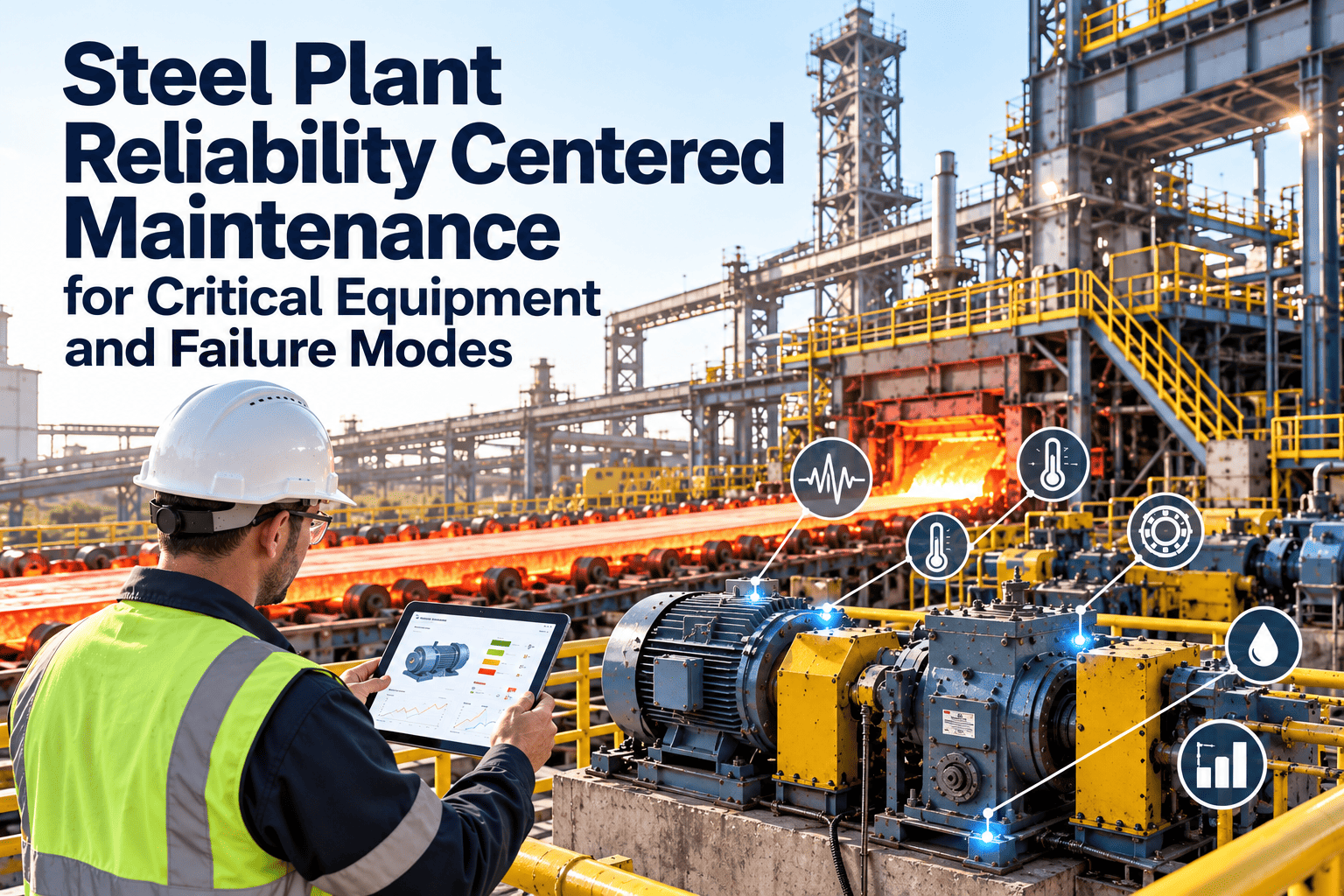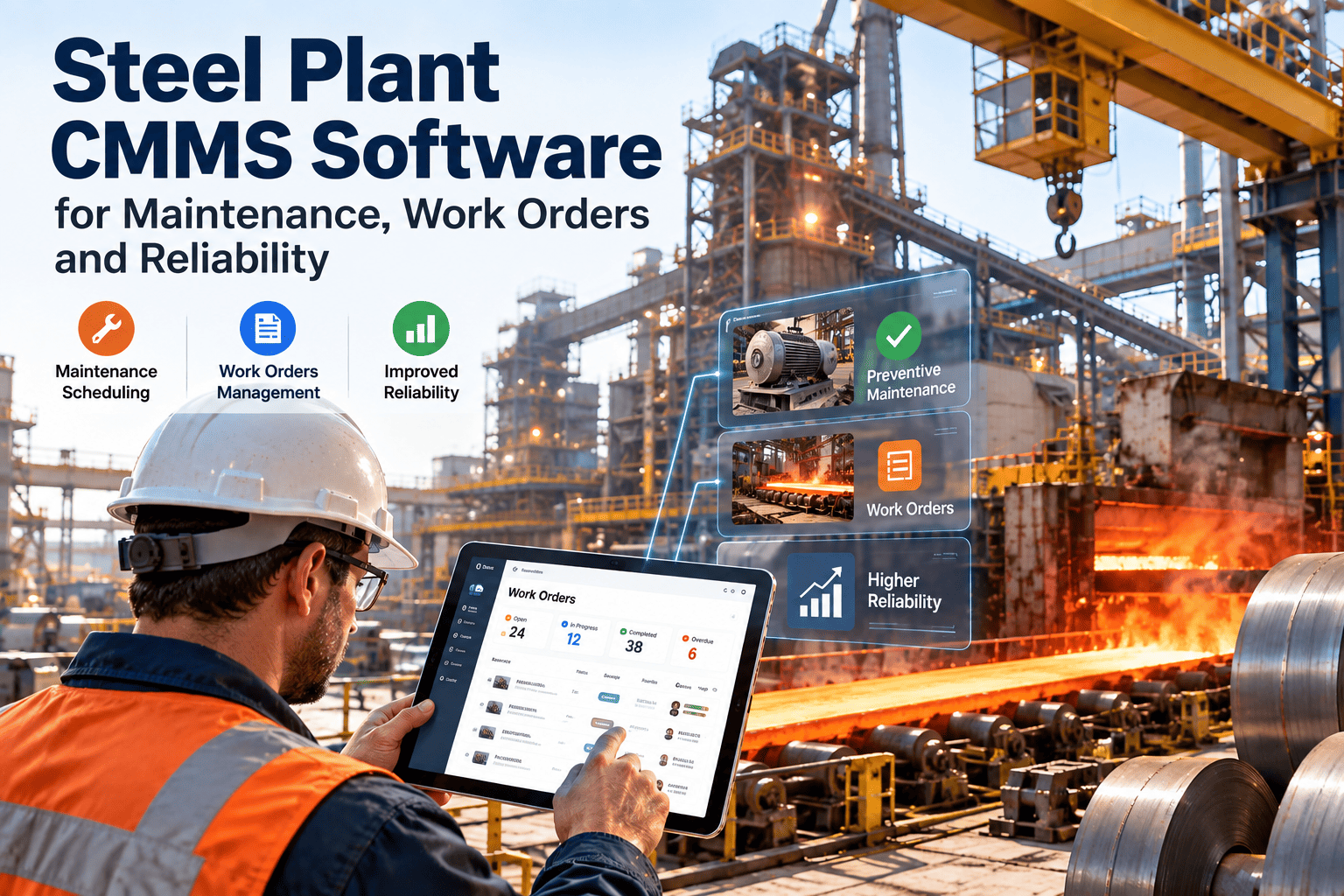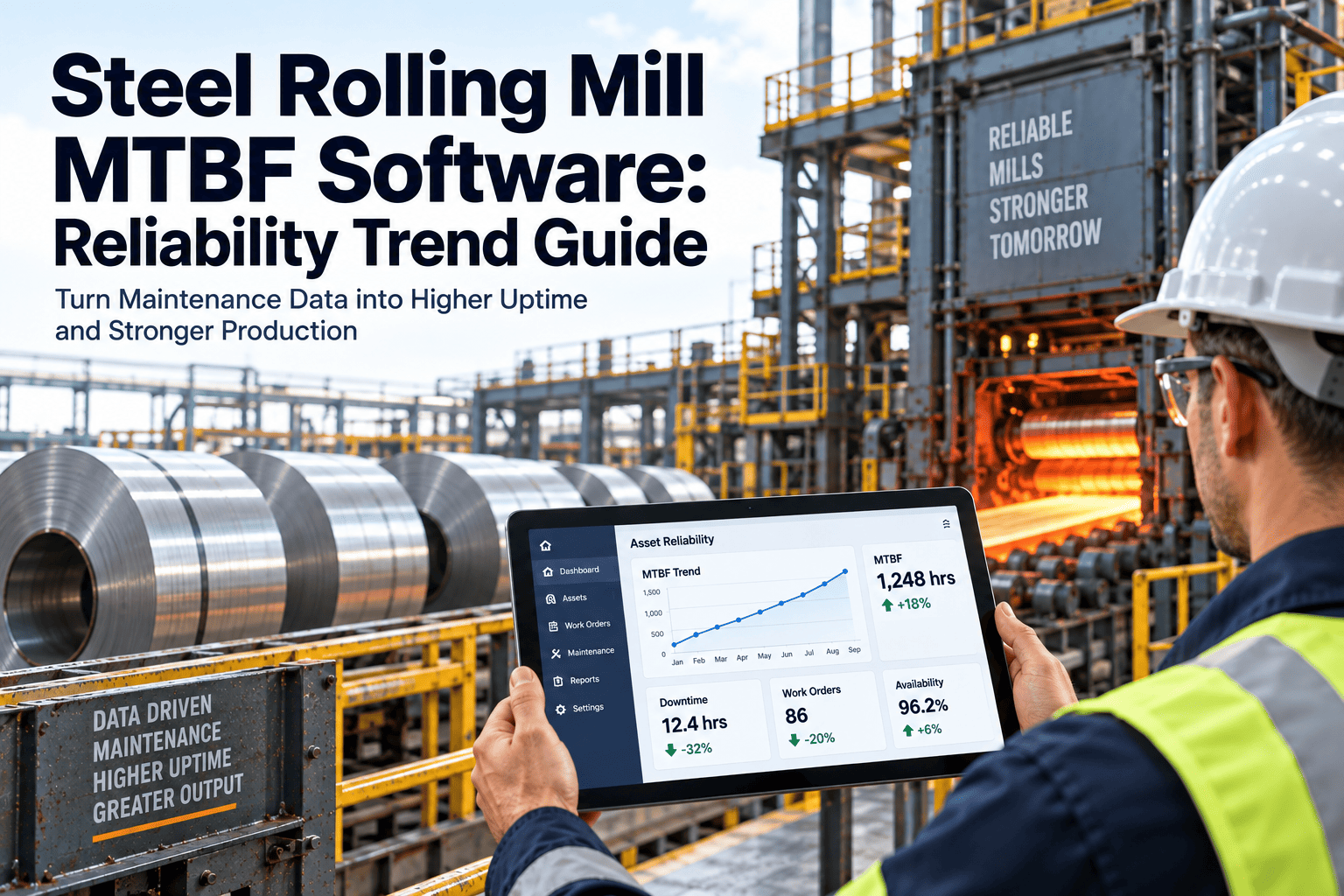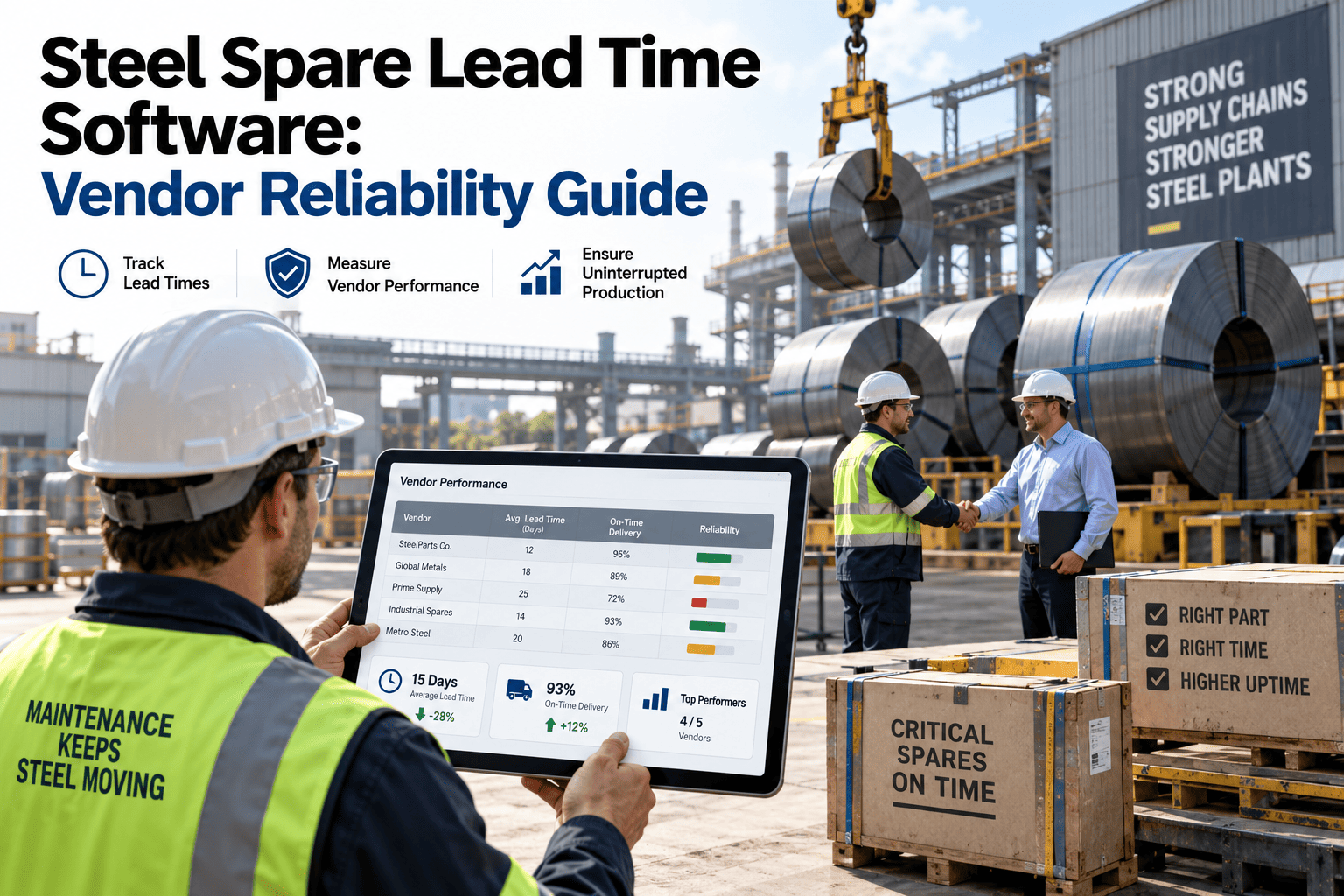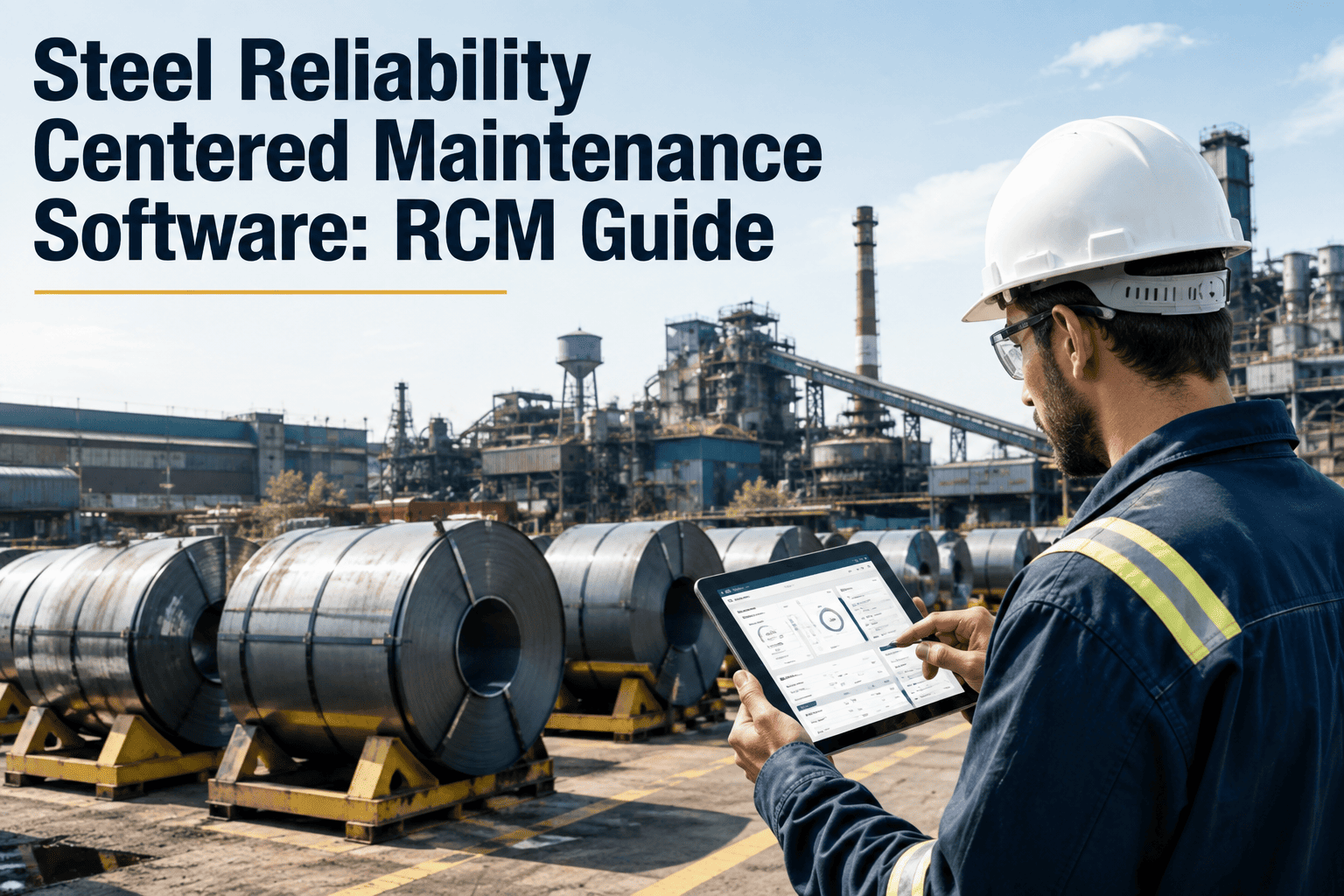
Most steel plants still run maintenance on a fixed calendar — greasing spindle couplings, changing gearbox oil, and rebuilding roll chocks on a schedule copied from an OEM manual written for average operating conditions. Reliability Centered Maintenance flips that logic: instead of asking how old a component is, RCM asks how each specific failure mode threatens safety, production, or cost, and only then decides whether a scheduled task, a condition-based check, or a planned redesign is the right response. For rolling mills, EAF and BOF equipment, and continuous casters running multiple daily cycles under heavy thermal and mechanical load, that distinction is the difference between a planned bearing swap and a burst hydraulic line mid-heat. Steel producers applying RCM to their top-tier critical assets routinely cut unplanned breakdown events by more than half within the first year of a disciplined rollout — start a free trial to see the framework mapped against your own asset register.
The Seven Questions Every Steel Asset Must Answer
RCM is standardized under SAE JA1011 as a structured decision process, not a checklist. Every critical steel plant asset — from a finishing stand roll neck to a caster segment bearing — has to be run through the same seven questions before a maintenance task gets assigned to it. Skipping a step is how plants end up over-servicing safe components while a hidden failure mode goes completely unmonitored. The sequence matters: each answer feeds directly into the next, and a wrong answer at question two or three quietly corrupts every task decision that follows it.
What does this asset need to do, and to what performance standard, in its current operating context — not the OEM's generic duty cycle? A finishing stand designed for one grade mix has a different real-world performance standard than the same stand running a heavier product family.
In how many distinct ways can the asset stop meeting that function — full stoppage, degraded output, or out-of-tolerance performance? An AGC system that still moves but cannot track gauge changes fast enough is a functional failure even though nothing has stopped.
What actually causes each functional failure — spalling, misalignment, contamination, fatigue cracking, lubrication starvation? This is where generic OEM failure lists fall short, because the dominant failure mode in a dusty, high-thermal-cycling environment often differs from the textbook case.
What happens when it fails — a cobble, an off-gauge coil, a safety event, a full line stoppage, or a silent quality drift that only surfaces at the customer? Documenting the effect, not just the cause, is what lets the consequence category get assigned correctly in step five.
Why does the failure matter — is it a safety and environmental consequence, an operational cost, or a hidden failure nobody would notice until it is tested? This single answer determines everything about the maintenance strategy that follows.
What condition-based, scheduled restoration, or scheduled discard task can predict or prevent the failure at a reasonable cost relative to the consequence it controls? Not every failure mode has a technically feasible proactive task, and RCM requires proving feasibility before assigning one.
If no proactive task is technically or economically justified, is failure-finding, redesign, or planned run-to-failure the correct call? For low-consequence components, deliberately choosing run-to-failure is a valid RCM outcome — not a gap in the programme.
Failure Consequence Decides the Maintenance Task — Not Age
This is the part most plants get backwards. A calendar-based PM programme treats every bearing, valve, and coupling the same way, regardless of what actually happens when each one fails. RCM sorts every failure mode into one of four consequence categories first, then picks the cheapest task that genuinely controls the risk. Independent research on this methodology shows that only a small share of failure modes justify a fixed time-based overhaul in the first place — the rest need condition monitoring, a redesign, or nothing at all, and applying blanket time-based PM across the board simply spends the maintenance budget on failure modes it cannot improve.
Any failure mode that could injure personnel or breach environmental limits — such as a hydraulic hose burst near an operator walkway, or a coolant discharge event — must be reduced to a tolerable risk. A proactive task is mandatory here; if none exists, the asset gets redesigned regardless of cost, because these consequences are non-negotiable.
Failures that stop or slow production — a gearbox seizure on a finishing stand, a caster segment bearing lockup — justify a task only when the task cost is clearly lower than the combined repair and lost-production cost it prevents. This is a straightforward economic calculation once real cost data exists.
Failures with no safety or production impact, such as a redundant standby pump or a non-critical instrument, are usually left to run to failure unless a very low-cost task is available. Spending engineering time here diverts attention from failure modes that actually matter.
Protective devices — pressure relief valves, backup limit switches, fire suppression systems — fail silently and give no warning during normal operation. RCM mandates a failure-finding task on a fixed schedule, since operators cannot otherwise know the protection has failed until it is actually needed.
Four Mistakes That Quietly Sink a Steel Plant RCM Rollout
RCM has a well-earned reputation for stalling after the initial workshop enthusiasm fades. The methodology itself is not the problem — the way it gets deployed usually is. Reliability engineers who have run these programmes across multiple plants tend to point to the same handful of decisions made in the first month that determine whether the analysis becomes a living part of the maintenance operation or a binder that sits on a shelf. These are the four patterns that repeatedly derail steel plant programmes before they reach the assets that matter most.
Importing an aviation or generic industrial failure database instead of using real CMMS work order history produces task intervals that do not match how your specific mills, furnaces, or casters actually fail.
A static FMEA study becomes a comfort document within a year of a major rebuild, product mix change, or line speed increase. Without a live link to CMMS data, the analysis stops reflecting reality.
Plants that try to FMEA the entire asset register before assigning a single new task lose momentum long before value shows up. The 20% of assets driving 80% of downtime cost deserve the first pass.
A completed FMEA sitting in a spreadsheet changes nothing on the floor. The task selected in question six needs a threshold and a trigger inside the CMMS, or the analysis never becomes a maintenance behavior.
Where RCM Pays Off Fastest on a Rolling Line
Bearing failures, gearbox degradation, and hydraulic AGC faults together account for the majority of unplanned rolling mill downtime, and nearly all of them give measurable early warning long before they show up as a stoppage. The table below maps the highest-value failure modes to the detection method and lead time that make a proactive RCM task worth deploying — these are the failure modes that should top the list in any first-pass FMEA on a hot strip or cold rolling line.
| Critical Asset | Dominant Failure Mode | Early Detection Method | Typical Lead Time |
|---|---|---|---|
| Roll Neck Bearings | Subsurface spalling from lubrication starvation | Bearing defect frequency (BPFO) vibration analysis | 3–8 weeks |
| Stand Gear Reducers | Gear tooth pitting, bearing wear | Oil analysis combined with vibration trending | 4–8 weeks |
| AGC Hydraulic Servo Valves | Contamination-driven response lag | ISO 4406 particle count trending on return line | 6–12 weeks |
| Drive Spindle Couplings | Torsional fatigue cracking | Torque signature analysis plus visual NDT | 2–6 weeks |
| Caster Segment Bearings | Roller bearing seizure under thermal load | Bearing temperature and vibration trend | 3–6 weeks |
| Reheat Furnace Skid Pipes | Scale buildup and refractory-driven distortion | Thermal imaging and skid pipe flow monitoring | 4–10 weeks |
| Laminar Cooling Headers | Nozzle clogging and scale buildup | Flow rate deviation against baseline | 1–4 weeks |
Every lead time in this table represents a planning window, not a guarantee — the exact figure shifts with duty cycle, product mix, and how consistently the detection method is applied. What stays constant is the principle: the detection method has to match the physical signature of the failure mode, or the warning window collapses to almost nothing.
Turn Failure Mode Analysis Into Automatic Work Orders
Oxmaint holds your steel plant asset hierarchy, failure mode library, and condition thresholds in one place — so the moment a bearing, valve, or gearbox reading crosses its RCM-defined limit, a work order is generated with the asset, failure mode, and procedure already attached.
Realistic Timeline and Cost for a Steel Plant RCM Programme
Reliability teams asking for budget need a defensible number, and the honest answer depends heavily on scope. A rigorous RCM analysis on a single complex asset system — a mill stand, or an HPU and its servo valves — typically takes three to five days with a cross-functional team of four to six people, including operators who know the failure history first-hand. Externally facilitated analyses for a full asset class commonly run from fifteen to fifty thousand dollars depending on plant size and asset count, while a full plant-wide programme covering every criticality tier is usually phased over twelve to eighteen months. The organizations that see the fastest payback are the ones that resist the urge to analyze everything at once, and instead complete a focused pass on the top critical assets within the first quarter, connect it to the CMMS immediately, and expand outward only after that first tranche is generating real work orders. Budget conversations go smoother when the programme is framed against avoided cost rather than analysis hours: a single prevented gearbox seizure on a finishing stand, or one avoided AGC servo valve replacement caused by contamination, typically covers the facilitation cost of an entire asset class analysis several times over. That framing also keeps the reliability team's mandate intact when production pressure tempts leadership to defer the next phase to "next quarter" indefinitely.
Five Steps to a Working Steel Plant FMEA Library
Failure Mode and Effects Analysis is the engine inside every RCM programme — it answers the "what causes it" and "what happens next" questions with plant-specific data rather than generic OEM failure rate tables. Here is the sequence that gets a rolling mill or EAF FMEA library from blank spreadsheet to live CMMS logic.
Build the asset hierarchy first — mill or furnace, then stand or subsystem, then component — so every failure mode has an exact home and nothing gets logged against the wrong level of the tree.
Pull real failure history from CMMS work orders and breakdown logs, not a generic industry failure rate database that ignores your specific operating context and duty cycle.
Document every credible failure mode per component along with its effect on production, safety, and product quality, using operator and technician input alongside the historical data.
Score each failure mode's consequence category to determine whether it needs a mandatory proactive task, an economically justified one, a failure-finding task, or run-to-failure.
Link the selected task to a measurable threshold so the CMMS can auto-generate the work order the instant a reading crosses the line, closing the loop from analysis to action.
What a Disciplined RCM Programme Returns
A Passed Inspection Is Not the Same as a Healthy Bearing
A documented case from a hot strip mill makes the point directly: an F6 backup roll bearing passed its monthly handheld vibration route with no anomalies flagged, then catastrophically spalled just thirteen days later. The overall vibration level checked out fine — the defect signal was sitting in a specific frequency band that a monthly overall-level reading was never built to see. RCM's job is to select the task that actually matches the failure mode's detection signature, not the task that is easiest to schedule around a lean maintenance headcount.
Catches gross imbalance and looseness late, often after the defect has already progressed past the point where a planned, low-cost repair is still possible.
Isolates the exact frequency band a spalling defect produces, giving a genuine three to eight week window to plan the repair on your own schedule, not the bearing's.
Configure Your Steel Plant Asset Hierarchy in One Session
Bring your mill, furnace, or caster asset list and Oxmaint's team maps it into a structured hierarchy with failure mode fields ready for your reliability engineers to populate.
Common Questions on Steel Plant RCM
A focused analysis on Class A critical assets — mill stands, gearboxes, AGC hydraulics — usually takes a few months with a small cross-functional team. A full plant-wide programme across every asset class is typically phased over 12 to 18 months. Book a demo to scope a phased plan for your plant.
A streamlined RCM approach that leans on historical CMMS failure data instead of a ground-up FMEA can cut initial analysis time significantly while still covering the highest-risk failure modes on your most critical assets first.
Yes. Early cycles can start with OEM failure rate guidance and operator experience, then get replaced with plant-specific data as your CMMS accumulates real work order history across the following maintenance cycles.
RCM is not a one-time study — it gets reviewed whenever actual failure experience diverges from the FMEA's predictions. Start a free trial to see how condition thresholds and task assignments stay linked to live asset data.
Start with the 20% of assets driving most of your downtime cost — typically mill stand bearings, gear reducers, AGC hydraulics, spindle couplings, and caster segment bearings — then expand the programme outward from there.
Give Every Steel Plant Failure Mode a Defined Task
Stop servicing every asset on the same fixed calendar. Oxmaint connects your RCM failure mode library directly to condition thresholds and auto-generated work orders — no spreadsheets, no lost analysis after the consultants leave.