An unplanned stoppage on a continuous galvanizing line rarely stays contained to the zinc pot or the air knife that actually failed — because the line runs as one continuous strip path, a single roll seizure or a clogged nozzle forces the entire furnace, pot, and finishing section to a stop at once, and restart is never instant once the strip has to be re-threaded through a hot zinc bath. Automotive coating customers measure supplier reliability in on-time coil delivery and coating-weight consistency, and a CGL stoppage threatens both in the same event. That combination of automotive quality pressure and total-line dependency is why continuous galvanizing lines carry some of the highest per-hour downtime costs in a steel plant, and why predictive maintenance on the zinc pot, air knife, and tension leveler pays back faster here than almost anywhere else in the mill. Book a demo to see CGL predictive maintenance mapped against your own line's asset list.
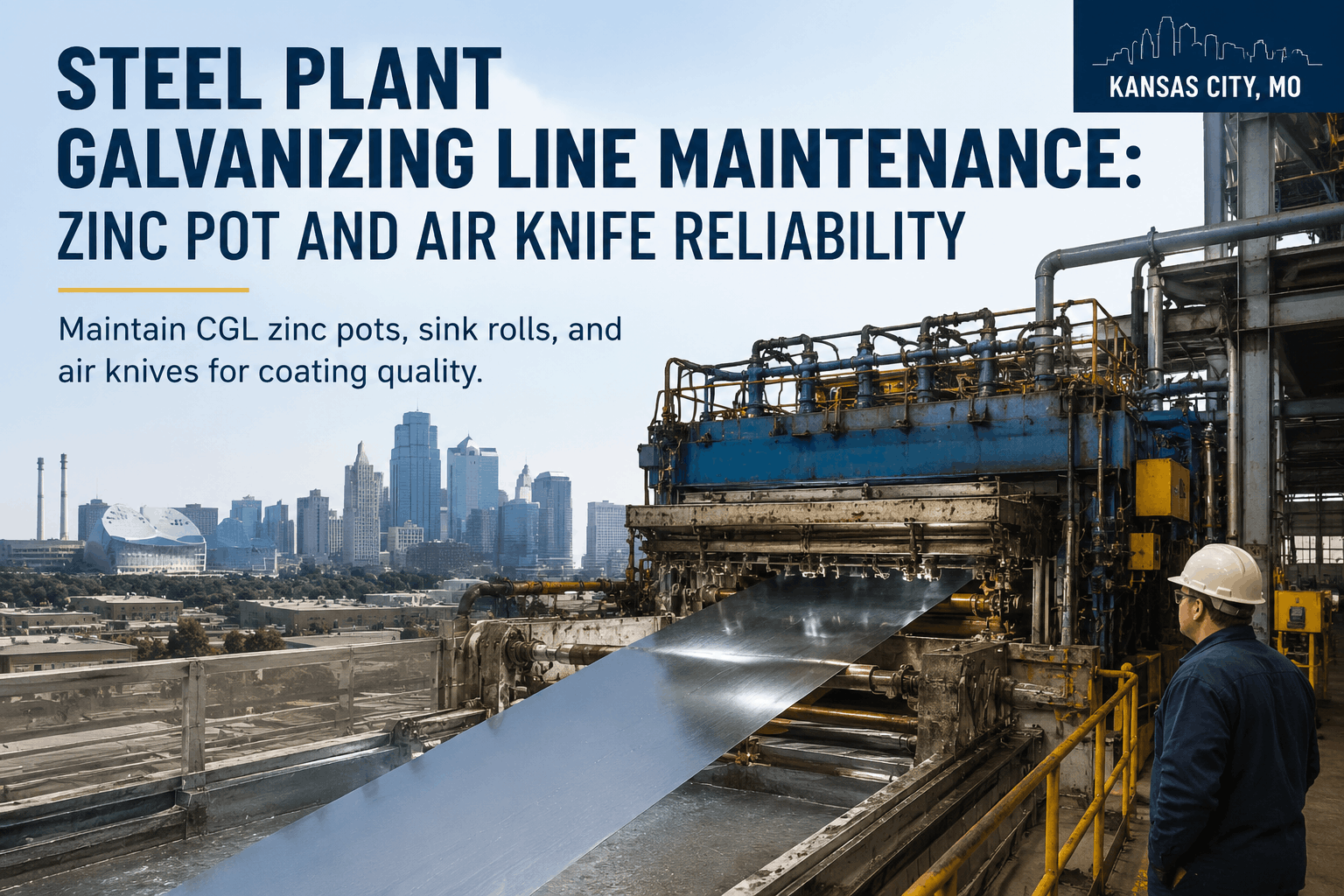
Steel CGL PdM Software: Galvanising Line Reliability Guide
A component-by-component look at predictive maintenance across the zinc pot, air knife wipers, and tension leveler drives on a continuous galvanizing line — where a single unplanned hour can cost well over $200,000 in stopped, re-threaded automotive-grade strip.
The CGL Strip Path: Where Each Failure Actually Costs You
A continuous galvanizing line is a single connected strip path from uncoiler to recoiler, which means a failure anywhere along it stops the whole line, not just the affected section — there is no bypassing a jammed section the way a plant might route around one failed unit in a batch process. The map below follows the strip through the line and flags where predictive maintenance delivers the fastest payback, based on which stages combine high failure consequence with a failure signature that can actually be monitored before the fault reaches the strip.
An unplanned stoppage on a continuous galvanizing line rarely stays contained to a single component, but the cost, tolerance, and reliability figures below give a quick sense of just how much precision and how much money ride on the zinc pot, air knife, and tension leveler working exactly as designed, shift after shift.
Zinc Pot Roll Reliability: What Predictive Monitoring Actually Tracks
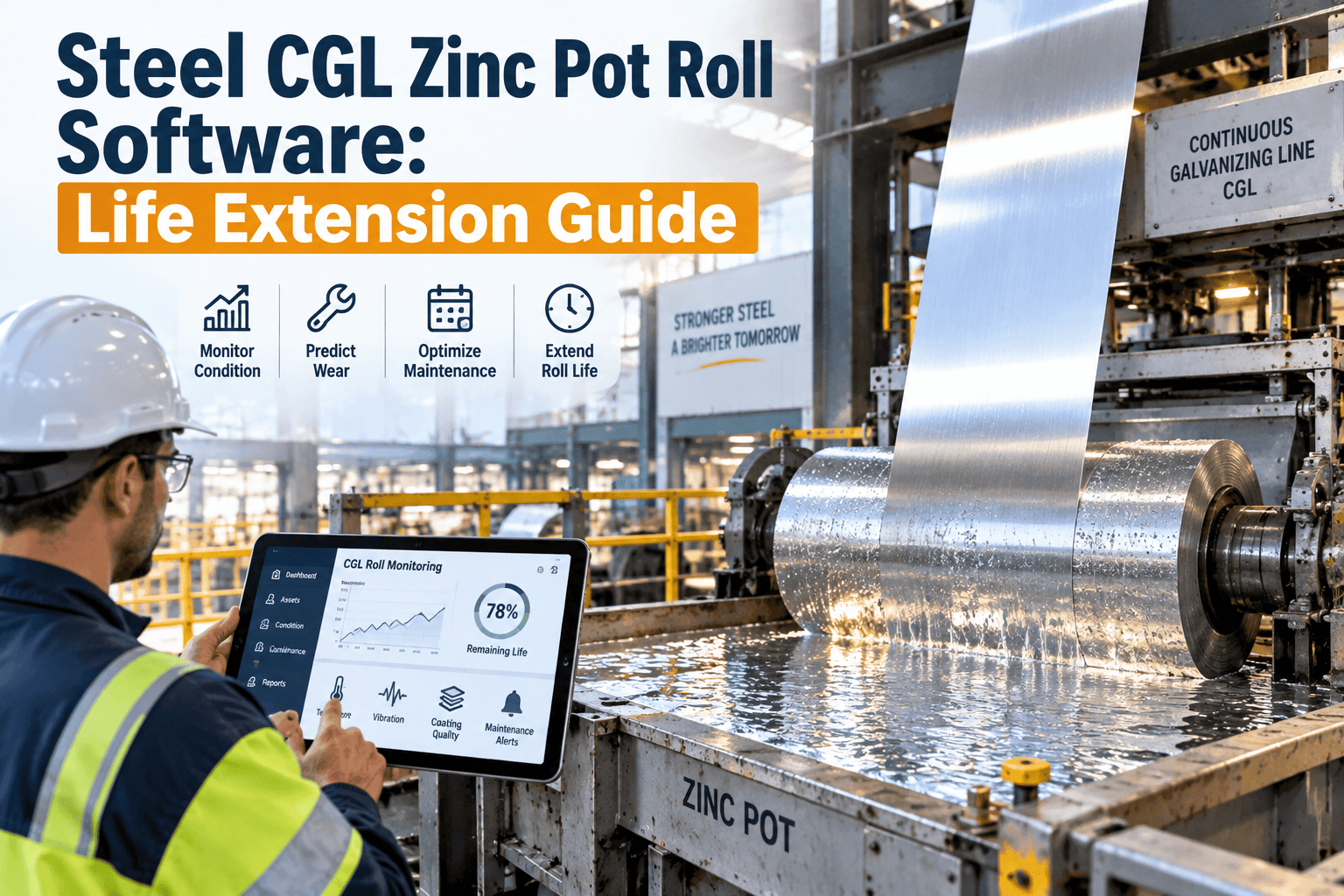
Submerged rolls operate inside molten zinc at roughly 450–460°C, which makes direct inspection impossible while the line is running and makes bearing failure one of the most disruptive events on the entire line — a seized submerged roll can mean draining the pot to make the repair, a job measured in shifts, not hours. Predictive monitoring focuses on the signals available without opening the pot: drive motor current draw, vibration transmitted through the roll shaft support structure, and strip tension variance across the roll's width, all trended against a baseline captured when the roll was known to be in good condition. A gradual current draw increase or a widening tension variance pattern typically precedes a bearing failure by days to weeks, giving the plant a window to plan a controlled pot drain and roll change instead of reacting to a seizure mid-shift, which almost always happens at the least convenient point in the production schedule.
Every Component on This Line Talks to the CMMS Before It Fails.
OxMaint tracks zinc pot roll vibration and current draw, air knife pressure drift, and tension leveler drive torque against condition baselines — generating a work order before a submerged roll seizure forces a full pot drain.
Failure Modes by Component: Signal, Root Cause, and PdM Response
The table below breaks down the three highest-cost CGL components by the specific failure signature each one produces, the underlying root cause, and how a predictive maintenance program should respond before the failure reaches the strip.
| Component | Early Warning Signal | Underlying Root Cause | PdM Response |
|---|---|---|---|
| Zinc pot submerged roll bearing | Rising drive current draw and vibration transmitted through the shaft support | Bearing degradation from continuous 450°C+ exposure and zinc infiltration | Schedule a controlled pot drain and roll change during a planned outage window |
| Air knife nozzle | Coating weight drifting outside the ±5 g/m² tolerance band across strip width | Zinc dross or oxide buildup partially clogging the nozzle slot | Trigger a cleaning PM before the next coil run rather than after a customer chargeback |
| Tension leveler drive | Torque signature anomaly on one bending roll relative to its paired roll | Drive misalignment or a developing gearbox fault under repeated flex-bend load | Flag for offline drive inspection at the next scheduled maintenance window |
| Zinc pot aluminum concentration | Dross formation rate accelerating faster than the drossing schedule accounts for | Aluminum concentration drifting outside the target metallurgical range | Adjust bath chemistry and confirm against the drossing interval before slag reaches the strip |
Rolling Out CGL PdM Without Interrupting a Running Line
A galvanizing line rarely has a convenient shutdown window long enough for a full instrumentation project, so a PdM rollout has to happen in stages that fit inside existing maintenance outages rather than requiring a dedicated one. Sequencing the rollout by risk and cost — starting with the zinc pot before moving to the air knife and tension leveler — also gives the maintenance team an early, visible win to justify continuing the investment across the rest of the line.
Why Automotive Customers Make CGL Reliability a Contract Issue
Coil coating for automotive body panels and structural components is sold against tight coating weight specifications, surface finish requirements, and delivery schedules tied directly to the customer's own production line — a missed shipment does not just cost the steel producer revenue, it can stop an assembly plant hundreds of miles away. That downstream exposure is why many automotive supply agreements include explicit language around coating consistency and on-time delivery performance, and why a CGL reliability failure carries commercial consequences that extend well past the immediate cost of the stopped line. A plant that can show an automotive customer a documented predictive maintenance program on the zinc pot, air knife, and tension leveler is making a reliability argument in the same conversation as a quality argument, and increasingly that combination is what separates a preferred supplier from a backup one during contract renewal discussions.
This is also why the highest-value PdM investment on a CGL is rarely the cheapest sensor to install. A vibration sensor on a motor is inexpensive and useful, but the data that actually protects a customer relationship is the coating weight consistency trend across thousands of coils, correlated back to air knife pressure and zinc bath temperature stability over the same period. Plants that build that correlation into their reliability program are the ones that can answer a customer's quality escalation with a specific root cause and a specific corrective action, rather than a general assurance that the issue has been addressed.
Building a Line-Specific Failure History, Not a Generic Sensor Feed
Raw sensor data on its own does not tell a maintenance team much — a vibration reading or a current draw value only becomes useful once it is compared against how that specific asset behaved before, during, and after a known good run and a known fault. This is the part of a CGL predictive maintenance program that takes longer to build than the sensor installation itself: capturing enough history on each zinc pot roll, each air knife assembly, and each tension leveler drive to know what normal actually looks like for that specific component at that specific line speed and strip grade, rather than applying a generic threshold borrowed from a different line or a different plant. A submerged roll running a heavier gauge grade at a slower line speed carries a different normal vibration signature than the same roll running a light-gauge automotive grade at full speed, and a predictive model that does not account for that difference will either miss real faults or flag false alarms often enough that operators start ignoring the alerts entirely.
This is also where connecting the CMMS work order history back to the sensor data pays off over time. Every time a submerged roll bearing is changed, a nozzle is cleaned, or a tension leveler drive is inspected, that event becomes a labeled data point the predictive model can learn from — this vibration pattern preceded this specific failure, this pressure drift preceded this specific coating weight exceedance. A plant that has been logging this connection for a year has a materially more accurate predictive model than one that installed the same sensors last month, which is why starting the data collection early matters more than waiting for the perfect analytics platform to layer on top of it.
Expert Perspective
Frequently Asked Questions
Protect the Line Where a Single Failure Costs the Most.
OxMaint connects zinc pot vibration, air knife pressure, and tension leveler torque data to a single predictive maintenance dashboard — turning the highest-cost failure modes on your galvanizing line into planned work orders instead of emergency stoppages.