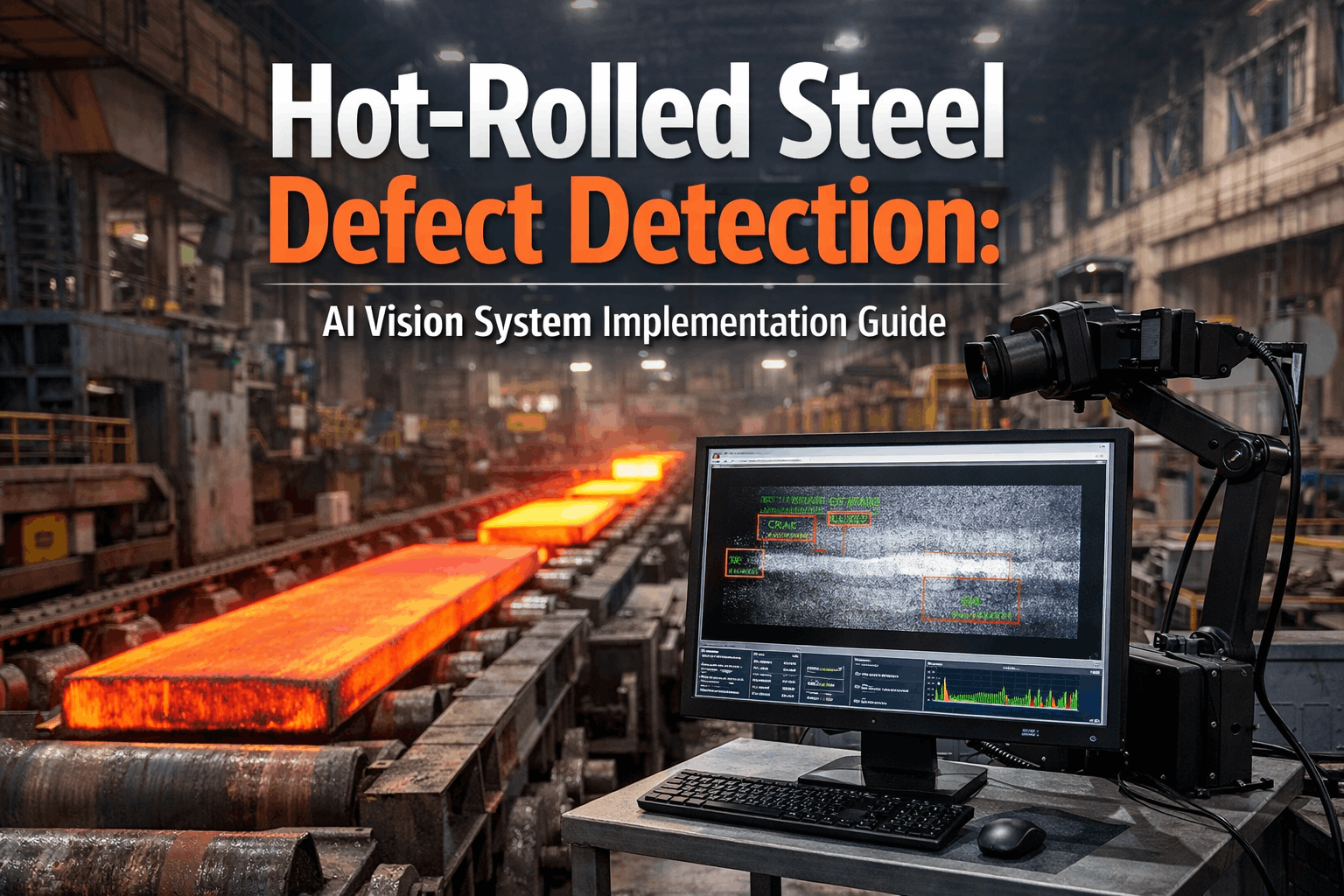
Steel Surface Defect Detection Using AI Vision

By Toji Fushiguro on January 20, 2026

steel-surface-defect-detection-using-ai-vision

The hot-rolled coil looked perfect to the naked eye—uniform color, consistent texture, ready for shipment to an automotive stamping plant. But embedded within that seemingly flawless surface were 23 microscopic inclusions, invisible to human inspectors moving at production speed. Two weeks later, those inclusions became stress concentrators in door panels, triggering a recall of 45,000 vehicles  and $12 million in warranty claims. A single AI vision system, scanning at line speed, would have flagged that coil in milliseconds—before it ever left the mill. Today's steel surface defect detection technology doesn't just find problems; it prevents them from becoming catastrophes.

99.7%
Detection Accuracy Achievable
Modern AI vision systems detect steel surface defects with near-perfect accuracy at production speeds exceeding 30 meters per second—far surpassing human inspection capabilities in both speed and consistency.

Steel surface quality determines everything downstream—weldability, paintability, formability, corrosion resistance, and fatigue life. Surface defects that escape detection at the mill propagate through the supply chain, multiplying costs at each stage until they reach end customers as failures, recalls, and reputation damage. Schedule a consultation to discover how AI-powered surface inspection can transform your quality control from reactive sampling to comprehensive, real-time detection.

The Challenge of Steel Surface Inspection

Steel surfaces present inspection challenges that overwhelm traditional quality control methods. Production speeds, environmental conditions, and the sheer variety of defect types create an inspection problem that human vision simply cannot solve at scale.

Why Traditional Inspection Falls Short
0.05mm
Minimum defect size requiring detection—smaller than a human hair and invisible at production speeds
1800 m/min
Typical hot strip mill line speed—human inspectors physically cannot evaluate surfaces at this velocity
50+
Distinct defect types requiring classification—each with different causes, severity levels, and remediation approaches
$500M+
Annual industry cost of undetected surface defects—quality claims, downgrades, scrap, and customer losses
Stop defects before they become claims. Join leading steel producers using AI to achieve 99%+ detection rates.
Sign Up Free

How AI Vision Detects Surface Defects

AI-powered surface inspection combines high-speed imaging, advanced lighting techniques, and deep learning algorithms trained on millions of defect examples. These systems see what humans cannot—and do it consistently, 24/7, at production speed.

AI Surface Defect Detection Pipeline From raw steel to quality-assured product
01
High-Speed Image Acquisition
Line-scan cameras capture continuous images at resolutions up to 8K, synchronized with production speed. Multiple camera angles and specialized lighting (bright field, dark field, structured light) reveal different defect types.

02
Real-Time Image Processing
Edge computing platforms process image streams in milliseconds using GPU acceleration. Background subtraction, contrast enhancement, and noise filtering prepare images for defect detection algorithms.

03
Defect Detection & Classification
Convolutional neural networks identify defect regions and classify them by type. Models distinguish true defects from acceptable surface variations, scale patterns, and imaging artifacts with high precision.

04
Severity Assessment & Grading
Detected defects are measured (size, depth, density) and graded against customer specifications. AI determines whether defects are acceptable, require downgrading, or mandate rejection.

05
Quality Documentation & Action
Complete defect maps with images, locations, and classifications feed into quality management systems. Sign up for Oxmaint to automatically generate quality reports, trigger alerts, and track defect trends for process improvement.

Steel Surface Defect Categories

Steel surface defects originate from multiple sources throughout the production process—from steelmaking through casting, rolling, and finishing. AI systems must recognize and distinguish dozens of defect types to enable proper disposition and root cause analysis.

Primary Defect Classification Groups

Scale Defects
Rolled-in scale, scale pits, and red scale from oxidation during hot processing. AI distinguishes harmful embedded scale from cosmetic surface oxide patterns that don't affect performance.

Mechanical Damage
Scratches, gouges, roll marks, and handling damage from contact with equipment. AI measures depth and orientation to assess impact on downstream processes and final product quality.

Inclusions & Slivers
Non-metallic inclusions, slivers, and seams from steelmaking or casting defects that surface during rolling. Critical for automotive and appliance applications requiring formability.

Pitting & Corrosion
Surface pitting from pickling, storage corrosion, or chemical attack. AI quantifies pit density and depth to determine if surfaces meet coating adhesion requirements.

Coating Defects
Bare spots, coating thickness variations, spangles, and zinc flowers on galvanized products. AI ensures uniform coating coverage critical for corrosion protection guarantees.

Laminations & Blisters
Subsurface separations that manifest as surface bulges or ruptures. Indicates internal quality issues from casting or hydrogen damage requiring material rejection.
See AI surface inspection in action. Book a personalized demo and discover how to achieve 99%+ defect detection rates at your facility.
Schedule Free Demo

Industry Applications

Steel surface defect detection serves diverse industries with varying quality requirements. AI systems adapt to specific customer specifications, surface finish standards, and end-use performance criteria.

Application-Specific Detection Requirements
Industry Critical Defect Types Detection Challenge Required Accuracy
Automotive Body Panels Inclusions, slivers, scratches, coating defects Class A surface finish requires zero visible defects after painting 99.9%+ detection
Appliance Manufacturing Scratches, dents, coating variations, staining Visible surfaces demand cosmetic perfection; functional surfaces allow minor defects 99.5%+ detection
Construction Steel Scale, laminations, seams, corrosion Structural integrity more critical than appearance; coating adhesion essential 98%+ detection
Pipe & Tube Seams, laps, scratches, wall thickness variations Must detect defects on curved surfaces during forming operations 99%+ detection
Electrical Steel Coating defects, scratches, edge damage, contamination Insulation coating integrity critical for electromagnetic performance 99.5%+ detection
Tinplate & Packaging Pinholes, scratches, coating weight, surface contamination Food contact surfaces require absolute cleanliness and coating integrity 99.9%+ detection
Accuracy requirements represent industry standards for critical defect escape rates. AI systems are typically configured with sensitivity margins above minimum requirements.
Not sure which detection approach fits your products? Our engineers will assess your quality requirements and recommend the optimal inspection configuration.
Schedule Assessment

Detection Technologies

Effective steel surface inspection combines multiple imaging technologies, each optimized for different defect types. AI systems fuse data from multiple sensors to achieve comprehensive defect coverage.

Imaging Technologies for Steel Surface Inspection

Bright Field Imaging
Direct illumination reveals color variations, staining, scale patterns, and coating defects. Best for detecting contamination and surface chemistry variations.

Dark Field Imaging
Angled illumination highlights surface topology—scratches, pits, and texture variations scatter light differently than flat surfaces. Essential for mechanical damage detection.

Structured Light
Projected light patterns enable 3D surface measurement, quantifying defect depth and height. Critical for assessing severity and predicting downstream impact.

Laser Triangulation
High-precision depth measurement for critical dimensional defects. Measures flatness, waviness, and camber alongside surface defect detection.
Transform Surface Quality Control with AI
Oxmaint connects AI surface inspection directly to your quality management workflow—automatically documenting defects, triggering disposition decisions, and providing data for process improvement initiatives.

AI vs. Traditional Inspection

The transition from human visual inspection and rule-based machine vision to AI-powered detection represents a fundamental improvement in capability—not just incremental gains but transformational change in what's possible.

Inspection Method Comparison
Traditional Inspection
⚠️
  • Human fatigue degrades accuracy over shifts
  • Limited to 10-15 m/min effective speed
  • Subjective interpretation varies by inspector
  • Rule-based systems miss novel defect types
  • Sample-based inspection misses defects
70-85% typical defect detection rate
AI Vision Inspection
✔️
  • Consistent accuracy 24/7/365
  • Full production speed inspection (30+ m/s)
  • Objective, repeatable classification
  • Learns new defect types from examples
  • 100% surface coverage, every coil
99%+ defect detection rate achievable

ROI of AI Surface Inspection

Investment in AI surface defect detection delivers measurable returns through reduced quality claims, improved yield, and optimized product allocation to customers based on actual surface quality.

Documented Business Impact Based on steel industry implementation studies
80%
Reduction in customer quality claims
55%
Decrease in product downgrades
35%
Improvement in prime yield
75%
Faster defect root cause identification
Start improving your surface quality today. Create your free Oxmaint account and begin tracking defects across your production lines.
Sign Up Free

Process Integration

AI surface inspection delivers maximum value when integrated into broader quality and production management systems. Real-time defect data enables immediate process adjustments and long-term quality improvement.

System Integration Points
Integration Data Flow Business Benefit
Production Control (MES) Real-time defect alerts, automatic line stoppage triggers, quality gates Immediate response to quality excursions, reduced defective material production
Quality Management (QMS) Defect documentation, inspection records, certificate of analysis data Automated compliance documentation, customer quality reporting
Maintenance Management (CMMS) Roll condition trends, equipment-correlated defects, predictive alerts Proactive maintenance scheduling, root cause identification
Process Control Feedback to rolling, coating, and finishing parameters Closed-loop quality optimization, reduced process variation
Customer Order Management Surface quality mapping, order-specific grading, allocation optimization Match product quality to customer requirements, maximize value recovery

Implementation Best Practices

Successful AI surface inspection deployment requires attention to imaging fundamentals, environmental control, and continuous model improvement processes.

Critical Success Factors

Lighting Stability
Consistent, uniform illumination is essential for repeatable defect detection. Environmental controls prevent ambient light interference; LED sources provide stable intensity throughout their lifetime.

Camera Calibration
Regular calibration ensures accurate defect sizing and position mapping. Automated calibration routines verify camera alignment and focus at the start of each production campaign.
Training Data Quality
AI model performance depends on comprehensive, accurately labeled training datasets. Include edge cases, novel defects, and customer-specific acceptance criteria in training libraries.

Continuous Improvement
Establish feedback loops from customer claims and internal quality audits to continuously improve detection models. Regular retraining incorporates new defect types and process changes.
Surface quality is the customer's first impression of your steel—and in many applications, it's the difference between prime product and scrap. AI inspection doesn't just find more defects; it enables a fundamentally different approach to quality assurance where every square meter is evaluated against the exact specification that matters for its end use.
— Steel Quality Engineering Principles

Implementation Timeline

Typical AI surface inspection deployments progress through structured phases, with each stage building on validated results from the previous phase.

Deployment Roadmap
Month 1-2
Assessment & Design
Audit current inspection methods Define detection requirements Design imaging configuration
Month 3-4
Installation & Training
Install cameras and lighting Collect training images Develop initial AI models
Month 5-6
Validation & Tuning
Parallel run with existing QC Tune detection thresholds Validate against customer specs
Month 7+
Production & Optimization
Full production deployment Continuous model improvement Expand to additional lines
Start your implementation journey today. Get a detailed project plan customized for your mill's specific production lines.
Get Project Plan

Quality Standards Compliance

AI surface inspection supports compliance with international steel quality standards while enabling more rigorous internal specifications for premium products.

Standards Framework
Standard Application AI Inspection Role
ASTM A568/A568M Carbon and HSLA steel sheet/strip surface quality Automated classification of surface imperfections per standard severity definitions
EN 10163 European steel surface condition delivery requirements Verify surfaces meet Class A, B, C, or D requirements as specified
JIS G 3302 Japanese hot-dip galvanized steel sheet coating quality Detect coating defects, measure spangle size, verify minimum coating weight
Automotive OEM Specs Customer-specific surface quality for exposed panels Grade surfaces to OEM defect maps; ensure Class A surface compliance
ISO 8501 Surface preparation for painting Verify surface cleanliness and profile meet coating application requirements

Common Implementation Challenges

Understanding typical challenges enables proactive mitigation strategies for successful AI surface inspection deployment.

Challenge Resolution Guide
Challenge Impact Solution
Environmental contamination Dust, oil mist, and debris on cameras/lights degrade image quality Protective enclosures, positive air pressure, automated lens cleaning, vibration-resistant mounts
Product variation Different steel grades and finishes require different detection parameters Grade-specific AI models, automatic parameter switching based on coil tracking data
False positives Acceptable surface variations flagged as defects reduce throughput Continuous model refinement, customer-specific acceptance criteria, human review of borderline cases
Edge effects Coil edges present different lighting conditions than center Edge-specific cameras and lighting, separate edge detection models, physics-based edge compensation
High-temperature inspection Hot strip mills require inspection at elevated temperatures Thermal cameras, water-cooled enclosures, compensate for thermal expansion in measurements
Elevate Your Steel Surface Quality to World-Class Standards
Every defect that escapes your mill becomes a problem for your customer—and eventually a problem for your reputation and bottom line. Oxmaint integrates AI surface inspection into comprehensive quality management, ensuring every detected defect becomes documented, dispositioned, and tracked for process improvement.

Frequently Asked Questions

How long does AI surface inspection implementation take?
Most steel mills can have AI-powered surface inspection running within 4-8 weeks for a single production line. The system integrates with your existing quality management and production control infrastructure—no major equipment changes required. Schedule a consultation to get a customized timeline for your facility.
Do we need to replace our existing inspection systems?
No. Oxmaint's AI surface inspection platform works alongside your existing quality control methods. It provides enhanced detection capabilities and automated documentation while integrating seamlessly with your current QMS, MES, and production control systems.
What data do we need to get started?
At minimum, you need high-resolution images of your steel surfaces captured with consistent lighting, plus examples of defect types you need to detect. The more historical inspection data and defect samples connected, the more accurate the AI models become. Sign up for a free account and our team will assess your data readiness.
How does AI handle different steel grades and surface finishes?
The system is designed with grade-specific AI models that automatically adjust detection parameters based on product tracking data. A single system can handle dozens of different steel grades and surface finishes—from hot-rolled black to bright-annealed to galvanized—by loading appropriate detection models for each product.
What ROI can we expect from AI surface inspection implementation?
Mills typically see 80% reduction in customer quality claims, 55% decrease in product downgrades, and 35% improvement in prime yield within the first year. Book a demo to get a customized ROI projection based on your production volumes and current quality metrics.

Share This Story, Choose Your Platform!