.png)
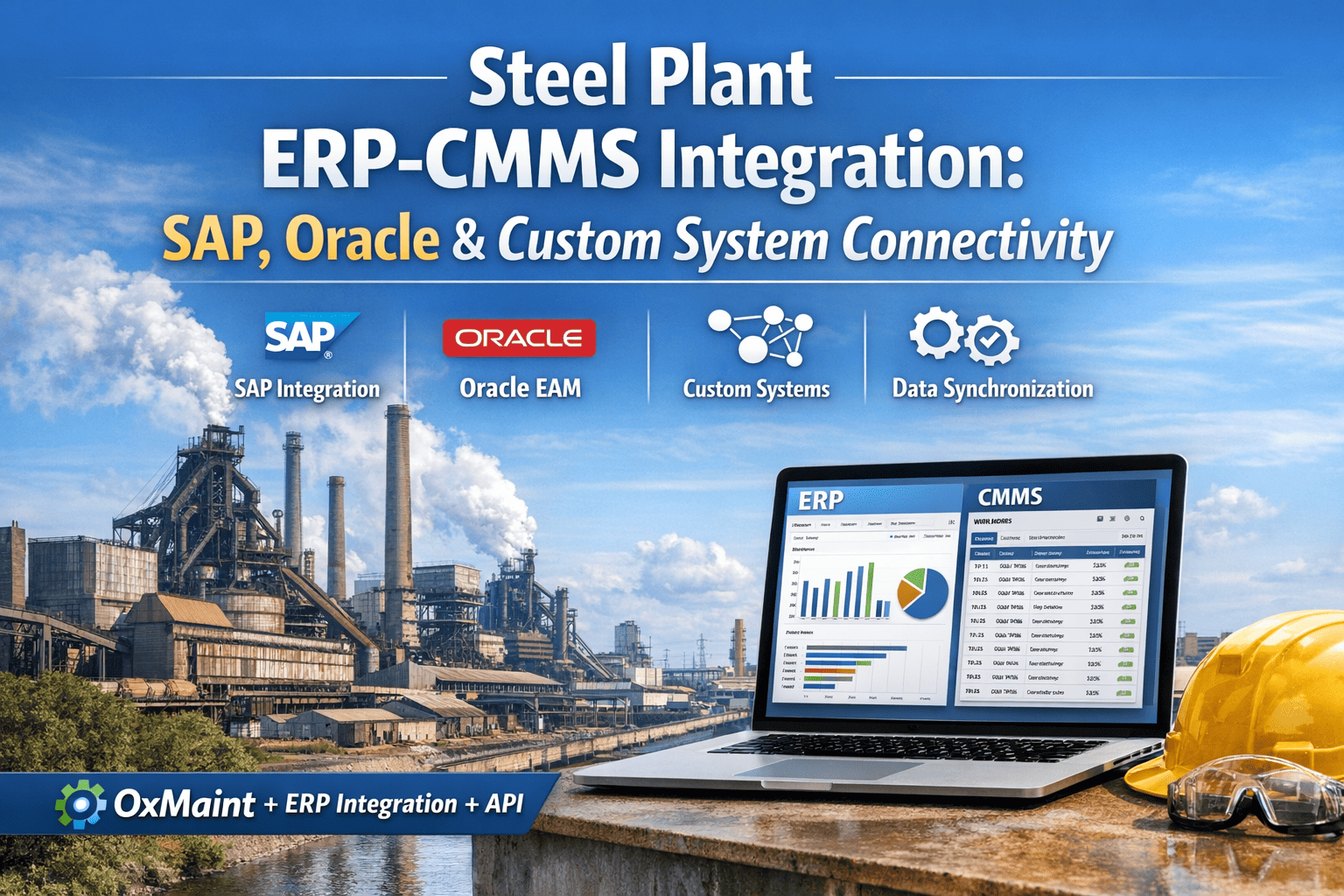
In the high-tonnage, asset-intensive arena of modern steel manufacturing, operational efficiency is governed by two distinct software layers: the corporate Enterprise Resource Planning (ERP) ledger and the shop-floor Computerized Maintenance Management System (CMMS). Historically, these platforms operated in isolated siloes, forcing maintenance planners to manually copy work orders, spare parts requisitions, and machine downtime logs from one system to the other. In 2026, this administrative disconnect represents a critical operational bottleneck, leading to delayed parts purchasing, inaccurate labor cost ledgers, and catastrophic equipment failures. Implementing a seamless steel plant ERP CMMS integration bridges this operational chasm, converting high-level business plans into real-time, trackable field work orders. By establishing a secure digital bridge between corporate finance and hands-on maintenance, US steel producers can automate inventory reconciliation, eliminate manual entry duplication, and achieve a continuous state of audit readiness. Sign Up Free to start optimizing your asset integrations today.
Synchronize Your Operations and Financial Ledgers
OxMaint provides primary metal manufacturers with a unified, mobile-first CMMS that integrates directly with legacy ERPs, accelerating procurement cycles and tracking exact asset maintenance costs.
Why Steel Plant ERP-CMMS Integration is Critical in 2026
Maintaining mill uptime requires tight coordination across massive electric arc furnaces, ladle refiners, and high-speed cold-rolling mills. When a critical component, such as a water-cooled furnace roof panel or a teeming crane hoist brake, shows signs of degradation, maintenance technicians must act instantly. Without an active integration, the process of checking spare parts availability in the central ERP warehouse, routing a requisition through purchasing managers, and scheduling the corrective work order can take hours—or even days. This administrative delay leaves the asset vulnerable, risking catastrophic breakdowns that can cost upwards of $20,000 per hour in lost productivity. Centralizing operational workflows in an integrated CMMS gives everyone from the corporate CFO to the frontline millwright a unified, live view of asset health, parts inventory levels, and labor allocations. Book a Demo to see our real-time integration workflows.
Top 7 ERP-CMMS Integrations for Steel Plants
SAP Plant Maintenance (PM) Integration
As the gold standard for global enterprise ledgers, SAP excels at financial tracking but can be difficult for shop-floor technicians to navigate. Connecting OxMaint CMMS to SAP PM allows technicians to use a clean, mobile interface to complete work orders while automatically updating SAP cost centers, maintenance histories, and labor logs.
Oracle Enterprise Asset Management (eAM)
Oracle handles large-scale capital planning and corporate purchasing. Our Oracle eAM integration ensures that when a technician marks a critical spare part—like an EAF transformer bus tube—as consumed in the CMMS, a secure API call instantly triggers a restock requisition within Oracle Procurement.
IFS Applications CMMS Integration
IFS is highly regarded in heavy, asset-intensive manufacturing sectors. Connecting IFS to a mobile CMMS synchronizes complex, multi-level asset structures and mechanical bills of material (BOM), ensuring that maintenance calendars align perfectly with active corporate production plans.
Microsoft Dynamics 365 Integration
Popular in mid-to-large steel processing facilities, Dynamics 365 manages corporate ledger and inventory tracking. The integration dynamically reconciles physical spare parts counts recorded during CMMS cycle counts with the central general ledger, eliminating year-end inventory write-offs.
AVEVA PI System Integration
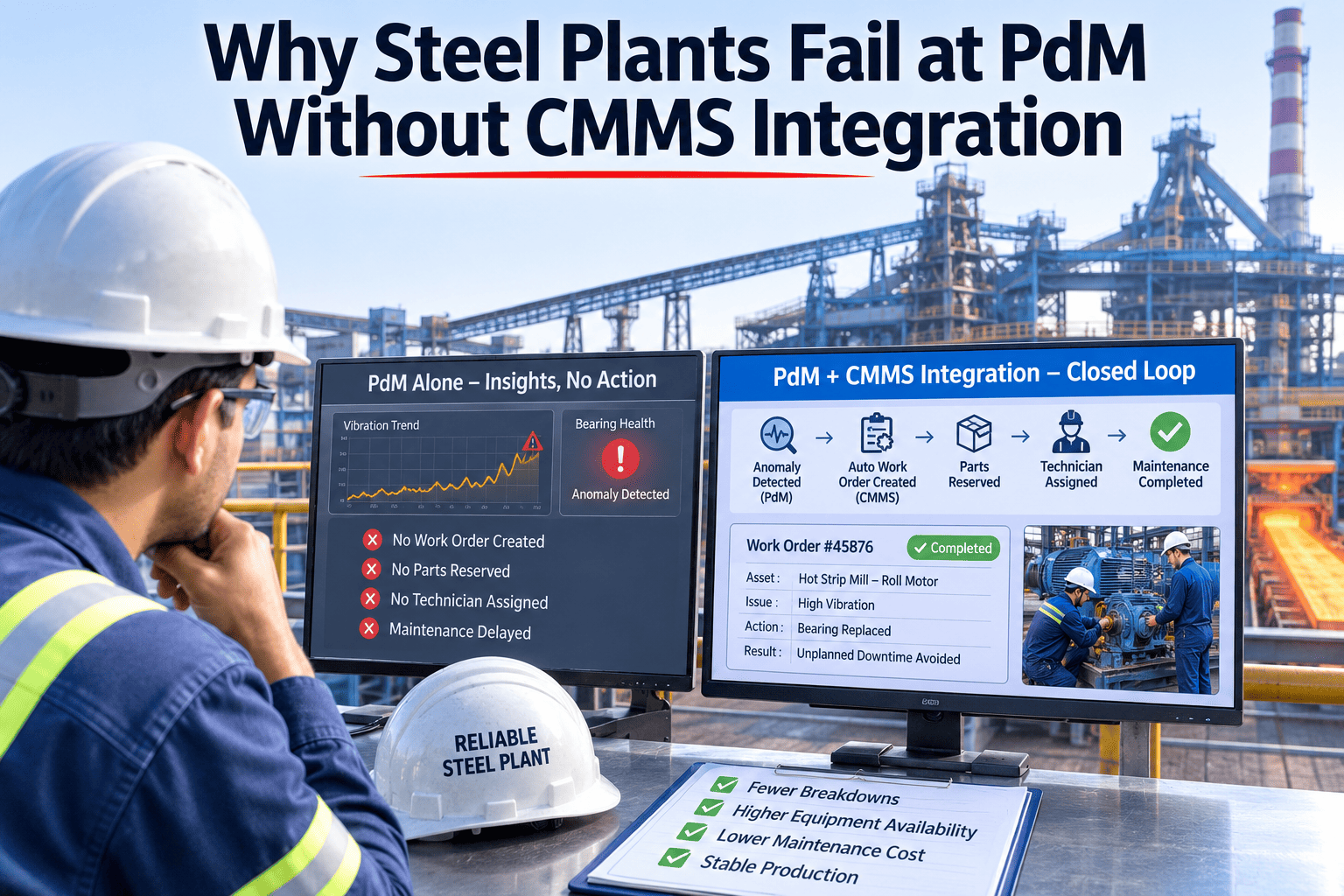
The AVEVA PI System acts as the high-speed operational technology (OT) data historian on the shop floor. Integrating AVEVA telemetry with OxMaint allows real-time thermal anomalies or high vibration alerts in ladle cranes to instantly generate high-priority preventative maintenance work orders.
OSIsoft PI Asset Framework (AF)
By mapping time-series sensor data from OSIsoft PI Asset Framework directly to CMMS asset records, steel mills transition from basic schedule-based maintenance to advanced predictive programs. The system maps raw PLC inputs to active equipment models to track precise degradation curves.
Honeywell PHD Process Database
Honeywell Process History Database (PHD) captures key process variables across furnace lines. Linking Honeywell PHD data to your CMMS ensures that high furnace operating temperatures or mechanical stress variables trigger automated calibration and inspection workflows for picking and reheating assets.
Chart A: ERP-CMMS Integration Data Flow Matrix
Achieving high operational reliability requires a clear understanding of how and when different data points synchronize between software systems. Different integration touchpoints utilize distinct transmission speeds (ranging from instant real-time telemetry to daily scheduled batches) and communication protocols to maintain system balance. The table below represents the standard data exchange parameters required to secure a reliable, high-performance integration within primary metal manufacturing environments.
| Data Object | Direction of Flow | Sync Frequency | Integration Method | Target Systems |
|---|---|---|---|---|
| Asset Structures & Hierarchies | ERP to CMMS (One-way) | Daily Scheduled Batch | REST API / JSON Payload | SAP PM, Oracle eAM, IFS |
| Telemetry & Sensor Alarms | OT Historian to CMMS | Real-time Stream | OPC UA / Webhook | AVEVA PI, OSIsoft, Honeywell |
| Spare Parts Inventory Counts | Bi-directional (Sync) | Hourly Delta Check | REST API / Secure SOAP | Dynamics 365, SAP, Oracle |
| Purchase Requisitions | CMMS to ERP (One-way) | Instant Trigger | REST API Gateway | SAP Ariba, Oracle Fusion |
| Work Order Costs & Labor Logs | CMMS to ERP (One-way) | Daily Close Batch | REST API / SFTP Flat File | Corporate General Ledger |
Note: Real-time telemetry protocols must pass through local plant industrial DMZs and OPC UA firewalls to prevent cybersecurity exposures within the corporate IT layer.
Chart B: Corporate IT-OT Integration Architecture Stack
Modern smart steel manufacturing relies on a layered technology stack to convert raw physical operations into verified corporate financial records. Telemetry from physical furnace sensors, ladle crane vibration PLCs, and wastewater discharge meters is captured at the operational technology (OT) edge and processed through high-speed historians. From there, the data streams into the CMMS execution layer where work orders and spare parts logs are generated. Finally, these work order close-outs and material costs sync up to the corporate ERP general ledger, providing executives with precise operating cost visibility. The stack diagram below represents the logical layers of a world-class IT-OT steel plant integration.
Corporate ERP & Financial Ledger (SAP PM / Oracle Fusion)
Asset capitalization rules, company-wide purchasing budgets, general ledger cost-center mapping, and enterprise-level resource planning.
OxMaint CMMS execution Layer (Mobile-first Field Platform)
Preventative maintenance scheduling, mobile work order checklists, QR code scans, spare parts stockroom tracking, and corrective action workflows.
OT Data Historian & SCADA Layer (AVEVA PI / OSIsoft / Honeywell)
High-speed time-series sensor databases, alarm management interfaces, specific energy consumption tracking, and telemetry event archiving.
Shop-Floor Physical Asset Layer (EAF, Ladle Cranes, Reheat Furnaces)
Physical machine components equipped with vibration transducers, thermocouples, pressure sensors, hoist limit switches, and PLC transmitters.
Note: Standardizing on REST APIs and OPC UA protocols across these four layers minimizes integration overhead and guarantees reliable data delivery.
Section 9: Procurement Lifecycle & Supply Chain Alignment
The direct alignment between plant maintenance actions and the corporate procurement lifecycle represents a primary driver of cost savings in integrated steel manufacturing. In typical, unintegrated facilities, spare parts management is a persistent source of friction. Maintenance crews often keep unauthorized "squirrel stocks" of expensive components—such as specialized hydraulic valves or motor bearings—in shop-floor lockers because they do not trust the corporate ERP's inventory records. Conversely, purchasing agents frequently delay ordering critical parts because they lack context regarding the urgency of a scheduled preventative maintenance work order. When your mobile CMMS is integrated directly with corporate purchasing systems, this friction is eliminated. Stockroom counts are updated instantly via barcode or QR code scans on technician mobile devices, triggering automatic purchase requisitions when stock falls below defined minimum reorder points. This automated flow maintains optimal warehouse levels, reduces expensive expedited shipping costs, and ensures that the right parts are on hand before major planned outages begin.
Section 10: Cybersecurity & OPC UA Industrial Firewalls
As steel manufacturing plants transition to interconnected IT-OT systems, securing the boundary between shop-floor automation and corporate databases is paramount. Industrial control systems (ICS)—including PLCs, SCADA networks, and high-speed data historians—operate under strict deterministic parameters and cannot tolerate network latency or unauthorized traffic. Integrating these critical systems with cloud-hosted CMMS platforms or corporate ERP servers requires a robust, defense-in-depth cybersecurity architecture. Standard implementations route all telemetry data through a secure Demilitarized Zone (DMZ) at the plant boundary, utilizing unidirectional data diodes or hardened OPC UA firewalls. This setup ensures that while the CMMS API can safely ingest sensor values, vibration thresholds, and temperature limits to trigger work orders, corporate IT systems are completely prevented from initiating control actions or writing data back to the shop-floor network. By enforcing strict certificate-based authentication and secure JSON data payloads, steel producers achieve complete operational integration without exposing critical production assets to external security risks.
"Before we integrated our shop-floor maintenance operations with our corporate SAP PM ledger using OxMaint, our spare parts supply chain was constantly out of sync. Technicians spent hours searching through paper warehouse binders, and we faced expensive emergency shipping costs when critical reheat furnace sensors were out of stock during outages. Centralizing our daily work order checklists in OxMaint and sync'ing the data back to SAP via their REST API has completely transformed our operational speed. Our average parts requisition lag dropped from 48 hours to under 30 minutes, and our planners have saved hundreds of manual data-entry hours. We now have absolute operating cost visibility, and our emergency parts spend has dropped by 35% in the first year."
Ready to Connect Your Shop Floor to Your Boardroom?
Join the forward-thinking American steel mills using OxMaint to automate ERP integrations, track real-time asset telemetry, and reduce maintenance costs.
Frequently Asked Questions
The integration eliminates the need for planners to manually copy frontline technician hand-written logs into SAP's ledger.
OxMaint handles the mobile data entry in the field and syncs completed work orders directly, saving hours of office typing weekly.
Connecting industrial historians requires routing API requests through a secure plant DMZ using hardened OPC UA firewalls.
This unidirectional flow allows the CMMS to ingest sensor data without opening up the local control network to external security risks.
Yes, when parts counts drop below defined reorder points in OxMaint, it triggers an automated purchase requisition in Oracle eAM.
This dynamic link eliminates manual ordering paperwork and guarantees that safety-critical spares are on hand before planned shutdowns.
Yes, linking safety-critical work orders to Dynamics 365 provides auditors with a single, unbroken chain of asset-level integrity evidence.
It proves that mandatory inspections were completed on schedule and that matching parts costs were properly reconciled in the ledger.
Critical spare parts inventories are sync'd via hourly delta batches to prevent stockroom discrepancies during busy shifts.
This frequency ensures that both corporate purchasing agents and shop-floor millwrights see identical, accurate inventory levels.
The integration synchronizes IFS parent-child engineering assets directly with the CMMS to keep mechanical bills of material aligned.
Technicians can scan QR codes on furnace components to instantly see matching spare parts numbers without opening legacy CAD files.
A bidirectional sync ensures that central warehouse purchases and frontline tool-crib consumption records stay identical.
This setup prevents double-ordering and eliminates the "squirrel stocks" that technicians keep when inventory logs are out of sync.
Honeywell PHD streams key parameters like furnace thermocouple outputs or pump discharge pressures directly to OxMaint's gateway.
If a process variable drifts past a defined safety limit, the platform instantly generates a corrective preventative maintenance work order.
Digitize and Integrate Your Steel Plant Operations Today
Join leading American metal producers using OxMaint to bridge the operational gap between frontline work and financial planning.
.png)
.png)