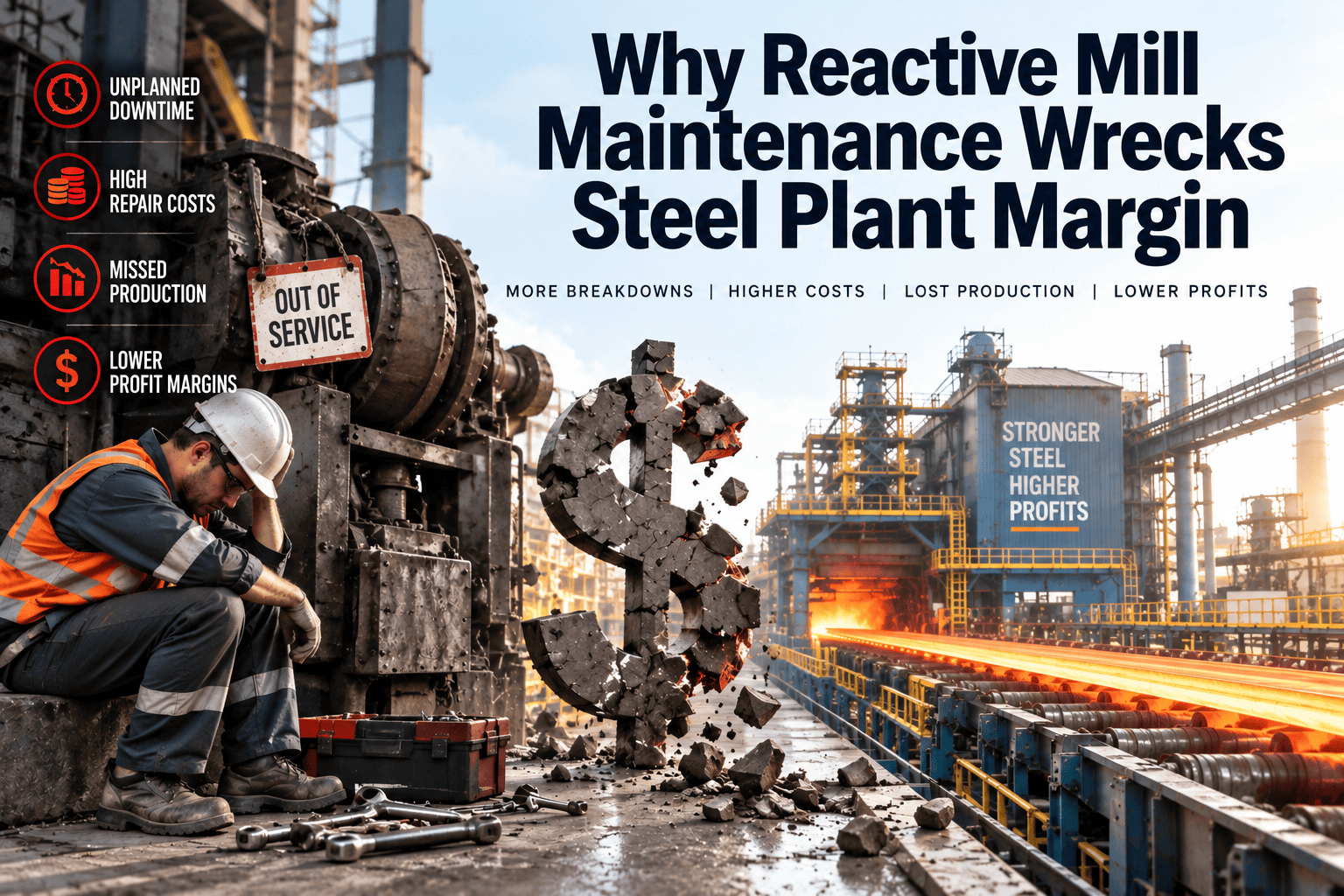
Rolling mills run on tight margin math — a few percentage points of yield, a few hours of uptime, a few tenths of a millimeter of gauge tolerance separate a profitable coil from a downgraded one. When maintenance stays reactive instead of planned, that margin bleeds out in places most plant managers never trace back to their root cause: a bearing that failed instead of being caught, a work roll changed mid-campaign instead of on schedule, a hydraulic AGC system that drifted for weeks before anyone noticed the gauge deviation. Steel producers running connected maintenance software are increasingly replacing that firefighting cycle with condition-based intervention timed to the mill's actual wear curve.
Reactive maintenance isn't a maintenance problem. It's a margin problem.
Every unplanned mill stoppage carries a hidden multiplier: lost rolling hours, scrapped or downgraded coils already in process, overtime labor to recover the schedule, and expedited freight on parts that should have been staged weeks earlier. Reactive maintenance doesn't just cost repair dollars — it quietly compresses the margin on every ton the mill produces around the failure.
The five places reactive mill maintenance quietly erodes margin
A single unplanned stoppage on a hot strip or cold rolling mill rarely shows up as one clean line item. It fragments across production, quality, labor, and procurement — which is exactly why it's so hard for plant leadership to see the true cost until someone maps it end to end.
Why reactive maintenance keeps winning on the mill floor
Most rolling mills don't choose reactive maintenance on purpose. It's the default state that calendar-based PM and paper work orders drift toward once production pressure takes priority over inspection discipline.
Calendar PM ignores actual wear rate
Work roll changes, bearing inspections, and hydraulic filter swaps scheduled on fixed intervals get pulled forward "just in case" during high-alloy campaigns and pushed back during easy schedules. Neither extreme matches the roll's real wear curve, so the mill either changes rolls too early and eats unnecessary downtime, or too late and rolls out a bearing failure mid-pass.
Condition data exists but never reaches a work order
Modern mill stands already generate vibration, oil temperature, AGC hydraulic pressure, and motor current data. On most plants that data sits in a historian or SCADA screen that operators glance at, but it never automatically becomes a prioritized, assigned maintenance task — so early warning signs get seen and then forgotten.
Spares aren't staged against the failure that's coming
When a bearing, chock liner, or backup roll bushing fails without warning, the plant discovers the spare is on backorder or sitting in the wrong warehouse. Emergency freight and premium sourcing turn a four-hour repair into a two-day stoppage, and that lag compounds every other cost on this page.
Reactive firefighting vs. condition-based mill maintenance
The operational difference between the two approaches shows up clearest side by side — not in the repair itself, but in everything surrounding it.
| Dimension | Reactive maintenance | Condition-based / planned maintenance |
|---|---|---|
| Work roll changes | Triggered by visible surface defect or gauge failure | Triggered by wear trend against campaign tonnage target |
| Bearing & chock inspection | After audible noise or vibration alarm trips | Scheduled against vibration RMS trend and oil analysis |
| Spare parts posture | Emergency sourcing, premium freight | Min/max stock tied to predicted failure window |
| Labor model | Overtime, weekend callouts, schedule scrambling | Planned outage windows, standard shift coverage |
| Quality impact | In-process coils often scrapped or downgraded | Changeover timed between orders, minimal WIP loss |
| Documentation | Paper logs, inconsistent failure records | Digital work order history tied to each asset |
What reactive maintenance actually costs a rolling mill per year
The formula below isolates the components plant controllers most often miss when they price out "just" the repair line.
See what reactive maintenance is actually costing your mill
Walk through your stand-level asset hierarchy and get a plant-specific breakdown of avoidable downtime, scrap, and overtime cost.
Four steps to move a rolling mill off reactive maintenance
Plants don't jump from reactive to fully predictive overnight. The transition happens in a sequence that builds trust in the data before automating decisions on top of it.
Build the stand-level asset register
Break each mill stand into trackable components — work rolls, backup rolls, chocks, bearings, AGC hydraulics, motor and gearbox — with individual maintenance and failure history attached.
Route existing sensor data into work orders
Connect vibration, oil temperature, and hydraulic pressure feeds already on the mill to automated alert thresholds that generate a prioritized, assigned work order instead of a dashboard notification nobody acts on.
Replace fixed intervals with wear-trend triggers
Shift work roll changes and bearing inspections from a fixed calendar to cumulative tonnage and condition trend, cutting unnecessary changeovers while catching real wear earlier.
Tie spares inventory to the predicted failure window
Set reorder points for bearings, chock liners, and backup roll components against the maintenance plan's forecast — not last year's usage average — so the part is staged before the work order fires.
Running this shift inside OxMaint
OxMaint gives rolling mill maintenance teams one system to move from calendar guesswork to condition-based execution, without replacing the sensors and control systems already on the mill.
Stand-level asset hierarchy
Model every stand, roll, chock, and bearing as an individual tracked asset with its own maintenance and failure history, drillable from plant KPIs down to one bearing.
Condition-triggered work orders
Turn vibration, temperature, and pressure threshold breaches into automatically assigned, prioritized work orders instead of alerts that sit unread.
Mobile inspection & digital sign-off
Replace paper roll-change logs and inspection sheets with mobile checklists, photo evidence, and meter readings tied directly to each asset's history.
Spares inventory tied to the maintenance plan
Set min/max thresholds on bearings, chock components, and hydraulic parts that follow the predicted failure window, with auto-generated purchase requests when stock runs low.
Signs your rolling mill is still running on reactive maintenance
Reactive rolling mill maintenance: frequently asked questions
What counts as reactive maintenance on a rolling mill?
Reactive maintenance is any repair or component change triggered after a failure or visible defect — a work roll pulled after strip marking appears, a bearing replaced after it seizes — rather than before, based on condition trend or wear plan.
How is reactive maintenance different from calendar-based PM?
Calendar PM at least schedules intervention in advance, but on a fixed time or tonnage interval that ignores actual wear. It reduces catastrophic failures compared to pure reactive maintenance but still causes unnecessary early changeovers and misses accelerated wear between intervals.
What's the fastest first step to reduce reactive maintenance?
Start by routing the vibration, temperature, and pressure data your mill already collects into automated, prioritized work orders in a CMMS — most plants have the sensor data already; what's missing is the automated path from signal to assigned task.
Does moving to condition-based maintenance mean fewer inspections?
No — it means inspections and interventions are timed to actual risk instead of a fixed calendar. Low-wear periods see fewer unnecessary changeovers, while accelerated wear periods get caught earlier than a fixed interval would allow.
How long does a mill CMMS rollout take?
Most rolling mill CMMS rollouts take 8-14 weeks to build the stand-level asset register, connect sensor feeds, and configure alert thresholds, with a full return typically realized within 12-15 months. Book a walkthrough at calendly.com/oxmaintapp/30min.
Stop losing margin to unplanned mill stops
See how OxMaint turns your existing stand sensor data into a working condition-based maintenance program — asset hierarchy and alert setup included in your 14-day free trial.
Free 14-day trial · No credit card required
.png)