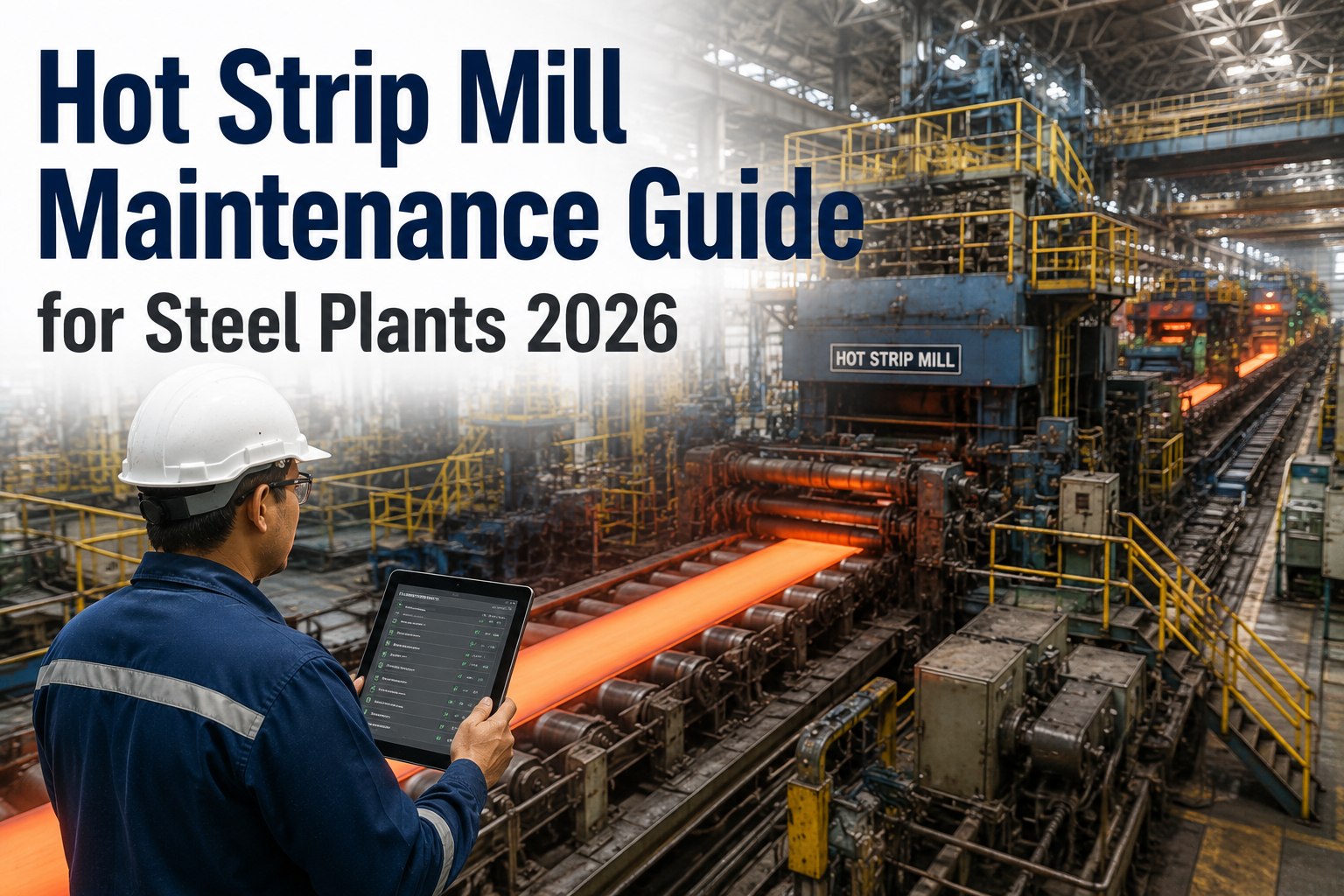
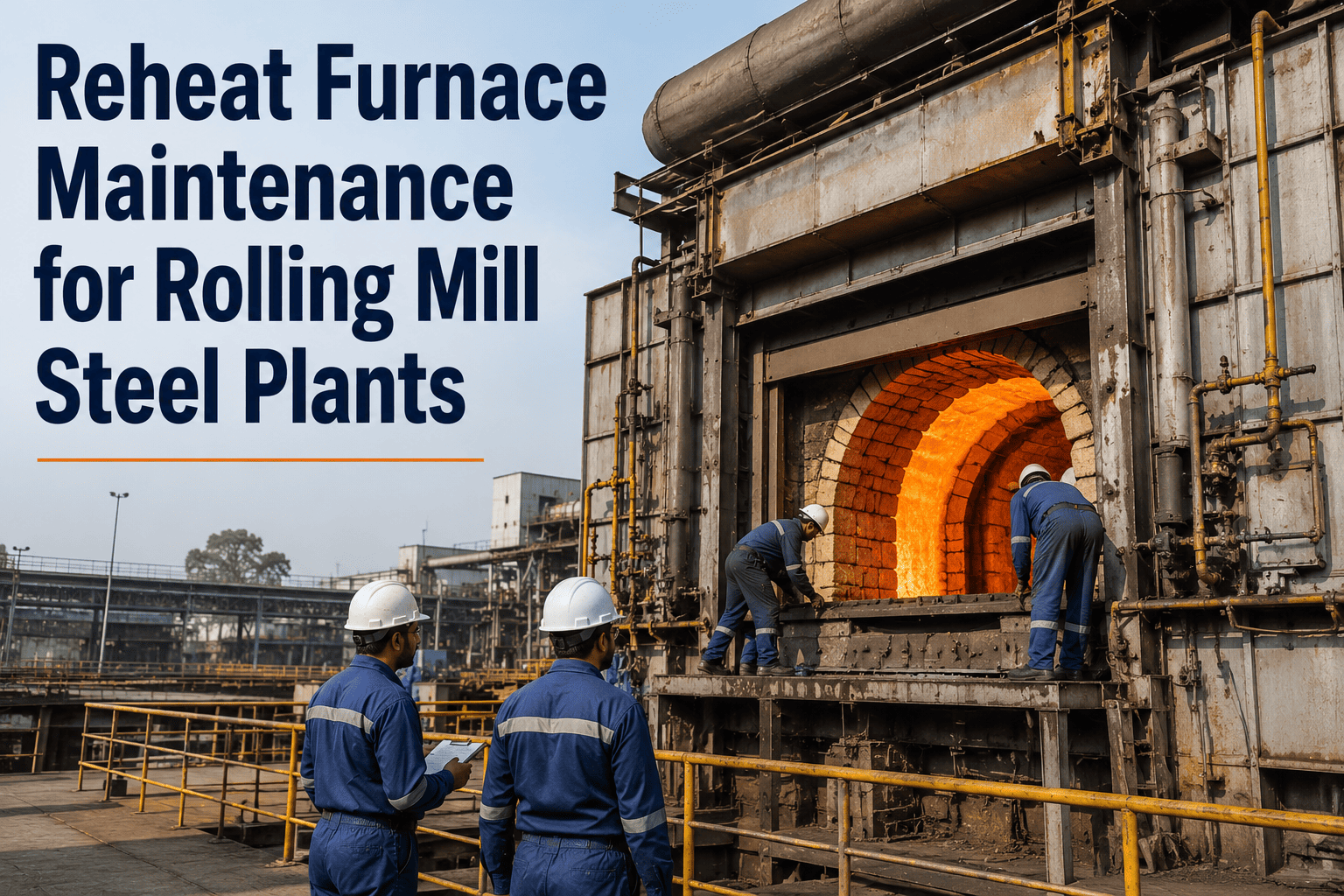
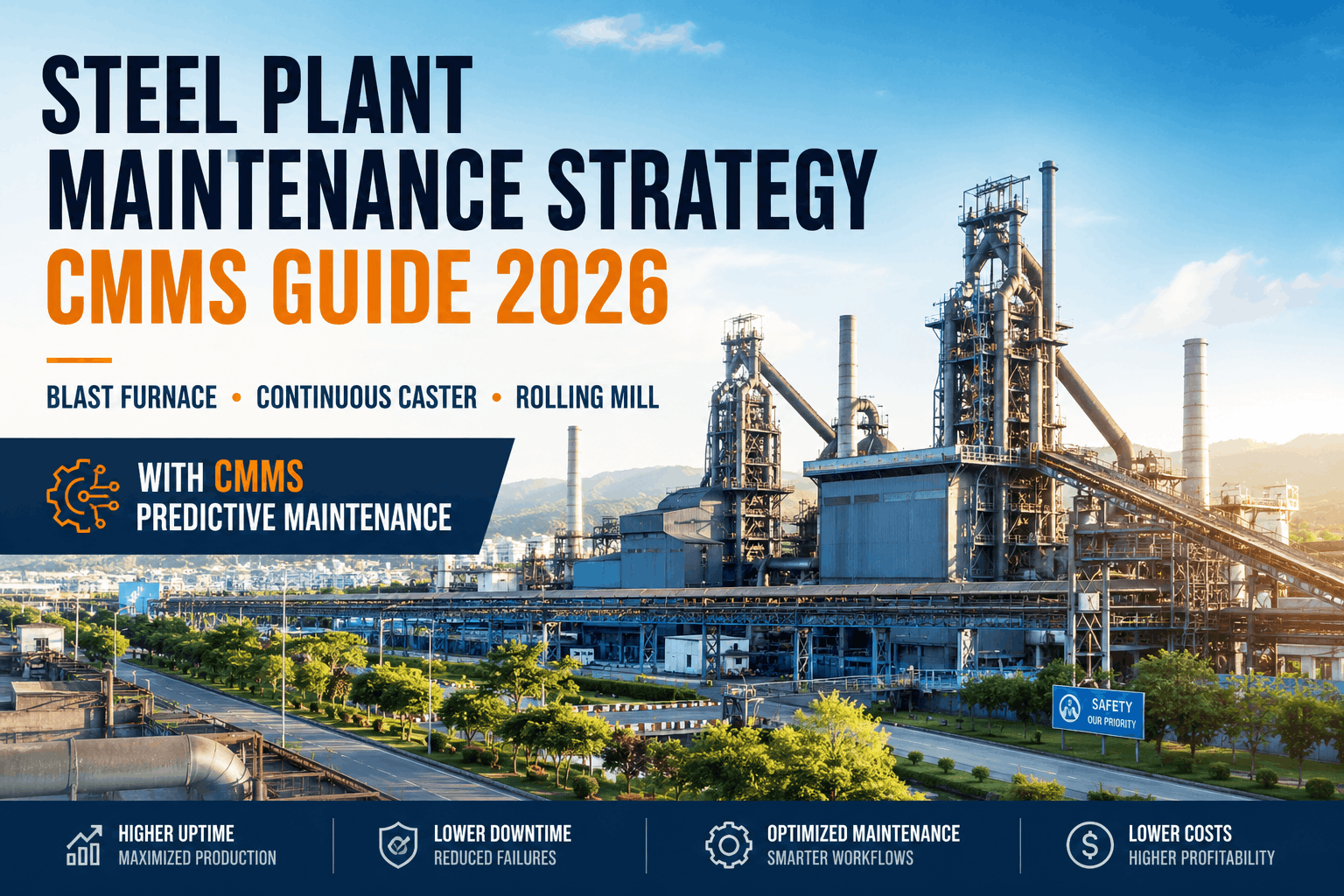
A heavy plate mill in eastern India was rejecting 340 tonnes of plate every month for flatness alone, and nobody could say why. Rolling parameters were checked and rechecked, operators were retrained, and the losses kept repeating heat after heat. It took a routine bearing vibration check on the hot leveler to find the real answer: one roll bearing had been drifting out of alignment for eleven weeks with nobody tracking it. The fix cost a shift of downtime. The plates saved that month alone were worth ten times that. Plate mills do not fail the way strip or bar mills do — they fail quietly, in the gap between one reversing pass and the next, which is exactly why a structured plate mill maintenance program matters more here than almost anywhere else in the plant.
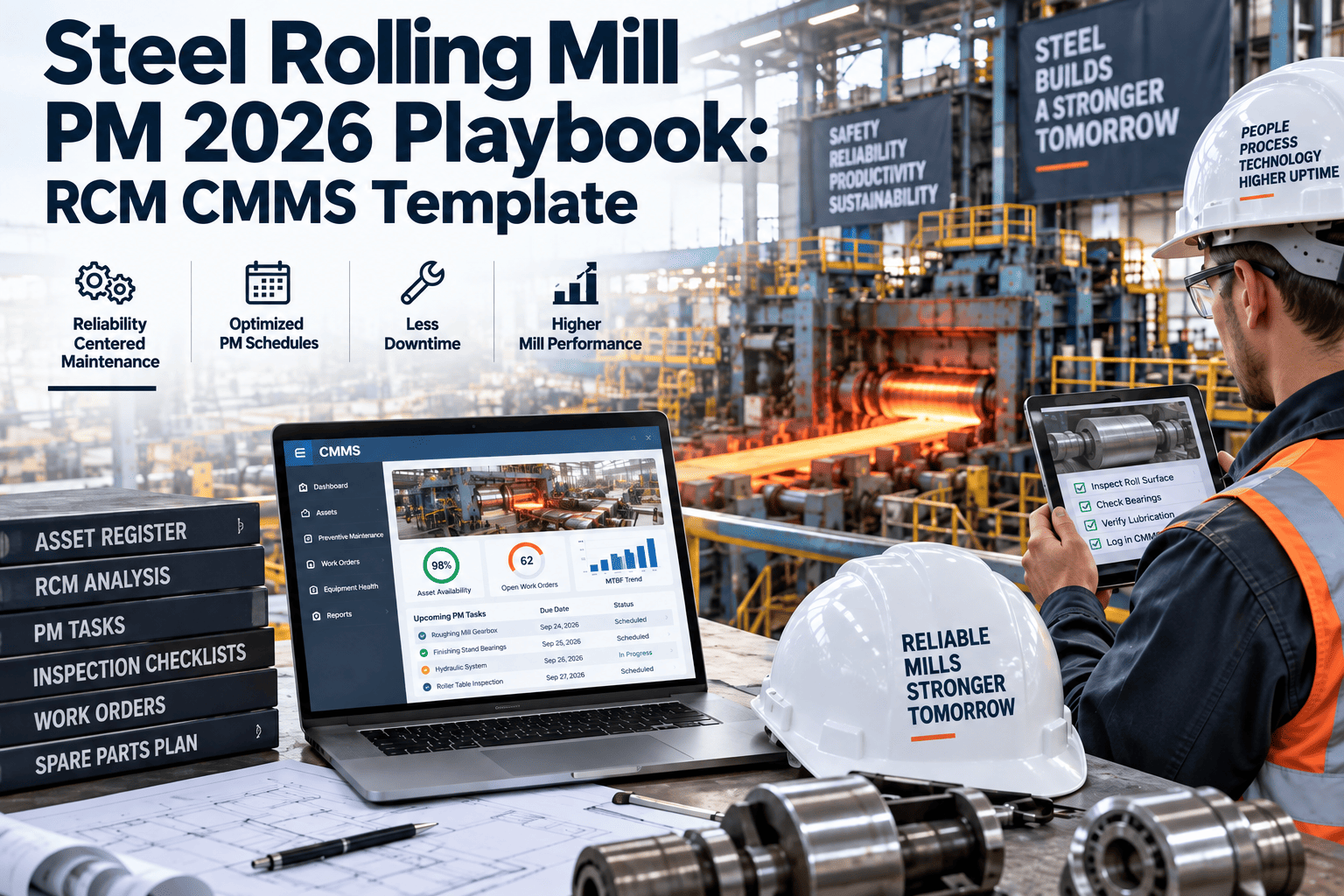
Steel Plant CMMS Guide 2026
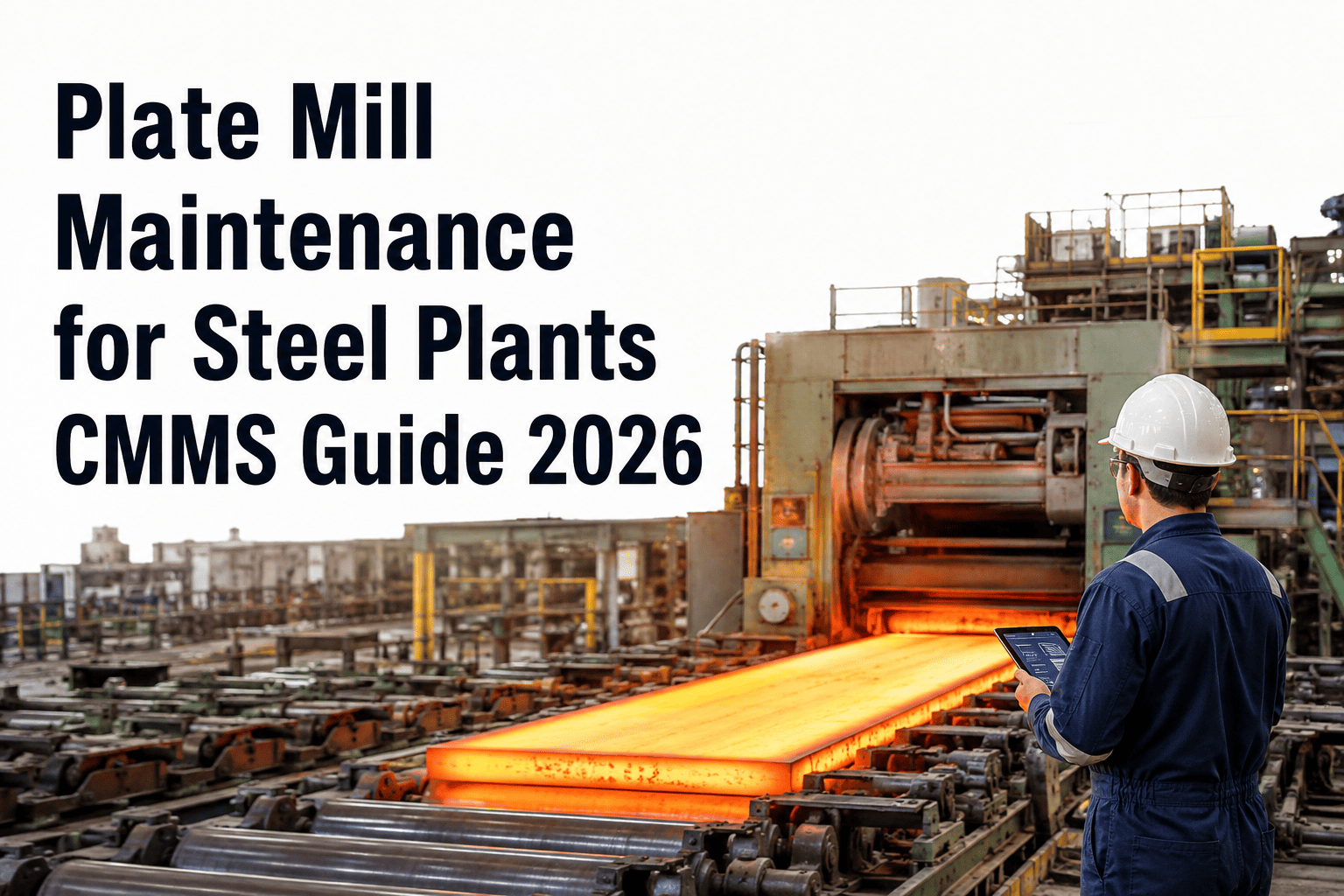
Plate Mill Maintenance for Steel Plants
Heavy roll change discipline meets precision hydraulics. Here is how reversing plate mills stay reliable, pass after pass.
Capacity Lost To Weak Roll Shop Discipline
Typical Roll Change Time Reduction
Of Flatness Rejects Traced To Equipment Drift
<10 mo
Typical PM Program Payback Period
Why Plate Mills Operate on Borrowed Time
A hot strip mill runs continuously and forgives small drifts because thousands of coils average out the noise. A plate mill does not get that luxury. Every slab is rolled in a handful of heavy reversing passes on a 4-high stand, so one worn chock, one sticky side guide, or one misaligned leveler roll shows up directly on the next plate — as a reject, a delay, or a safety incident on the roller table.
Rolling forces on modern reversing plate stands run up to 120 MN, which turns even minor bearing or spindle wear into large, fast-compounding damage. Downstream, the hot plate leveler and accelerated cooling system need near-precision alignment to hold flatness and metallurgy — margins that a calendar-only PM schedule simply cannot protect.
60%
Of flatness and dimensional rejects on plate mills trace back to slow equipment drift — bearing wear, roll misalignment, or nozzle blockage — that a tonnage-based maintenance program would have caught weeks earlier.
Stop losing plates to drift nobody is tracking. Book a demo and see how plate mills gain full visibility into every reversing pass.
The Anatomy of Plate Mill Maintenance
Effective plate mill maintenance is not one checklist — it is layered visibility from the whole mill down to a single bearing. Here is how a properly structured program is built:
The Core Design Principle
Every reading, alert, or checklist item should answer a question that leads to action. If a data point cannot be tied to a decision — change the roll, adjust the guide, stop the campaign — it does not belong on the mill floor screen.
L1
Mill Overview
Live campaign status, tonnes rolled since last roll change, current stand load, overall equipment availability
L2
Section Breakdown
Roughing stand, vertical edger, roller tables, ACC cooling, hot leveler, and shearing line, each with live status and open alerts
L3
Equipment Detail
Chock bearing temperature, spindle alignment, leveler roll vibration, ACC header pressure, gearbox oil condition
L4
Drift Detection
Alerts when readings deviate from the baseline signature for that asset, well before the drift becomes a reject or a stoppage
L5
Reliability Intelligence
The Bottom Line: Roll change time trends, campaign utilisation, first-pass flatness yield, and cost per tonne rolled
Common mistake: building dashboards that show raw readings without a baseline or a threshold. A bearing temperature number means nothing without knowing what normal looks like for that exact asset.
Where Plate Mill Reliability Actually Breaks
Theory becomes clear through real patterns. Here are four common ways plate mills lose reliability — and how structured monitoring catches each one before it becomes an expensive habit.
Initial Situation
Average roll change time had crept from 38 to 61 minutes over a year, accepted as "just how the mill runs now." No one had a baseline to compare against.
Discovery Path
1
What did the roll change log show?
Change times varied widely between crews with no clear pattern by shift
2
What did chock removal data reveal?
Chock bolt torque was inconsistent, with several bolts reused well past their rated cycles
3
Why were worn bolts still in use?
No tracked replacement schedule existed; bolts were reused until visibly damaged
4
What effect did this have on changeover?
Worn threads required extra torqueing passes, adding 15-20 minutes per change
5
What was the root cause?
FINDING: No cycle-based replacement tracking for chock hardware, so wear accumulated silently until it slowed every changeover
Actions Taken
Immediate: Standard bolt torque and replacement checklist issued to all roll change crews
CMMS Enhancement: Cycle-based replacement tracking added for all chock hardware
Systemic Fix: Roll change time added as a shift-visible KPI with crew-level comparison
Outcome
Average roll change time fell back under 40 minutes within two campaigns, recovering meaningful rolling hours every week.
Initial Situation
Flatness rejects had climbed steadily for months. Every rejected batch was blamed on slab quality or rolling temperature.
Discovery Path
1
What did reject data show by cause code?
Flatness rejects were rising even on plates from consistent, high-quality slabs
2
What did leveler roll alignment logs show?
No alignment log existed; the leveler had not been surveyed in over a year
3
What did a bearing vibration check find?
One roll station showed a slow vibration drift building over eleven weeks
4
What was that station doing to the plate?
The misaligned roll was applying uneven pressure across plate width during levelling
5
What was the root cause?
FINDING: No routine vibration monitoring on leveler roll stations, so a slow bearing drift went undetected for weeks
Actions Taken
Immediate: Leveler roll realigned during the next scheduled campaign-end stop
CMMS Enhancement: Monthly vibration checks added for every leveler roll station
Systemic Fix: Flatness reject rate linked to leveler alignment history for faster future root-causing
Outcome
Flatness rejects dropped roughly 70% the following month, recovering several hundred tonnes of first-pass yield.
Initial Situation
Mechanical property test failures were rising for one plate grade. Metallurgy assumed chemistry variation; chemistry data showed nothing unusual.
Discovery Path
1
What did cooling rate data show?
Cooling rate varied noticeably across plate width on affected heats
2
What did header pressure trends reveal?
Pressure was uneven across cooling zones, with no flow check ever performed
3
What did a nozzle inspection find?
Several ACC nozzles were partially blocked with mill scale buildup
4
Why had this gone unnoticed?
Nozzle condition was never on any inspection checklist for the cooling system
5
What was the root cause?
FINDING: No scheduled nozzle-flow inspection on the ACC system, letting blockages build up unnoticed for months
Actions Taken
Immediate: Full nozzle cleaning and flow verification across all cooling zones
CMMS Enhancement: Monthly nozzle-flow checks added with zone-wise pressure trending
Systemic Fix: Cooling uniformity linked to mechanical property test results for early warning
Outcome
Mechanical property failures on the affected grade returned to normal levels within one production cycle.
Initial Situation
A key customer flagged width variation on consecutive plate deliveries before the mill's own quality checks caught it.
Discovery Path
1
What did width measurement records show?
Width drifted gradually across a single production run rather than jumping suddenly
2
What did edger hydraulic response data reveal?
Gap control response time had slowed compared to the baseline signature
3
What did a roll surface scan find?
Edger roll wear had exceeded the recommended limit without triggering any alert
4
Why was wear not flagged earlier?
Roll wear was checked visually rather than measured against a defined threshold
5
What was the root cause?
FINDING: No measured wear threshold for edger rolls, so gradual degradation was invisible until a customer caught it
Actions Taken
Immediate: Edger roll replaced ahead of the next scheduled campaign
CMMS Enhancement: Measured wear thresholds set with automatic replacement alerts
Systemic Fix: Width variance tracked against edger wear data to catch drift before shipment
Outcome
Width variance complaints stopped, and the customer relationship was protected without further escalation.
See Every Plate Mill Asset Before It Drifts
Oxmaint connects roughing stand, leveler, and ACC cooling data into one reliability view your roll shop can act on before rejects happen.
Critical KPIs for Plate Mill Maintenance
Not every reading matters equally. These are the metrics that actually drive decisions on a reversing plate mill:
Roughing Stand
Reversing Mill Metrics
- Roll change time (minutes)
- Chock bearing temperature
- Spindle alignment deviation
- Rolling force trend
- Tonnes since last roll change
Vertical Edger
Width Control Metrics
- Roll wear vs. threshold
- Hydraulic gap response time
- Width variance per run
- Guide alignment deviation
Hot Leveler
Flatness Control Metrics
- Roll station vibration trend
- Flatness reject rate
- Calibration deviation
- Bearing temperature trend
ACC Cooling
Cooling System Metrics
- Header pressure by zone
- Nozzle flow uniformity
- Cooling rate variance
- Mechanical property pass rate
Shearing Line
Finishing Line Metrics
- Blade gap measurement
- Hydraulic clamp condition
- Crop-end alignment
- Dimensional reject rate
Reliability
Mill-Wide Metrics
- Campaign utilisation rate
- Mean time between failures
- First-pass yield
- Cost per tonne rolled
Plate Mill Maintenance Implementation Roadmap
Structured plate mill maintenance is built in stages. Here is the sequence that delivers results without disrupting production:
01
Baseline Assessment
Map every stand, roll, guide, and cooling zone; document current roll change times, reject rates, and campaign lengths
02
Monitoring Strategy
Define which bearings, spindles, and rolls need vibration or temperature sensors; prioritise the 20% of assets driving 80% of downtime
03
Data Infrastructure
Connect Level 1 and Level 2 automation and PLC data into a shared CMMS so readings and work orders live in one place
04
Tonnage-Based PM
Replace calendar-only schedules with intervals tied to tonnes rolled, roll change count, and campaign length
05
Crew Training
Train roll shop and leveler crews on reading dashboards, responding to alerts, and logging changeover data consistently
06
Continuous Review
Review every campaign-end stop for what drifted and why; revise thresholds quarterly as baseline data matures
Building a Reliability-First Culture on the Plate Mill
Dashboards and checklists are tools. Culture decides whether crews actually use them. These are the elements that make plate mill reliability stick:
Visible Metrics
Display live roll change time and campaign status at the mill floor. What crews can see, they manage.
Clear Targets
Set specific targets like "roll change under 40 minutes" rather than vague goals like "work faster."
Recognition
Celebrate the fastest clean roll change or the shift with zero flatness rejects, publicly and often.
Idea Capture
Give roll shop crews a channel to flag wear and drift they notice daily, before it becomes a work order.
Regular Reviews
Weekly reviews between production, maintenance, and quality; monthly trend reviews at management level.
Integrated KPIs
Tie reliability metrics to shift performance so maintenance discipline becomes everyone's job, not one department's.
Frequently Asked Questions
How often should plate mill rolls be changed?
Roll change frequency depends on tonnage rolled and product grade rather than a fixed calendar. Most mills track roll surface wear and rolling force trends to decide the change point.
Book a demo to see tonnage-based roll change triggers.
What causes most flatness rejects in plate mills?
Hot leveler roll misalignment is the most common cause, followed by uneven ACC cooling across plate width. Both drift slowly, so vibration and flow monitoring catch them before rejects pile up.
Can a CMMS integrate with existing plate mill automation?
Yes, Oxmaint connects to Level 1 and Level 2 automation systems and PLC data through standard industrial protocols.
Sign in to see supported integrations for your mill.
How much downtime does poor plate mill maintenance cause?
Industry data points to 12-18% annual capacity loss at plants with weak roll shop and cooling bed maintenance, driven mainly by unplanned roll change delays and flatness rework.
What is the fastest way to improve plate mill reliability?
Standardising roll change procedures usually delivers the fastest result, since roll change time directly eats into rolling hours on every single shift.
Keep Your Plate Mill Rolling, Not Waiting
Oxmaint gives your roll shop, leveler, and cooling teams one shared view of asset health, built for the reality of reversing mill operations.