SAP S/4HANA Cloud vs On-Premise for Maintenance and CMMS Integration
Choosing between SAP S/4HANA Cloud and on-premise is no longer just an IT decision—it shapes how your maintenance organization will operate for the next decade. Cloud delivers faster deployment, standardized processes, and predictable subscription costs. On-premise delivers customization depth, direct data control, and integration flexibility complex industrial operations often demand. Both can connect to a CMMS. Both can power AI-driven analytics. The right choice depends on factors most architects evaluate too narrowly. This guide breaks down the real trade-offs maintenance leaders face when committing to either path.
DEPLOYMENT DECISION
Cloud or On-Premise? Your Maintenance Future Depends On It.
Both deliver SAP-driven maintenance management. Each shapes integration, customization depth, and AI analytics differently—for years to come.
6–12moCloud go-live
100%On-prem control
BothCMMS-ready
The Strategic Choice Behind Every SAP Maintenance Project
The cloud-versus-on-premise debate for SAP looks like an IT decision on the surface, but it's a maintenance strategy decision underneath. The deployment model determines how easily you can extend SAP Plant Maintenance with bespoke workflows, how your CMMS connects to enterprise data, whether AI analytics runs centrally or at the plant edge, and how much your team controls upgrade timing. With SAP ECC mainstream support ending in 2027, most manufacturers are forced to pick a lane—Public Cloud, Private Cloud (via RISE with SAP), or traditional on-premise—and each path has multi-year consequences for maintenance operations.
At a Glance: What Each Deployment Optimizes For
CLOUD
S/4HANA Public & Private Cloud
Speed of deployment
Predictable subscription cost
Auto-updates & patches
Standardized best practices
Lower IT operational burden
VS
ON-PREMISE
Traditional S/4HANA Deployment
Full customization depth
Direct data residency control
Upgrade timing on your terms
Deep third-party integration
Owned infrastructure choices
Neither answer is universally right. A specialty chemical plant running heavily customized maintenance workflows will struggle inside the Public Cloud's standardization guardrails. A multi-site retail operation onboarding facilities every quarter will burn out maintaining 30 customized on-premise instances. The deployment model has to match the maintenance reality—not the other way around. Teams working through this decision can sign up free to map their SAP integration approach against either deployment model and see which delivers faster value.
Side-by-Side: How the Two Architectures Differ
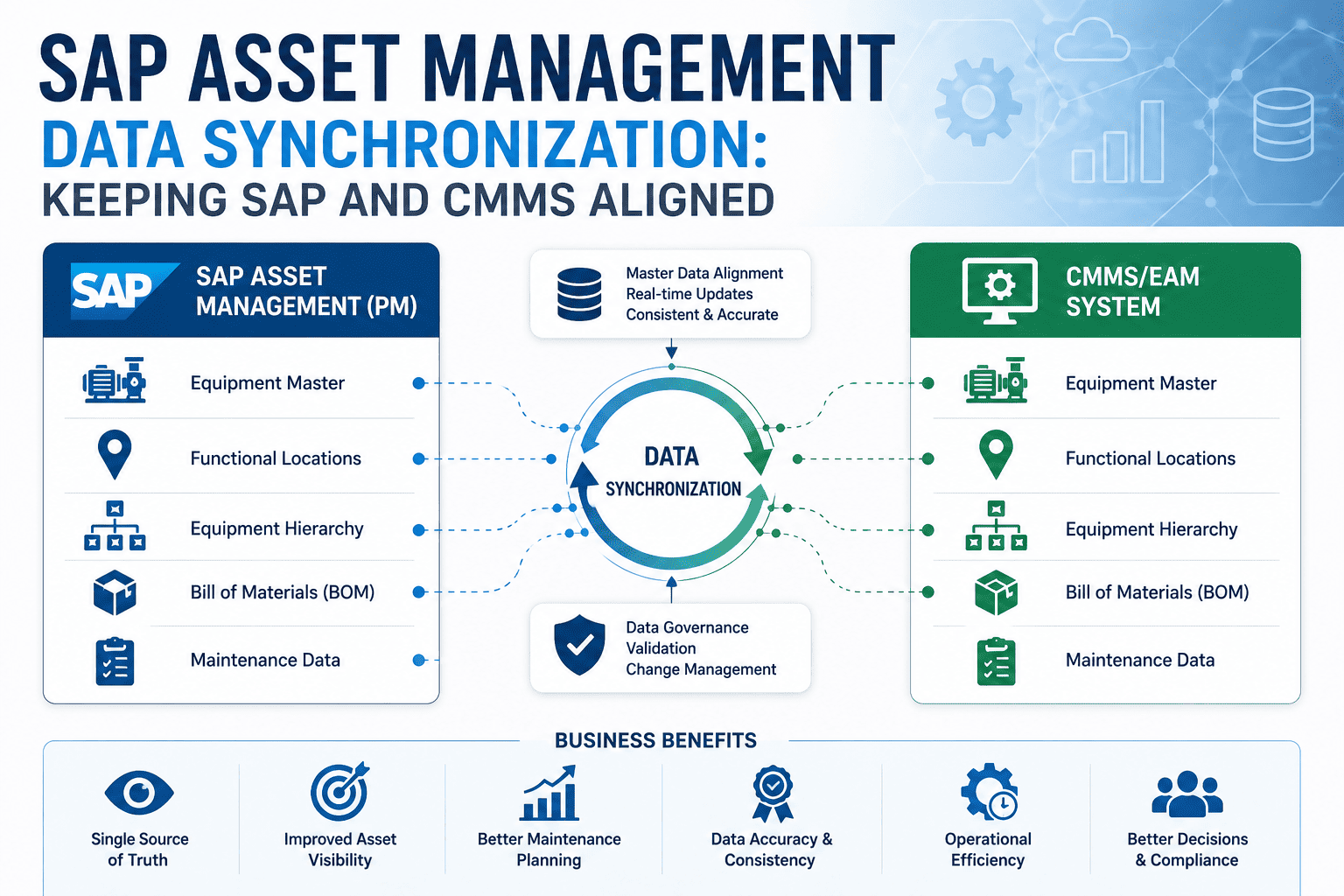
At the architectural level, cloud and on-premise diverge in nearly every layer—from how users access the system, through where integration logic lives, to how the CMMS ultimately connects. Looking at the full stack side-by-side makes the trade-offs concrete and removes the abstraction that often clouds (no pun intended) this decision.
Architecture Stack Comparison
Layer-by-layer view of the two deployment models
S/4HANA Cloud
User Layer
Fiori (Browser-Native)
Standardized UI, no SAP GUI
Core Application
S/4HANA Public/Private Cloud
SAP-managed, quarterly releases
Integration APIs
Standard OData & SOAP
Whitelisted, pre-published catalog
Integration Platform
SAP BTP Integration Suite
Cloud-native, pre-built connectors
CMMS Connection
REST API Pattern
Faster onboarding, less flexibility
Trade-off
Faster to deploy and operate, but customization stays within SAP's guardrails.
VS
S/4HANA On-Premise
User Layer
Fiori + Classic SAP GUI
Familiar to long-time SAP teams
Core Application
S/4HANA On Your Servers
You control upgrade timing
Integration APIs
OData + RFC + IDoc + BAPI
Full SAP API surface available
Integration Platform
SAP PI/PO or Custom
Maximum flexibility, more ops work
CMMS Connection
Custom-built Integrations
Deeper fit, longer build time
Trade-off
Maximum control and depth, but you carry the operational and upgrade burden.
Six Dimensions Where Cloud and On-Premise Diverge
The deployment models behave differently across the dimensions that matter most for maintenance integration. The chart below uses real-world implementation data to score each model—not as a winner-loser exercise, but as a visual guide to which environment optimizes for which capability.
Cloud vs On-Premise Scoreboard
Higher bar = stronger fit for that dimension
CloudOn-Premise
Deployment Speed
Cloud
6–12mo
On-Prem
12–24mo
Customization Depth
Cloud
Limited
On-Prem
Unlimited
Cost Predictability
Cloud
OpEx
On-Prem
CapEx
Data Residency Control
Cloud
Region-bound
On-Prem
Total
Upgrade Control
Cloud
Auto
On-Prem
You choose
CMMS Integration Speed
Cloud
Weeks
On-Prem
Months
CMMS Integration Patterns by Deployment Model
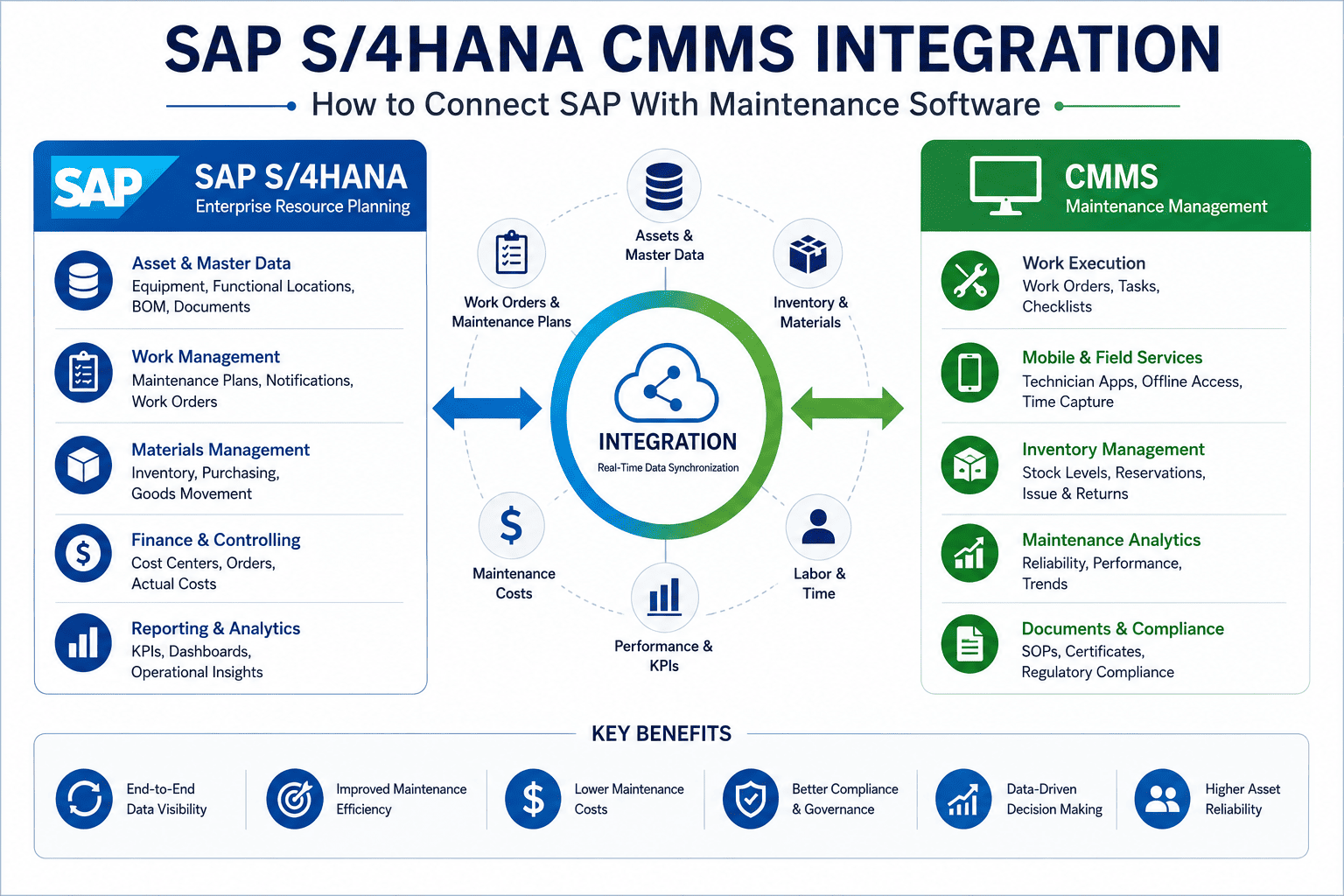
The CMMS still connects to SAP in both deployments—but the path looks very different. Cloud integrations flow through SAP BTP using standardized OData APIs and pre-published interfaces. On-premise integrations typically run through SAP PI/PO or custom middleware, leveraging the deeper RFC and IDoc surface. Modern CMMS platforms like Oxmaint connect to either, and the AI analytics layer runs on local hardware—an RTX PRO 6000 Blackwell central server with Jetson AGX edge nodes—so operational intelligence stays at the plant regardless of where SAP itself lives.
Two Integration Paths to the Same CMMS
CLOUD PATTERN
API-First, BTP-Mediated
S/4HANA Cloud
SAP BTP
OData Connector
CMMS
Standardized REST/OData interfaces
BTP handles authentication & routing
Faster initial connect, less custom work
ON-PREMISE PATTERN
Middleware + Custom Adapters
S/4HANA On-Prem
PI/PO or PO
Custom Adapter
CMMS
Access full RFC, BAPI, and IDoc surface
Custom field mapping at any depth
Slower to build, but matches any process
See the SAP Connector for Your Deployment
A 30-minute working session walks through both integration patterns—Cloud via BTP and On-Premise via middleware—and shows how the same CMMS analytics layer plugs into either, with the AI engine running on local hardware.
The strongest indicator of which deployment fits is the operational pattern your business actually runs. Below are four common scenarios where the right answer becomes obvious once you map the deployment model against the specific operating requirement. Use these as starting points, not as universal verdicts—every plant has nuances—but the recommendation pattern holds for most maintenance organizations.
01
CLOUD FITS
Multi-Site Standardization
You operate 10+ plants and want consistent maintenance processes across every site without per-location custom configurations. Cloud's standardization is the feature, not the limitation.
02
ON-PREM FITS
Heavy Industry Customization
Your maintenance workflows have evolved over decades with deep customizations in PM module, custom transaction codes, and specialized integrations to OT systems. Cloud's guardrails will break them.
03
CLOUD FITS
Greenfield Plant Deployment
You're standing up a new facility and have no legacy SAP baggage. Cloud delivers in months what on-premise would take a year, and the standardized processes accelerate maintenance team onboarding.
04
ON-PREM FITS
Regulated Data Sovereignty
You operate in defense, nuclear, or jurisdictions where maintenance data must remain inside specific borders or on owned infrastructure. On-premise gives you total control; Private Cloud is the compromise.
The companies that regret their SAP deployment choice almost always made it as a finance decision rather than an operations decision. They picked cloud because it looked cheaper on paper, then discovered their maintenance team needed a customization that wasn't possible. Or they picked on-premise because they wanted control, then spent the next decade carrying the upgrade weight. The right framing is: which deployment model lets your maintenance organization move faster three years from now?
I
Cloud Standardization Is a Feature
The constraints that frustrate one company accelerate another. If your maintenance organization is trying to enforce consistent practices across sites, Cloud's standardization is the lever—not the limitation.
II
On-Premise Carries Hidden Costs
The visible CapEx is just the start. Maintaining custom code through SAP releases, running upgrade projects every few years, and operating the infrastructure adds up to 30–40% of the total system cost over a decade.
III
Your AI Layer Doesn't Have to Follow SAP
Even with SAP in the cloud, your CMMS and AI analytics can stay on-premises—keeping operational data at the plant edge while still integrating cleanly with cloud-resident ERP records.
For most maintenance organizations, the decision comes down to two questions: how much do you actually customize today, and how much do you want to customize tomorrow? Honest answers usually point clearly to one model. Organizations ready to validate their direction can sign up free to start their integration assessment or book a free demo with our SAP integration architects for a deployment-specific scoping conversation.
Cloud, On-Prem, or Hybrid—Your CMMS Should Just Work
Oxmaint connects to SAP S/4HANA in any deployment configuration, runs AI analytics on local hardware, and gives your maintenance team a consistent operating experience regardless of where SAP lives.
What is the main difference between SAP S/4HANA Cloud and on-premise for maintenance operations?
S/4HANA Cloud is delivered as a managed service—SAP runs the infrastructure, applies quarterly updates, and exposes a standardized set of APIs. Maintenance functionality works out of the box but customization is limited to what the public APIs and extension framework allow. On-premise runs in your data center, gives you the full SAP API surface (OData, RFC, BAPI, IDoc), and lets you customize PM module behavior, transaction codes, and integrations at any depth. The trade-off is speed and predictability (cloud) versus depth and control (on-premise).
Can my CMMS integrate with both deployment models equally well?
Modern CMMS platforms support both, but the integration mechanics differ. Cloud connects through SAP BTP using OData and SOAP APIs—generally faster to build and lighter to maintain. On-premise typically connects through SAP PI/PO or custom middleware, leveraging RFC and IDoc interfaces that allow deeper data exchange and custom field mapping. Cloud integrations usually go live in weeks; on-premise integrations take longer to build but can match more complex business logic. Either way, the operational result for maintenance teams looks the same.
Which option is better for industries with strict data residency requirements?
For maximum control, on-premise is unambiguous—your data sits on your infrastructure, in your jurisdiction, under your security policies. SAP S/4HANA Private Cloud Edition (via RISE with SAP) is a strong middle ground when data needs to stay in a specific region but you want to offload infrastructure management. Public Cloud offers regional data center options but less granular control. Industries like defense, nuclear, regulated pharma, and certain energy operations typically default to on-premise or Private Cloud with strict data residency configurations.
How does SAP RISE fit into the cloud-versus-on-premise decision?
RISE with SAP is a bundled offering that delivers S/4HANA Private Cloud Edition along with infrastructure, support, and transformation services. It sits between Public Cloud and traditional on-premise—giving customers more customization flexibility than Public Cloud while still moving infrastructure and operations to a managed environment. For maintenance organizations that need deeper customization than Public Cloud allows but don't want to run their own data center, RISE is often the practical middle path.
Can I run AI-powered maintenance analytics with SAP S/4HANA Cloud?
Yes. The AI analytics layer is independent of where SAP runs. Even with S/4HANA Cloud, maintenance data flows through standardized APIs to a CMMS, and AI analytics can run on dedicated on-premises hardware at the plant—keeping sensor data and model inference local while still consuming SAP master data and work order context. This split architecture is increasingly common: cloud for enterprise ERP processes, on-premise for plant-level intelligence and data residency.