ISO 55001 is not a maintenance certification. It is an asset management standard — the international benchmark for how organizations plan, deliver, monitor, and continuously improve the value they extract from physical assets across the entire lifecycle. For industrial enterprises, achieving and maintaining ISO 55001 compliance is the difference between asset management that reacts to problems and asset management that actively creates business value. The challenge is that ISO 55001 touches nearly every system in the enterprise — SAP for master data and finance, Oxmaint for maintenance execution, AI for predictive intelligence, and governance systems for audit trails. When these systems work in isolation, compliance is a constant fire drill. When they work together, ISO 55001 compliance becomes a byproduct of daily operations, not an annual project. Start your free Oxmaint trial with ISO 55001-ready asset management workflows out of the box. Or book a demo to see how Oxmaint + SAP + AI delivers audit-ready asset management.
ISO 55001 Compliance Guide
ISO 55001 Compliance: SAP + Oxmaint AI Asset Management
The practical playbook for achieving and sustaining ISO 55001 certification using integrated SAP enterprise systems, Oxmaint maintenance execution, and AI-powered asset intelligence.
What ISO 55001 Actually Requires
Most leaders approach ISO 55001 expecting a checklist. It is not a checklist. It is a management system standard — meaning it prescribes how you should govern your asset management activities, not which specific activities you must perform. The standard is deliberately technology-neutral, which is why so many organizations struggle with it. Without a clear technology architecture connecting strategy to execution, compliance efforts produce beautiful documents that nobody reads and processes that nobody follows.
ISO 55001 is NOT
A checklist of maintenance tasks
A specific technology platform
A one-time audit you pass
A certificate hung on the wall
A maintenance department project
ISO 55001 IS
A management system for asset value
A continuous improvement framework
Ongoing audit-ready operations
Cross-functional strategic alignment
An executive-sponsored transformation
The Seven Core Clauses and What Each Demands
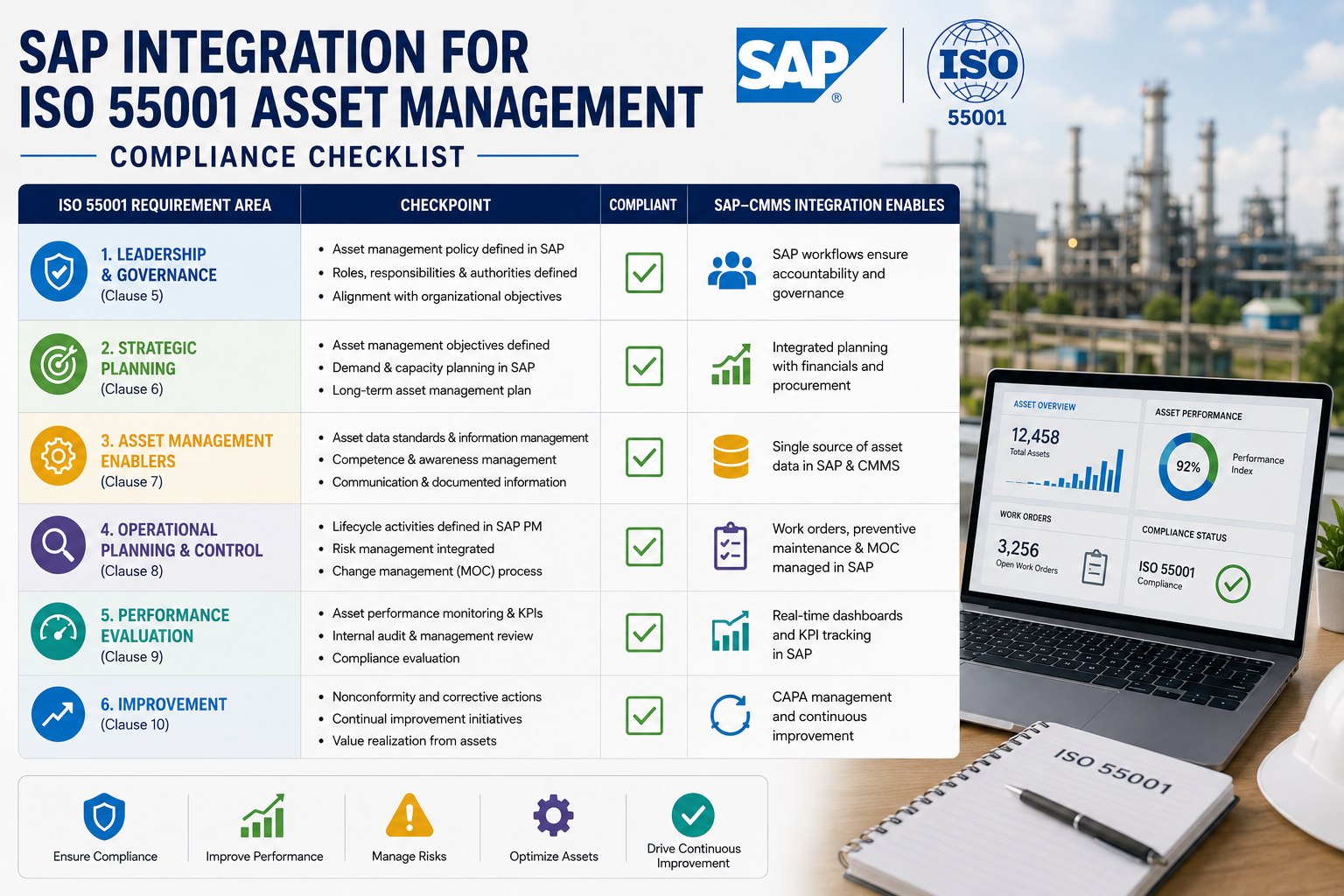
The ISO 55001 standard is structured around seven clauses covering everything from organizational context to continual improvement. Each clause maps to specific control requirements that auditors will evaluate. Here is what each clause actually asks for — and where Oxmaint + SAP + AI integration directly satisfies the requirement.
4
Context of Organization
Define the organization's context, stakeholders, and the scope of the asset management system.
SAP master data defines asset scope; Oxmaint captures stakeholder interactions; AI analyzes stakeholder impact patterns.
Demonstrate top management commitment, establish asset management policy, define roles and authorities.
Policy documents linked to Oxmaint work order rules; role-based access across SAP and Oxmaint; executive dashboards show commitment.
Address risks and opportunities, establish asset management objectives, plan how to achieve them.
AI risk scoring feeds objective-setting; Oxmaint work plans execute strategy; SAP tracks financial alignment to plans.
Provide resources, competence, awareness, communication, and documented information.
Oxmaint manages technician competence records; SAP tracks resource allocation; AI surfaces training gaps automatically.
Plan and control operations, manage change, and oversee outsourced activities.
Oxmaint handles work execution and change tracking; SAP Fieldglass manages outsourced vendors; AI monitors operational drift.
Monitor, measure, analyze, and evaluate asset management performance.
Oxmaint KPIs feed ISO dashboards; AI identifies performance patterns; SAP consolidates financial performance data.
Address nonconformities, implement corrective actions, drive continual improvement.
Oxmaint tracks nonconformities and CAPAs; AI predicts recurrence; SAP measures cost impact of improvements.
Why Compliance Efforts Fail Without the Right System Architecture
Three out of four ISO 55001 certification attempts encounter significant gaps during audit. The failures are remarkably consistent — not because organizations lack intent, but because the underlying system architecture makes sustained compliance impossible. Understanding these failure patterns is the first step to avoiding them.
A
Disconnected Asset Master Data
Asset records in SAP diverge from the version in maintenance systems. Auditors find the same asset described three different ways across three different systems. Clause 4 scope boundaries become impossible to defend.
Fix with Oxmaint: Single source of truth synced bidirectionally with SAP
B
Missing Evidence Trails
Organizations do the right things but cannot prove it at audit time. Work orders are completed but closeout notes are missing. Inspections happen but photos are lost. The management system exists only in peoples' heads.
Fix with Oxmaint: Every action timestamped, photographed, signed, and retained
C
No Link Between Strategy and Execution
The organization has asset management objectives in a policy document and work orders in a CMMS — with no traceable connection between them. Auditors cannot verify that daily execution actually delivers the stated strategy.
Fix with Oxmaint: Strategic objectives linked to work order priorities via AI mapping
D
Performance Metrics That Don't Predict
Reports show last quarter's performance. Clause 9 requires the ability to evaluate effectiveness in near-real-time, with forward-looking indicators. Lagging metrics alone fail the performance evaluation clause.
Fix with Oxmaint: AI forecasts feed leading indicators alongside historical KPIs
The Integrated Compliance Architecture
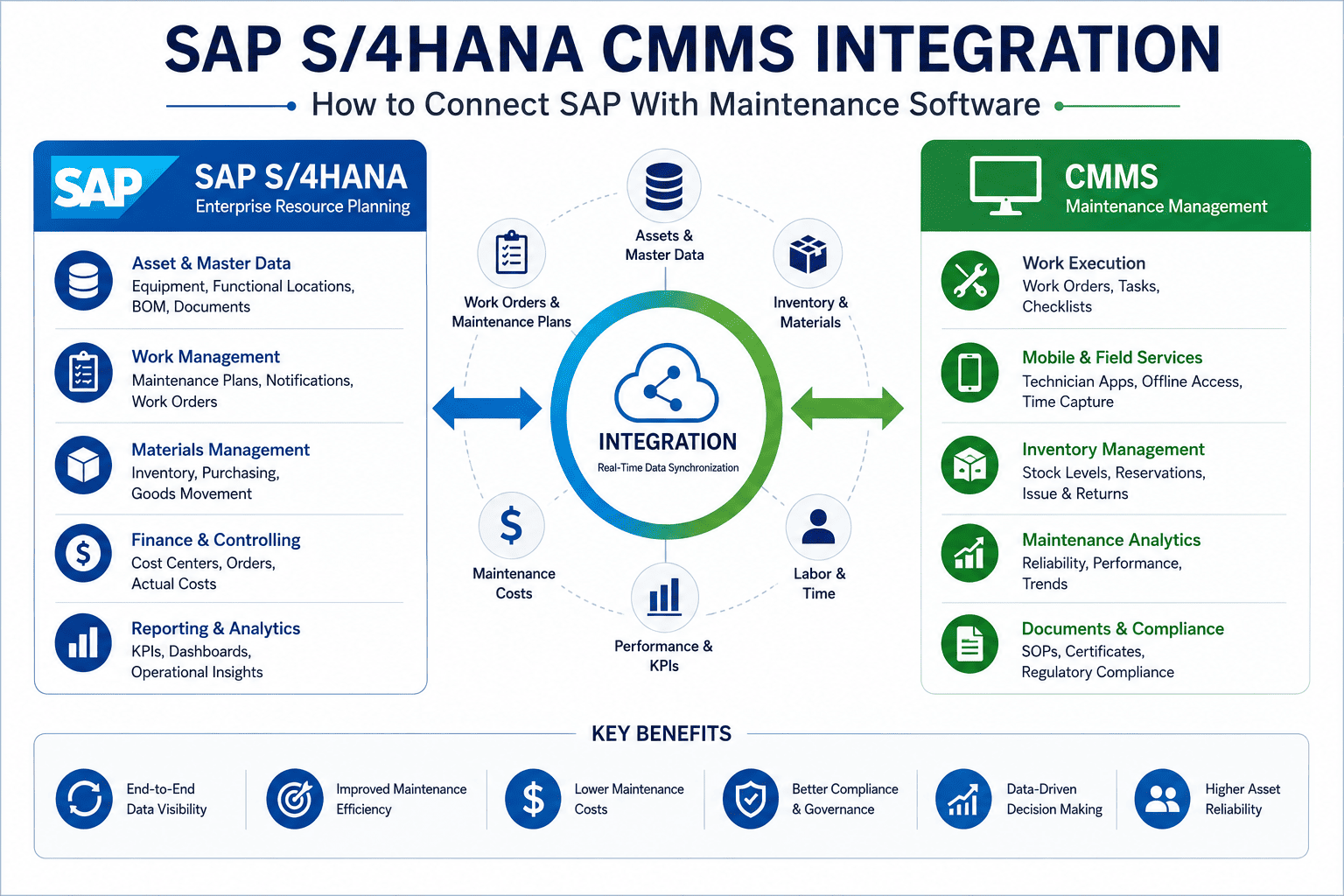
Achieving sustained ISO 55001 compliance requires a specific integration pattern between SAP, Oxmaint, and AI services. Each component carries a distinct responsibility, and it is the combination — not any single system — that produces audit-ready asset management. Here is the reference architecture that certified organizations converge on after iteration.
01
SAP
System of Record
Asset master data & hierarchies
Financial & cost governance
Procurement & supplier records
HR & competence registries
Enterprise reporting layer
02
Oxmaint
System of Action
Work order execution & tracking
Inspection workflows & evidence
Nonconformity & CAPA tracking
Mobile field data capture
Real-time operational dashboards
03
AI Layer
System of Insight
Risk scoring & prioritization
Predictive failure modeling
Performance pattern detection
Continuous improvement signals
Audit-trail anomaly monitoring
Clause-to-Evidence Mapping: What Auditors Ask For
ISO 55001 auditors do not accept "we have a process." They ask for documented evidence that the process was followed, with timestamps, approvals, and outcomes. This mapping shows the specific evidence each clause demands — and exactly where Oxmaint generates it automatically as a side effect of daily operations.
| Clause |
Evidence Auditors Request |
Generated by Oxmaint |
| 4.3 Scope |
Documented asset inventory with boundaries defined |
Asset registry synced with SAP, hierarchy visualized |
| 5.2 Policy |
Asset management policy signed by leadership |
Policy module with version control and approval audit |
| 6.2 Objectives |
Measurable asset management objectives with targets |
KPI dashboards tied to objectives, AI-tracked progress |
| 7.2 Competence |
Technician qualification records and certifications |
Competence matrix with expiry alerts and training links |
| 8.1 Planning |
Work plans aligned to risk assessments |
AI-scored work orders, RCM-based PM schedules |
| 9.1 Monitoring |
Performance data collection and analysis records |
Real-time KPI tracking, AI anomaly detection |
| 9.2 Internal Audit |
Documented internal audit programme and findings |
Audit module with findings, CAPAs, and closures |
| 10.1 Nonconformity |
Nonconformity tracking with root cause analysis |
NCR workflow with AI root cause suggestions |
| 10.2 Improvement |
Evidence of continual improvement actions |
Improvement register linked to measurable outcomes |
Always Audit-Ready
Stop preparing for ISO audits — start operating inside a system that generates evidence continuously
Oxmaint's integrated architecture means audit evidence is created as a byproduct of daily work. No scrambling the week before the auditor arrives; no "document sprints" to reconstruct history. Every action timestamped, every decision traceable, every nonconformity tracked.
The AI Advantage in ISO 55001 Compliance
Traditional compliance treats AI as a separate initiative from certification. That view leaves value on the table. When AI is embedded in the asset management system, it strengthens compliance directly — converting lagging evidence into leading insight, turning passive records into active early warnings, and making continual improvement a data-driven practice rather than a quarterly workshop.
Risk Scoring at Scale
AI evaluates thousands of assets against dozens of risk dimensions simultaneously, producing the risk register that Clause 6.1 demands — refreshed continuously instead of quarterly.
Clause 6.1 · Risk Management
Predictive Nonconformity
Instead of waiting for a failure to document, AI flags anomalies that predict future nonconformities — enabling preventive action before an audit finding materializes.
Clause 10.1 · Nonconformity
Competence Gap Detection
AI compares work patterns against technician qualifications in real time, surfacing training gaps before they become competence-related audit findings.
Clause 7.2 · Competence
Objective Alignment Scoring
AI measures whether daily work order execution is actually advancing stated asset management objectives — the hardest evidence to produce manually.
Clause 6.2 · Objectives
Improvement Pattern Learning
AI identifies which corrective actions actually reduced recurrence and which did not — turning Clause 10.2 from anecdote-driven into evidence-driven.
Clause 10.2 · Improvement
Audit-Trail Integrity
AI monitors the audit trail itself, flagging any anomalies in timestamp sequences, missing approvals, or inconsistent evidence chains that auditors would catch.
Clause 7.5 · Documented Info
12-Month Certification Journey
Most organizations underestimate how long ISO 55001 certification takes from decision to certificate. Done well, it is a 12-month journey with distinct phases. Oxmaint-enabled organizations typically move through this journey 30–40% faster because the evidence-generation work is built into the platform, not added on top.
Month 1–2
Gap Analysis
Assess current state against all 31 control requirements. Identify policy, process, system, and evidence gaps.
Month 2–4
System Foundation
Deploy Oxmaint, connect to SAP, sync asset masters. Establish policy documents, role definitions, and risk framework.
Month 4–7
Process Enablement
Configure work order workflows, NCR processes, audit modules, and competence tracking. Enable AI risk scoring.
Month 7–9
Evidence Build-Up
Operate the system to generate 90+ days of audit trails, KPI data, completed work orders, and improvement records.
Month 9–11
Internal Audit
Run full internal audit programme, identify nonconformities, implement corrective actions with documented closure.
Month 11–12
Certification Audit
Stage 1 documentation review, Stage 2 on-site audit. Evidence pulled directly from Oxmaint in real time.
What Certification Is Actually Worth
ISO 55001 certification is not a trophy. For asset-heavy organizations, it produces measurable financial, operational, and strategic returns. The ROI typically comes from six distinct value streams — each addressing a different stakeholder group, each quantifiable, and together producing a payback period that usually lands inside the first 18 months.
$
Reduced Insurance Premiums
Certified asset management programmes typically secure 8–15% premium reductions across property, equipment, and liability lines
8–15% annual savings
$
Lower Financing Costs
Lenders and bond markets price certified asset management risk differently — often reflected in 15–40 bps improvement on facility rates
15–40 bps reduction
$
Competitive Contract Wins
Many public-sector tenders and large private contracts explicitly require or prefer ISO 55001 certification in prequalification
Tender eligibility
$
Extended Asset Life
Disciplined asset management extends useful life by 10–25%, directly reducing capital expenditure on replacement equipment
10–25% longer life
$
Reduced Downtime Losses
Risk-based maintenance enabled by certified systems typically cuts unplanned downtime by 30–50%, preserving revenue
30–50% less downtime
$
Regulatory Risk Mitigation
Documented compliance frameworks reduce exposure to regulatory penalties, which for heavy industry can run into millions per incident
Avoided penalties
Common Audit Findings and How to Avoid Them
Certification bodies publish annual reports of the most frequent nonconformities across their ISO 55001 audits. The patterns are strikingly consistent across industries and geographies. Knowing these ahead of time lets leaders build a system that avoids the top findings before the first audit even begins.
#1
Objectives Without Measurable Targets
"Improve reliability" is not an objective; "reduce MTBF variance by 20%" is. Auditors reject qualitative objectives that cannot be measured or verified.
Prevention: Oxmaint links every objective to a quantifiable KPI with auto-updating baseline and target tracking
#2
Risk Register Not Maintained
A risk register reviewed once a year is a document, not a management tool. Clause 6.1 requires evidence of ongoing risk identification and treatment.
Prevention: AI-driven continuous risk scoring updates the register every time asset condition or context changes
#3
Competence Evidence Gaps
Technicians perform work requiring specific certifications, but auditors cannot find matching training records — especially for outsourced and contingent workers.
Prevention: Competence matrix tied to work assignments; system blocks unqualified assignments automatically
#4
CAPA Closure Without Verification
Corrective actions are marked complete but effectiveness is never verified. Clause 10.1 requires confirmation that the corrective action actually worked.
Prevention: Oxmaint CAPA workflow requires post-implementation verification with evidence before final closure
#5
Management Review Without Actions
Top management reviews happen and are minuted, but minutes show no decisions, action items, or follow-through on previous actions.
Prevention: Management review module structures agenda, captures decisions, and tracks action closure
Industries Where ISO 55001 Matters Most
While any asset-intensive organization can pursue ISO 55001 certification, four industries see the most dramatic impact. These are sectors where asset management is core to business continuity, regulatory obligations are heavy, and stakeholder scrutiny demands demonstrable excellence.
Utilities & Energy
Regulatory bodies increasingly mandate certified asset management. Grid reliability and public safety depend on rigorous lifecycle management.
Transmission operators, water utilities, gas distribution, power generation
Transportation & Infrastructure
Public safety obligations, massive asset bases, and long useful lives make structured asset management essential and often required by law.
Rail operators, port authorities, airports, highway authorities
Heavy Manufacturing
Capital-intensive operations where unplanned downtime cascades into significant revenue loss and customer commitments slip.
Steel, cement, chemicals, automotive assembly, food processing
Oil, Gas & Mining
Safety-critical assets in remote locations with expensive failure consequences; strong regulatory drivers for compliance.
Upstream, refining, pipelines, offshore platforms, mine operations
Move Faster
See how Oxmaint accelerates your ISO 55001 certification journey
In 30 minutes, we map your current asset management maturity against the seven clauses, identify your fastest path to certification, and show the Oxmaint + SAP + AI configuration that closes your specific gaps.
Frequently Asked Questions
Does using Oxmaint automatically make us ISO 55001 compliant?
Oxmaint provides the system capabilities ISO 55001 requires — asset registries, evidence trails, competence tracking, KPI dashboards, CAPA workflows, and more. Compliance itself requires organizational commitment, policy, and disciplined operation of the system. Oxmaint removes the technology barriers that cause most certification failures.
How does Oxmaint integrate with our existing SAP asset master data?
Oxmaint's certified SAP connector synchronizes asset hierarchies, functional locations, cost centres, and maintenance plans bidirectionally in real time. SAP remains the enterprise system of record; Oxmaint adds the operational execution and compliance evidence layer.
Book a demo to verify your SAP configuration.
What is the typical timeline from Oxmaint deployment to ISO certification?
Organizations with mature asset management practices can reach certification in 8–10 months with Oxmaint. Organizations starting from scratch typically need 12–14 months. The Oxmaint platform itself deploys in 4–8 weeks; the remaining time is evidence accumulation and internal audit cycles.
Can Oxmaint support multi-site and multi-entity certification?
Yes. Oxmaint's hierarchy model supports enterprise, site, plant, and asset group structures with role-based access and federated reporting. Multi-site certification programs use Oxmaint to maintain consistent evidence across dispersed operations while allowing local execution flexibility.
Do we need AI capabilities to achieve ISO 55001 certification?
AI is not required by the standard. AI strengthens compliance by converting reactive evidence into proactive insight — predicting nonconformities before they occur, scoring risk continuously, detecting competence gaps. Oxmaint includes AI as a standard capability; using it improves compliance quality and audit outcomes.
How does Oxmaint handle audit documentation and evidence retention?
Every action in Oxmaint generates an immutable audit trail with user, timestamp, device, location, and content. Retention policies are configurable to match regulatory and ISO requirements. Auditors receive direct read-only access or can review pre-compiled evidence packages by clause.
Start a free trial to explore the audit module.
ISO 55001 Compliance Without the Fire Drills
Oxmaint + SAP + AI is the integrated architecture that makes certified asset management a natural outcome of daily operations rather than a crisis every three years. Deploy the platform, operate the system, and let the evidence build itself.