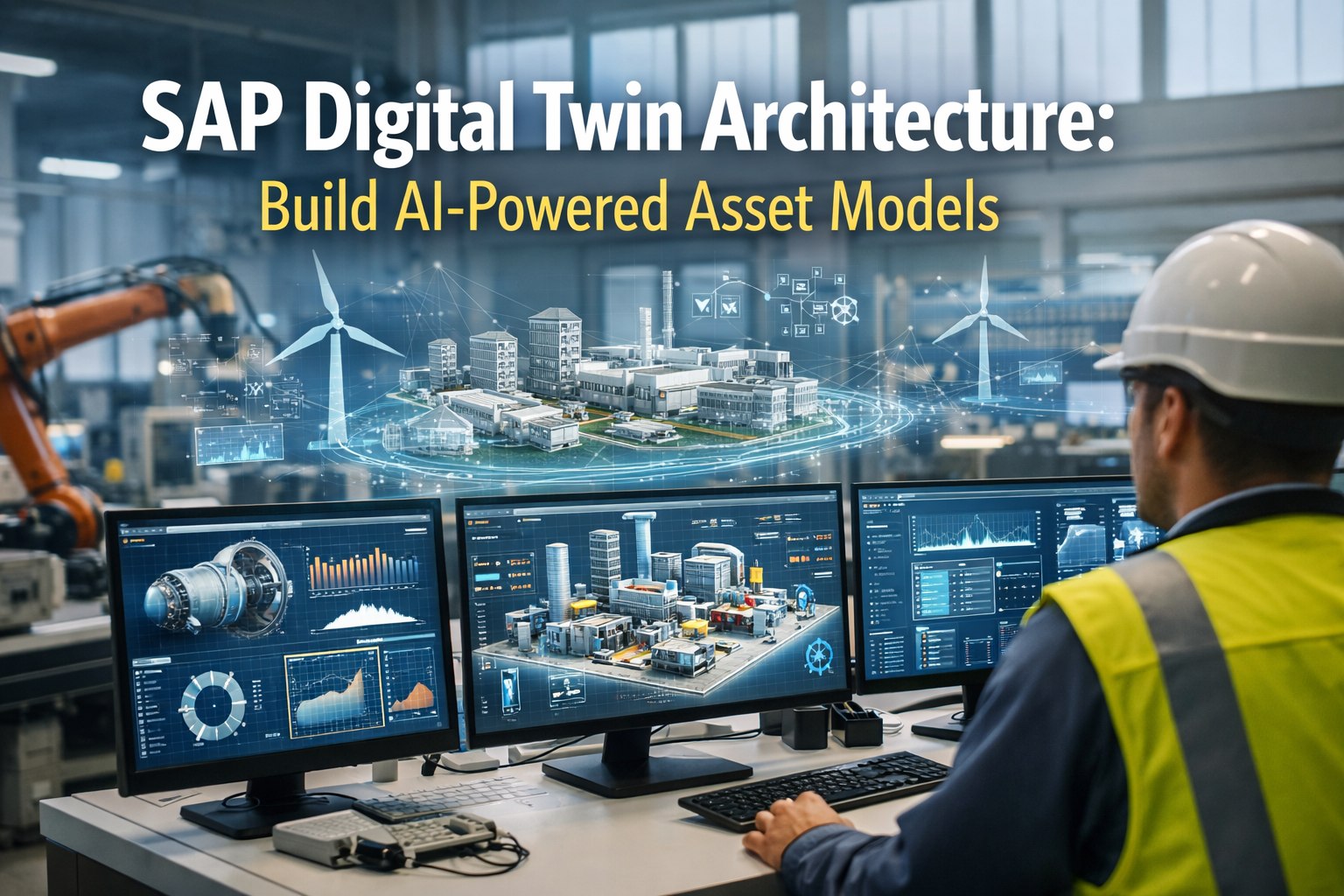
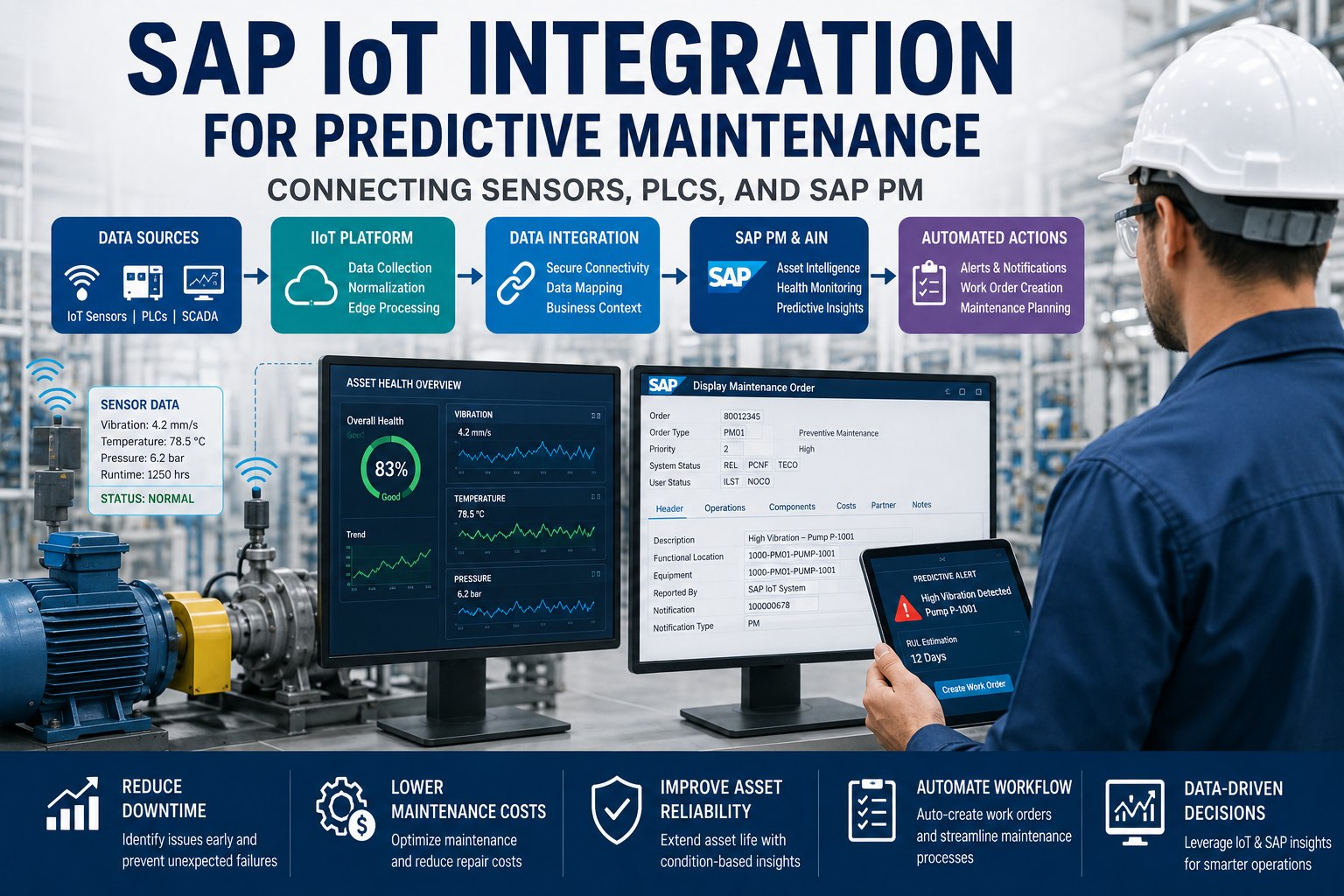
A digital twin is not a 3D model of a machine. A digital twin is a living, breathing software representation of a physical asset — continuously synchronized with sensor data, updated with maintenance history, enriched by AI predictions, and governed by enterprise systems like SAP. For industrial operations, a SAP-integrated digital twin with AI is where three worlds converge: the physical asset on the plant floor, the enterprise record of truth in SAP, and the predictive intelligence of machine learning. When this architecture is done right, maintenance stops being reactive or even scheduled — it becomes prescriptive, with the twin telling you exactly what will fail, when, and what to do about it. Start your free Oxmaint trial and build your first AI-powered asset digital twin in weeks. Or book a demo to see how Oxmaint connects SAP, IoT sensors, and AI models into a single operational twin.
What a Digital Twin Actually Is
The term "digital twin" is overloaded. In product marketing it often means a pretty 3D animation. In industrial engineering it means something much more specific — a software entity that mirrors a physical asset in real time, with bi-directional data flow, historical context, predictive modelling, and governance integration. A true digital twin satisfies four conditions simultaneously; missing any one turns it into a simulation or a dashboard, not a twin.
1
Continuous Real-Time Sync
Sensor data from the physical asset streams into the twin continuously — vibration, temperature, flow rate, power draw, load cycles — updating the digital state second-by-second.
2
Historical Context Preserved
The twin remembers every work order, every inspection, every parts change, every failure mode. AI models need this history to learn what normal looks like — and what drift looks like.
3
Predictive Intelligence Embedded
Machine learning models run against the twin — failure prediction, remaining useful life, anomaly detection. The twin does not just report state; it forecasts future state.
4
Enterprise Systems Integration
The twin is wired into SAP for asset master data, Oxmaint for work orders, ERP for costs, and compliance systems for safety. It is a governed digital entity, not a sandbox experiment.
The Five-Layer Digital Twin Stack
Every production-grade SAP digital twin architecture follows the same logical five-layer structure. Each layer has distinct responsibilities and distinct technology choices. Understanding where each layer begins and ends prevents the most common architectural mistake — collapsing two layers into one and losing the ability to upgrade either independently.
L5
Experience Layer
Mobile apps, dashboards, 3D visualizations, AR overlays — the human-facing surface where operators, engineers, and executives interact with the twin.
Oxmaint mobile · Web dashboards · 3D viewers · AR glasses
L4
Intelligence Layer
AI and ML models that transform raw twin state into predictions, prescriptions, and recommendations. This is where remaining-useful-life forecasts and anomaly scores live.
Failure prediction · RUL models · Anomaly detection · Root cause AI
L3
Twin State Layer
The canonical digital representation of the asset — current state, historical state, derived metrics, asset hierarchy. This is the twin itself as a data structure.
Asset models · State database · Time-series store · Knowledge graph
L2
Integration Layer
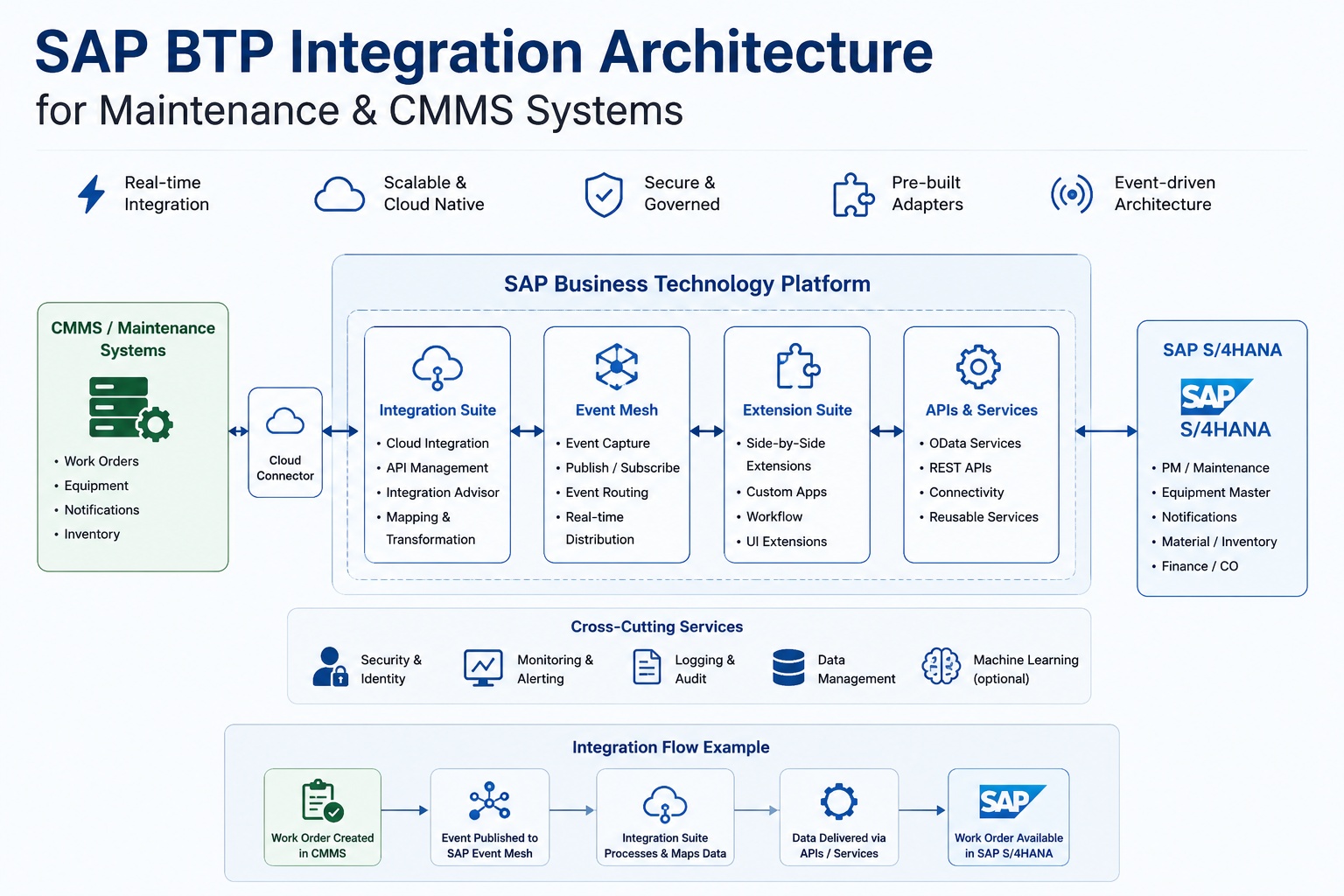
Connectors that bring data in and push actions out — SAP PM for asset master, Oxmaint for work orders, IoT platforms for sensors, ERP for financials.
SAP connectors · MQTT brokers · OPC-UA · REST & OData APIs
L1
Physical Asset Layer
The actual equipment — pumps, motors, boilers, turbines, conveyors. Instrumented with sensors that stream telemetry to the layers above.
Sensors · PLCs · SCADA · Edge gateways · Industrial IoT
How Data Flows Through the Architecture
Digital twin data never flows in just one direction. Understanding the bi-directional flow — sensor data up through the stack, commands and context down through the stack — is what separates a functioning twin from a static visualization. Here is how a single event propagates through a well-designed SAP-integrated architecture.
Data Flowing UP
01
Pump vibration sensor fires
Edge gateway samples at 1 kHz, forwards to IoT broker
02
Integration layer ingests
MQTT broker routes data through Oxmaint sensor gateway
03
Twin state updates
Time-series store records value, derived metrics recalculated
04
AI model scores
Anomaly detection flags deviation from normal vibration profile
05
Experience layer displays
Maintenance supervisor sees red indicator on mobile dashboard
Commands Flowing DOWN
01
Supervisor triggers action
Approves AI-suggested maintenance work order from mobile
02
AI enriches context
Model attaches predicted failure mode and parts list to order
03
Twin reserves capacity
Asset state updates to scheduled-for-maintenance
04
SAP & Oxmaint sync
Work order posted to SAP PM, dispatched to Oxmaint mobile
05
Technician receives task
Field tech gets pre-diagnosed work order with parts ready
Twin Maturity: Where You Are, Where You're Going
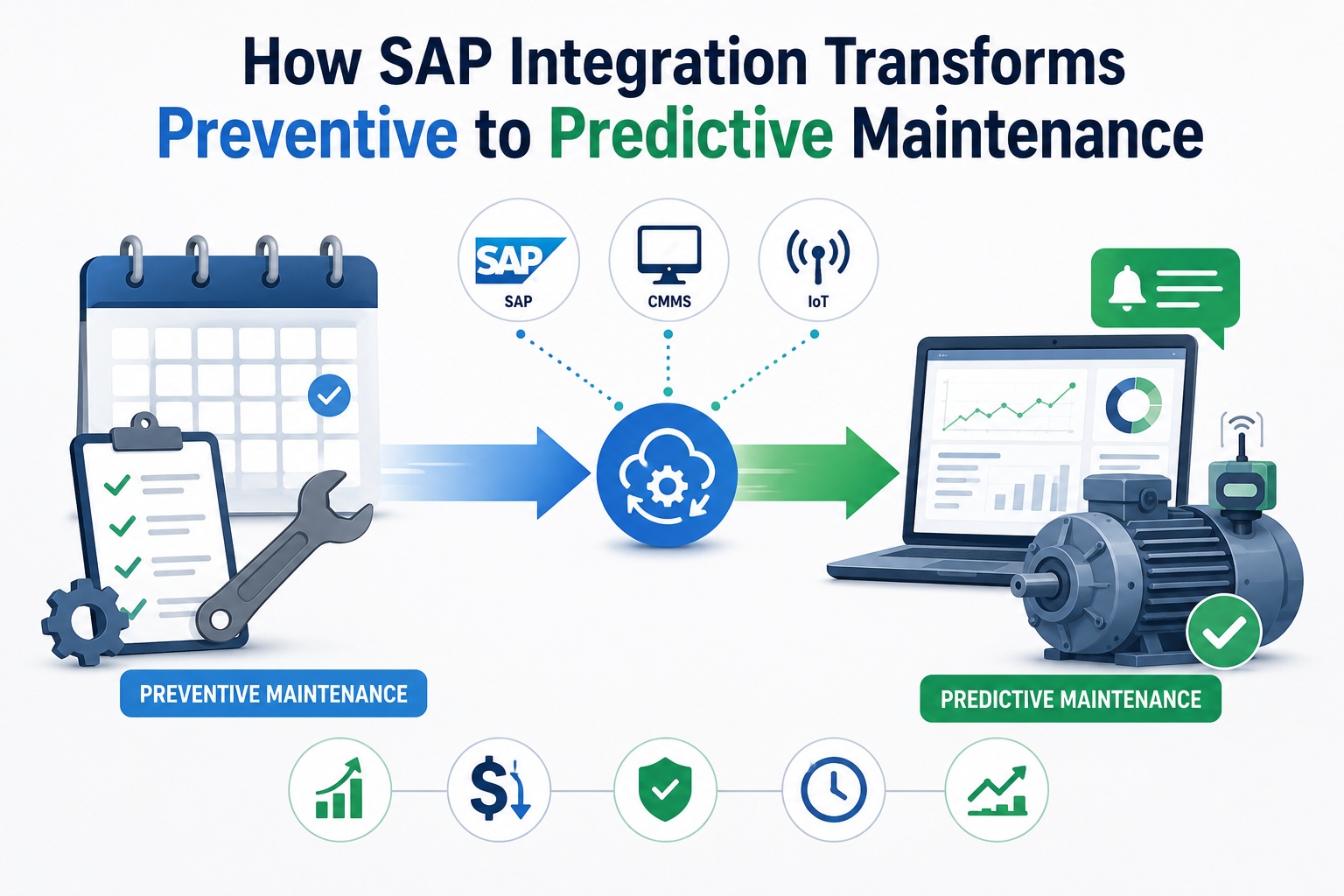
Not every twin is created equal. The industry has converged on a five-level maturity model that maps clearly to business outcomes. Most industrial organizations today sit at Level 2 or Level 3. The breakthrough value lives at Levels 4 and 5 — where AI makes the twin prescriptive, not just predictive.
Level 1
Descriptive
Tells you what happened. Historical dashboards and reports.
Level 2
Diagnostic
Tells you why it happened. Root cause analysis, drill-downs.
Level 3
Monitoring
Tells you what is happening now. Real-time state, alerts.
Level 4
Predictive
Tells you what will happen. Failure forecasts, RUL models.
Level 5
Prescriptive
Tells you what to do. AI-recommended actions, autonomous optimization.
The Core AI Models Inside an Asset Twin
The intelligence layer of a digital twin is not one big AI — it is a portfolio of specialized models, each trained on different data, each answering a different question. Six models typically form the core set for industrial asset twins, and understanding what each one does helps teams prioritize where to invest model development effort.
Remaining Useful Life
Predicts how many operational hours or cycles before an asset reaches end-of-life or a critical failure threshold.
Input: Sensor trends, age, cycles, load history
Output: Days or hours to failure with confidence bounds
Anomaly Detection
Identifies sensor patterns that deviate from normal operating profiles, flagging conditions that may not match known failure modes.
Input: Multi-sensor time series
Output: Anomaly score + contributing signals
Failure Mode Classifier
Matches current asset behavior to historical failure patterns — bearing degradation, cavitation, misalignment, seal wear.
Input: Vibration signatures, temperature trends
Output: Specific failure mode + probability
Performance Optimization
Suggests operating setpoints that balance output, energy consumption, and asset wear — finding the sweet spot dynamically.
Input: Performance curves, load forecasts
Output: Recommended setpoint adjustments
Root Cause Analysis
When failures occur, traces backward through sensor history and work order records to identify the likely originating cause.
Input: Failure event + history
Output: Ranked list of probable root causes
What-If Simulation
Simulates asset behavior under proposed changes — different operating modes, load shifts, or environmental conditions.
Input: Proposed scenario parameters
Output: Projected asset response curves
Deploy in Weeks
Oxmaint provides the digital twin foundation most enterprises spend years trying to build
Pre-built SAP connectors, ready AI model library, IoT integrations, mobile experience layer — all assembled into a production-grade twin architecture you can deploy in 4–8 weeks rather than 18–24 months.
Asset
Twin
SAP PM
AI Models
IoT Data
Oxmaint
Real-World Use Cases Across Industries
Abstract architecture is easier to understand when anchored to concrete industrial applications. Here is how SAP-integrated digital twins are solving specific, measurable problems across four asset-heavy industries today.
Manufacturing
CNC Machine Twin
Tool wear checked manually every shift; unplanned tool failures cause batch rejects worth $40K each.
Twin monitors spindle vibration, predicts tool edge wear within 50 cycles, auto-schedules replacement during planned breaks.
72%
Reduction in batch rejects
Oil & Gas
Centrifugal Pump Twin
Monthly inspections on offshore platforms cost $15K per visit; many are preventive not truly needed.
Twin evaluates seal condition and bearing health continuously; dispatches crews only when prediction confidence is high.
$2.1M
Annual inspection cost saved
Utilities
Transformer Twin
Transformer failures cause multi-hour outages; oil analysis every 6 months misses rapid degradation.
Twin ingests dissolved gas analysis, load patterns, weather data; flags failures 30–90 days in advance.
84%
Fewer unplanned outages
Pharmaceutical
Bioreactor Twin
Batch variability costs millions; cleaning cycles rigid and over-conservative; validation painfully manual.
Twin tracks every batch parameter, predicts quality drift, optimizes cleaning intervals based on actual residue levels.
28%
Batch yield improvement
The SAP Integration Pattern
An SAP-connected digital twin is not just a twin with SAP data loaded in. It is an architecture where SAP remains the master of record for financial, procurement, and compliance data, while the twin owns the operational state and predictive intelligence. The integration pattern below is what most enterprises converge on after trial-and-error.
SAP Asset Master
Equipment hierarchy, functional locations, technical attributes
SAP PM Work Orders
Maintenance plans, task lists, notifications, completions
SAP MM Parts
Material master, BOM, inventory levels, consumption
SAP FI/CO Cost
Cost centres, asset accounting, spend attribution
IoT Sensor Streams
Vibration, temperature, pressure, flow, power draw
AI Model Outputs
Predictions, anomalies, root causes, recommendations
Mobile Field Data
Inspections, photos, readings, completion notes
External Systems
Weather, production schedules, quality systems
Build Phases: From Zero to Production Twin
A production-grade SAP-integrated digital twin does not land in one big deployment. It gets built in phases, with each phase delivering measurable value on its own. Organizations that try to build "everything at once" typically never finish; organizations that ship phase-by-phase see value by month three.
Phase 01
Pilot Asset Selection
Select 5–10 critical assets with existing sensors and clear failure history. Connect to Oxmaint and SAP master data.
Outcome: Twin state layer populated for pilot set
Weeks 1–4
Phase 02
Sensor & SAP Integration
Wire IoT brokers into Oxmaint integration layer. Connect SAP PM for work orders, MM for parts, FI/CO for costs.
Outcome: Real-time state sync across physical, SAP, and twin
Weeks 4–10
Phase 03
Baseline AI Models
Deploy pre-trained anomaly detection and RUL models. Tune against historical failures. Validate prediction accuracy.
Outcome: Predictive layer active for pilot assets
Weeks 8–16
Phase 04
Scale & Prescriptive Layer
Roll out to remaining asset classes. Add failure mode classifier and root cause models. Enable prescriptive recommendations.
Outcome: Full Level 5 prescriptive twin operational
Weeks 16–32
Key Metrics a Digital Twin Should Move
A digital twin is not a science project. It earns its keep by moving specific operational metrics. These are the seven KPIs that executive sponsors track in every successful twin deployment — and the typical magnitude of improvement after 12 months of production operation.
Unplanned Downtime
From average 6.8% to 3.2% of scheduled runtime
Mean Time Between Failures
Extended by predictive interventions before failure
Mean Time To Repair
Pre-diagnosed work orders cut on-site troubleshooting time
Maintenance Spend
Fewer emergency calls, less parts waste, lower overtime
Asset Effective Utilization
Higher uptime + optimized setpoints lift throughput
Safety Incident Rate
Predictive alerts reduce exposure to failing equipment
Spare Parts Inventory
Forecasted demand lets stock levels drop without stock-outs
Pitfalls That Derail Twin Projects
Many digital twin programs stall. The failures follow predictable patterns, and almost all of them are organizational or architectural rather than technical. Recognizing these pitfalls early lets leaders avoid the expensive mistake of a twin that looks impressive in demos but never makes production decisions.
!
Boiling the Ocean
Attempting to twin every asset from day one. Start with 5–10 critical assets, prove value, scale from there. Mass deployment without pilot learnings guarantees architectural rework later.
!
Disconnected From SAP
Building a standalone twin without SAP master data integration. The twin ends up with stale asset hierarchies and no way to trigger real maintenance actions.
!
Pretty but Passive
Investing in 3D visualization before getting the data pipeline right. The twin looks impressive but cannot tell you anything useful because the underlying state is unreliable.
!
AI Without Operations Context
Data science teams building models in isolation. Without maintenance engineer input, models optimize for the wrong thing and operators never trust the outputs.
!
No Governance Model
Unclear ownership of twin data, models, and actions. Decisions stall because nobody is empowered to act on what the twin is saying.
!
Ignoring Field Feedback
Treating the twin as read-only for field teams. Technicians know things sensors miss — the twin must accept field observations as first-class data.
See It in Action
30 minutes to see Oxmaint's SAP-integrated digital twin in your operating context
Bring your asset hierarchy, your SAP version, and a handful of critical assets. We will map out exactly how a production-grade twin looks for your environment — with the AI models and SAP connectors already wired.
Oxmaint
Twin
L5 Prescriptive
L4 Predictive
L3 Monitored
L2 Connected
Frequently Asked Questions
What exactly makes Oxmaint a digital twin platform rather than just a CMMS?
Oxmaint includes the full five-layer twin architecture out of the box — physical integration layer, twin state storage, AI intelligence layer, and experience layer — all pre-wired to SAP. Traditional CMMS tools cover only the work order workflow; Oxmaint is the complete operational twin foundation.
Does Oxmaint require 3D models to operate as a digital twin?
No. 3D visualization is an optional experience-layer feature. The twin's core value comes from data integration, state tracking, and AI — all of which operate perfectly against 2D hierarchies and asset cards. You can add 3D later if your use case benefits from it.
Book a demo to see what works best for your operations.
How does Oxmaint integrate with existing SAP PM, MM, and FI/CO modules?
Oxmaint uses a certified SAP connector supporting both ECC and S/4HANA. Equipment masters, work orders, parts consumption, and cost postings flow bidirectionally in real time through standard SAP APIs — no middleware required.
What kind of IoT sensor data can Oxmaint ingest for the twin?
Oxmaint accepts data through OPC-UA, MQTT, REST, and direct integrations with common industrial platforms like OSIsoft PI, Wonderware, and Ignition. Any sensor capable of streaming through these protocols can feed the twin — vibration, temperature, pressure, flow, electrical, chemical.
How long does building the first production digital twin take?
A typical pilot twin covering 5–10 critical assets goes live in 4–8 weeks including SAP integration. Scaling to hundreds of assets with full predictive and prescriptive AI typically runs 6–9 months.
Start your free trial to begin phase 1 this week.
Can we use our existing AI models, or do we need Oxmaint's?
Both options work. Oxmaint ships with a pre-trained model library covering the six core twin AI patterns (RUL, anomaly detection, failure mode, optimization, root cause, simulation). Organizations with existing models can plug them into the intelligence layer through standard APIs.
Oxmaint: The Fastest Path to an SAP-Integrated AI Digital Twin
Every element of production-grade twin architecture — physical integration, state management, AI intelligence, mobile experience, SAP connectivity — delivered as a single platform you deploy in weeks, not years. Stop building from scratch; start predicting failures before they happen.