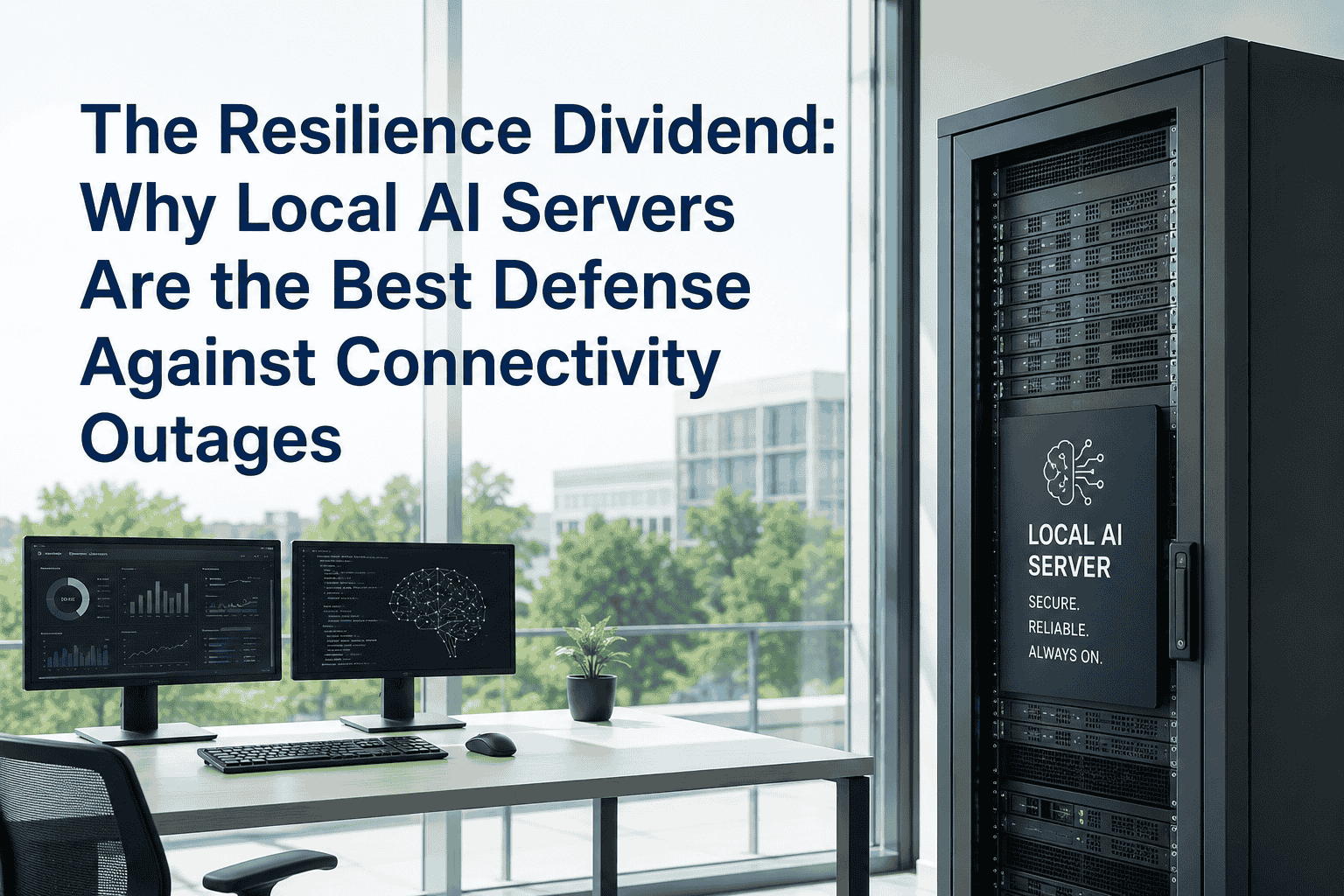
The Resilience Dividend: Why Local AI Servers Are the Best Defense Against Connectivity Outages
On October 20, 2025, a DNS automation bug inside AWS DynamoDB cascaded across 60+ countries and took down 3,500+ companies for 15 hours. Ten days later, a misconfiguration in Azure Front Door did the same. Between August 2024 and August 2025, AWS, Azure, and Google Cloud together logged over 100 service outages. The average cost of cloud downtime rose to $8,600 per minute in 2025 — and manufacturing firms averaged 4.2 hours per incident, with some sectors reporting daily downtime costs exceeding $1.9 million. Cloud AI stops when the cloud stops. Local AI servers do not notice. That is the resilience dividend — and for manufacturing operations running predictive maintenance, quality inspection, and process control on AI, it is not optional anymore. Sign up free to evaluate OxMaint's on-prem AI stack for your operations.
EDGE AI · ZERO CLOUD DEPENDENCY · AIR-GAP CAPABLE
100+ Cloud Outages in 12 Months. $8,600 per Minute. Local AI Servers Don't Notice.
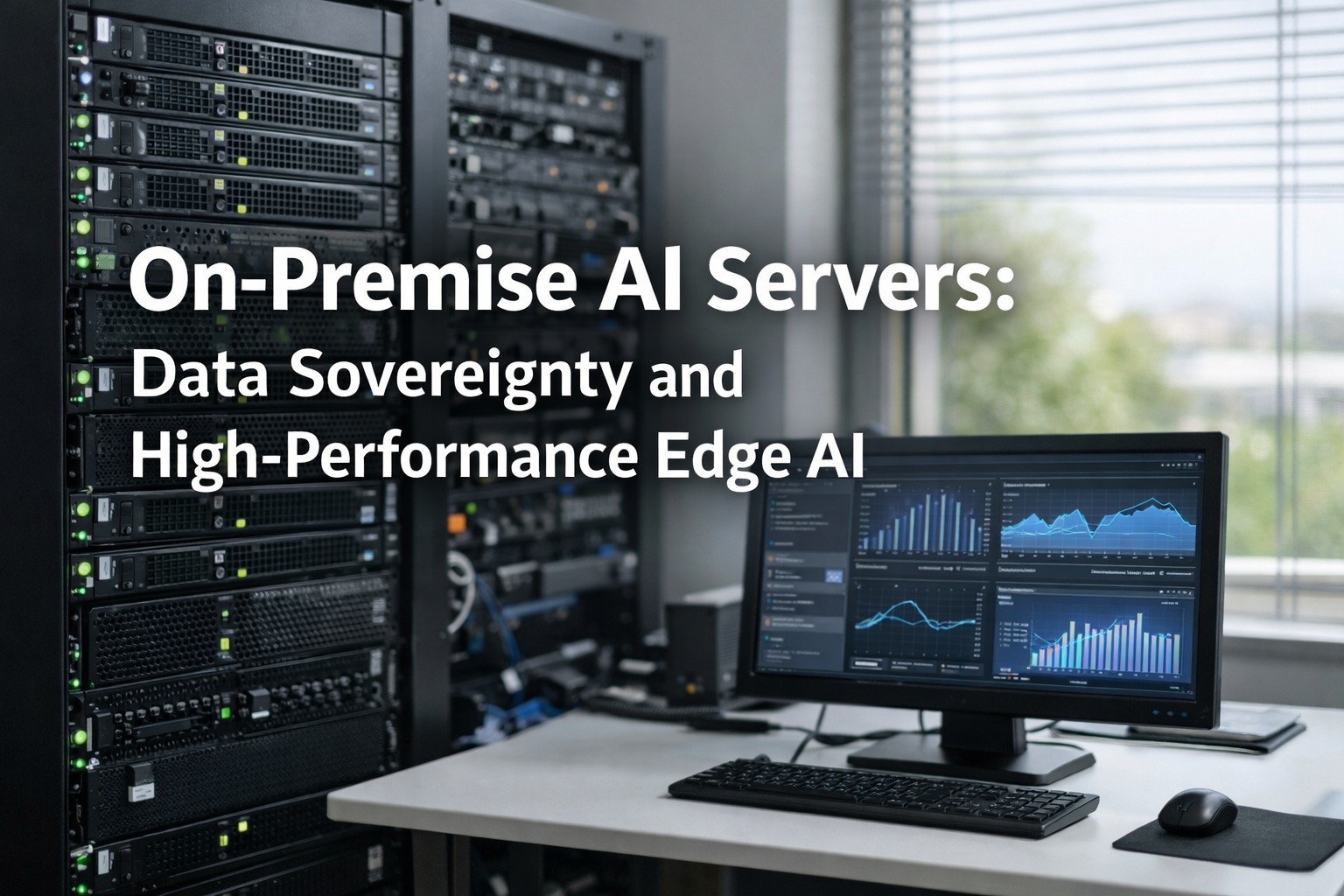
Cloud-hosted AI sends every sensor reading, every prediction, and every dashboard query through infrastructure you do not control — DNS, CDN, hyperscaler control plane, and an internet connection that goes down more often than the uptime SLA suggests. Local AI servers on NVIDIA on-prem hardware process everything at the edge and in the plant control room. No internet required. No round-trip latency. No dependency on a hyperscaler's configuration management. When the connection drops, your predictive maintenance, quality inspection, and process control continue as if nothing happened — because, for them, nothing did.
Five Outage Scenarios · What Breaks and What Doesn't
Every outage has a different root cause — but the outcome for cloud-dependent AI is always the same: it stops. Here are five real-world scenarios that occurred in the last 18 months and what happens to cloud AI versus local AI in each one. Sign up free to evaluate the local AI resilience path for your operations.
01HYPERSCALER CONTROL PLANE FAILURE
Oct 20, 2025 — AWS DynamoDB DNS bug cascaded across 60+ countries. 3,500+ companies affected. 15 hours to full recovery.
CLOUD AIPredictive maintenance dashboards, quality alerts, and process-control models go dark. No fallback — the AI compute was in the cloud region that failed.
LOCAL AIZero impact. Jetson edge and RTX engine continue operating in the plant control room. No dependency on AWS DynamoDB or any hyperscaler service.
02ISP / FIBER CUT AT PLANT BOUNDARY
A contractor trenching outside a chemical plant in Texas severs the plant's single fiber connection. Plant has no redundant WAN path. Duration: 9 hours.
CLOUD AIEverything cloud-hosted is unreachable — AI dashboards, remote monitoring, vendor SaaS. Operations revert to paper-based procedures.
LOCAL AINothing changes. AI models, data, and dashboards are inside the plant perimeter. The fiber cut is invisible to the AI stack.
03CDN / DNS PROPAGATION FAILURE
Nov-Dec 2025 — Cloudflare outages disabled 20-28% of global HTTP traffic. SaaS dashboards and cloud APIs became unreachable even for plants with working internet.
CLOUD AICloud AI platforms hosted behind Cloudflare CDN return 502/503 errors. Internet works but the AI platform does not.
LOCAL AINo CDN dependency. No DNS lookup required. RTX engine answers queries on the local network at <1ms latency.
04SOFTWARE UPDATE CASCADING FAILURE
Jul 19, 2024 — CrowdStrike Falcon update crashed 8.5 million Windows devices globally. Airlines, hospitals, banks, manufacturers all went down. $5.4 billion estimated cost.
CLOUD AICloud VMs running Windows + CrowdStrike hit the blue screen of death. AI workloads terminated. Even non-Windows AI platforms lost dependent services.
LOCAL AINVIDIA Jetson and RTX run Linux. CrowdStrike agent not installed. The update that crashed 8.5 million machines worldwide had zero effect on local AI hardware.
05NATURAL DISASTER / GRID EVENT
Regional power grid failure or hurricane takes down the internet backbone for a metropolitan area. Cloud regions in the affected area lose connectivity for 12-72 hours.
CLOUD AIAI hosted in the affected cloud region is unreachable. Multi-region failover adds 100-150% to infrastructure costs and still takes minutes to hours to activate.
LOCAL AIIf the plant has backup power (generator/UPS), local AI runs on it. No internet required. The AI stack is as resilient as the plant's own electrical supply.
$8,600
Per minute · avg downtime cost · 2025
4.2 hr
Avg manufacturing outage · longest of all sectors
75 days
Revenue recovery time after major outage event
0 min
Local AI downtime from any cloud outage
The pattern is the same in all five scenarios: the root cause varies, the cloud AI outcome is always "stops," and the local AI outcome is always "continues." The resilience dividend is not theoretical — it is the $2M+ manufacturing plants avoid losing every time a connectivity event happens. Book a free demo to see how the on-prem AI stack handles connectivity loss.
"Our cloud-hosted predictive maintenance platform went dark during the October 2025 AWS outage. A kiln bearing was in active degradation and we received zero alerts for 11 hours. We found out about the bearing when it got loud enough to hear."
THE PROBLEM
Cement manufacturer running a cloud-hosted predictive maintenance SaaS platform for vibration monitoring. During the Oct 20, 2025 AWS outage, the platform was unreachable for 11 hours. Vibration sensors continued collecting data locally but the AI analysis, alerting, and dashboard all ran in the cloud. A kiln gearbox bearing had entered active inner-race degradation three days earlier. During the 11-hour blind window, the degradation accelerated. When the platform came back online, the RUL estimate had dropped from 6 weeks to 10 days. Emergency parts procurement was required at premium cost.
HOW LOCAL AI SOLVES IT
Plant Floor Edge (Jetson)
FFT computed on the edge box every 60 seconds — no cloud round-trip. When internet drops, the edge box continues processing. Zero data gap during the outage.
AI Engine (RTX)
Failure-mode classification and RUL calculation run on the RTX server in the plant control room. Alert fires at the normal threshold. Maintenance planner receives the notification on the plant LAN — no internet required.
SAP PM Work Order
Auto-created on the plant's SAP server (also on-prem). Parts ordered within the RUL window at standard cost — not emergency premium. Internet outage is invisible to the entire prediction-to-work-order chain.
THE RESULT
Zero data gap during outage. Alert fired on schedule. Parts ordered at standard cost. $380K emergency premium avoided.
SCENARIO 02
"A fiber cut outside our chemical plant took out internet for 9 hours. Our cloud quality-inspection AI went offline. We shipped 4 batches without AI inspection — 2 came back as customer rejects."
THE PROBLEM
Specialty chemical manufacturer. Cloud-hosted AI vision system for final product quality inspection — color, viscosity, particulate count. A contractor trenching outside the plant boundary severed the fiber connection at 06:30. Internet restored at 15:20 — 9 hours later. During the gap, operators used manual visual inspection. Four batches shipped. Two returned by the customer as out-of-spec on particulate count — a defect that the vision AI would have caught at the filling station. Customer reject cost: $92K product value + $18K shipping + damaged relationship with a top-5 account.
HOW LOCAL AI SOLVES IT
Plant Floor Edge (Jetson)
Vision cameras connected directly to Jetson via industrial Ethernet inside the plant. Image capture, inference, and pass/fail classification all happen on the edge box — no cloud API call needed.
AI Engine (RTX)
Quality model runs on the plant LAN. Particulate count exceeds threshold → batch flagged → filling station paused → operator alerted. All on internal network. Fiber cut outside the fence has zero effect.
Batch Record On-Prem
Inspection results, timestamps, and pass/fail verdicts stored locally. When internet restores, the 9-hour gap is backfilled to the cloud archive — but the quality gate never missed a batch.
THE RESULT
All 4 batches inspected by AI during fiber cut. 2 out-of-spec batches caught at fill station. $110K reject cost avoided. Customer relationship protected.
Does local AI mean we lose cloud benefits entirely?
No. Local AI handles real-time operations — predictive maintenance, quality inspection, process control — at the plant level with zero cloud dependency. Cloud can still serve optional functions: fleet-wide benchmarking, model retraining on aggregated data, corporate dashboard rollup, and remote monitoring when connectivity is available. The architecture is "local-first, cloud-optional" — operations never depend on the connection, but the connection is used when it exists. If internet drops, nothing mission-critical stops.
How does local AI handle model updates without cloud?
Model updates are delivered as versioned packages — downloaded during connectivity windows, validated on a staging instance, and deployed to production during a controlled maintenance window. The same process most enterprises use for firmware and PLC logic updates. Updates never happen automatically or mid-operation. The DGX Station can retrain models on your own plant data entirely on-prem — weights never leave the perimeter. For multi-plant operations, a corporate DGX trains fleet models and pushes versioned updates to each plant's RTX server on an update schedule you control.
What happens if the local server hardware fails?
Local AI hardware follows the same redundancy principles as any plant-critical equipment. The RTX PRO 6000 tower includes ECC memory, redundant power supply option, and RAID storage. For mission-critical operations, a hot-standby RTX unit can be configured for automatic failover — identical to how plants handle redundant DCS controllers. MTBF on NVIDIA enterprise hardware exceeds 50,000 hours. The hardware is warranted for 3 years and field-replaceable without specialized tools.
How does local AI compare on cost to cloud AI?
Cloud AI costs scale linearly — you pay per inference, per API call, per GB stored, per month, forever. Local AI is a one-time capital purchase with a 5-7 year hardware life. A single avoided outage event (avg 4.2 hours at $8,600/minute = $2.17M) pays for the entire local AI stack multiple times over. For manufacturing operations running 24/7 with 100+ sensor streams, local AI typically reaches cost parity with cloud AI within 12-18 months and runs at near-zero marginal cost thereafter.
How fast can we deploy local AI servers?
Eight to twelve weeks from contract signature. Weeks 1-2 — site survey, critical AI workloads identified, network topology mapped. Weeks 3-4 — Jetson edge boxes deployed at asset clusters, RTX server installed in plant control room, sensor connections validated. Weeks 5-6 — AI models loaded, baseline data captured, first predictive alerts flowing on the plant LAN. Weeks 7-8 — SAP PM integration tested, operator dashboards configured, resilience tested with simulated connectivity loss. Week 8 onward — operational, resilient, and independent of internet availability.
Resilience Edition · Zero Cloud Dependency · 8-Week Pilot
The Next Cloud Outage Is Coming. Your AI Doesn't Have to Notice.
Book a 30-minute call with our deployment engineers. Walk through your connectivity risk profile, your critical AI workloads, and your resilience requirements. See how local AI servers keep predictive maintenance, quality inspection, and process control running through any outage. Perpetual license, source code included, $0/mo.