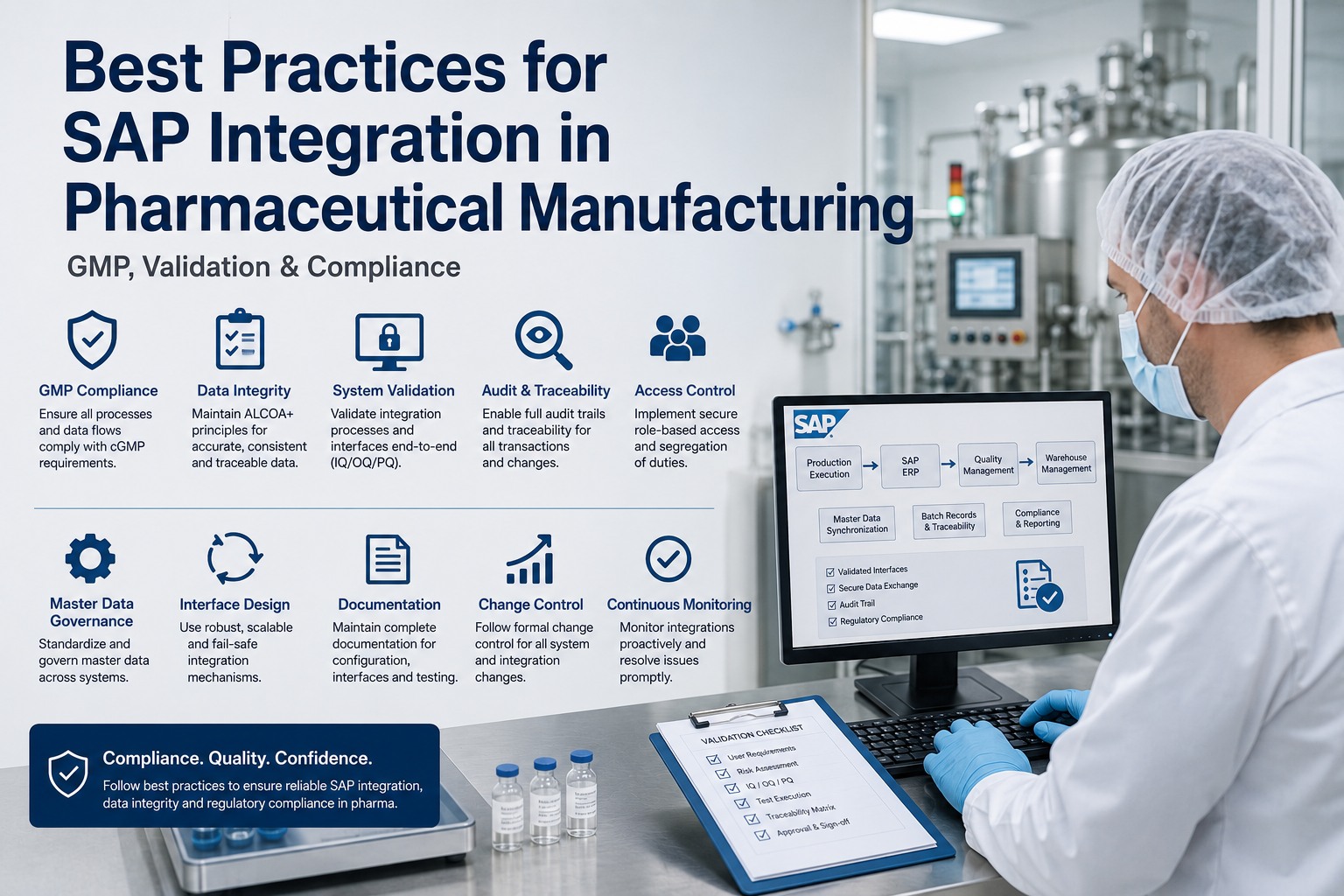
Best Practices for SAP Integration in Pharmaceutical Manufacturing | GMP, Validation & Compliance
Pharmaceutical manufacturers face a compliance reality no other industry shares. Every piece of equipment must be qualified. Every calibration must be documented. Every maintenance action becomes a regulatory record. SAP-CMMS integration in pharma isn't just about operational efficiency—it is about producing audit-ready evidence that satisfies 21 CFR Part 11, EU Annex 11, GAMP 5, and ALCOA+ data integrity requirements simultaneously. Get the integration right and FDA inspections become predictable; get it wrong and observations cascade across multiple findings. This article maps how to do it right. Book a free demo to see pharma-compliant integration.
PHARMA COMPLIANCE REALITY
60-70% of GMP Inspection Findings Trace to Data Integrity Gaps
60-70%
Findings Tied to Data Integrity
ALCOA+
Foundation Framework
8
Compliance Pillars
21 CFR §11
FDA Electronic Records
Why Pharma SAP Integration Is Different From Standard Manufacturing
A general manufacturer's SAP integration is judged on uptime, throughput, and cost. A pharmaceutical manufacturer's SAP integration is judged on the same operational dimensions—plus the question that changes everything: would this survive an FDA Form 483 inspection? Every transaction must produce defensible audit evidence. Every electronic record must satisfy ALCOA+ data integrity. Every system change must follow documented change control. The bar isn't "does it work"; it's "can we prove it works to a regulator's satisfaction."
This regulatory overlay shapes integration architecture from the ground up. Configurations that pass for general manufacturing—loose authorization, partial audit trails, ad-hoc change control—create cascading findings during pharma inspections. The compliance-first approach isn't an overhead burden; it's the operating discipline that prevents the regulatory crises that destroy pharma operations. Maintenance leaders ready to assess pharma compliance readiness can Sign up free to assess pharma compliance readiness.
The 8 Compliance Pillars Where SAP-CMMS Integration Meets GMP
The framework below maps eight pharma-critical compliance areas where SAP-CMMS integration directly satisfies regulatory requirements. The ALCOA+ data integrity foundation at the top applies across all eight—every record produced by integration must demonstrate all nine ALCOA+ principles to survive inspection.
Each pillar's regulatory requirement is the FDA's published expectation; each integration capability is what audit-ready architecture actually produces. Pharma maintenance leaders ready to map their integration against the framework can Sign up free to map your integration against the 8 pillars.
SEE IT IN PRACTICE
Walk Through Pharma-Compliant Integration Live
30-minute walkthrough showing audit trails, electronic signatures, calibration management, and CAPA workflow running in a GMP-aligned SAP-CMMS architecture.
How FDA Inspections Actually Stress-Test SAP-CMMS Integration
FDA Form 483 observations rarely come from inspectors finding novel problems. They come from inspectors asking simple questions and not receiving simple answers. "Show me the calibration record for instrument X on date Y." "Demonstrate the audit trail for this work order change." "Walk me through how you ensure only qualified technicians perform this procedure." Integrations designed for compliance respond in seconds; integrations designed only for operations require manual reconstruction that creates the gaps inspectors document. Building for inspection from the start prevents the cascade of findings that turns a routine inspection into a regulatory crisis.
21 CFR Part 11 & EU Annex 11: Integration Checkpoints That Matter
21 CFR Part 11 (FDA) and EU Annex 11 (EMA) both govern electronic records and electronic signatures in regulated manufacturing. The four checkpoints below are where SAP-CMMS integrations most often pass or fail compliance evaluation. Address each one explicitly during integration design rather than reactively during inspection prep.
Electronic Signatures
Two-factor authentication required for signing operations. Signature manifestations linked to specific records, immutable thereafter.
Audit Trail Coverage
Every create, update, delete logged with user, timestamp, and reason. Audit trail itself must be immutable and exportable.
System Validation
Integration follows GAMP 5 V-model: User Requirements → Functional Spec → Design → IQ → OQ → PQ. Documented end-to-end.
Each checkpoint maps to specific 21 CFR Part 11 sub-sections (§11.10, §11.50, §11.100) and EU Annex 11 paragraphs. Designing for all four during initial integration is far less costly than retrofitting after an inspection finding. Maintenance leaders ready to audit their checkpoints can Sign up free to audit your 21 CFR §11 checkpoints.
ROI of Compliance-Aligned Pharma Integration
Pharma SAP integration ROI measures different dimensions than general manufacturing. The performance delta below shows where compliance-aligned integration produces the largest gains—measured in audit posture, deviation cycle time, and inspection readiness.
AD-HOC vs COMPLIANCE-ALIGNED INTEGRATION
Pharma Operational & Audit Performance Delta
Audit Observations (483s)
8-15 / inspection
1-3 / inspection
−80%
Audit Prep Time
6-8 wk
3-5 days
−90%
Deviation Investigation Cycle
30 days
5 days
−85%
Data Integrity Score
~70%
95%+
+25 pts
CAPA Closure Cycle
90 days
30 days
−67%
3-5 days
Audit prep time with compliance-aligned integration architecture
95%+
Data integrity score sustained with ALCOA+ aligned architecture
The compounding effect: better data integrity reduces deviations; faster CAPA closure reduces backlog; clean audit trails compress inspection prep. Each metric reinforces the others. Pharma leaders ready to benchmark their compliance posture can Book a free demo to benchmark pharma compliance posture.
Expert Perspective on Pharma SAP Integration
"
The pharma operations I've watched genuinely thrive with SAP-CMMS integration share an unusual property: they stopped treating compliance and operations as separate concerns. The integration architecture is the same architecture that runs daily maintenance, produces audit evidence, satisfies ALCOA+, and feeds the quality system. There's no "operations integration" and "compliance integration"—it's one architecture serving both purposes. The pharma operations that struggle treat them separately: they build an integration for operational efficiency, then bolt on compliance documentation as an afterthought. The bolt-on never quite works under inspection scrutiny. The compliance-first approach feels heavier at the start but produces dramatically lower total cost over the system lifecycle. Build it right once.
01
One Architecture, Two Purposes
Operations and compliance share the same integration. Separating them creates gaps that inspectors find.
02
Validate, Don't Bolt-On
GAMP 5 validation during build is cheaper than retrofitting after an inspection finding forces it.
03
ALCOA+ Is the Acid Test
If your audit trail can't demonstrate all 9 ALCOA+ principles on demand, your data integrity isn't ready.
90-Day Pharma Validation Readiness Roadmap
The 90-day program below establishes the validation, audit trail, and compliance foundation pharma operations need before SAP-CMMS integration enters productive GMP use.
90-DAY VALIDATION READINESS
From Gap Assessment to Validated GMP Use
DAYS 1–25
01
Gap Assessment
Assess current integration against ALCOA+ and 21 CFR §11. Document gaps in audit trail, signatures, validation, access controls.
Execute URS, FS, DS, IQ, OQ, PQ for the integrated system. Document evidence per V-model. Quality approval of validation package.
DAYS 76–90
04
Production Release
SOPs updated. Training delivered. Validation report approved. Move to productive GMP use with audit-ready evidence trail.
BUILD COMPLIANCE IN
Make Your SAP-CMMS Integration Inspection-Ready
Eight pillars mapped. ALCOA+ foundation applied. 21 CFR Part 11 checkpoints addressed. The compliance-first architecture that turns FDA inspections into predictable outcomes.
Does SAP-CMMS integration need to be GAMP 5 validated for pharma use?
Yes. Any computerized system that handles GMP-relevant data—including maintenance records, calibration data, equipment qualification status, and deviation tracking—requires validation per GAMP 5 V-model principles. The validation level depends on system risk category (typically Category 4 for configured products or Category 5 for custom integrations). The validation package includes User Requirements Specification, Functional Specification, Design Specification, plus IQ, OQ, and PQ execution with documented evidence. Skipping validation produces immediate FDA Form 483 findings during inspection and may trigger consent decree action in severe cases.
What changes for pharma vs general manufacturing SAP integration?
Three things change fundamentally. First, every electronic record must satisfy ALCOA+ data integrity—operational integrations satisfy maybe two or three of the nine principles, pharma integrations must satisfy all nine. Second, system validation per GAMP 5 is required, not optional—the validation package is itself an audit artifact. Third, change control becomes formal—every configuration change requires documented assessment, approval, and validation impact analysis. Operationally the integration looks similar; the audit and validation overlay is what makes pharma integrations different to build and operate.
How do electronic signatures work in CMMS for 21 CFR Part 11 compliance?
21 CFR Part 11 electronic signatures require two distinct identification components (typically username + password, or username + biometric) executed at the time of signing. The signature manifestation must include the signer's printed name, signing date/time, and the meaning of the signature. The signature is permanently linked to the signed record—the record cannot be modified after signing without invalidating the signature and creating a new audit trail entry. CMMS platforms with native 21 CFR Part 11 support handle this through built-in signature workflows; platforms without native support require careful configuration and validation to demonstrate compliance.
What ALCOA+ requirements does maintenance integration specifically introduce?
All nine principles apply to maintenance records. Attributable: every maintenance action must identify the performing technician. Legible: digital records solve this naturally. Contemporaneous: actions recorded at the time of execution, not reconstructed later. Original: the CMMS record is the original; SAP synchronization preserves rather than replaces. Accurate: data validated at entry, sensor data calibrated. Complete: no missing fields, no incomplete records. Consistent: same conventions across all sites and technicians. Enduring: records retained per retention schedule, immune to drive failures. Available: retrievable on demand for inspectors. The integration architecture must enforce all nine—technician shortcuts that satisfy operational needs but violate ALCOA+ create inspection vulnerabilities.
How does compliance-aligned integration affect FDA inspection readiness?
Profoundly. Inspections that focus on maintenance and equipment qualification typically require pulling records that span months of work order history, calibration records, training certifications, and change control documentation. With compliance-aligned integration, the inspector's questions are answered in minutes via audit-trail queries; without it, the answers take days of manual record reconstruction with high risk of finding gaps. Recent industry data shows roughly 60-70% of GMP inspection observations trace to data integrity and documentation gaps—exactly the areas where compliance-aligned integration delivers value. The integration is effectively inspection insurance, with audit prep time dropping from weeks to days when the architecture is right.