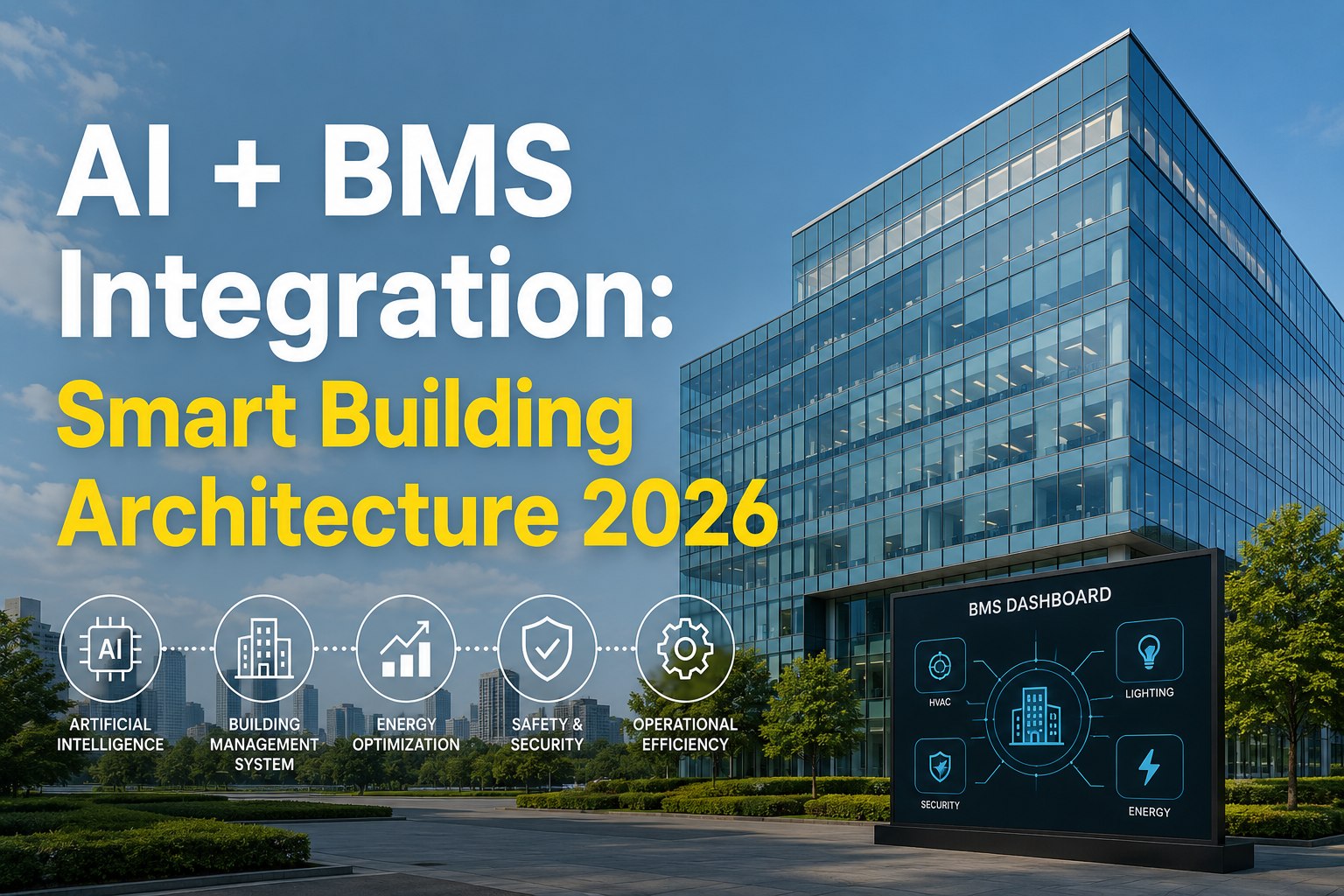
AI + BMS Integration: Smart Building Architecture 2026
By Jack Edwards on May 2, 2026
A BMS without AI is a data logger. It records temperatures, pressures, runtimes, and alarm states — but it does not learn, predict, or act. In 2026, facility teams are no longer satisfied with dashboards that show what already happened. They want systems that see a chiller degradation pattern three weeks before failure, auto-generate a work order with the correct parts reserved, and route it to the certified technician who is closest to the asset. That is what AI-BMS integration delivers. This guide breaks down the architecture, the ROI, and the deployment path.
73%
Work Orders Auto-Routed
AI-powered BMS systems vs. manual dispatch workflows
14–30
Days Early Warning
Average predictive fault detection window before failure
$0.28/sqft
Annual HVAC Savings
AI optimization vs. fixed BMS schedules in CRE portfolios
92%
Alarm Noise Reduction
AI filters false positives, routes only actionable alerts
Build Your BMS-to-AI Integration in 90 Minutes
Join the Oxmaint engineering team to map your existing BMS (Siemens, JCI, Honeywell, Schneider) to an AI-powered work order engine, HVAC optimizer, and predictive fault detector — live, in one session.
AI-BMS integration is the connection layer between your building management system and a machine learning engine that interprets sensor data, predicts equipment failures, optimizes HVAC schedules, and generates work orders automatically. Your BMS collects the data. AI turns it into decisions. Without this layer, your facility team drowns in alarm noise, reacts to failures after they happen, and wastes energy running HVAC on fixed schedules that ignore occupancy and weather. With it, the building becomes self-diagnosing and self-optimizing. Talk to an Oxmaint BMS integration specialist and see your building's current data mapped to AI workflows — book a 30-minute demo.
Protocol Connectivity
BACnet IP/MS/TP, Modbus TCP/RTU, OPC-UA, MQTT, and direct API connectors for Siemens Desigo, JCI Metasys, Honeywell, Schneider EcoStruxure.
Anomaly Detection Engine
Machine learning models trained on your building's normal operating baselines — flags temperature drift, vibration spikes, pressure anomalies before failure.
Work Order Automation
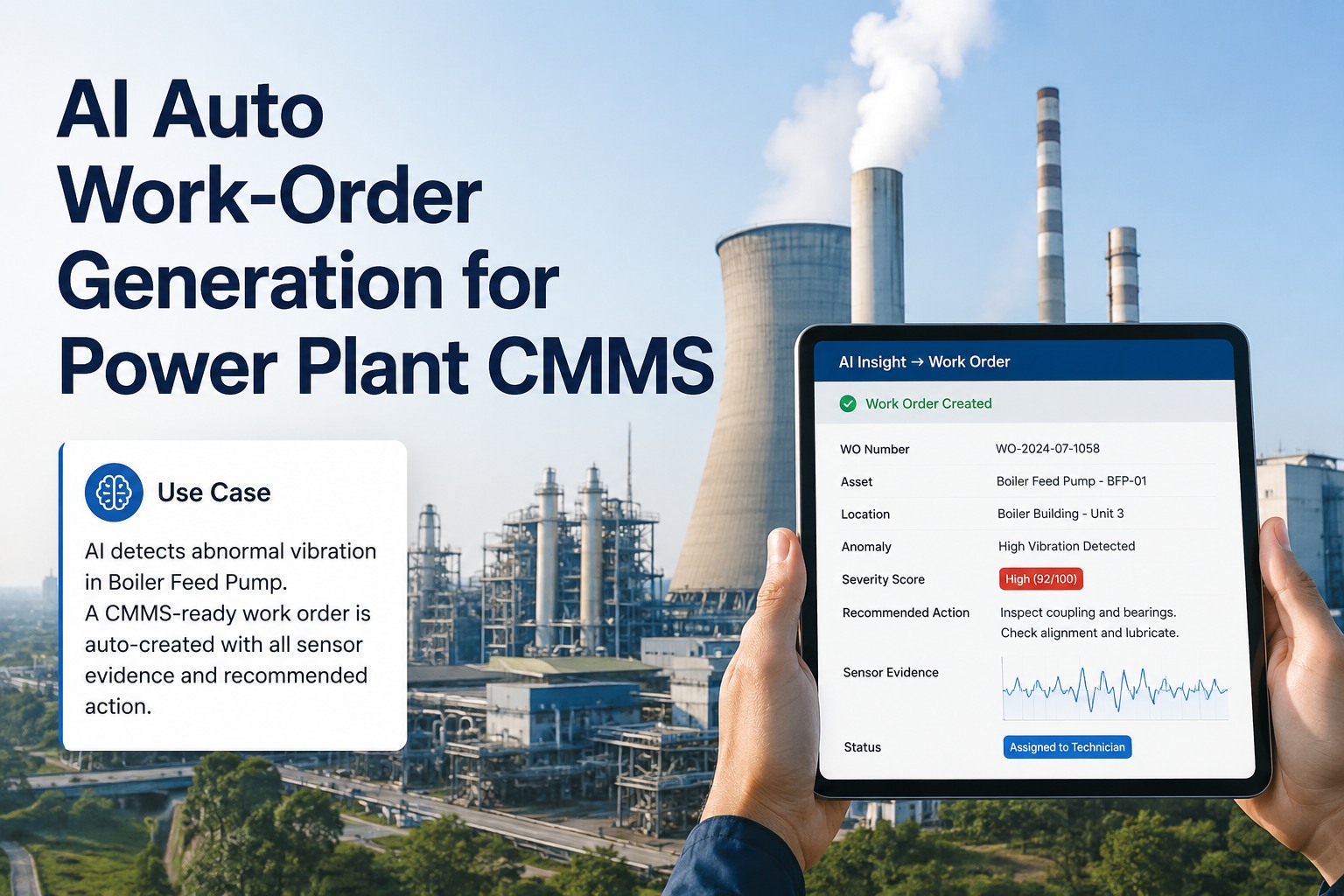
Sensor anomaly triggers a fully populated work order with asset ID, fault classification, SOP, parts list, and skill-matched technician assignment — in under 60 seconds.
HVAC Schedule Optimization
AI learns occupancy patterns, weather forecasts, and utility tariffs to run HVAC at minimum cost while meeting comfort setpoints — 22–38% energy reduction typical.
Alarm Intelligence Layer
Filters 92% of nuisance alarms, correlates related faults into single work orders, and escalates only actionable issues to the maintenance team.
Multi-Site Intelligence
Portfolio-level dashboards aggregate energy intensity, fault frequency, and equipment health across all properties — benchmark performance site-to-site.
The Six Problems BMS Alone Cannot Solve
Your BMS is excellent at collecting data and executing commands. It is not built to learn from that data, predict what will happen next, or route work to the right person at the right time. These six gaps kill operational efficiency — and AI fills every one of them. Start a free trial and connect your BMS to Oxmaint's AI engine in the first 14 days.
01
Alarm Fatigue and Noise
Traditional BMS generates 400–800 alarms per week in a typical commercial building. 87% are false positives or duplicates. Teams ignore alarms because the signal-to-noise ratio is broken.
02
No Predictive Capability
BMS reports failures after they occur. It has no baseline learning, no trend analysis, no ability to flag a chiller vibration increase that predicts bearing failure in 18 days.
03
Fixed HVAC Schedules Waste Energy
Time-of-day schedules run HVAC when no one is in the building. Mild weather days still trigger full conditioning. 24–38% of HVAC energy spend is pure waste.
04
Manual Work Order Creation
BMS alarm fires. Operator logs it. Planner searches asset history. Parts checked. Technician assigned. Average time: 45 minutes to 4 hours. AI does it in 15 seconds.
05
Siloed Building Data
Each building runs its own BMS with no cross-property intelligence. Portfolio managers cannot benchmark energy performance or fault frequency across sites without manual exports.
06
No Asset Lifecycle Intelligence
BMS does not track equipment condition or remaining useful life. CapEx decisions are made on age alone — which misses high-use assets that need early replacement and low-use assets that can run longer.
Your existing BMS platform — Siemens Desigo, JCI Metasys, Honeywell Building Manager, Schneider EcoStruxure, or others. This layer stays unchanged.
Layer 2
Protocol Integration Gateway
BACnet IP/MS/TP, Modbus TCP/RTU, OPC-UA, MQTT — reads sensor data from BMS and forwards to AI engine. Read-only by default; write capability configurable for HVAC optimization.
Layer 3
AI Intelligence Engine
Machine learning models for anomaly detection, fault classification, HVAC optimization, alarm correlation, and predictive maintenance. Trains on 2–4 weeks of baseline data, then goes live.
Layer 4
Work Order & CMMS Integration
AI-generated work orders flow into Oxmaint CMMS or your existing system (SAP, Oracle, Maximo) via API. Fully populated with asset, fault, parts, technician assignment, and SOP.
Layer 5
Portfolio Dashboard & Reporting
Aggregated KPIs across all sites — energy intensity, fault frequency, equipment health scores, PM compliance, CapEx forecast. Real-time and historical analytics.
Connects to Siemens, JCI, Honeywell, Schneider, Trane, Carrier, and any BMS supporting BACnet, Modbus, OPC-UA, or MQTT. No vendor lock-in.
Predictive AI
Anomaly Detection Across 200+ Asset Types
ML models trained on chillers, AHUs, boilers, pumps, VAVs, motors, and more. Flags faults 14–30 days before failure in 78% of cases.
Work Order Engine
Sensor-to-Dispatch in Under 60 Seconds
Anomaly detected → work order auto-generated → parts reserved → skill-matched technician assigned → mobile push notification sent. Zero manual input required for 73% of routine faults.
HVAC Optimization
Occupancy-Driven Climate Control
AI learns occupancy patterns, weather forecasts, and tariff structures. Pre-conditions spaces based on predicted load — average 22–38% HVAC energy reduction.
Alarm Intelligence
92% Alarm Noise Reduction
Correlates related alarms into single work orders, filters duplicates and false positives, escalates only actionable issues — maintenance teams see real problems, not spam.
Portfolio Intelligence
Cross-Property Benchmarking and CapEx Forecasts
Roll up energy intensity, fault frequency, and equipment condition scores across all buildings. 5–10 year CapEx forecasts based on AI-scored remaining useful life.
Your BMS Is Already Generating the Data — Are You Using It?
Every sensor in your building produces thousands of data points per hour. Oxmaint turns that signal into predictive work orders, HVAC optimization, and portfolio-level intelligence — without replacing your BMS or hiring a systems integrator.
Operator notices abnormal reading during routine check or equipment fails and triggers alarm. Average detection time: 2–7 days after fault begins.
AI anomaly detection flags deviation from baseline in real time. Predictive alerts 14–30 days before failure in 78% of cases.
Work Order Creation
BMS alarm reviewed by operator, logged in email or paper form, planner searches asset history and parts inventory, manually creates WO. Time: 45 minutes to 4 hours.
AI generates fully populated work order with asset ID, fault classification, SOP, parts list, and skill-matched technician assignment in under 60 seconds.
Technician Assignment
Supervisor checks who is on shift, who has the right skills, who is available. 18–25% misassignment rate — wrong tech, idle time, rework.
AI routes to certified tech based on skill match, GPS proximity, current workload, and shift schedule. Misassignment rate drops to under 5%.
HVAC Scheduling
Fixed time-of-day schedules. Conditioning empty floors on weekends. Running full capacity during mild weather. 24–38% energy waste typical.
Occupancy-driven schedules based on sensor data, weather forecast, and tariff windows. Pre-conditioning based on predicted load — 22–38% energy reduction.
Alarm Management
400–800 alarms per week in typical commercial building. 87% false positives or duplicates. Team ignores alarms due to noise — critical issues missed.
AI filters duplicates, correlates related alarms into single work order, escalates only actionable issues. 92% noise reduction — team sees real problems.
Portfolio Visibility
Each building operates independently. No cross-property benchmarking. Portfolio managers manually export BMS data to compare energy or fault rates.
Unified dashboard aggregates energy intensity, fault frequency, equipment health, PM compliance across all sites. Real-time and historical analytics.
CapEx Planning
Replacement decisions based on equipment age or reactive failure. No condition scoring. CapEx forecasts are spreadsheet guesswork.
AI scores equipment condition and remaining useful life from runtime data and failure history. Rolling 5–10 year CapEx forecast updated continuously.
ROI and Results: What the Numbers Show
AI-BMS integration is not a data science experiment. It is a high-ROI operational improvement that pays back inside the first quarter for most commercial portfolios. The outcomes below are drawn from documented case studies across Class-A office, healthcare, and industrial facilities. Start a free trial and measure your own baseline — first AI-generated work orders in week one.
22–38%
HVAC Energy Reduction
AI occupancy scheduling vs. fixed time-of-day programs
73%
Work Orders Auto-Routed
Sensor-triggered WO with skill-matched tech assignment — no planner input
78%
Failures Predicted Early
Faults caught 14–30 days before failure event — time to plan repair
14 Days
To Live Deployment
BMS connection, baseline training, first AI-generated work orders
Real-World Case Study: 12-Building Commercial Portfolio
$487K
Annual Energy Savings
22% HVAC reduction across portfolio — occupancy-driven optimization vs. fixed schedules
68%
Faster Mean Time to Repair
AI-triggered work orders vs. manual fault discovery and dispatch workflows
4.2M sqft
Portfolio Under AI Management
Mixed-use CRE — office, retail, mixed-use — managed from single unified platform
19 Days
Full Deployment Time
BMS integration, AI baseline training, first predictive alerts, HVAC optimization live
Deployment Roadmap: 14 Days to Live AI-BMS Integration
Full system handoff — facility team trained, first month of data captured, continuous improvement begins
Frequently Asked Questions
Does Oxmaint replace my existing BMS or does it integrate with it?
Oxmaint integrates with your existing BMS — it does not replace it. Your building management system stays in place and continues to execute control logic, manage setpoints, and run HVAC sequences exactly as it does today. Oxmaint connects to your BMS through standard industrial protocols (BACnet IP/MS/TP, Modbus TCP/RTU, OPC-UA, MQTT) and reads sensor data in real time. This data flows into the AI engine for anomaly detection, fault classification, HVAC optimization, and work order automation. For HVAC optimization, Oxmaint can optionally write optimized setpoints and schedules back to the BMS if you enable that feature — but this is configurable and entirely under your control. The typical deployment is read-only for the first 2–4 weeks while the AI trains on baseline data, then write capability is enabled after the facility team validates the recommendations. There is no hardware rip-and-replace, no control logic rewrite, and no vendor lock-in. Your BMS vendor relationship stays intact.
How does AI HVAC optimization work without violating comfort setpoints or tenant SLAs?
AI HVAC optimization does not change comfort setpoints — it optimizes how and when energy is used to meet those setpoints. The AI model learns three things: your building's thermal mass characteristics (how quickly zones heat up or cool down), real-time occupancy patterns from sensor data or scheduled occupancy if sensors are unavailable, and weather forecasts plus utility tariff structures. With this data, the AI pre-conditions spaces based on predicted occupancy rather than fixed start times. For example: if a zone is scheduled to be occupied at 8:00 AM and needs to be at 72 degrees, the AI calculates the minimum pre-conditioning time required based on current outdoor temperature and thermal mass, then starts HVAC at 7:42 AM instead of the typical 6:00 AM blanket start. Empty floors stop being conditioned to full setpoint. Mild weather days trigger setback mode automatically. Peak demand charge windows trigger load-shifting strategies. The result is 22–38% energy reduction with zero comfort complaints because the setpoints are never violated — the AI just delivers them more efficiently.
What BMS platforms does Oxmaint support and are there any integration limitations?
Oxmaint supports all major BMS platforms through standard industrial protocols. BACnet IP and MS/TP cover the majority of building automation systems including Siemens Desigo CC, Johnson Controls Metasys, Honeywell Building Manager, Schneider Electric EcoStruxure Building, Trane Tracer, and Carrier i-Vu. Modbus TCP and RTU integration covers legacy equipment, sub-metering, and specialty HVAC controllers. OPC-UA connects to Siemens SIMATIC and other process control platforms common in industrial facilities. MQTT handles IoT sensor networks and edge devices. For proprietary or closed systems without standard protocol support, Oxmaint's API gateway accepts JSON data pushes from any BMS capable of HTTP output. The only hard limitation is systems with zero external connectivity — fully air-gapped networks require on-premises Oxmaint deployment and a physically connected gateway. For cloud-connected systems, the typical deployment is 14 days from kickoff to live AI alerts. For on-prem deployments, server provisioning adds 2–4 weeks to the timeline.
How accurate is the predictive fault detection and what is the false positive rate?
Oxmaint's AI anomaly detection models are trained on 2–4 weeks of your building's actual operating data to establish normal baselines for each asset class — chillers, AHUs, boilers, pumps, VAVs, motors, and others. After the baseline period, the models flag deviations that exceed learned thresholds with statistical confidence scoring. The documented accuracy metrics from deployed systems: 78% of equipment failures are flagged 14–30 days before the failure event occurs, giving facility teams time to plan the repair during a scheduled outage rather than responding to an emergency. The false positive rate after tuning is under 8%, meaning 92% of alerts are actionable issues that require maintenance attention. For comparison, traditional BMS alarm systems generate false positive rates of 80–87% because they use fixed thresholds that do not account for normal operating variability. The AI model continuously re-trains as new data arrives, so accuracy improves over time. High-criticality assets like chillers and primary AHUs get more sensitive tuning; low-criticality assets like zone VAVs get wider tolerances to avoid nuisance alerts.
Built for Facility Teams Managing Real Buildings
Connect Your BMS to AI in 14 Days — Start Predicting Failures, Not Reacting to Them
Oxmaint integrates with your existing BMS (Siemens, JCI, Honeywell, Schneider) and turns sensor data into predictive work orders, HVAC optimization, and portfolio-level intelligence — without replacing your infrastructure or hiring a systems integrator.