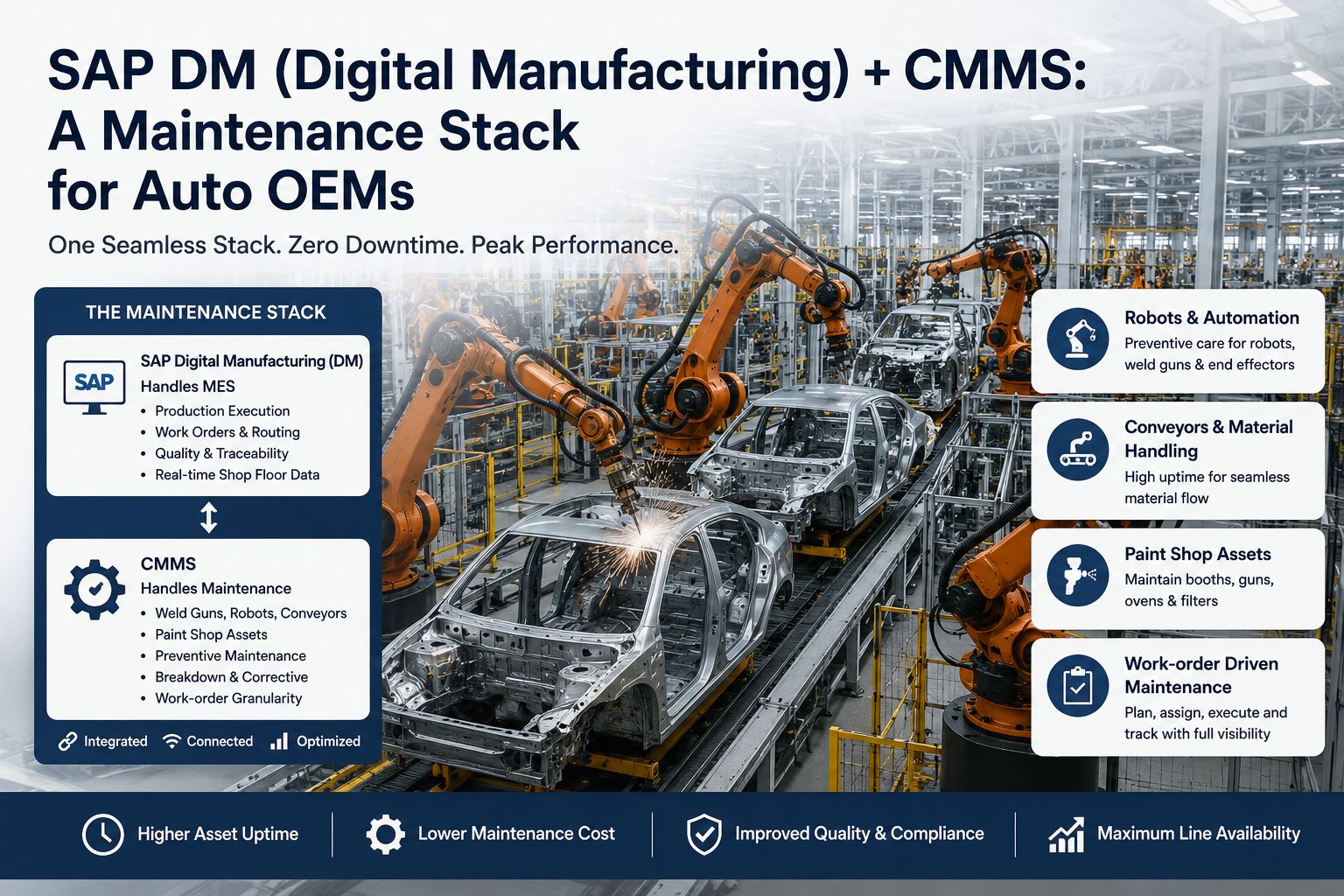
An automotive OEM plant loses around $2.3 million per hour to unplanned downtime — the highest figure in any manufacturing sector. A single robotic welding cell going down can run $1,000 to $10,000 per minute. For an MES Architect or Plant IT Head sitting inside an automotive OEM, that economics rewrites every architecture decision around two questions: what runs production execution, and what keeps the assets that execute it running reliably. SAP Digital Manufacturing is increasingly the answer to the first question for SAP-centric OEMs. It is not the answer to the second. This guide walks through the architecture pattern emerging across automotive OEMs in 2026 — SAP DM at the MES layer, a dedicated CMMS at the maintenance layer — and the integration, governance, and ROI math that makes the pairing work.
Why the MES and the CMMS are not the same system
There is a recurring confusion in automotive plant IT discussions: the assumption that a modern MES like SAP Digital Manufacturing handles maintenance because it touches the equipment. It does not, and it was not designed to. The ISA-95 standard that defines manufacturing IT architecture is explicit about this. MES sits at Level 3 and orchestrates production execution — production orders, work-in-process tracking, genealogy, traceability, quality data collection, and OEE telemetry. Maintenance management is a separate Level 3 concern with its own data model, its own user workflows, and its own integration footprint to ERP and the shop floor.
Automotive OEMs that have tried to make SAP DM carry the maintenance load discover the boundary the hard way. SAP DM models a production order, an SFC, a routing, an operation, a recipe — not a calibration interval, a CML thickness, a vibration spectrum, or a fluid sample. It tracks operator confirmations, not technician work orders. It can ingest equipment status, but it does not run PM scheduling, mobile execution, spare parts reservation, or root-cause analysis. Trying to bolt those workflows into SAP DM through custom development produces exactly the same architectural debt that pushed automotive OEMs off SAP MII in the first place.
The ISA-95 reference architecture, applied to an automotive OEM plant
At Level 3, both SAP DM and OxMaint coexist. They are peers, not parent and child. SAP DM consumes production orders from S/4HANA, executes them, and posts confirmations back. OxMaint consumes asset master data from S/4HANA, manages the maintenance lifecycle of every asset SAP DM executes against, and posts work order completion back to S/4. The two systems exchange data with each other only on specific operational events — an unplanned stop, a planned shutdown, an OEE threshold breach, a quality deviation linked to equipment.
The integration pattern: three data flows that make the architecture work
The integration is not point-to-point spaghetti. It is three well-defined data flows running on standard APIs — SAP OData V4 for clean-core ERP communication, SAP BTP Integration Suite or equivalent middleware for the MES handshake, and OPC UA or REST for shop-floor connectivity. No custom ABAP. No proprietary connectors. The three flows below cover roughly 95 percent of operational integration needs for an automotive OEM plant.
What each system owns in an automotive OEM context
Architecture decisions cluster in the grey area between systems. The split below is the boundary line most automotive OEMs converge on after the first 6 to 12 months of running SAP DM and a dedicated CMMS together. Every item to the left of the boundary is a SAP DM concern. Every item to the right is a CMMS concern. Items that touch both systems flow through the integration layer described above.
- Production order release & routing
- Shop floor control (SFC) tracking
- Operator confirmations & clocking
- Vehicle genealogy & traceability
- IATF 16949 traceability evidence
- Quality data collection at workstation
- OEE telemetry per line & cell
- Real-time WIP visibility
- Andon escalation
- Production reporting to S/4HANA
- PM scheduling & condition-based triggers
- Mobile work order execution
- Robot & cell maintenance plans
- Spare parts reservation against work orders
- Technician qualification & skill matrix
- Root cause analysis on breakdowns
- Calibration of torque guns & vision systems
- MTTR / MTBF / PM compliance dashboards
- Vibration trend & predictive maintenance
- Turnaround and shutdown work packs
Where the OEE numbers actually move
OEE in an automotive OEM is the headline metric. Availability, Performance, and Quality multiplied together. Most plants run somewhere between 58 and 78 percent. World-class is 85 percent and above. The architectural question is which system actually drives improvements in each component — because that determines where to invest. Below is the split, drawn from documented automotive OEM deployments.
The point of the split is concrete: the Availability component, which is typically the largest single OEE loss in automotive plants, is owned by the maintenance system. A documented Tier 2 automotive parts manufacturer case study moved OEE from 58 to 82 percent in 14 months, with unplanned downtime falling 71 percent, by addressing exactly this — bringing PM compliance up, catching bearing degradation 18-22 days before failure on hydraulic presses, recalibrating worn servo motors on welding cells. The MES surfaced the loss. The CMMS fixed the cause.
The asset classes a CMMS has to model in automotive
An automotive OEM plant is not a uniform asset population. Body shop, paint shop, and assembly each carry different equipment, different failure modes, different PM strategies, and different IATF 16949 documentation requirements. The CMMS has to model each correctly or the maintenance team ends up with templates that do not match the equipment they cover.
| Asset class | Plant area | Primary failure mode | PM strategy |
|---|---|---|---|
| Robotic welding cells | Body shop | Servo motor wear, weld gun contamination | Vibration trend + welds-per-tip cycle count |
| Stamping presses | Press shop | Hydraulic pressure loss, die wear | Pressure trend + die-cycle interval |
| Paint robots & booths | Paint shop | Atomiser blockage, conveyor jam, environmental drift | Cycle-based + condition triggers from booth sensors |
| Conveyor systems | All | Bearing degradation, chain wear, drive motor | Vibration + runtime hours |
| CNC machining centres | Powertrain | Spindle bearing wear, tool breakage | Spindle hours + thermal trend |
| Torque guns & tools | Assembly line | Calibration drift | IATF 16949 calibration cycle |
| Vision systems & sensors | All | Lens contamination, calibration drift | Cleaning cycle + calibration interval |
| Conveyor & AGV fleet | Assembly & logistics | Battery degradation, sensor failure, wheel wear | Charge cycle count + condition triggers |
| Air handling & HVAC | Paint shop, ovens | Filter loading, fan bearing wear | Differential pressure + runtime hours |
IATF 16949 traceability: where the systems hand off
Tier 1 and Tier 2 suppliers to OEMs including Stellantis, Renault, and Volkswagen face documented OEE thresholds and IATF 16949 traceability requirements as conditions of contract renewal. The traceability burden is real — every component must trace back through production history with audit-grade evidence. The split between MES and CMMS here is sharp. SAP DM owns the component traceability — what was made, when, on what line, by which operator, with which torque value, against which work instruction. The CMMS owns the equipment evidence — what state was the line in, when was it last calibrated, was the PM current, was there an open work order against the asset at the time of production.
During an IATF audit, the auditor pulls a vehicle VIN or a component lot. SAP DM produces the production history. OxMaint produces the equipment state — every PM signed off, every calibration certificate current, every torque gun within tolerance, every maintenance signature on the maintenance log for the line in question. The two evidence packages link via the asset ID and timestamp, and the auditor moves on. Plants running paper logs, spreadsheets, or a generic CMMS without IATF-aware workflows fail this evidence test routinely.
The 5-year ROI math for an automotive OEM plant
The ROI case for pairing SAP DM with a dedicated CMMS is not abstract. It is downtime hours recovered, multiplied by the cost-per-hour of automotive production, less the cost of the platform. The model below uses mid-range numbers for a single OEM plant running 4 to 6 production lines, 800 to 1,200 maintained assets, and an annual maintenance budget of $8 million to $15 million. Numbers are conservative against the published 71 percent downtime reduction and 58 to 82 percent OEE shift seen in field deployments.
| ROI component, single OEM plant | Annual value | 5-year cumulative |
|---|---|---|
| Unplanned downtime reduction (30-50 percent) | $3.5M - $8M | $17M - $40M |
| OEE improvement (8-15 percentage points) | $2M - $5M | $10M - $25M |
| Reactive-to-preventive shift, maintenance cost | $0.8M - $2M | $4M - $10M |
| Spare parts inventory optimisation | $200K - $600K | $1M - $3M |
| Audit preparation time, IATF + corporate | $120K - $300K | $600K - $1.5M |
| Reduced consultant & ABAP development | $200K - $600K | $1M - $3M |
| Total annual value | $6.8M - $16.5M | $33.6M - $82.5M |
Against this, the cost of the CMMS layer for a single plant runs in the low-to-mid six figures annually on a flat-subscription model — including unlimited users and unlimited assets within the plan. The payback period is measured in months, not years. The reason is structural: in automotive, the cost of one hour of downtime exceeds the annual cost of the entire maintenance management platform.
The rollout pattern that works for multi-plant OEM networks
Automotive OEMs do not run single plants. They run networks — 8 to 20 plants across regions, multiple vehicle programmes, varying degrees of automation, mixed legacy systems. The rollout pattern that has emerged from successful deployments follows three phases, with the CMMS deliberately rolled out alongside the SAP DM cutover rather than after it.
Frequently asked questions
Why not build maintenance into SAP DM directly?
How does OxMaint integrate with SAP DM?
Does OxMaint support IATF 16949 traceability requirements?
Is OxMaint available on-premise as well as cloud?
Can we deploy OxMaint before SAP DM cutover is complete?
What about plants still on SAP ECC, not S/4HANA?
How quickly does the OEE number actually move?
How does OxMaint price for a multi-plant OEM network?
See the SAP DM + CMMS architecture for your OEM plant
Walk through the integration pattern, the asset class workflows, the IATF 16949 evidence model, and the 5-year ROI math against your specific plant on a 30-minute call. Bring your current OEE baseline and unplanned downtime numbers — we will build the case against them live.