SAP PM pricing is famously opaque. Talk to ten oil and gas operators running SAP PM today and you will hear ten different numbers — because SAP rarely publishes enterprise rate cards, list prices are routinely discounted 30 to 50 percent on volume commitments, and the true cost of running SAP PM in an upstream, midstream, or downstream operation only becomes visible once integration, customisation, and annual maintenance fees are added in. For an upstream IT lead or a downstream refinery CFO building a 5-year TCO model, that opacity is the problem. This guide breaks down the per-user, per-site, and per-asset pricing structure of SAP PM for oil and gas operations in 2026 — and benchmarks it against a flat-subscription CMMS alternative, with a worked example for a 5,000-asset refinery so the numbers stop being abstract.
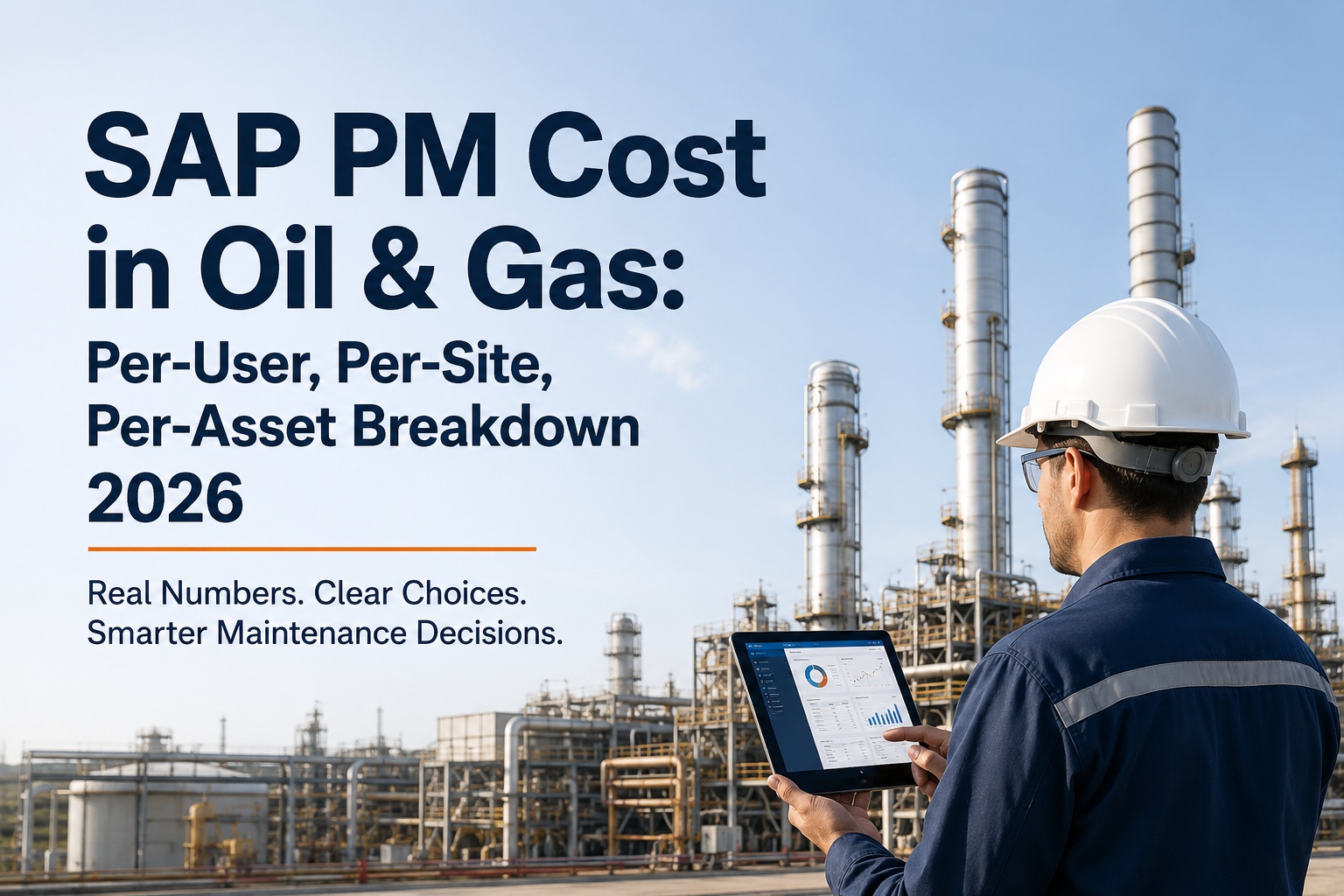
SAP PM Cost in Oil & Gas: Per-User, Per-Site & Per-Asset Pricing Breakdown for 2026
Transparent comparison of SAP PM costs for upstream and downstream operations — enterprise licensing, implementation, integration, and maintenance fees — versus a flat-subscription CMMS alternative built for refinery, pipeline, and field operations.
Why SAP PM pricing is hard to pin down
SAP runs four distinct commercial models that collide in any oil and gas deployment. RISE with SAP bundles software, infrastructure, and services under Full-Use Equivalent licensing. S/4HANA Cloud Public Edition uses straightforward per-user-per-month pricing. S/4HANA Private Edition continues on FUE. Perpetual on-premise licensing is still common in oil and gas, where heavy customisation, sovereign hosting, and decade-plus deployments favour ownership over subscription. Within those four models, every customer negotiates a unique discount stack against unpublished list prices.
For oil and gas specifically, three structural factors push pricing higher than the published averages. The asset count is enormous — a single mid-sized refinery handles 5,000 to 15,000 maintained assets across rotating equipment, static vessels, piping circuits, instrumentation, and electrical distribution. The user base is broad — operators, maintenance planners, reliability engineers, inspectors, contractors, and field technicians all touch the maintenance system. And the integration footprint is heavy — SCADA, OSIsoft PI, DCS historians, MES, and process safety systems all feed data the CMMS must consume. Each of those factors shows up as a line item on the implementation invoice.
The four SAP PM commercial models, at a glance
Per-user pricing: what you actually pay before discounts
User counting in SAP is its own discipline. SAP user types are weighted differently — Advanced, Core, Self-Service, Developer — and in FUE licensing the weighted count drives the bill, not the headcount. Refineries and upstream operators routinely over-assign Advanced tier licenses when Core or Self-Service would suffice, and proper user classification at project onset can reduce licensing costs by 20 to 30 percent. The published price ranges below are starting points; actual rates depend on contract size, multi-year commitment, and the geography of deployment.
| User class | SAP S/4HANA range | Tier 1 CMMS (Maximo, AVEVA APM) | OxMaint flat plan |
|---|---|---|---|
| Maintenance planner / advanced | $200-$350/user/mo | $200-$300/user/mo | Included in flat fee |
| Reliability engineer / inspector | $150-$250/user/mo | $150-$250/user/mo | Included in flat fee |
| Field technician / mobile | $80-$150/user/mo | $100-$200/user/mo | Included in flat fee |
| Contractor / occasional | $40-$90/user/mo | $40-$100/user/mo | Included in flat fee |
| Self-service viewer | $20-$50/user/mo | $25-$60/user/mo | Included in flat fee |
Per-site costs: the integration footprint
Per-user pricing is only one slice of the SAP PM bill. Each site brings its own integration cost — SCADA tie-in, OSIsoft PI System bridge, DCS historian connection, MES handshake, document management integration, and identity federation with corporate Active Directory. For a multi-site oil and gas major running 8 to 15 facilities across upstream, midstream, and downstream, the per-site implementation tail is often larger than the per-user license total in the first three years.
| Per-site cost line | SAP PM typical range | OxMaint range |
|---|---|---|
| Initial site onboarding | $80K-$250K per site | $8K-$25K per site |
| SCADA / PI / DCS integration | $150K-$500K per integration | Included in subscription via BACnet / Modbus / OPC-UA / API connectors |
| Identity & SSO setup | $30K-$80K per site | Included in subscription, SAML / OIDC |
| Mobile rollout per site | $40K-$150K | Included; mobile app free for all users |
| Site-specific custom workflow | $50K-$250K per major workflow | Configurable in-platform, no ABAP equivalent |
| Training & change management | $25K-$120K per site | $5K-$20K typical per site |
Per-asset cost: the line item nobody quotes upfront
A refinery does not have ten thousand users. It has ten thousand assets. Per-asset cost is where the maintenance system pricing actually lands on the operations budget, and where SAP PM and CMMS alternatives diverge most visibly. SAP PM does not publish a per-asset price — assets are functional locations and equipment records inside a broader S/4HANA licence, and the cost is embedded in the implementation effort to model, import, and maintain the asset hierarchy. Modern CMMS platforms increasingly expose per-asset pricing directly, which makes scaling from 5,000 to 15,000 assets a known cost rather than a surprise.
A worked example: 5,000-asset refinery, 5-year TCO
Numbers without context are abstract. This is a mid-sized downstream refinery — 5,000 maintained assets, 120 maintenance and reliability users (40 planners and engineers, 60 technicians, 20 contractors and viewers), one production site, integrations to OSIsoft PI and a DCS historian, mobile rollout to the technician group. The model below uses mid-point estimates from the ranges above, with enterprise SAP discounting at 35 percent off list. OxMaint is modelled at its published flat-subscription pricing for a refinery-class deployment.
| Cost line, 5-year horizon | SAP PM, mid-point estimate | OxMaint flat subscription |
|---|---|---|
| Software licensing · 120 users, 5 years | $1.2M-$1.8M | Flat fee, $180K-$300K total |
| Initial implementation | $1.5M-$3M | $35K-$80K |
| SCADA / PI / DCS integration | $400K-$900K | Included in subscription |
| Mobile deployment | $80K-$200K | Included |
| Annual maintenance / support, 5 yr | $900K-$1.6M | Included |
| Customisation & ABAP development | $300K-$800K | Configurable, no equivalent |
| Training & change management | $80K-$200K | $10K-$25K |
| Internal IT FTE allocation, 5 yr | $600K-$1.2M | $80K-$200K |
| 5-year total TCO | $5.0M-$9.7M | $305K-$605K |
The difference is not subtle. A 5,000-asset refinery looking at SAP PM for the maintenance function alone is committing to a 5-year cost envelope somewhere between $5 million and $10 million. The same operational scope on a dedicated CMMS subscription lands an order of magnitude lower. The gap does not exist because one platform is dramatically more capable than the other — it exists because SAP PM is part of a much larger ERP licensing model that absorbs maintenance as a sub-module, while a focused CMMS is priced specifically for the maintenance workload.
Hidden costs that rarely make the first quote
Most failed SAP PM rollouts in oil and gas do not fail because of the published price. They fail because the published price was a fraction of the actual cost by year three. The hidden cost categories below appear consistently in post-implementation reviews — and they apply less or not at all to flat-subscription CMMS platforms because the commercial model is structurally different.
A pattern is visible across these six hidden cost categories. Each one scales with the size of the deployment, the number of customisations, and the years the system has been running. SAP PM in oil and gas does not get cheaper over time. The licence base grows as the operator adds users, the customisation footprint expands as new workflows are bolted on, and the basis administration overhead compounds with each major upgrade cycle. The flat-subscription model on a dedicated CMMS is structurally different — the headline cost is the cost, and the absence of these hidden categories is the actual commercial advantage, not the lower starting price.
Where the value actually closes for oil & gas operators
Deloitte's 2024 analysis of asset-intensive energy operations found that a well-implemented CMMS reduces overall maintenance costs by up to 36 percent within the first 24 months of full adoption. That number applies regardless of which CMMS sits underneath. The operating case for either SAP PM or a flat-subscription CMMS is the same — fewer breakdowns, faster MTTR, higher PM compliance, better turnaround execution. The difference is the cost of capturing it.
The honest framing is that SAP PM and a dedicated CMMS solve the same operational problem at very different commercial commitments. For an oil and gas major already running SAP at the corporate ERP layer, the integration argument for SAP PM is real — and the discount math at scale narrows the headline gap. For mid-sized refineries, single-asset upstream operators, midstream pipeline operators, and downstream terminal networks, the TCO case for a dedicated CMMS is overwhelmingly clear. The job of any vendor selection exercise is to make those tradeoffs visible before the contract is signed, not after.
How OxMaint prices for oil and gas operations
OxMaint runs a flat-subscription commercial model — per organisation or per site, with unlimited users and unlimited assets inside the plan. Both on-premise and cloud deployments carry the same feature set and the same pricing logic. For oil and gas operators specifically, the platform includes API standard compliance workflows for 510, 570, 580, 581, 653, native OSIsoft PI integration, offline-capable mobile for remote wellsites and offshore platforms, and process safety management module support out of the box.
The commercial logic behind the flat model is straightforward. A refinery should not pay more for the CMMS because it onboarded a turnaround contractor crew of 60 technicians for six weeks. A pipeline operator should not pay more because it added 2,000 cathodic protection assets to the registry. The maintenance system's job is to support the operation, not to penalise it for growth.
Frequently asked questions
Is OxMaint trying to replace SAP entirely?
Can OxMaint integrate with SAP for an oil and gas operator running S/4HANA?
Is the platform suitable for upstream, midstream, and downstream?
Does OxMaint support API 510, 570, 580, 581, and 653 workflows?
Is OxMaint available on-premise?
How does the SAP discount math actually work?
What is a realistic pilot timeline for an oil and gas operator?
How is the per-asset cost actually calculated?
See the TCO model for your specific oil & gas operation
Walk through the per-user, per-site, per-asset cost model with your actual asset count, user mix, and integration scope on a 30-minute call. Bring your existing SAP PM cost baseline — we will build the side-by-side comparison live.