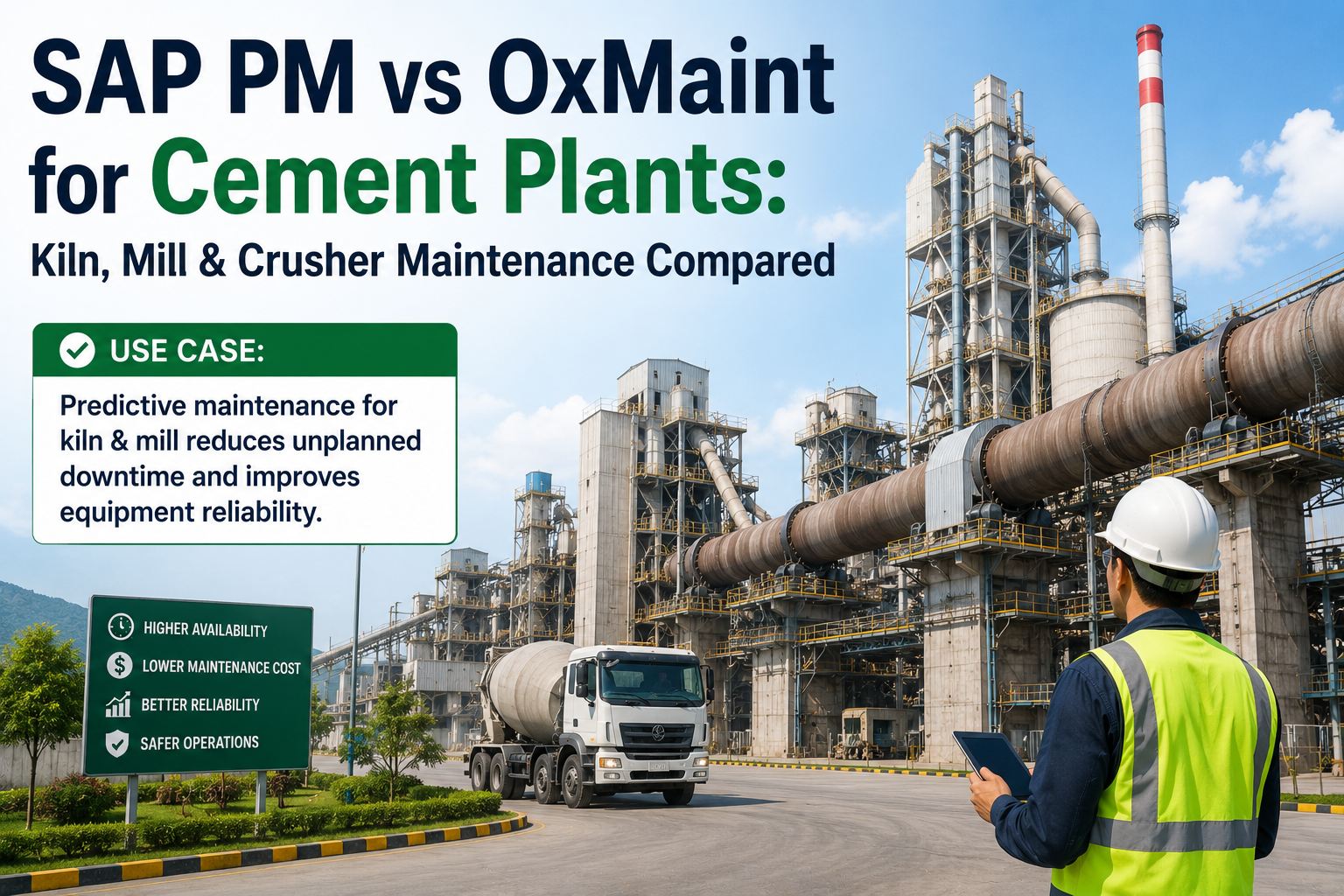
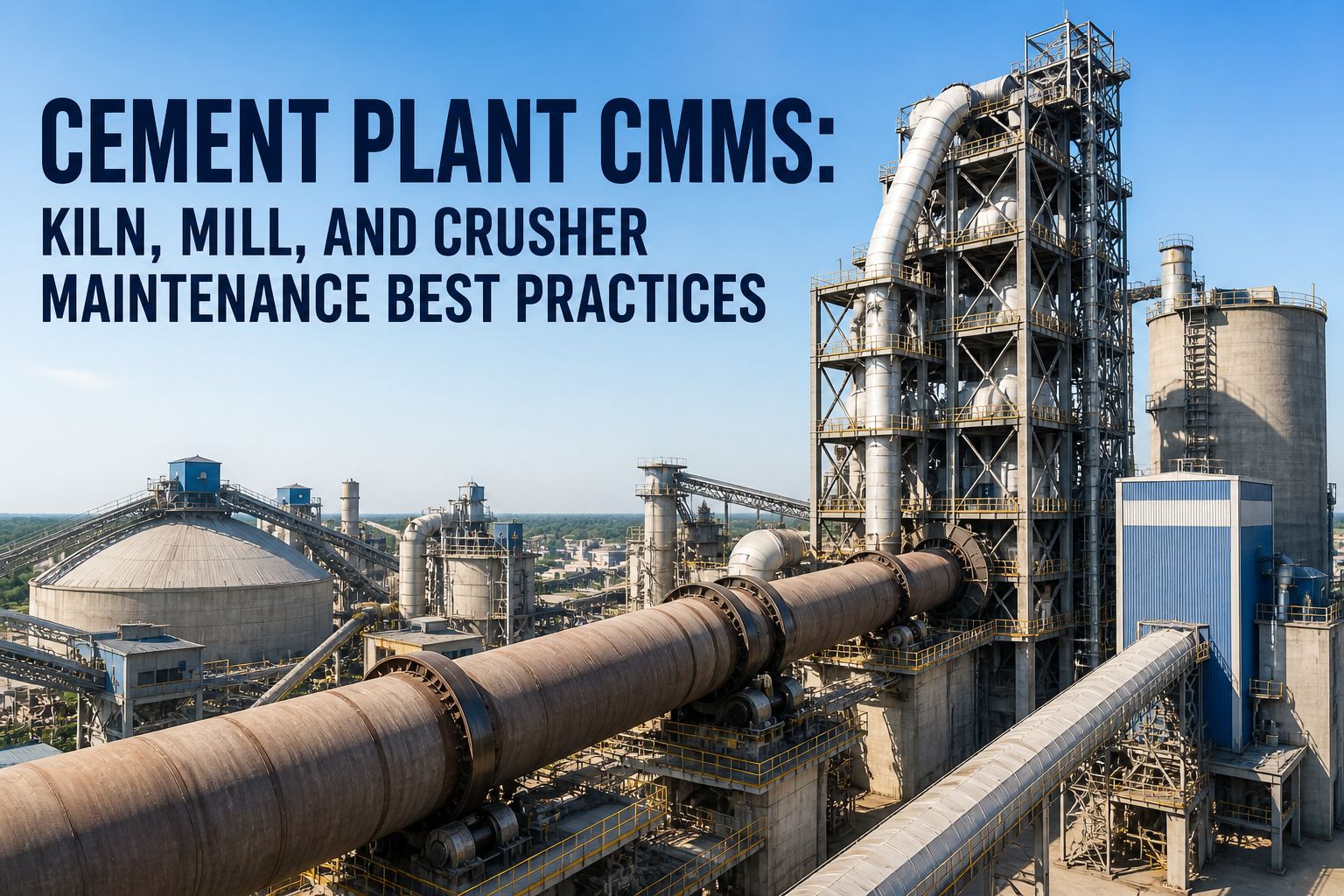
SAP PM vs OxMaint for Cement Plants: Kiln, Mill & Crusher Maintenance Compared
By Riley Quinn on May 12, 2026
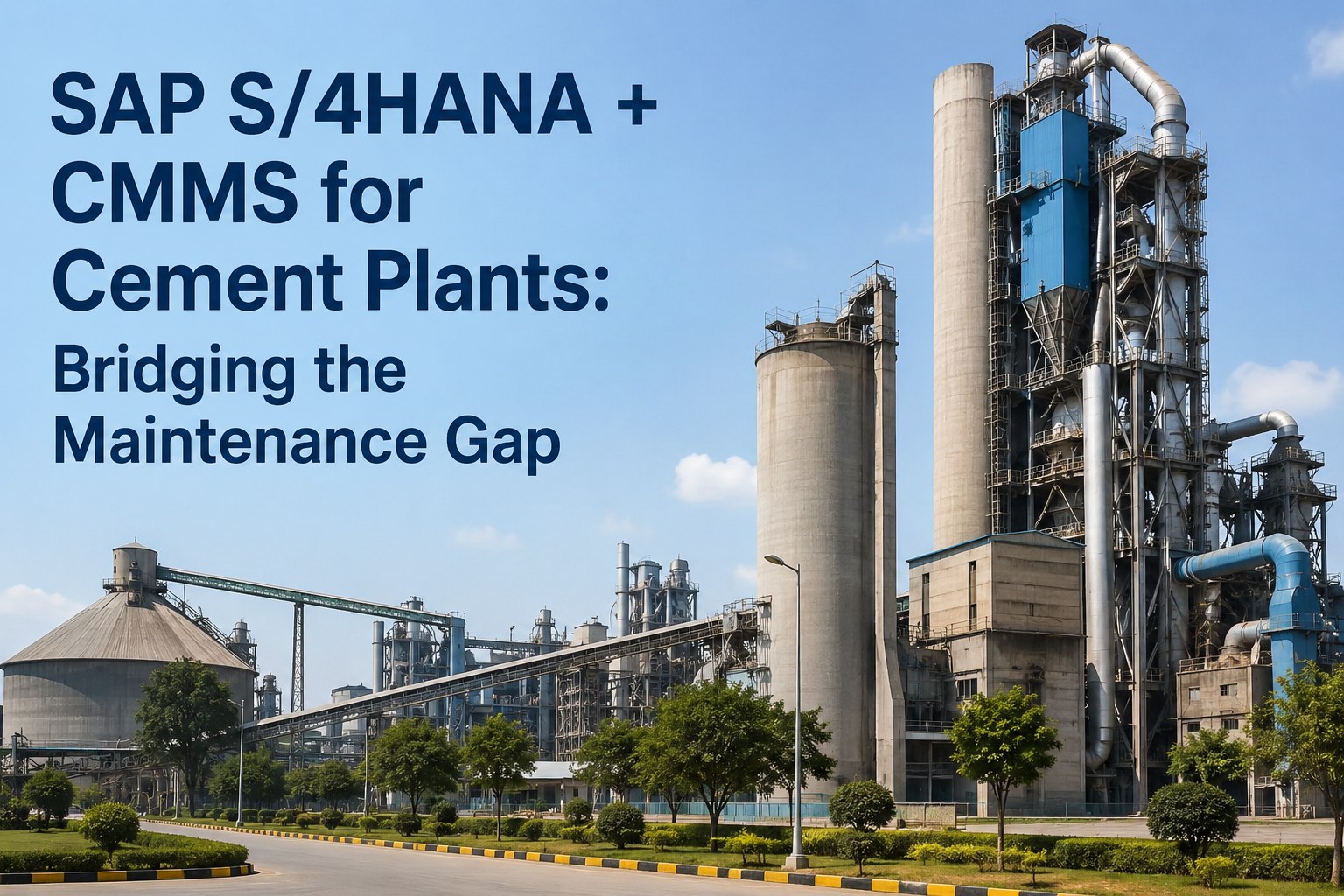
If you run a cement plant on SAP PM today, you already know the story. Kiln vibration alarms live in one system, work orders in another, throughput tonnage in a third, and someone manually copies numbers between them at the start of every shift. SAP PM is excellent at financial integration with S/4HANA. It is not built for cement-specific maintenance — revolution-counter PM triggers on the kiln, tonnage-based liner wear on the mill, ISO 10816 vibration thresholds on the crusher bearings. Most cement plants running on SAP PM end up paying $15,000 to $40,000 per kiln in custom ABAP development just to reach feature parity with what a purpose-built cement CMMS ships on day one. The honest comparison most SAP partners won't put in writing: for kiln, mill, and crusher maintenance, SAP PM is a financial system bolted to a maintenance use case. OxMaint is a maintenance system that integrates back to your financials. Book a free demo of cement plant CMMS software.
CEMENT-SPECIFIC FEATURE MATRIX
SAP PM Costs $15-40K Per Kiln in Custom ABAP to Match Cement-Specific CMMS Features. OxMaint Ships Them Standard.
Cement plants have unique maintenance signatures — revolution-counter PMs on the kiln, throughput-based liner wear on mills, ISO 10816 vibration thresholds on crusher bearings, refractory zone tracking, girth gear wear progression. SAP PM treats all of this as generic time-based maintenance unless your team writes custom ABAP. OxMaint ships these as default configuration. All running on NVIDIA on-prem AI hardware behind your firewall. Pilot in 6 to 12 weeks. Source code included.
The On-Prem Server Stack — Cement-Specific AI, Behind Your Firewall
Cement plant data is competitive IP — fuel mix recipes, kiln operating envelopes, mill specific power benchmarks. Three pieces of NVIDIA hardware sit in your control room, never connect to the public internet, and run your full cement-specific CMMS plus AI predictive layer. Book a free demo of cement plant CMMS software.
EDGE · VIBRATION LISTENER
NVIDIA Jetson AGX Orin The Kiln & Mill Listener
JobReads vibration, kiln shell temp, mill power, gas analyzers
SpeedSub-second updates from every sensor
WhereMounts at kiln, mill, and crusher control rooms
FormRuggedized box, fits in switchgear cabinet
What it does: Captures continuous vibration from kiln support rollers, mill main drive, crusher main bearings, ID fan rotors. Applies ISO 10816 thresholds locally. Pushes only anomalies upstream — no flooding the network.
ISO 10816VIBRATION + THERMAL + OIL
CONTROL ROOM · CMMS BRAIN
RTX PRO 6000 Blackwell The Cement CMMS Brain
JobRuns cement-specific CMMS + AI predictive models
SpeedAnomaly to work order in under 10 seconds
WhereSits in your control room behind your firewall
FormTower computer, fits under a desk
What it does: Runs OxMaint with cement-specific asset library, revolution-counter PMs, tonnage triggers, refractory zone tracking. AI models predict bearing, girth gear, and roller failures 2-6 weeks ahead.
2-6 WKFAILURE WARNING LEAD TIME
ENTERPRISE · FLEET RELIABILITY
NVIDIA DGX Station GB300 · Fleet Reliability Brain
JobAggregates reliability data across all cement plants
SpeedCross-plant pattern matching in hours
WhereSits at corporate HQ in a server rack
FormRack-mounted, 24/7 enterprise grade
What it does: Compares MTBF, MTTR, and OEE across all your cement plants. Surfaces best-performing maintenance practices. Ranks plants on reliability KPIs your VP of Operations needs.
FLEETMTBF · MTTR · OEE BENCHMARK
100%
Stays inside your plant · never goes online
$0/mo
No subscription · buy once, own forever
Offline
Works fully air-gapped if your team requires it
Yours
Source code included · modify it freely
The Cement-Specific Feature Matrix — SAP PM vs OxMaint, Line by Line
Eight cement-specific capabilities that decide whether your kiln, mill, and crusher maintenance runs on a system designed for it or on a financial module retrofitted for it. Each row shows SAP PM's out-of-the-box capability, custom ABAP cost to match OxMaint, and OxMaint's standard configuration. Sign up free for cement plant CMMS software.
CEMENT-SPECIFIC FEATURE
SAP PM
ABAP TO MATCH
OxMaint
Kiln revolution-counter PM triggers
Trigger inspections by rotations · not days
Generic time-based only
$15-40K
Standard
Mill tonnage-based liner wear tracking
Liner inspection scales with throughput
Time-based intervals only
$12-28K
Standard
ISO 10816 vibration → auto-WO
Vibration spike triggers cement-specific WO
Requires integration layer
$25-60K
Standard
Kiln shell thermal scan integration
Refractory hot-spot · zone-by-zone tracking
No native scan support
$10-22K
Standard
Girth gear wear progression
Tooth profile + lube condition · trend
Generic asset record only
$8-18K
Standard
Crusher PM intervals by tons-crushed
Jaw, hammer, gyratory wear by throughput
Time-based PMs only
$6-14K
Standard
AI predictive failure scoring
Bearing, gear, roller failure 2-6 wk ahead
Not available
$80-200K+
Included
Pyro section dashboards
Preheater, calciner, kiln, cooler unified
Generic Fiori tiles only
$12-30K
Standard
TYPICAL CUSTOM ABAP TOTAL FOR FEATURE PARITY
$168-412K per kiln line
Three Real Cement Plant Scenarios — Where the Choice Pays Off
Three real scenarios from cement plant heads who moved kiln, mill, and crusher maintenance from SAP PM to OxMaint. Each shows the exact moment the decision started paying for itself. Book a free demo of cement plant CMMS software.
SCENARIO 01
"Our VRM trips at 9.0 mm/s vibration once a quarter. SAP PM tells us after the fact. Can a cement-specific CMMS catch it days earlier?"
THE PROBLEM
Cement plant runs a 240 TPH vertical roller mill. Once a quarter it trips at 9.0 mm/s vibration — followed by emergency repairs at $18,000-$32,000 per hour of stoppage. SAP PM logs the breakdown after it happens. Vibration data lives in an isolated PI Historian. Warning signs were there for 3-5 days but nobody connected the dots.
HOW OXMAINT SOLVES IT
The Kiln & Mill Listener (Jetson)
Reads VRM body vibration, hydraulic accumulator pressure, nozzle ring delta-P, roller hour counter every second. Applies ISO 10816 thresholds for vertical mills locally.
The CMMS Brain (RTX)
AI model detects rising vibration trend 4 days ahead. Auto-WO created with diagnosis (bed thickness drift), recommended fix (recirculation gate adjustment), reliability engineer assigned. Mobile alert in 8 seconds.
Planned Window
20-minute process correction during planned downtime — instead of 14-hour emergency relining. No production lost.
THE RESULT
VRM trips eliminated for 3 quarters straight. $420K saved on prevented emergency relining + lost production.
SCENARIO 02
"Our kiln support roller bearings failed twice in 18 months. SAP PM ran the calendar-based PMs perfectly. What changes with a cement-specific CMMS?"
THE PROBLEM
3,500 TPD dry-process kiln. Support roller bearings catastrophically failed twice in 18 months — $1.2M direct repair + $600K lost production each time. SAP PM ran quarterly time-based PMs as scheduled. They caught nothing. Failure mode was bearing fatigue from accumulated kiln revolutions, not calendar time.
HOW OXMAINT SOLVES IT
Revolution-Counter PMs (Standard)
Kiln support roller PMs tied to actual revolution count, not days. Tonnage-based liner wear tracking on the mill. Cement-specific defaults — zero custom ABAP needed.
The CMMS Brain (RTX) + AI
AI predictive model learns bearing degradation signature from vibration + temperature + revolution data. Issues failure-probability score updated daily. Lead time: 2-6 weeks before mechanical failure.
Planned Bearing Replacement
Replace bearings during next scheduled stoppage with parts already on order. SAP PM finance integration unchanged for cost accounting.
THE RESULT
Zero catastrophic bearing failures in 14 months. $1.8M avoided per prevented event.
SCENARIO 03
"Our SAP partner quoted $180K to add cement-specific maintenance features in ABAP. What's the alternative?"
THE PROBLEM
Integrated cement company with 3 plants. SAP partner quoted $180K + 9 months to develop revolution-counter PMs, tonnage triggers, vibration integration, and refractory zone tracking in custom ABAP. Plus $30-50K/year ongoing ABAP support. CIO is asking IT: is there really no off-the-shelf option that ships these features standard?
HOW OXMAINT SOLVES IT
Cement Edition · Pre-Configured
OxMaint ships with cement-specific asset library, revolution-counter PMs, tonnage triggers, refractory zone tracking, kiln/mill/crusher templates — all out-of-the-box. Zero ABAP. Zero custom dev.
Sits Alongside SAP PM
OxMaint handles maintenance, SAP keeps financial integration. Work order costs flow back to SAP PM via standard API for cost-center accounting. No SAP ECC reconfiguration needed.
3-Plant Rollout
All 3 plants live in 10 weeks vs 9 months. Standard cement templates accelerate per-plant configuration. Fleet reliability dashboard across all sites from week 12.
THE RESULT
3 plants live in 10 weeks vs 9-month ABAP path. $140K saved on dev + $30K/yr support eliminated.
$2-3M/yr
Typical annual value at a mid-size cement plant when moving kiln, mill, and crusher maintenance from SAP PM to a cement-specific CMMS — prevented catastrophic failures, eliminated emergency repairs, optimized PM intervals, AI-driven predictive lead time. Most cement plants reach break-even within the first 6 months.
See the Cement-Specific Feature Matrix Live on Your Equipment.
Book a 30-minute demo with our cement reliability team. We map your kiln, mill, crusher, and pyro section assets to OxMaint's cement edition. You leave with a side-by-side comparison against your current SAP PM configuration, plus a 6-to-12-week pilot plan. Buy it once, own it forever — no monthly fees, source code included.
The most common questions cement plant heads, reliability engineers, and CIOs ask when evaluating OxMaint as an SAP PM alternative for kiln, mill, and crusher maintenance. Sign up free for cement plant CMMS software.
Do we have to replace SAP PM entirely?
No. Most cement plants run OxMaint alongside SAP PM. OxMaint handles cement-specific maintenance — kiln, mill, crusher PMs, vibration monitoring, AI predictive models, pyro section dashboards. SAP PM keeps doing what it does best: financial cost-center integration with S/4HANA, asset depreciation, capex tracking. Work order costs flow from OxMaint back to SAP PM via standard API. Your CFO sees the same SAP PM reports. Your maintenance team uses a cement-specific platform.
How does OxMaint compare on TCO over 5 years?
Typical cement plant 5-year TCO: SAP PM with cement-specific ABAP development ranges $400K-$900K (initial ABAP $168-412K per kiln line + annual support $30-80K + S/4HANA license growth). OxMaint perpetual license + optional hardware ranges $180K-$420K total over 5 years, with no recurring software fees after initial purchase. Real savings come from prevented downtime — typical cement plant saves $2-3M/year in avoided emergency repairs, with payback in months not years.
Can OxMaint pull data from our existing PI Historian and DCS?
Yes. The Jetson sensor hub integrates with major plant systems: OSIsoft PI / AVEVA, ABB 800xA DCS, Siemens PCS 7, Honeywell Experion, Yokogawa Centum, Emerson DeltaV. Standard protocols supported: OPC-UA, OPC DA, Modbus TCP, MQTT, REST, and direct historian APIs. Cement-specific sensor tags (kiln support rollers, mill main drive, crusher main bearings, ID fan rotors) are auto-mapped to the cement asset library. Most plants are reading existing sensor data within the first week of deployment.
How long until our first prevented breakdown?
Typical cement plant deployment: Weeks 1-4 — cement asset library loaded, PMs migrated from SAP PM, mobile work orders activated. Weeks 5-8 — vibration baselines on kiln support rollers, mill main drive, crusher bearings. Weeks 9-12 — AI predictive models activate after 60 days of sensor baseline. First condition-triggered work orders typically appear by week 8-10. First prevented breakdown event typically lands in months 3-6 of operation — and is often the single event that pays back the entire investment.
What if our team has 10+ years invested in SAP PM customizations?
Your SAP PM investment is preserved. OxMaint operates as the cement-specific maintenance execution layer; your existing SAP PM customizations for financial reporting, asset capitalization, and cost-center accounting continue to work. Master data (equipment, BOMs, cost centers) syncs from SAP to OxMaint via standard API. Most plants find their ABAP custom code remains 100% in production — but they stop having to add more of it for every cement-specific maintenance requirement that comes up.
Cement Edition · Side-by-Side Demo · 6-12 Week Pilot
Stop Paying for ABAP. Start Catching Failures 2-6 Weeks Early.
Book a 30-minute call with our cement reliability team. Walk through your kiln, mill, crusher assets. See the cement-specific feature matrix run on your equipment. Pilot in 6 to 12 weeks. Buy it once, own it forever — no monthly fees, source code included.