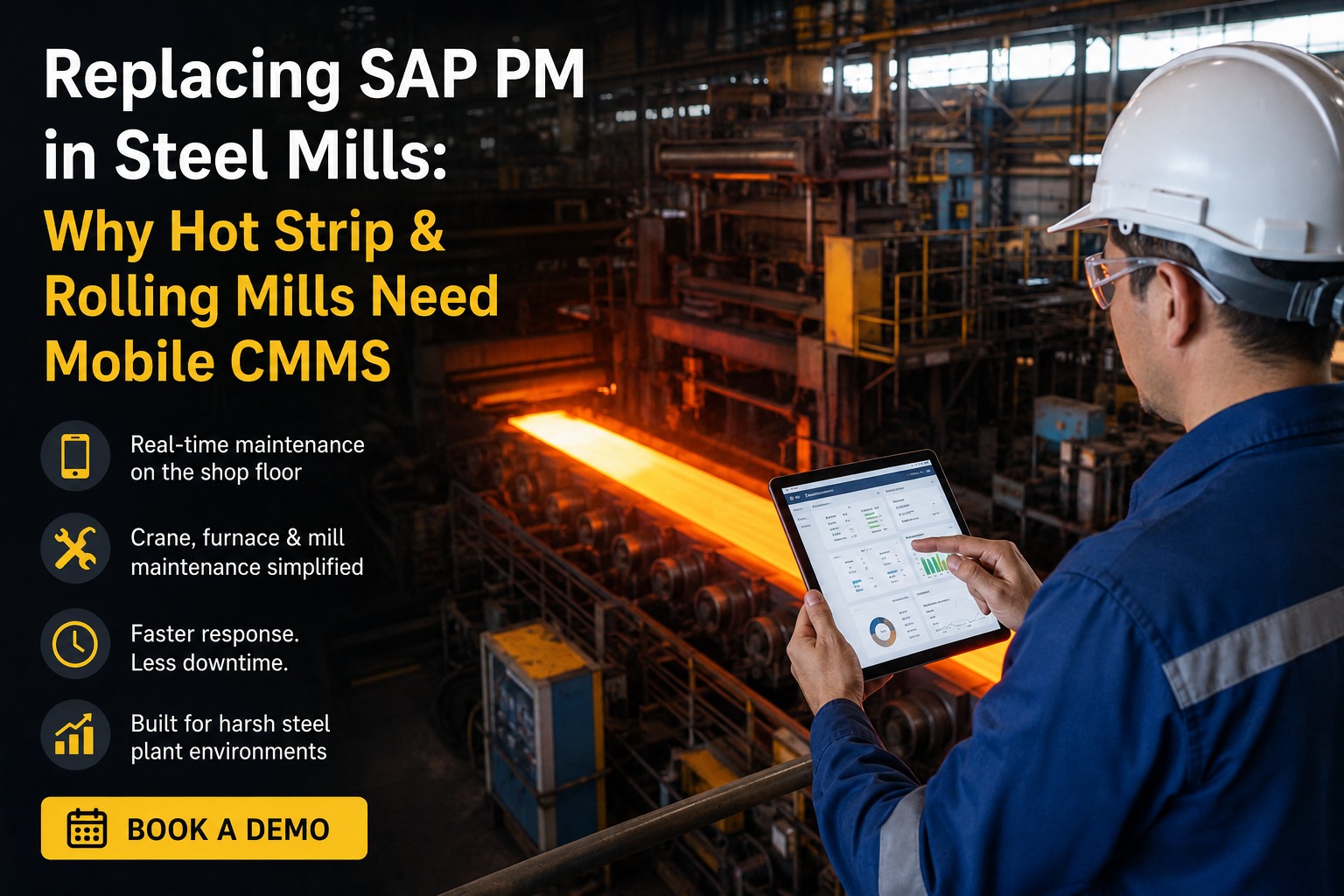
Replacing SAP PM in Steel Mills: Why Hot Strip & Rolling Mills Need Mobile CMMS
By lamine yamal on May 12, 2026
If your steel plant is running SAP PM as its primary field maintenance tool, three numbers are quietly costing you money every shift. Technician adoption under 30% on consumer-grade mobile SAP. 4–8 hour latency between a SCADA alarm and a CMMS work order. $500,000+ per finishing-stand cobble that better field-level visibility could have prevented. This is the commercial case for putting OxMaint CMMS on the shop floor as the execution layer — while SAP S/4HANA or ECC stays the financial system of record. Not a rip-and-replace. A surgical replacement of the field layer where steel mills lose the most money.
For Maintenance Heads & Mill SuperintendentsHot Strip Mill · Rolling Mill · Caster · EAF · Crane Bay
SAP PM Was Built for the Boardroom. Steel Mills Are Built Differently.
A technician with gloved hands in a hot strip mill pit cannot navigate six SAP screens to close a work order. A supervisor responding to a 2 a.m. bearing alarm cannot afford a four-hour delay between SCADA and CMMS. Replace SAP PM where it slows steel down — on the floor — and keep it where it earns its place in the back office.
The hidden cost no one models: SAP PM's licensing is the visible expense. The hidden cost is the consulting dependency — every PM trigger adjustment, new equipment class, and reporting tweak requires SAP Basis or ABAP engagement. Over 36 months, operational independence with a purpose-built CMMS reduces TCO by 60–65% at a mid-size integrated steel plant.
The Field Reality SAP PM Cannot See
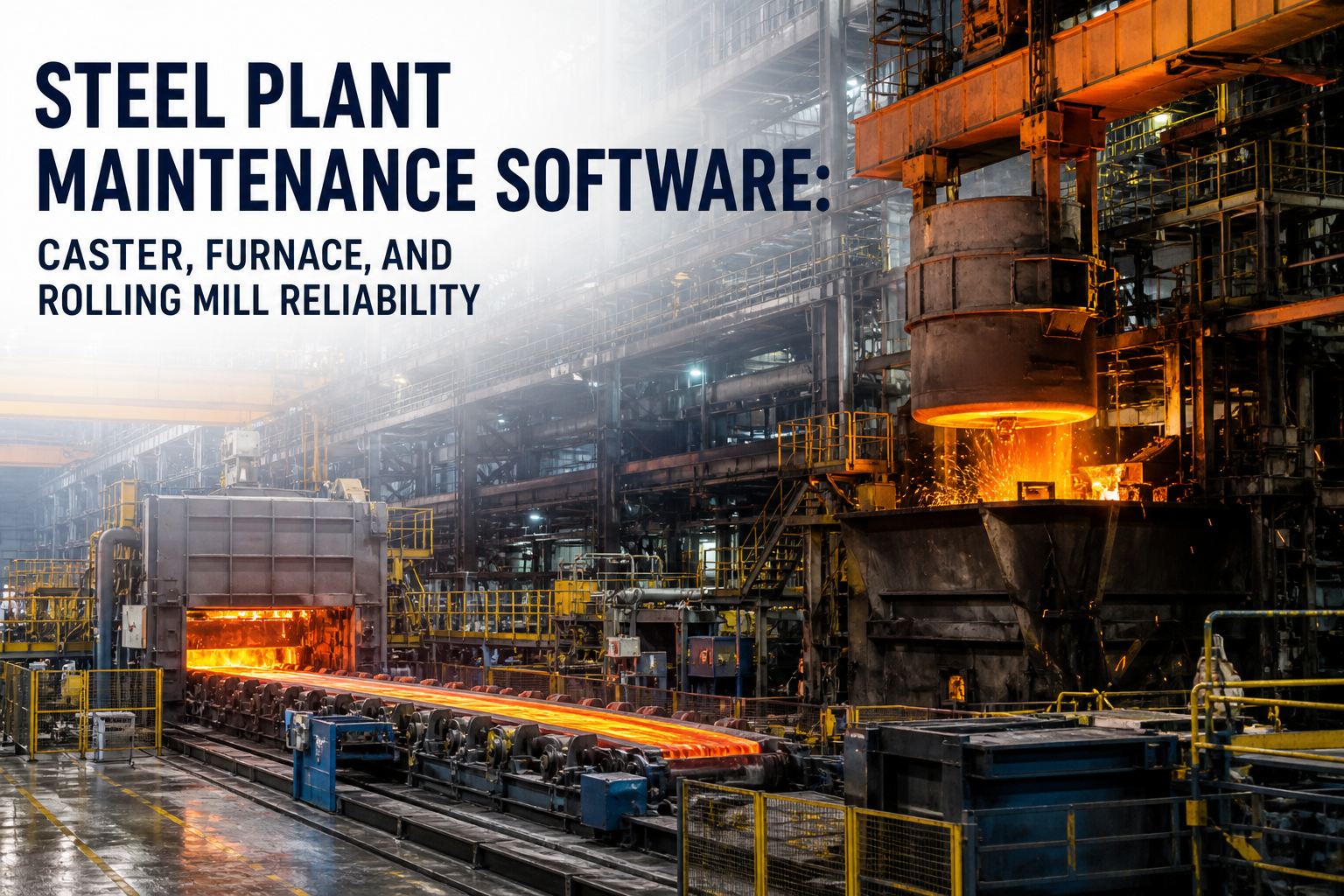
Walk a hot strip mill at 7 a.m. shift change and ask the maintenance crew where they actually work. The answer is the same in every plant: the pit, the casthouse, the EAF transformer bay, the coke battery, the underground utility tunnel, the overhead crane rail. None of these places have a desktop. Most of them have intermittent cellular and Wi-Fi. All of them have gloved technicians whose touchscreen input is unreliable on a standard mobile app.
65°C
Casthouse Floor Ambient
During tap operations. Sensors fail, screens fog, consumer devices throttle. A maintenance app must run on IP67-rated hardware certified for these conditions.
8–15 km
Technician Daily Walk
Per shift across blast furnace platforms, mill basements, coke batteries. Every minute walking back to a control room for a work order is wrench time lost.
Dead Zones
Connectivity Reality
Rolling mill pits, EAF bays, blast furnace basements. Offline-first CMMS is non-negotiable. "View-only offline mode" does not survive contact with the floor.
3,400 SKUs
Spare Parts Catalog
Typical for a 3.5 MTPA integrated plant. Linked to specific assets and PM procedures. Demand-driven reorder, not min/max guesswork.
Head-to-Head: SAP PM Standalone vs SAP PM + OxMaint Field Layer
Eight dimensions that determine whether your maintenance program actually performs in steel plant conditions. Rated against published benchmark data and real deployments, not vendor marketing.
Dimension
SAP PM Standalone
SAP + OxMaint Field Layer
Mobile field execution
Limited Desktop-primary. Fiori requires separate license & project. Technicians make office trips.
Native Full work-order lifecycle on iOS, Android, ruggedized devices. Day-one mobile.
Offline capability
Add-on SAP Asset Manager required for true offline. Separate purchase + implementation.
Native Offline-first by design. Accept, execute, photo, close in mill pits and EAF bays.
Technician adoption (Day 30)
~30% Six-screen close. Weeks of training. Workarounds common.
~85% Under 3 taps to accept. Hours of training. Designed for gloved input.
PM trigger flexibility
Calendar-default Tonnage/heat-count requires custom config & SAP transports.
Production-variable Heat counts, tonnage, rolling hours read live from Level 2 MES.
SCADA → work order latency
4–8 hours Manual re-keying. No native OPC-UA listener.
Seconds OPC-UA client adapter on historian. Recurring-alarm auto-escalation.
Configuration ownership
Consulting Every change needs ABAP/Basis. Ongoing consulting dependency.
Maintenance team Planners configure PM triggers, workflows, dashboards directly.
Time to first value
12–18 months Long greenfield or migration project before field benefit.
2–4 weeks Pilot section live in weeks. Full plant in 16–24 weeks.
Financial integration
Native Cost, parts, settlement built-in. This is where SAP earns its place.
Native Reads master data, writes confirmations and goods movements back via standard BAPI/OData.
The verdict, put simply: Keep SAP as the financial system of record. Replace SAP PM as the field execution layer with a mobile, offline-first CMMS. You get adoption, speed, and predictive automation without losing financial integration. The integration uses standard BAPI and OData — no ABAP, no transports, no impact on existing custom code.
Where SAP PM Slows Steel Down — Three Critical Friction Points
The case against SAP PM as a field execution tool in steel is not philosophical. It is mechanical. These friction points show up in every integrated steel plant running SAP PM as the primary maintenance interface.
F1
Six-Screen Work Order Close & Calendar-Only PM
Closing a work order in SAP PM takes a technician through multiple screens. In a casthouse with gloved hands, the process is so slow that technicians batch-close at end of shift. Worse, SAP PM defaults to calendar triggers, but steel equipment wears by heat count, tonnage, and rolling hours — not by days on a calendar.
Impact: data quality drops; PMs misaligned with actual wear.
F2
4–8 Hour SCADA-to-CMMS Latency
The average delay between a SCADA alarm and a CMMS work order is measured in hours, not seconds. SAP PM has no native OPC-UA listener; alarm-to-work-order automation requires custom middleware few maintenance teams own. Roughly 80% of alarm signals never become work orders.
Impact: detectable failures go unaddressed; reactive cost soars.
F3
No Native Offline + Adoption Under 30%
SAP Fiori works online; rolling mill basements and EAF bays do not have online. Technicians revert to paper. The single hardest number to defend in any SAP PM steel deployment is technician adoption — consumer-grade mobile SAP sees roughly 30% day-30 active usage versus 85% on industrial-grade mobile CMMS.
Impact: predictive program never delivers on its business case.
"Replacement" Means Field Execution — Not Tearing Out SAP
A specialist mobile CMMS does not replace SAP at the financial layer. It replaces SAP PM as the field execution tool while keeping SAP as the system of record for equipment master, cost settlement, and inventory accounting. The integration uses standard interfaces.
SAP S/4HANA or ECC Keeps
Back-office financial backbone
OxMaint Takes Over
Field execution & mobile workflow
Equipment master & functional location hierarchy
Mobile work order acceptance, execution, completion
Material master, MRO inventory accounting, procurement
Tonnage- and heat-count-based PM triggers from Level 2
Vendor master, depreciation, fixed asset register
SCADA-to-work-order automation via OPC-UA
Long-term audit trail, BW extracts, group reporting
Predictive triggers from vibration, motor current, thermal
Asset-Level Replacement: Where the Mobile CMMS Earns Its Place
Steel mill maintenance is not one workflow. The friction with SAP PM appears across distinct asset classes, and the mobile-first replacement pattern follows the same logic in each.
Asset Class A
Rolling Mill Stands & Drives
Failure modes:Work roll bearing seizure, backup roll bearing fatigue, drive gearbox vibration, AGC servo valve failure, hydraulic oil contamination.
Mobile CMMS workflow:Roll change inspection checklist on tablet, bearing temperature reading capture, AGC calibration step-response logged on work order, hydraulic oil cleanliness sample linked to asset record.
Mobile CMMS workflow:Heat-count-based PM triggers, segment tonnage tracking, mobile inspection rounds with thermal imaging upload, mold oscillator alignment work order with OEM tolerance check.
Asset Class C
Coke Oven & Blast Furnace
Failure modes:Stave cooling leakage, tuyere wear, tap-hole drill bit fatigue, coke pusher ram drift, door seal degradation, dry quench winch wear.
Mobile CMMS workflow:Stave temperature monitoring with heat-count triggers, robotic inspection feed integration, ram alignment checks per push cycle, tap-hole drill bit log on shift handover.
Mobile CMMS workflow:Coil-count-based PM scheduling, blade change inspection record, statutory crane forms digital, structural NDT result linked to asset, lift-count PM triggers from crane control system.
Deployment Options: On-Premise, Cloud, or Hybrid — Built for Steel IT Reality
Steel plants are not standard SaaS customers. OT network isolation, IEC 62443 segmentation, group-IT data residency rules, legacy DCS/PLC integration, and capex-vs-opex preferences all shape the deployment choice. OxMaint runs in three deployment modes for steel operations — with SAP integration preserved across all three.
Deployment Mode A
On-Premise Deployment
For air-gapped, OT-isolated, or data-sovereignty-bound steel plants
Who chooses this:
Integrated plants on air-gapped OT networks with IEC 62443 zone segmentation
Defence-linked specialty steel under ITAR or export-controlled material constraints
State-owned and government-affiliated groups with data sovereignty mandates
Plants with deep DCS/PLC integration at protocol level (Siemens TIA, ABB 800xA, Honeywell Experion)
Reference architecture:
Application server in plant data center on corporate LAN, DMZ-isolated from OT
Database server on separate physical or virtual machine; daily encrypted backups
OPC-UA gateway in Level 3 DMZ reading from SCADA historian
Air-gap variant: wired zone kiosks plus ruggedized tablets that sync on plant Wi-Fi
SSO: Active Directory / LDAP nativeOS: RHEL, Oracle Linux, Windows ServerSAP integration: Local OData/BAPI, zero internet egress
The AI BrainNVIDIA-Powered Predictive Layer
Pre-configured NVIDIA AI servers ship racked-and-ready with the predictive software pre-loaded. Hardware tier matches plant scale and model complexity:
DGX B300 / GB300 NVL72
Group-level AI factory tier. Blackwell Ultra, 192 PFLOPS inference. For multi-plant model training, group reasoning workloads. Liquid-cooled rack scale.
RTX PRO 6000 Blackwell
Plant inference workstation. 96GB GDDR7, 4,000 AI TOPS, FP4/FP8. Runs live SCADA pattern detection + LLM ops assistant inside the plant DMZ.
Jetson AGX Orin
Mill-floor edge AI. 275 TOPS, fanless IP67 enclosure for casthouse/EAF. Real-time vibration, thermal, motor-current anomaly scoring at the asset.
All units arrive pre-loaded with the predictive maintenance stack. Plug in power + Ethernet, AI is live. Field techs handle cabling, network, PLC integration, and operator training.
Deployment Mode B
Cloud SaaS Deployment
For multi-plant groups standardizing on cloud-first IT
Who chooses this:
Multi-site steel groups wanting unified portfolio reporting across plants
Plants with reliable internet and no air-gap requirement
Groups preferring opex over capex; standardizing on SaaS across IT estate
Operators wanting deployment live in 3–5 days, not 3–6 months
Reference architecture:
Multi-tenant SaaS or single-tenant cloud instance with regional data residency
SOC 2 Type II, ISO 27001 certified hosting
On-premise OPC-UA gateway at the plant talks outbound to cloud over TLS 1.3
Regional data centers for EU, US, India, Middle East data residency
Time to live: 3–5 days from contractUpdates: Vendor-managed, no downtime windowsTCO: 3–5× lower than on-premise over 5 years
Deployment Mode C
Hybrid Deployment
The pattern most large steel groups actually choose
Who chooses this:
Multi-plant groups where individual plants need OT isolation but HQ wants cross-plant analytics
Operators running integrated plants on-premise and EAF mini-mills on cloud
Groups in geographies with mixed data-residency rules
Plants needing floor-level on-premise and exec dashboard cloud-accessible
Reference architecture:
On-premise execution layer per plant: work orders, mobile, OPC-UA, PM triggers
Cloud rollup tier at HQ aggregating non-sensitive KPIs only
Replication is one-way (plant → HQ), summary-level only, never master data
Each plant retains operational autonomy; HQ gets portfolio visibility
Best for: Groups with 3+ plants across geographiesGovernance: Each plant retains data ownershipRollout: Plant by plant, no big-bang risk
Quick Decision Guide
Air-gapped or OT-isolated with no internet egress permitted
→
On-Premise (Mode A)
Strict data sovereignty / defence material constraints
→
On-Premise (Mode A)
Single-plant or small group with reliable internet and lean IT team
→
Cloud SaaS (Mode B)
Multi-plant group with mixed regulatory and OT environments
→
Hybrid (Mode C)
Decision Flowchart: Should Your Plant Make This Move?
Six questions decide whether replacing SAP PM at the field layer makes sense at your specific plant. Three "yes" answers usually justify the move. Five or six puts it in the urgent category.
Q1
Is your current SAP PM technician adoption below 60%?
YES → field layer is leaking
Q2
Do technicians close work orders at end of shift in batches rather than in real-time?
YES → data quality suffering
Q3
Are most PM triggers calendar-based rather than tonnage or heat-count?
YES → PMs misaligned with wear
Q4
Is SCADA-to-work-order latency more than 1 hour at your plant?
YES → alarms turning into failures
Q5
Do every PM change, new asset, or report tweak require ABAP or Basis effort?
YES → consulting dependency high
Q6
Is your S/4HANA program targeting a clean core with minimal customization?
YES → side-by-side is the right pattern
Common Objections — And the Honest Answers
Every commercial conversation about replacing SAP PM at the field layer surfaces the same objections. They deserve direct answers, not marketing deflection.
We'll lose financial integration with SAP.
No. OxMaint reads master data and writes confirmations, time, and goods movements back to SAP via standard BAPI (BAPI_ALM_CONF_CREATE, BAPI_GOODSMVT_CREATE) and OData APIs. SAP remains the system of record. Reports and BW extracts continue to work unchanged.
This conflicts with our clean-core S/4HANA strategy.
It is the clean-core pattern. SAP customization stays minimal; specialist capability lives in a side-by-side system connected through documented APIs. This is precisely what SAP's own clean-core guidance recommends.
Big-bang cutover is too risky for our plant.
Agreed. There is no big-bang cutover. Pilot one mill section or one shift in 2–4 weeks. SAP remains live throughout. If pilot does not deliver, you stop. If it delivers, you scale. The risk surface is tiny.
Our plant network is air-gapped — no cloud allowed.
Then on-premise deployment is the right mode. OxMaint runs fully on-premise inside the plant data center, talking to SAP locally with zero internet egress. Air-gap variants use wired zone kiosks plus ruggedized tablets that sync only when on the plant network.
We need IEC 62443 / Purdue zone compliance preserved.
OxMaint deploys at Level 3 (Operations) of the Purdue model, never at Level 1 or 2. The OPC-UA gateway sits in the Level 3 DMZ reading from the SCADA historian; it never writes back to control systems. Plant zone segmentation stays exactly as your IT security team designed.
Our technicians are too senior to adopt new tools.
Counter-evidence: published deployments with 20+ year crews show 85% day-30 adoption when peer-led training is used. Senior technicians often become the strongest advocates once they see the interface respects their expertise.
For Steel Plant Maintenance Heads & Mill Superintendents
Replace SAP PM Where Steel Demands It — Keep It Where It Earns Its Place
Book a working session with a solutions engineer who has deployed mobile CMMS alongside SAP at integrated steel plants and EAF mini-mills. We will walk your hot strip mill, EAF bay, or casthouse floor — and show what offline-first, gloved-input, OPC-UA-driven maintenance actually looks like.
Live pilot in 2–4 weeks on one mill section
SAP master data preserved; confirmations post back via standard BAPI
No commitment. No SAP changes. No ABAP. We can show you the offline mill-pit work order flow in 15 minutes.
Frequently Asked Questions
Are we replacing SAP entirely, or only SAP PM as the field execution tool?
Only the field execution layer. SAP S/4HANA or ECC remains the system of record for equipment master, materials, cost settlement, and finance. OxMaint replaces SAP PM as the technician-facing mobile tool and posts confirmations, time, and parts back to SAP via standard BAPI and OData APIs.
Does this require ABAP development or SAP transports?
No. The integration uses standard SAP interfaces — OData on S/4HANA, BAPI on ECC 6.0. No ABAP development, no SAP transports, no impact on existing custom code. The SAP Basis team provisions a scoped service account and the connection is live in days.
Is OxMaint available on-premise or cloud only?
Three deployment modes. On-premise for air-gapped, OT-isolated, or data-sovereignty-bound plants — servers in your data center, no internet egress required. Cloud SaaS for groups standardizing on cloud-first IT — SOC 2 Type II, ISO 27001, regional data residency. Hybrid for multi-plant groups — on-premise per plant for execution, cloud rollup at HQ for portfolio analytics.
Can OxMaint run inside an air-gapped, IEC 62443-zoned steel plant?
Yes. On-premise deployment runs entirely inside the plant corporate LAN with no internet egress required. The OPC-UA gateway sits in the Level 3 DMZ and reads from the SCADA historian; it never writes to Level 1 or Level 2 control systems. For fully air-gapped variants, ruggedized tablets sync only when on the plant Wi-Fi.
Can the CMMS use heat counts and tonnage instead of calendar for PM triggers?
Yes. PM triggers can be configured against heat counts, tonnage processed, operating hours, or any measurable production variable read from Level 2 MES. Blast furnace stave inspections fire after a defined number of heats; rolling mill rebuilds fire after defined rolling hours.
How does SCADA-to-work-order automation work?
An OPC-UA client adapter sits on the SCADA historian or edge gateway. Configured alarm tags trigger work orders automatically in seconds. Recurring alarm patterns generate root-cause investigation work orders. The control layer is never touched; only read.
What payback period do steel plants typically see?
Published case data places payback in the 9–14 month range. A 3.5 MTPA integrated plant case study documented full payback at month 11 with 34% reduction in maintenance cost per tonne and 58% reduction in emergency work orders.