AI Work Order Summarization: LLMs for Maintenance Insights
By Riley Quinn on May 4, 2026
A maintenance planner at a 1,400-asset manufacturing site spends roughly 11 hours every week reading the previous shift's work orders, parsing technician scribbles, and writing the Monday morning summary. Across 6 sites, that's $340,000 a year paid to humans for what is mechanically a text summarization problem. AI work order summarization solves it — but only if the LLM runs on hardware you own, with no per-token fees and no risk of your failure data leaking into someone else's cloud. The real 2026 question isn't whether to deploy a maintenance LLM — it's whether you're renting one or owning one. Sign up free to try the on-prem maintenance LLM.
MAY 12, 2026 5:30 PM EST , Orlando
Upcoming OxMaint AI Live Webinar — See a Maintenance LLM Summarize 5,000 Work Orders in 90 Seconds
Live walkthrough of the OxMaint on-prem maintenance LLM running on owned hardware: bulk work-order summarization, failure-mode extraction, KPI narrative generation, and an end-to-end audit-log demo for regulated facilities. No SaaS subscription. No data leaves your firewall.
Bulk WO summarization at <90s for 5,000 records
Failure-mode extraction from technician notes
Auto-generated KPI narratives for executives
Perpetual-license pricing — sign up free or book on the call
The Hidden Tax on Every Maintenance Team — Documentation Time
Industry research is unambiguous on this: maintenance technicians spend 15–25% of working hours on documentation, work-order creation, and CMMS data entry. That's a full day a week, per technician, on activities that produce zero reliability improvement. The number gets larger as you move up the org chart. Planners spend 25–30%. Reliability engineers spend 30–40% of their time pulling reports. And every one of them is doing the same fundamental task — reading unstructured text and producing a structured summary. That's exactly what an LLM does. The unlock isn't the AI; the unlock is doing it on hardware you own.
The Transformation
Anatomy of an AI-Summarized Work Order
Same raw data. 90 seconds vs. 4 hours. Owned LLM vs. manual reading.
RAW INPUT
WO #48291 · Pump House 3 · Tech: D. Reyes
"Got call abt P-407 leak. 2nd time this month. Mech seal weeping bad — flange wet. Iso'd, drained, pulled volute. Seal face scored, primary o-ring split. Shaft runout looks ok. Replaced w/ Flowserve kit p/n 4488-A. Aligned w/ laser. Restarted, vib 0.18 in/s — within spec. Total ~3.5 hrs incl wait on parts. May be alignment drift, recommend monitoring weekly."
Format: Free-text narrative
Searchable: Keyword only
Failure mode: Buried in prose
STRUCTURED OUTPUT
AssetP-407 (Centrifugal Pump)
Failure ModeMechanical seal failure — face scoring
Root CauseSuspected alignment drift (recurring)
Repeat?YES — 2× this month
MTTR3.5 hrs (parts wait: 0.8 hrs)
Parts UsedFlowserve 4488-A seal kit
ActionFlag for weekly vib monitoring
Format: Structured + searchable
Indexed: Failure mode, asset, RCA
Time saved: ~12 min per WO
Five Capabilities Every Maintenance LLM Must Deliver
"AI for work orders" gets thrown around as if it were one feature. It isn't. A useful maintenance LLM does five distinct things — and most cloud-only tools cover two or three. Before committing to any platform, walk down this list and confirm each one runs locally on hardware you'd own. Book a demo to watch all five capabilities run live.
01
Bulk Summarization
Process 5,000+ work orders into shift, weekly, and monthly digests. The planner gets a 1-page summary instead of reading 200 records. Saves 8–12 hours per planner per week on reporting.
8–12 hrs/wk saved per planner
02
Failure Mode Extraction
NLP classifies free-text technician notes into ISO 14224 failure modes — bearing wear, seal leakage, electrical short, lube contamination — turning unstructured prose into queryable Pareto data.
35–50% better WO accuracy
03
KPI Narrative Generation
"MTTR up 14% this month — driven by 3 recurring seal failures on the P-400 series; recommend root-cause investigation." The LLM writes the narrative paragraph that humans usually write at month-end.
20–40 hrs/mo reporting cut
04
Repeat-Failure Detection
"This is the 4th time pump P-407 has had this exact failure in 90 days." The LLM cross-references the asset history every time a new WO closes — catching repeat issues human eyes miss in a sea of records.
3× faster RCA trigger
05
Audit-Trail Logging
Every LLM input, output, and decision gets logged with provenance. Critical for FDA, ISO 55000, and pharma GxP environments where you must trace any AI-generated text back to its source records.
Full ISO/GxP traceability
The Real Question: Rented LLM or Owned LLM?
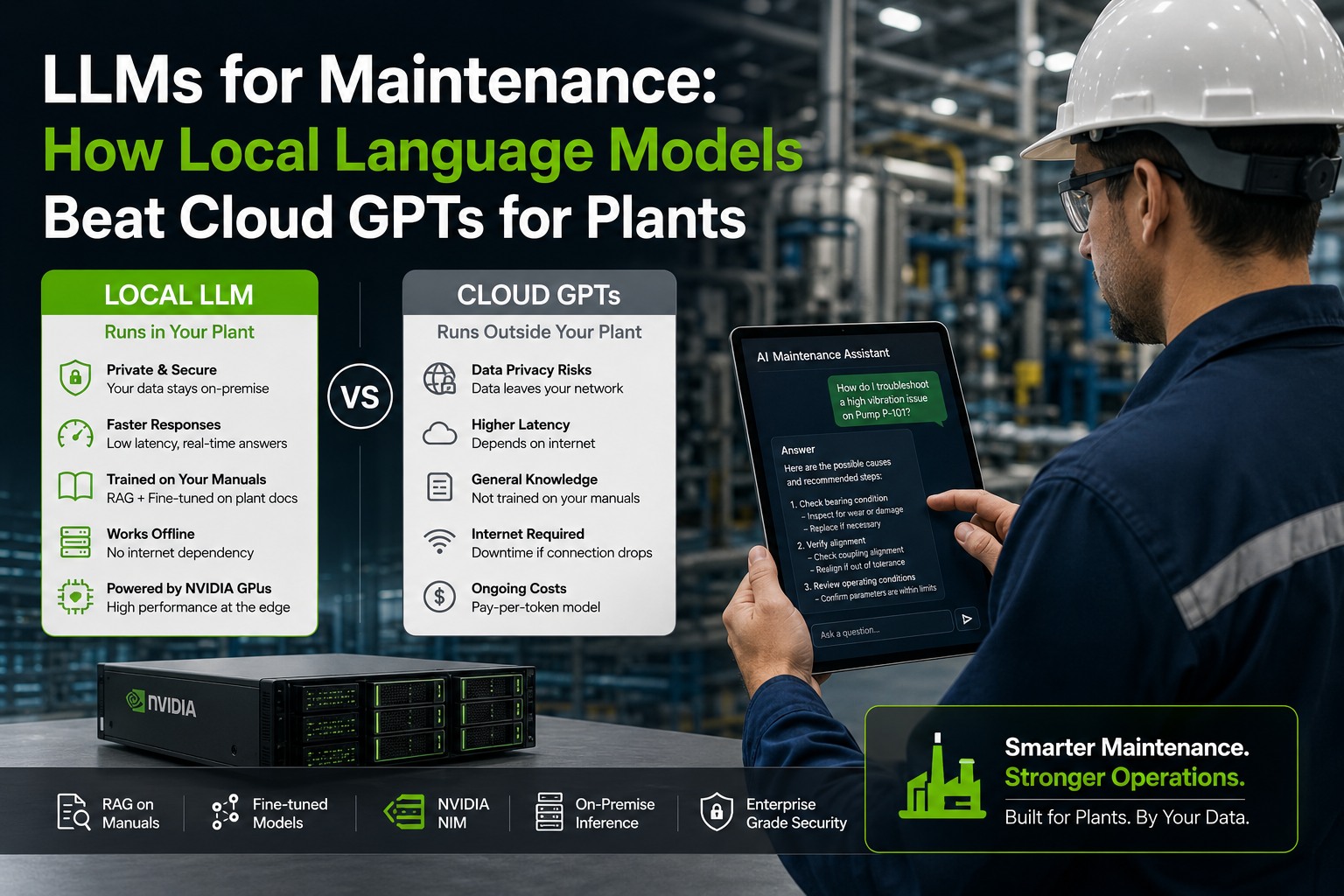
This is the part most vendor blogs skip. A maintenance LLM that solves the technical problem isn't enough — the commercial structure matters just as much. Three facts shape the decision: (1) maintenance data contains 5–20 years of failure history that competitors would pay to see; (2) cloud LLM providers can audit a percentage of prompts for QA, meaning your shutdown causes can leak into someone's training pipeline; (3) per-token pricing scales linearly with your operation, so success punishes you. The owned alternative isn't theoretical — it's the same model your ERP runs on. Sign up free to try the perpetual-license maintenance AI platform.
Swipe to compare
RENTED
SaaS Cloud LLM
Per-seat · per-token · monthly
PricingRecurring forever
Data locationVendor's cloud
Source codeClosed
Modify / extendVendor controls
If you stop payingService ends
Audit logsVendor-mediated
Compliance postureShared responsibility
RECOMMENDED
OWNED
On-Prem AI Server
Pre-installed · ships in 6–12 weeks · perpetual
PricingOne-time + optional support
Data locationBehind your firewall
Source codeFull access
Modify / extendYour team — no permission needed
If you stop payingKeeps running. You own it.
Audit logsLocal — your control
Compliance postureSingle tenant — you own it
The Order-It-Like-Hardware Path
The shift the maintenance AI market is going through in 2026 is simple: AI is moving from "consulting engagement" to "product you order." OxMaint's on-prem maintenance LLM ships as a fully integrated AI-powered EAM/CMMS — pre-configured on enterprise-grade AI hardware, pre-tested, and ready to run within days of arrival at your site. No 9-month implementation. No SI markup. No surprise scope. Sign up free to start your on-prem deployment.
01
Sign Up & Scope
Sign up free, then tell us your site count, asset count, technician headcount, and CMMS. We size the hardware and prepare your perpetual-license configuration.
Day 1–3
02
Hardware Pre-Configured
AI server + GPU + CMMS + maintenance LLM models all installed, integrated, and pre-tested in our facility before shipping.
Wk 2–6
03
Ships to Your Site
Hardware arrives at your loading dock. Plug into power, plug into your VLAN, run the connect-CMMS wizard.
Wk 6–8
04
Live in Days
Your team logs in, your data flows in, the LLM starts summarizing. You own the platform — outright, perpetual, source access included.
Wk 8–10
Perpetual License · Source Access · Full Data Sovereignty
Order a Maintenance LLM, Don't Subscribe to One
OxMaint's on-prem AI server arrives pre-configured with the maintenance LLM, your CMMS, and the full source — ready to run within days. One purchase. No monthly fees. Behind your firewall, forever.
Here's the math a CFO actually asks for when reviewing an AI capital request. Real-world deployments of maintenance LLM platforms in 2025 produced these ranges, drawn from manufacturing, energy, and process-industry case studies. Book a demo to see a custom ROI model for your work-order volume.
38%
Admin time reduction
Plants deploying voice-to-CMMS and LLM summarization workflows trim administrative effort by 38% within six months — documented across multiple AI-pilot sites.
32%
WO backlog drop
AI-pilot sites saw work-order backlogs fall by 32% — driven by faster intake, automatic prioritization, and reduced rework from incomplete data.
85%
Admin burden cut
Manufacturers running agentic AI maintenance loops achieve 70–85% reduction in administrative burden — the LLM handles the documentation, technicians do the wrench work.
18×
Cheaper inference
Running an open-weight model on your own hardware costs up to 18× less per million tokens than premium public APIs at scale — and the cost is fixed and predictable.
35–50%
Better WO accuracy
LLM-assisted WO creation improves accuracy by 35–50% over manual entry — fewer missing fields, fewer wrong asset codes, fewer back-and-forth corrections.
20–40
Hours/month saved
Maintenance leaders eliminate 20–40 hours per month previously spent creating performance summaries and KPI dashboards by hand.
Expert Perspective — Why Owned Beats Rented for Maintenance Data
The pattern I keep seeing in maintenance AI procurement is that operations leaders evaluate the LLM purely on capability — can it summarize a work order, can it extract a failure mode — and skip past the commercial and data-governance questions until much later. By then they've already signed something that puts ten years of failure history on a third-party server, with usage costs that grow as the platform succeeds. The teams getting this right in 2026 are flipping the order of evaluation: data sovereignty first, commercial structure second, capability third. They're treating maintenance AI the way they treat ERP or SCADA — a perpetual-license platform that lives on their hardware, that they can modify, and that doesn't disappear when a budget cycle gets tight.
The economic logic is also clear once you do the math. A mid-size manufacturer running 100,000+ work orders annually generates enough token volume to cross the on-prem break-even point inside the first year. Below that threshold, SaaS may be cheaper for a while. Above it, you're paying a vendor a recurring tax on your own data. The tipping point used to be much higher; with open-weight models in the 7B–13B parameter range now strong enough for maintenance summarization, the hardware floor has dropped dramatically. The real question isn't "can we afford to own it" — it's "can we afford not to."
65%
Adoption Plans (12 mo)
Roughly 65% of maintenance teams plan to adopt some form of AI within the next 12 months — the question is no longer if, only how it gets deployed.
15–25%
Hours Lost to Docs
Maintenance technicians spend 15–25% of working hours on documentation activities that produce zero reliability improvement — pure overhead the LLM removes.
83%
Cost Reduction Case
A documented enterprise case reduced monthly AI spend from $47K to $8K — an 83% reduction — by switching from public-API LLMs to a hybrid self-hosted architecture.
What "AI-Native, Owned, On-Prem" Actually Looks Like
Buyers comparing options should know what to ask for in writing. These are the four characteristics that separate a real owned platform from a rebranded SaaS contract.
Perpetual License
No monthly fees. No per-seat charges. Ever. One-time purchase covers the software, the AI models, and modification rights — for the life of the platform.
Data Sovereignty
All data lives on your server, behind your firewall. Failure history, work orders, asset performance, technician notes — none of it leaves your network unless you choose.
Source Access
Modify, extend, customize freely within your organization. Your team can adapt prompts, tune models, add integrations — without vendor approval, without change orders.
AI-Native Core
Predictive maintenance, anomaly detection, NLP work-order processing, and KPI narrative generation — built into the core, not bolted on. The LLM is part of the platform, not an add-on SKU.
Pre-Installed · Pre-Tested · Ready to Ship in 6–12 Weeks
Stop Renting a Maintenance LLM. Order One You Own.
A complete, integrated AI-powered EAM/CMMS — deployed on enterprise-grade AI hardware at your premises, perpetual license, full source access, total data sovereignty. No SaaS lock-in. No recurring fees. Sign up free or book a demo to see it running on your work-order data today.
What exactly does an AI work order summarization LLM do that a normal CMMS report can't?
A standard CMMS report counts and sorts structured fields — number of WOs, mean time to repair, top assets by spend. A maintenance LLM reads the unstructured text fields that contain 70–80% of the actual diagnostic information: technician notes, failure descriptions, root-cause comments, parts-used narratives. It then extracts failure modes, identifies repeat issues, generates plain-English KPI narratives ("MTTR climbed 14% this month, driven by three recurring seal failures on the P-400 series"), and writes shift, weekly, and monthly summaries that previously required a planner to read the records by hand. Industry research shows technicians spend 15–25% of working hours on documentation, and planners spend 25–30% — most of which the LLM removes. The output is structured, searchable, and auditable in ways that raw work-order text never has been.
Why does on-premise deployment matter for maintenance data specifically?
Maintenance data is uniquely sensitive in three ways. First, failure history reveals operational patterns that competitors and adversaries would value — knowing which assets fail and how often is competitive intelligence about your operation. Second, regulated industries (pharma GxP, FDA Part 11, ISO 55000, defense, nuclear) require traceability that public cloud LLMs cannot consistently provide because vendors may audit a percentage of prompts for QA or safety filtering. Third, recurring per-token costs scale with operational success — the more work orders you run through the LLM, the more you pay forever. On-prem deployment puts the LLM on hardware you own, behind your firewall, with audit logs you control. Reference research found that running open-weight models locally costs up to 18× less per million tokens than premium public APIs at high volume, with predictable fixed costs instead of variable subscriptions.
How does the perpetual license actually work compared to a SaaS subscription?
A perpetual license is a one-time purchase that grants permanent rights to use the software, the AI models, and the source code (with modification rights) — for the life of the platform. There are no monthly fees, no per-seat charges, no per-token costs. Future expenses are entirely optional and at your discretion: you can buy support contracts, training, or feature add-ons, or you can run the platform indefinitely on what you originally purchased. If you stop paying for support, the platform keeps running. Compare this to SaaS, where ending the subscription ends the service. The commercial implication for maintenance AI is large: a manufacturer planning a 10-year asset-management horizon should not be paying recurring fees on an LLM that summarizes work orders — that's an operating expense that grows forever instead of a capital expense that amortizes.
How fast can a pre-installed on-prem maintenance AI server actually deploy?
Six to twelve weeks from sign-up to live operation is typical for OxMaint's pre-installed AI server model. The compressed timeline works because the hardware is configured, integrated, and pre-tested in the factory before shipping — the AI server, the GPU, the maintenance LLM models, and the CMMS are all installed and validated against a synthetic data set before the unit leaves the assembly line. On-site work then collapses to plugging the server into power and the network, running the connect-CMMS wizard against your existing system, and importing your asset master and historical work-order data. This is fundamentally different from the traditional 6–12 month enterprise software implementation because there is no integration project — the integration was already done. The "consulting + AI solution" storytelling that dominated the first wave of industrial AI is being replaced by "order this AI package and get it delivered in 6–12 weeks."
What's the realistic ROI window for on-prem maintenance LLM deployment?
Most mid-size manufacturers see payback inside 12 months — often inside the first 6 — driven by three sources of value. Documentation time savings alone typically recover 20–40 hours per month per planner, and admin burden across the maintenance team drops 70–85% according to deployment case data, with administrative effort trimmed 38% within six months at AI-pilot sites. Work-order accuracy improvements of 35–50% reduce rework, and AI-pilot sites have documented work-order backlog drops of 32%. Finally, the perpetual-license commercial model means there is no recurring cost line item to extend the payback horizon — once you've paid back the capital, the platform runs at marginal cost forever. Documented enterprise cases include an 83% reduction in monthly AI spend ($47K to $8K) when switching from public-API LLMs to a self-hosted architecture. The combination of capability ROI plus commercial-model ROI is what makes the perpetual-license path unusually fast to payback for maintenance teams running enough volume to justify it.