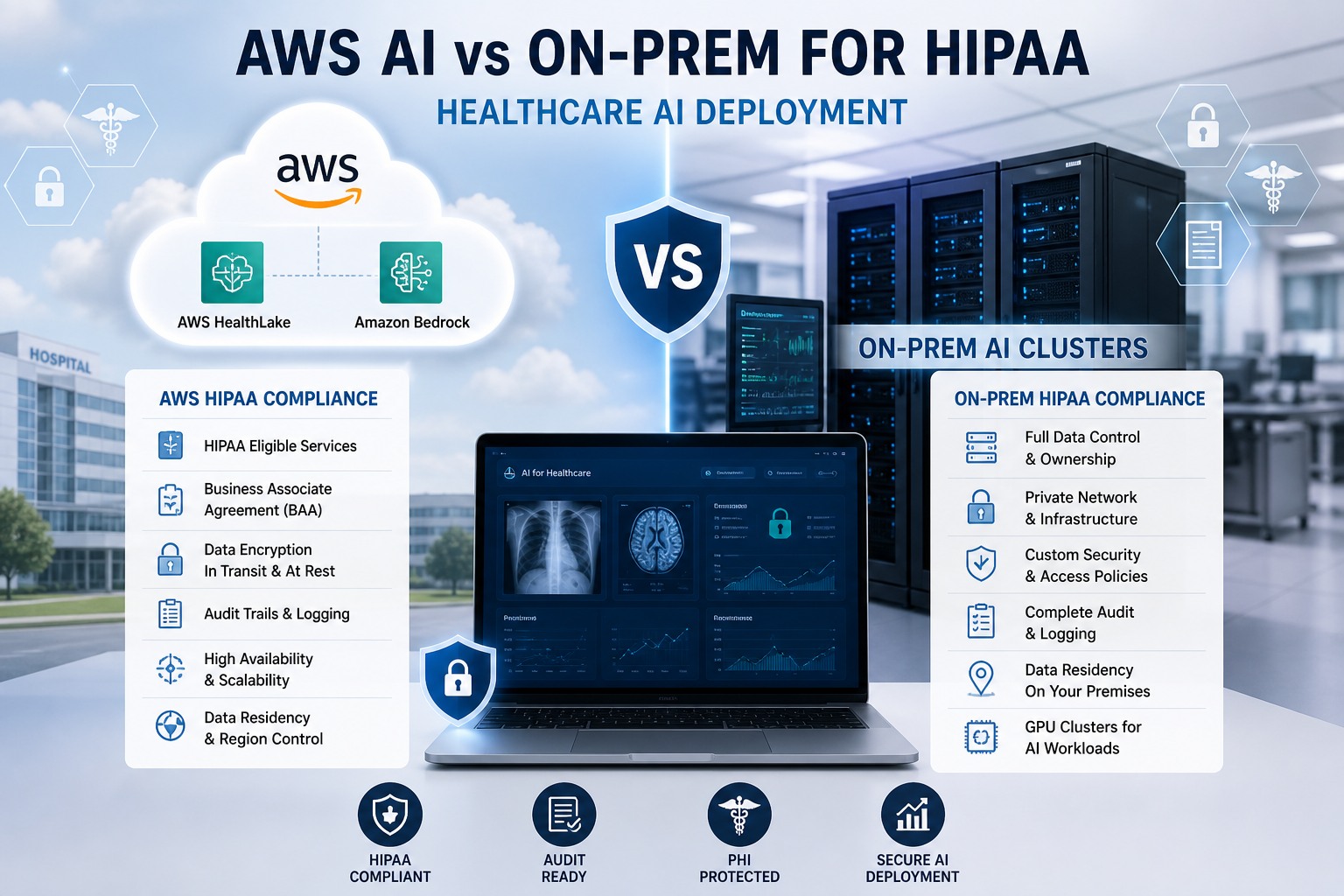
AWS AI vs On-Prem for HIPAA: Healthcare AI Deployment
By Riley Quinn on May 4, 2026
On February 10, 2026, AWS updated its HIPAA-eligible services list to include Amazon Bedrock and Bedrock AgentCore — making AWS, on paper, a viable place to run healthcare AI workloads. But "HIPAA-eligible" doesn't mean "HIPAA-compliant." Gartner estimated that through 2025, 99% of cloud security failures would be the customer's fault. With healthcare breach costs averaging $10.22M per incident and HIPAA penalties reaching $2.19M per violation category, the architecture decision for clinical AI isn't really about cloud vs on-prem — it's about where the compliance burden sits. Sign up free to try the on-prem healthcare AI platform with full data sovereignty.
MAY 12, 2026 5:30 PM EST , Orlando
Upcoming OxMaint AI Live Webinar — AWS HIPAA AI vs On-Prem: A Side-by-Side Compliance Walkthrough
Live demo for healthcare CIOs, CISOs, and privacy officers. We'll architect the same clinical AI workload two ways — once on AWS HealthLake + Bedrock with a BAA, once on the OxMaint on-prem AI server — and walk through the audit logs, BAA scope, breach exposure, and 5-year cost differences for both.
This is the single most expensive misconception in healthcare AI procurement: assuming that because a vendor's service appears on AWS's HIPAA-eligible list with a signed BAA, the organization is now compliant. It isn't. A HIPAA-eligible service has the security features and the vendor will sign a BAA — but compliance is a configuration outcome, not a checkbox. The customer remains responsible for proper configuration, access controls, encryption settings, audit logging, IAM scoping, VPC isolation, and usage policies. AWS gives you the building blocks. You build the compliant system.
HIPAA-ELIGIBLE
What AWS Delivers
Signed standard BAA via AWS Artifact
Encryption capability (KMS, TLS 1.2+)
Service-side controls available
HITRUST, SOC 1/2/3, ISO 27001 certs
HIPAA-COMPLIANT
What You Must Configure
Designate HIPAA accounts correctly
Restrict PHI to eligible services only
IAM least-privilege + MFA + SSO
VPC isolation, private endpoints
Risk analysis + risk management plan
Audit logging, breach notification SOPs
99%
of cloud security failures through 2025 were the customer's fault, not the cloud provider's — Gartner
The Shared Responsibility Model — Visualized
HIPAA compliance under AWS works on a split: AWS is responsible for the security of the cloud, you are responsible for security in the cloud. On paper, simple. In practice, the responsibilities you inherit when you deploy clinical AI on AWS are the most expensive items on the HIPAA Security Rule — the ones that most often fail audits and trigger breaches. On-prem deployment collapses both columns into one. Book a demo to see the on-prem responsibility model in action.
AWS HIPAA AI MODEL
Shared Responsibility
AWS owns
Physical data centerHypervisor securityService availabilityFoundation model hosting
You own everything — and the controls live on your server
Physical hardware (your DC)PHI never leaves firewallNo BAA chain to manageNo subprocessor riskYour AD / SSO nativeAudit logs you controlNo region/jurisdiction issuesNo CLOUD Act exposureZero data egress to vendor
Why this matters for HIPAA: when PHI never leaves your network, the entire third-party-vendor chapter of the Security Rule becomes a documentation exercise — not an integration project.
Where Does the PHI Actually Go?
This is the question every privacy officer asks, and the answer determines half the compliance work. Trace the path of a single chest X-ray as it moves through a clinical AI summarization workflow on AWS, then trace the same workflow on an owned on-prem server. The number of trust boundaries crossed is the number of places a breach can happen. Book a demo to walk through PHI flow on your specific clinical AI use case.
PATH A
PHI on AWS HIPAA AI
7 trust boundaries · 4 BAAs in chain
1EHRYour network
2VPC EndpointAWS Region
3HealthLakeFHIR storage
4Bedrock APIInference
5Foundation ModelAnthropic / Meta
6CloudWatch LogsLogging
7Clinician UIYour network
PHI crosses your firewall & AWS trust boundaries 6 times. Each hop = encryption check, IAM check, audit log entry.
PATH B
PHI on Owned On-Prem AI Server
2 trust boundaries · 0 BAAs needed
1EHRYour network
2On-Prem AI ServerYour DC · same VLAN
3Clinician UIYour network
PHI never crosses your firewall. Inference, storage, and logs all stay on equipment you own.
Pre-Configured · HIPAA-Ready · Ships in 6–12 Weeks
Deploy Healthcare AI That Never Sends PHI Off-Site
OxMaint's on-prem AI server arrives pre-configured with the clinical LLM, audit logging, RBAC, and encryption — ready to plug into your EHR and run within days. Perpetual license. No SaaS fees. No BAA chain. PHI stays behind your firewall, by architecture.
"Cloud is cheaper" is the most repeated assumption in healthcare IT, and the most context-dependent. For workloads in the hundreds of thousands of clinical inferences per month, AWS HealthLake + Bedrock costs cross over the on-prem economics in under 24 months. For workloads where PHI breach exposure is a meaningful risk, the cost equation includes something cloud-only architectures cannot price out: sign up free to model your own 5-year TCO.
AWS HIPAA AI · 5 YR
HealthLake + Bedrock
HealthLake storage (per GB/mo)$0.27
FHIR API queriesPer request
Bedrock inferencePer token
VPC endpoints, KMS, CloudWatchAdd-on
Compliance consulting$10K–$30K/yr
BAA gap auditsRecurring
Profile
Recurring · scales with use · forever
RECOMMENDED
ON-PREM AI SERVER · 5 YR
OxMaint Healthcare AI
Hardware + software bundleOne-time
Perpetual licenseIncluded
Source code accessIncluded
Storage / inference / queries$0 marginal
Optional support contractAnnual, optional
BAA chainNone
Profile
Capital purchase · fixed · you own it
$10.22M
Average healthcare data breach cost in 2026 — the highest of any industry for 14 consecutive years
$670K
Additional breach cost when shadow AI is involved — present in 40% of hospitals
$1M/mo
What enterprise cloud AI bills can reach at scale, per Presidio's healthcare benchmarks
The Decision Matrix Healthcare CIOs Actually Use
Not every healthcare AI workload should run on-prem, and not every workload should run on AWS. Use this decision matrix to score a specific use case — clinical documentation, prior authorization, sepsis prediction, radiology triage — against the eight factors that drive the architectural call. Sign up free to try the OxMaint on-prem AI platform on a sandbox workload.
Swipe to compare AWS vs on-prem
Decision Factor
AWS HIPAA AI
On-Prem AI Server
PHI volume sensitivity
Mixeddepends on classification
Strongnever leaves firewall
Audit-trail control
Vendor-mediatedvia CloudTrail
Direct controlyour SIEM, your retention
Cost predictability
Variablescales with usage
Fixed CapExno per-token bill
BAA chain complexity
3–4 deepAWS + FM provider + you
None neededPHI never leaves you
Time to deploy
Daysif BAA in place
6–12 wkshardware ships ready
Source modification
Closedvendor-defined limits
Full accessyour team, your changes
CLOUD Act exposure
YesUS legal reach
Noyour jurisdiction only
5-yr TCO at scale
$$$ ongoinggrows with success
$ amortizedpaid in year 1
Expert Perspective — Why "It Has a BAA" Isn't Enough
The most common mistake I see in healthcare AI procurement is treating the BAA as the finish line. It isn't — it's the starting line. A signed BAA with AWS does not, by itself, make a Bedrock-powered clinical AI deployment HIPAA-compliant. The customer is still responsible for designating HIPAA accounts, restricting PHI to eligible services, configuring IAM and KMS correctly, isolating workloads in a VPC, retaining audit logs, conducting risk analysis, and proving every quarter that the technical controls actually match what the BAA promised. Through 2025, Gartner estimated that 99% of cloud security failures would be the customer's fault — not the cloud provider's.
The architecture pattern winning the 2026 healthcare AI conversation is what I'd call "compliance by reduction." Instead of layering more controls on top of a multi-tenant cloud architecture, you eliminate the trust boundaries that create the compliance burden in the first place. PHI never leaves your network, no third party processes it, no BAA chain has to be audited annually, no CLOUD Act requests can compel disclosure. The on-prem AI server isn't competing with AWS on features — it's competing on the surface area of the compliance problem. And for high-PHI-volume use cases like clinical documentation and prior authorization, that smaller surface area is what makes the project shippable in the first place.
92%
Healthcare GenAI Adoption
92% of healthcare executives are experimenting with or investing in generative AI per Deloitte's 2025 Global Health Care Executive Outlook — but HIPAA remains the #1 production blocker.
40%
Shadow AI in Hospitals
40% of hospitals have unauthorized AI tools in use per Wolters Kluwer 2026 — driven largely by clinicians frustrated with slow IT-approved cloud workflows.
$2.19M
Max HIPAA Penalty
HIPAA penalties range $145–$2,190,294 per violation in 2026, with a $2.19M annual cap per identical violation category for willful neglect.
The Owned-Platform Sales Model
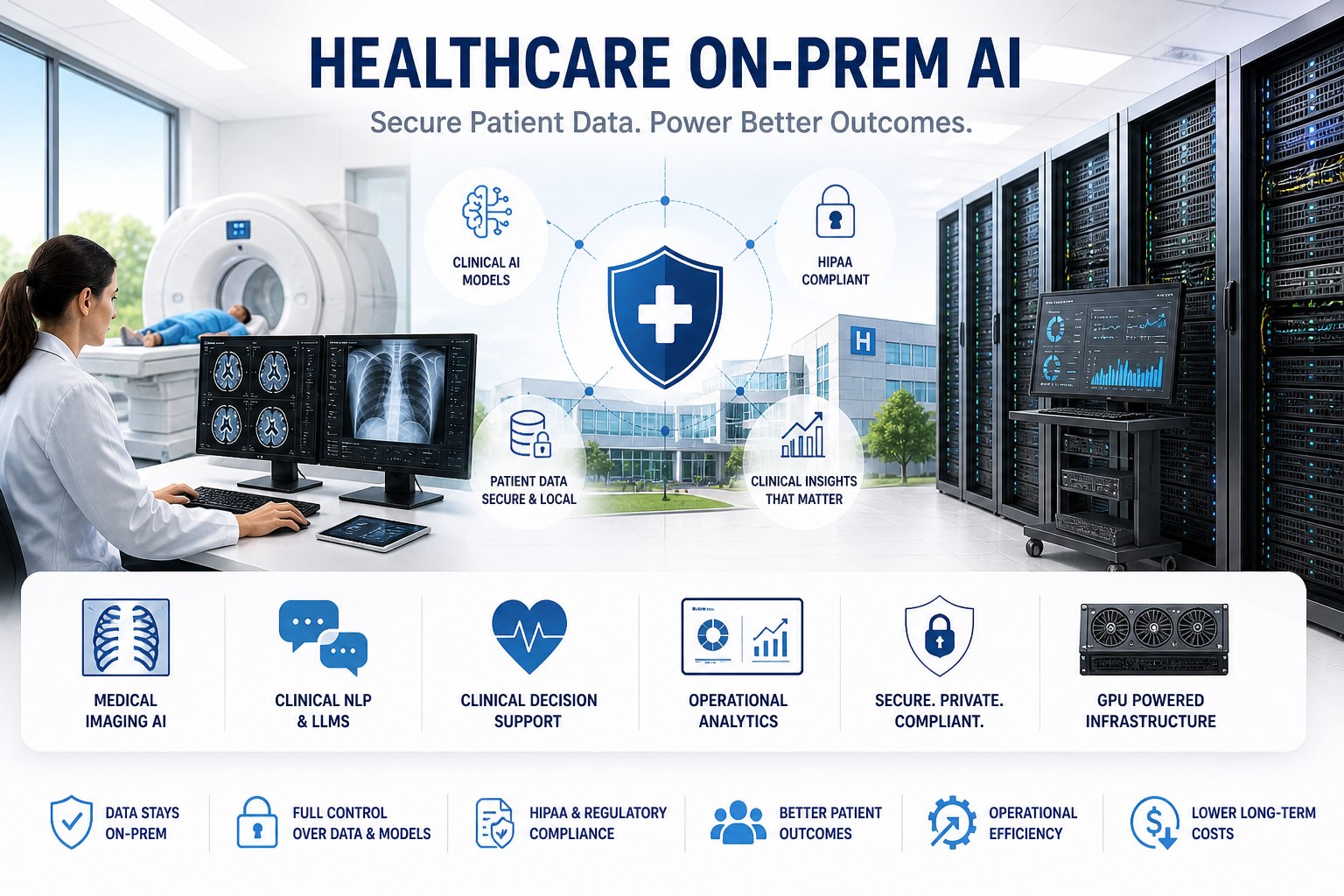
The shift the healthcare AI market is going through right now is structural: AI infrastructure is moving from "consulting engagement" to "product you order." OxMaint's on-prem healthcare AI server ships as a fully integrated AI platform — perpetual license, full source access, complete data sovereignty, pre-configured on enterprise-grade hardware, pre-tested, ready to run within days of arrival.
Perpetual License
No monthly fees. No per-seat charges. No per-token billing. One-time purchase covers software, AI models, and modification rights — for the life of the platform.
Data Sovereignty
All PHI lives on your server, behind your firewall. Patient records, clinical notes, imaging metadata, audit logs — none of it leaves your network unless you choose.
Source Access
Modify, extend, customize freely within your organization. Your team adapts prompts, tunes models, adds EHR integrations — without vendor approval, without change orders.
AI-Native Core
Clinical NLP, predictive analytics, anomaly detection, and document summarization — built into the core, not bolted on. The LLM is part of the platform, not an add-on SKU.
Perpetual · On-Prem · HIPAA-Architected · Ships in 6–12 Weeks
Stop Configuring Compliance. Eliminate It.
A complete, integrated healthcare AI platform — deployed on enterprise-grade AI hardware at your premises, with the entire HIPAA shared-responsibility model collapsed onto your side of the firewall. No SaaS lock-in. No BAA chain. No data sovereignty exposure.
AWS is HIPAA-eligible — meaning AWS will sign a standard Business Associate Agreement (BAA) and the relevant services have the security features needed to support compliance. As of February 10, 2026, the HIPAA-eligible services list includes Amazon Bedrock and Bedrock AgentCore alongside HealthLake, SageMaker AI, S3, and other foundational services. However, "HIPAA-eligible" does not mean "HIPAA-compliant." Compliance is the customer's outcome, achieved through correct configuration: designating HIPAA accounts, restricting PHI processing to eligible services, implementing least-privilege IAM with MFA, deploying inside isolated VPCs with private endpoints, configuring KMS encryption, retaining CloudTrail audit logs, conducting risk analysis and risk management, and signing the BAA before any PHI touches the environment. Gartner estimated through 2025 that 99% of cloud security failures would be the customer's fault — driven primarily by misconfiguration of these customer-side controls. The architecture is viable; the operational burden is real.
When does on-prem AI make more sense than AWS HealthLake + Bedrock?
On-prem deployment becomes the better architectural fit when one or more of these conditions apply: high PHI volume where per-token Bedrock pricing scales unfavorably (typically 100K+ clinical inferences per month); regulated workflows where audit-trail control and data residency must be demonstrated to OCR or state attorneys general without cloud-vendor mediation; defense-related, classified, or air-gapped environments where AWS public-cloud regions are excluded by policy; international operations subject to GDPR or non-US data sovereignty laws where US CLOUD Act exposure is a contractual problem; or organizations that want a perpetual-license capital-expense model rather than recurring OpEx. AWS HealthLake + Bedrock fits well for variable-volume workloads, prototype phases, or organizations already deeply invested in the AWS ecosystem with mature cloud-security practices. Most large health systems in 2026 end up running both — cloud for variable analytical workloads, on-prem for the high-volume PHI-heavy clinical AI use cases where the surface area of the compliance problem matters most.
What's the BAA chain when running clinical AI on AWS Bedrock?
The BAA chain typically runs three to four entities deep. Your organization signs the AWS BAA via AWS Artifact, which covers AWS-provided services including Bedrock and HealthLake. AWS in turn has its own arrangements with foundation model providers (Anthropic, Meta, Mistral, AI21) whose models are accessible through Bedrock. Your downstream business associates — your EHR vendor, your clinical NLP provider, your analytics integrator — each need their own BAAs with you covering their slice of the workflow. If you use additional AWS services that aren't HIPAA-eligible for any reason, those are excluded from PHI processing entirely. The chain is auditable but operationally heavy: every annual HIPAA review needs to verify that every link is current, scoped correctly, and matches actual data flows. On-prem deployment eliminates this chain because PHI never leaves your custody — there's no business associate to sign a BAA with when the AI is running on hardware you own.
How much does a healthcare data breach actually cost in 2026?
Healthcare breach costs averaged $10.22 million per incident in 2026 per IBM's Cost of a Data Breach Report — the highest of any industry for 14 consecutive years. The healthcare premium is driven by HIPAA regulatory costs, the high black-market value of medical records (10–40× the value of credit card data), and the life-critical nature of healthcare systems where downtime is unacceptable. Detection and containment averages 279 days — five weeks longer than the cross-industry average. When shadow AI is involved in the breach (now affecting 40% of hospitals per Wolters Kluwer 2026), the breach cost increases by an additional $670K on average. HIPAA civil penalties run from $145 to $2,190,294 per violation depending on culpability tier, with a $2.19M annual cap per identical violation category for willful neglect. Criminal penalties for knowing violations include fines up to $250,000 and imprisonment from 1 to 10 years. The cost calculus changes significantly when the architectural decision can either expand or shrink the breach surface area.
How fast can an on-prem healthcare AI server actually deploy?
Six to twelve weeks from sign-up to live operation is typical for OxMaint's pre-installed on-prem healthcare AI model. The compressed timeline works because the hardware is configured, integrated, and pre-tested in the factory before shipping — the AI server, the GPU, the clinical LLM models, audit logging, RBAC, and encryption are all installed and validated against synthetic FHIR data before the unit leaves the assembly line. On-site work then collapses to plugging the server into power and the network, running the connect-EHR wizard against your existing system (Epic, Cerner, Athena, or FHIR-native), and configuring your AD/SSO integration. This is fundamentally different from the traditional 6–12 month enterprise healthcare software implementation because there is no integration project — the integration was already done. The "consulting + AI solution" storytelling that dominated the first wave of healthcare AI is being replaced by "order this AI package and get it delivered in 6–12 weeks."