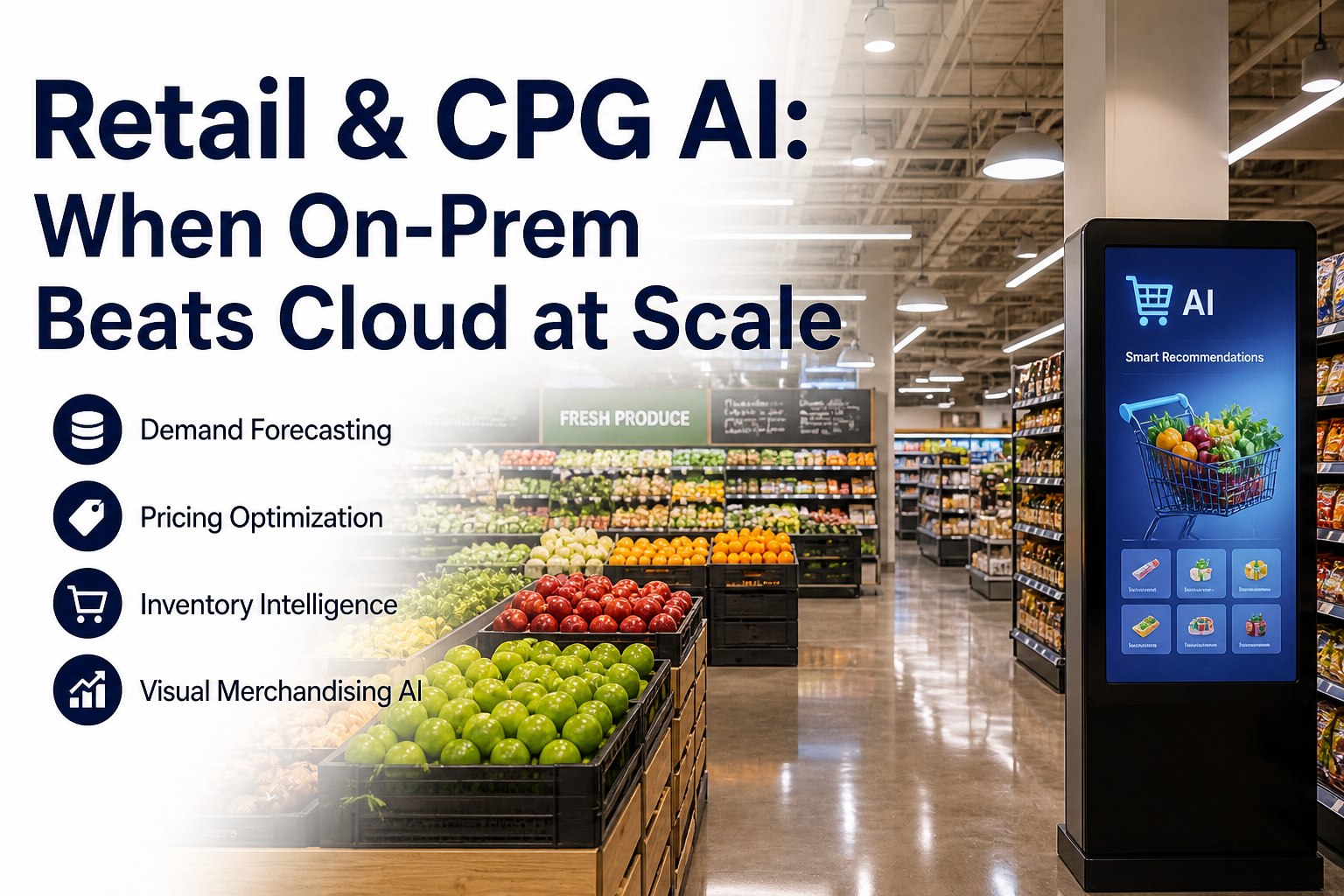
Retail & CPG AI: When On-Prem Beats Cloud at Scale
By Riley Quinn on May 4, 2026
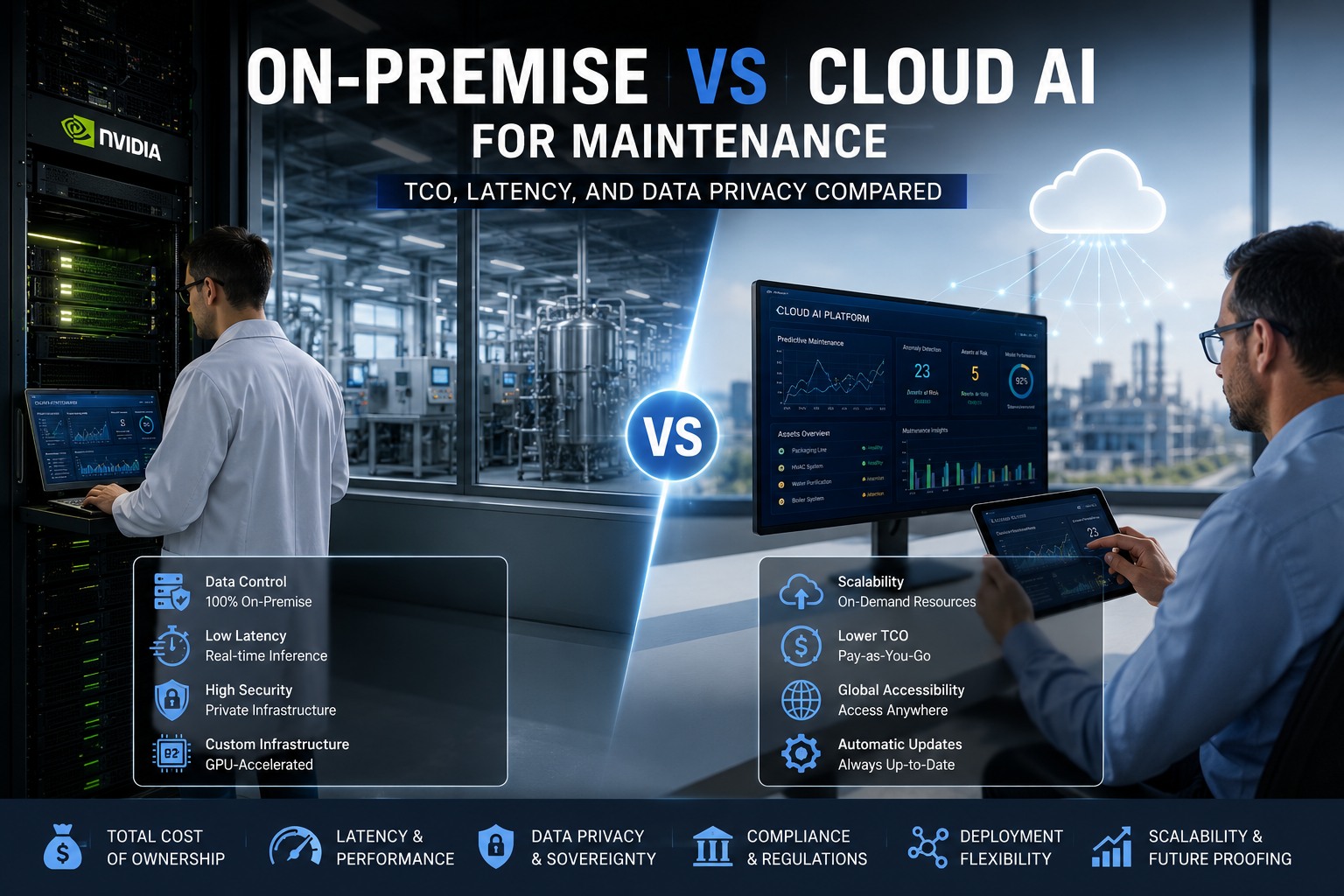
In a 2024 Google Cloud–Omdia survey, 100% of retailers said they plan to use edge computing within 12 months — driven by latency-sensitive use cases (33%) and security/compliance (29%). At the same time, 91% of retail and CPG companies are actively using or assessing AI in 2026, and 9 in 10 are increasing AI budgets. Yet most retail AI procurement still defaults to a single-tier cloud question: "AWS or Azure?" The retailers actually shipping ROI run a three-tier stack — store edge, distribution center, and HQ — each with different latency, scale, and economics. The cloud-vs-on-prem answer isn't one decision; it's three. Sign up free to map the three-tier retail AI stack against your store and DC footprint.
MAY 12, 2026 5:30 PM EST , Orlando
Upcoming OxMaint AI Live Webinar — Retail & CPG AI: Three Tiers, One Stack, Real Numbers
Live session for retail CIOs, CPG operations leaders, store-tech directors, and supply chain VPs. We'll architect the three-tier retail AI stack — store edge for sub-second computer vision and POS resilience, distribution-center AI for inventory and replenishment, HQ deployment for brand-wide forecasting and agentic commerce — with deployment numbers, latency budgets, and the cloud-vs-on-prem decision logic at each tier.
The Three-Tier Retail AI Stack — Where Each Workload Belongs
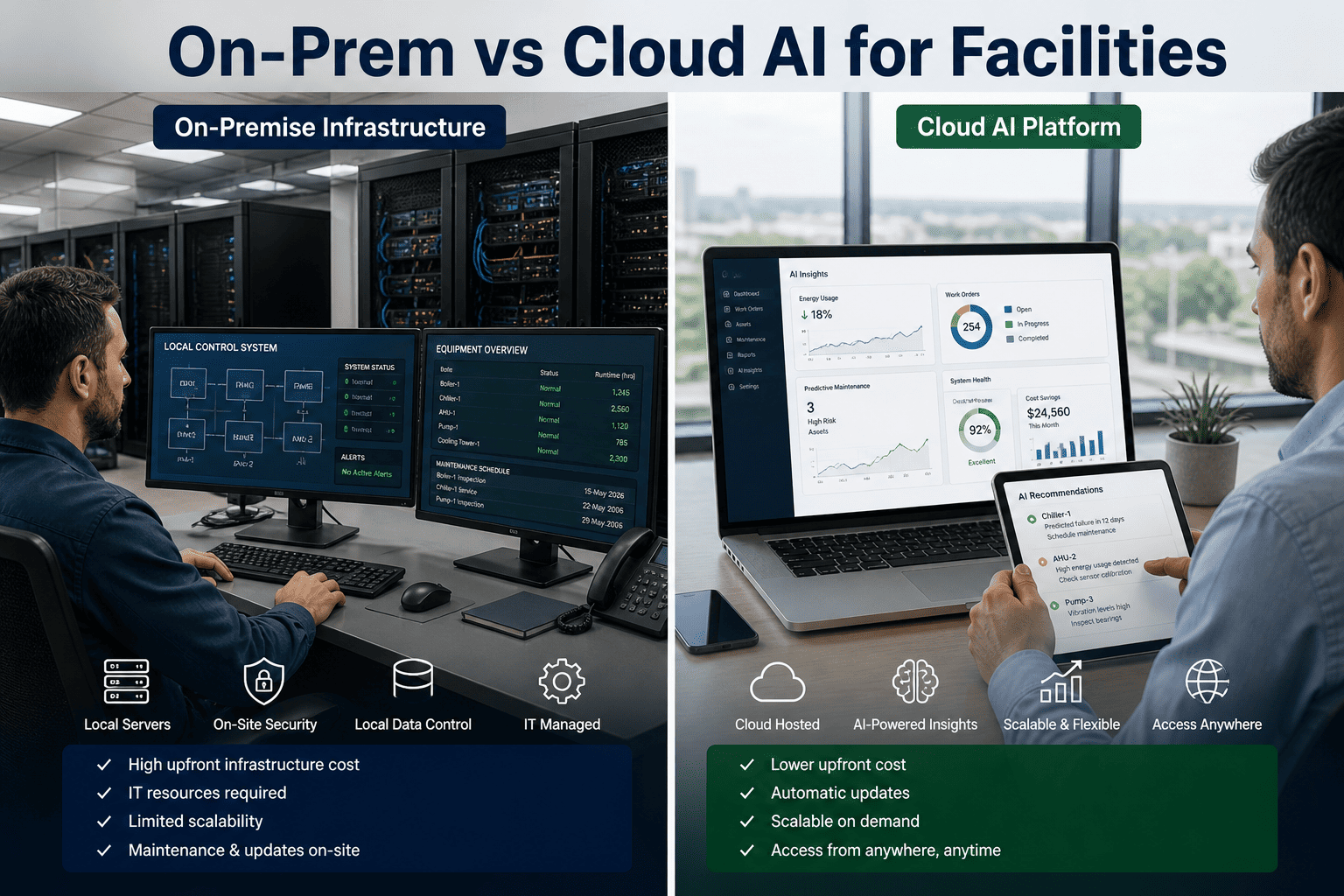
Retail AI isn't one problem. A computer-vision model watching shelves needs sub-second latency. An inventory replenishment model needs distribution-center scale. A brand-wide demand forecaster needs cloud elasticity for monthly Monte Carlo runs. Trying to run all three in the same place is why most retail AI projects underperform — they end up in the cloud (where store-edge fails on latency) or all on-prem (where HQ-scale forecasting is slow and expensive). The retailers winning in 2026 split the stack into three tiers and put each workload where it actually belongs.
TIER 1
STORE EDGE
Sub-Second AI in the Store
Latency<100ms — must work offline
WorkloadsPOS validation · CV shelf monitoring · loss prevention · self-checkout · digital signage
HardwareCompact AI box per store · 1× edge GPU
Why on-premCloud round-trip kills the use case · ISP outage = store down
Why on-premBandwidth cost of streaming inventory data to cloud · WMS latency budgets
TIER 3
HQ / CLOUD
Brand-Wide Forecasting & Agentic Commerce
LatencyHours to days — strategic, not operational
WorkloadsBrand-wide demand forecasting · pricing models · RMN ad allocation · agentic commerce · marketing personalization at scale
HardwareCloud bursting OK · or HQ AI cluster for sensitive data
Why cloud often winsBursty Monte Carlo · monthly model retraining · variable load
What Actually Runs at Each Tier — The Workload Map
The "where to deploy" question gets concrete when you map specific workloads against the three tiers. Computer vision for shelf monitoring is a different infrastructure problem than brand-wide pricing optimization, even if both are "retail AI." Here's the 2026 map of which workloads land at which tier — and why the answer almost never lands all in one place.
Workload
Store
DC
HQ
Computer vision shelf monitoring
POS validation & loss prevention
Self-checkout & loyalty lookup
Inventory rebalancing across stores
Robotics & warehouse orchestration
Last-mile delivery routing
Brand-wide demand forecasting
Dynamic pricing & markdown optimization
Agentic commerce & RMN allocation
Best fit Workable Wrong tier
The 2026 Numbers That Make On-Prem Math Work
Retail AI isn't a research project anymore. The 2026 numbers from NVIDIA's State of AI in Retail and CPG survey, Grand View edge AI market data, and the Google Cloud–Omdia edge survey paint a clear commercial picture — and the retailers running on cloud-only architectures are fighting the trend. Book a demo to see how OxMaint maps to your specific store-count and DC footprint.
9 in 10
Retailers increasing AI budgets in 2026 — and 89% report AI has already increased revenue
100%
Of retailers in the Google Cloud–Omdia survey plan to use edge computing within 12 months
80%
Of retail dollars still captured by physical stores — where edge AI economics actually matter
$118.69B
Edge AI market size projected by 2033 — 21.7% CAGR from $24.91B in 2025
47%
Already using or assessing agentic AI — 20% have agents active today, 21% within next year
$1T
Agentic commerce projected for US retail by 2030 — built on infrastructure decisions made now
The Cloud-Only Trap — Why Retailers Are Pulling Back
The cloud-only retail AI strategy hits three walls at scale that don't show up in the proof-of-concept phase. The retailers that hit them in 2024–2025 spent 2026 rebalancing — and most landed on a hybrid where store-edge and DC workloads moved on-prem while HQ-tier forecasting stayed in cloud. Here's what actually breaks. Sign up free to see the cost-per-store calculator for your specific store-count.
01
Bandwidth cost compounds with stores
A single store running 8 cameras at 1080p sends ~30 GB/day of raw video. For a 1,200-store chain, that's 36 TB/day of cloud egress just for vision workloads — even before POS data, IoT telemetry, or shopper analytics. Bandwidth bill scales linearly with store count and resolution upgrades.
02
Latency kills the use case, not the user
Self-checkout has a sub-200ms latency budget. Cloud round-trip on a stable connection averages 80–150ms before the model even runs. On a Saturday afternoon with congested store Wi-Fi, that's 400–800ms — long enough to break the customer flow. Computer vision shelf alerts have similar budgets. ISP outage = store down.
03
Per-call pricing is incompatible with high-volume inference
Cloud LLM endpoints charge per token. A single store processing 5,000 customer interactions per day at 500 tokens each is 2.5M tokens/day per store. At cloud retail rates, that's $200–$600 per store per day for a chain of 1,200 stores — recurring, indefinitely. On-prem inference collapses that to electricity cost.
Pre-Configured · Store + DC Ready · Ships in 6–12 Weeks
Order an AI Stack Designed for Three-Tier Retail
OxMaint's retail AI server arrives pre-configured with computer vision models for shelf monitoring and loss prevention, POS validation models, predictive maintenance for store equipment, inventory replenishment models for DC tier, and brand-wide forecasting scaffolding for HQ tier. Pre-configured, pre-tested, ready to plug into your store and DC networks within days.
Retail AI vendors typically quote against a confusing mix of per-store, per-camera, per-token, and per-seat fees. The OxMaint retail AI stack is a one-time capital purchase: hardware, perpetual software license, AI models, and integration with your POS, WMS, and BMS. No recurring license fees. Once purchased, your company owns the platform outright. Future costs are entirely optional and at your discretion. Sign up free to see the full retail AI pricing tailored to your chain size.
Parallel deployment across DC network + store rollout
$84.5K
Avg per site
4 mo
Delivery
$0
Recurring fees
∞
Perpetual
What Hits the Floor First — The Day-One Workloads
Retail CIOs in 2026 don't need a list of theoretical AI use cases — they need to know what actually deploys week one and starts paying for itself. Here are the five workloads that consistently land first across deployments at the store-edge and DC tiers, and what each one is replacing or augmenting in your existing stack. Book a demo to see these workloads running on real store data.
CV · STORE
Shelf monitoring & out-of-stock detection
Cameras already in the ceiling get a model that flags empty shelves, misplaced items, and planogram drift. Pages staff in real time. Replaces or complements Trax-style audit programs at lower per-store cost.
CV · STORE
Loss prevention & self-checkout validation
Real-time visual confirmation that the item scanned matches the item in the bag. Catches the most common shrink patterns without needing dedicated LP staff watching every register.
FORECAST · DC
Store-level demand forecasting
Forecasts at the store + SKU level instead of regional rollups — the difference NVIDIA's survey identifies as the actual driver of out-of-stock reduction. More factors, more granular, runs at the DC where the data already lives.
OPS · STORE+DC
Predictive maintenance — refrigeration & HVAC
For grocery and CPG distribution, refrigeration failures are the most expensive single-asset outage. Edge box reads compressor and case telemetry, predicts failures days in advance, prevents inventory loss and emergency calls.
NLP · DC
Work-order & vendor communication automation
Store managers' free-text maintenance reports get auto-categorized, severity-rated, and routed to the right vendor. Replaces the half-day per week each district manager spends triaging tickets.
Perpetual · Owned · Three-Tier Retail Stack
Stop Renting Retail AI by the Camera, by the Token, by the Store
A complete retail AI platform on enterprise-grade hardware at your DC and stores. Computer vision shelf monitoring, POS resilience, predictive maintenance, store-level forecasting, and work-order NLP — all pre-installed, all owned. No SaaS lock-in. No per-store recurring fees. Source code and modification rights included.
Do we need an AI server in every single store, or just at the DC?
It depends on which workloads you're deploying. A small edge box ($4,000 unit cost) per store is necessary for the workloads with sub-second latency requirements: real-time computer vision for shelf monitoring or loss prevention, POS validation, self-checkout, and digital signage personalization. These can't tolerate a cloud round-trip and can't tolerate ISP outages. Workloads at the DC tier — inventory rebalancing, replenishment, robotics orchestration, last-mile routing — only need one regional AI server per DC, which serves the stores in that region. The typical pattern for a 200-store chain is one AI server per DC (4-8 DCs total) plus a small edge box in each store. For a 20-store independent or specialty chain, often one regional AI server plus edge boxes is enough. Smaller chains sometimes start with edge boxes only for store-tier workloads and use cloud for DC-tier forecasting until scale justifies the regional server.
How does this integrate with our existing retail tech stack — POS, WMS, BMS, ERP?
The OxMaint retail AI server connects to your existing systems through standard APIs that all major retail platforms support. POS integration: NCR, Toshiba, Oracle Xstore, Square, Shopify POS — REST APIs for transaction validation, loyalty lookup, and self-checkout. WMS integration: Manhattan, Blue Yonder WMS, Oracle WMS Cloud, Korber — REST and EDI for inventory and order data. BMS integration: Honeywell, JCI, Schneider, Siemens — BACnet and Modbus for refrigeration, HVAC, and lighting. ERP integration: SAP, Oracle, Microsoft Dynamics — REST and OData. Integration scaffolding for major retail platforms ships pre-configured on the OxMaint server. Typical first connection takes 2-3 days from credentials handover to live data flow. Custom integrations to in-house systems are typically 1-2 weeks with the source-access pattern.
What about agentic AI — should we wait until the technology matures?
According to NVIDIA's 2026 State of AI in Retail and CPG survey, 47% of retailers are already using or assessing agentic AI — 20% have agents active in production, and another 21% expect agents within the next year. AI agents are projected to power 40% of enterprise applications in 2026. The retailers waiting will be playing catch-up by 2027. The infrastructure decisions you make in 2026 determine whether your agentic deployment runs on cost-effective owned infrastructure or expensive cloud per-token billing. The OxMaint retail AI server is built to host agentic workloads at the DC tier (inventory rebalancing agents, dynamic pricing agents, vendor negotiation agents, replenishment agents) and at the store-edge tier (associate-assist agents, customer-service agents). Agentic commerce — projected to be a $1 trillion US retail market by 2030 — is built on the infrastructure decisions made now.
How does this compare to Blue Yonder, RELEX, Trax, Vision Group, or NVIDIA Metropolis?
These are point solutions for specific workloads — Blue Yonder and RELEX for predictive planning and forecasting, Trax for computer vision shelf monitoring, Vision Group for retail execution, NVIDIA Metropolis for store video analytics. They each do one thing well, and most retailers in 2026 run two or three of them stacked on top of each other with separate vendor contracts, separate per-store pricing, and separate integration projects. The OxMaint approach is different: one owned AI platform that runs the workloads each of these solves, on enterprise-grade hardware you own outright, with source-code modification rights so your team can extend the models for your specific store formats, regions, or product categories. You can still use Blue Yonder or RELEX alongside OxMaint at the HQ tier if you've invested in them — the OxMaint platform integrates with their APIs the same way it integrates with POS or WMS. The decision is whether you want one owned platform handling the bulk of the retail AI stack, or 4-5 vendor relationships each with their own per-store recurring bill.
How long from purchase to live operation across stores and DCs?
Six to twelve weeks from sign-up to live operation is typical for the first DC plus a pilot of 5-10 stores. The compressed timeline works because the server is configured, integrated, and pre-tested in the OxMaint factory before shipping — GPU, AI software, computer vision models, forecasting models, POS/WMS/BMS connectors, and audit logging are all installed and validated against synthetic retail data before the unit ships. On-site work then collapses to: rack the regional server at the DC (1 day), connect to your retail network (2-3 days), install edge boxes at pilot stores (1 day each, or 5-10 stores in a week with a small crew), validate against your specific POS and WMS instances (1-2 weeks), then go live. For a full-chain rollout across 200+ stores, parallel deployment lands the entire network inside a 4-6 month window using a phased rollout pattern by region.