Healthcare On-Prem AI: HIPAA, Patient Data, and Clinical Models
By Riley Quinn on May 4, 2026
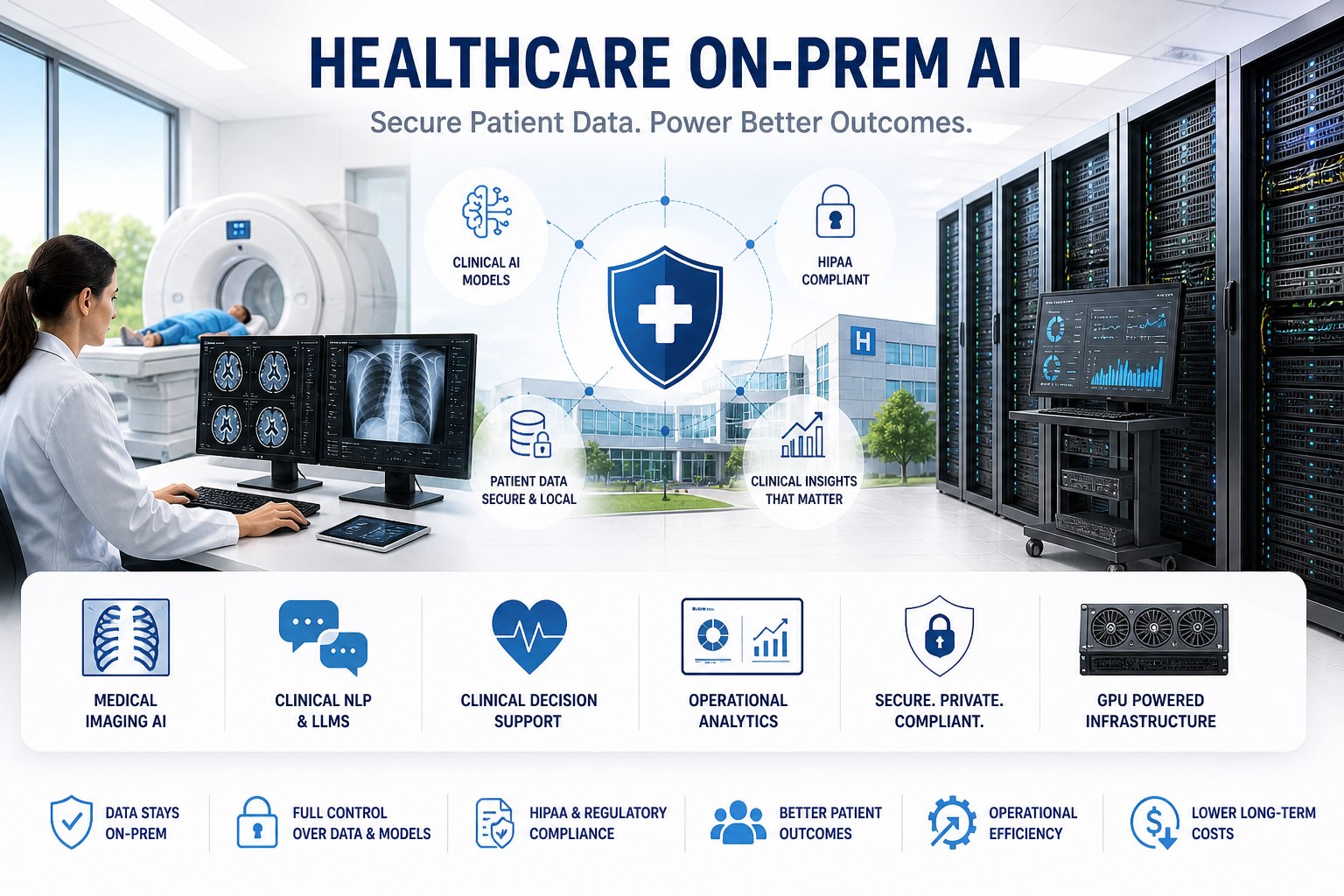
Healthcare AI is moving from experimentation to clinical production at scale, but the data powering these systems — patient records, imaging studies, genomic sequences, clinical notes — carries HIPAA obligations that fundamentally change what infrastructure is acceptable. In January 2025, HHS OCR proposed the first major HIPAA Security Rule overhaul in 20 years, explicitly addressing dynamic AI compute environments. The hospitals winning in 2026 aren't choosing between AI models — they're building owned infrastructure where patient data never leaves the building. Sign up free to try the on-prem hospital AI platform.
MAY 12, 2026 5:30 PM EST , Orlando
Upcoming OxMaint AI Live Webinar — Hospital AI Stack Walkthrough: GPU, MONAI, PACS, EHR
Live session for hospital CIOs, radiology directors, and clinical informatics leads. We'll architect a complete on-prem AI deployment for a 400-bed hospital — GPU sizing, MONAI framework setup, DICOM/PACS integration, EHR connection — and walk through the HIPAA Security Rule audit checklist that lands in front of OCR investigators.
"Healthcare AI" isn't one workload — it's three with completely different GPU, storage, and latency requirements. Speccing the wrong profile is the most common reason hospital AI projects stall after 12 months. Here's what actually runs on your servers and what each profile demands.
Profile 1
Medical Imaging AI
2GB–30GB per study
Radiology, pathology, ophthalmology. Whole-slide pathology images at 40× magnification: ~100,000×100,000 pixels, 2GB compressed. CT/MRI studies routinely several GB. Stroke and pulmonary embolism triage models must return findings within seconds of scan acquisition.
GPU: RTX PRO 6000 Blackwell, 96GB ECC
Frame: MONAI on PyTorch
Storage: NVMe + PACS bridge
Profile 2
Clinical LLM
70B params at FP8
Documentation automation, prior authorization, record summarization, diagnostic coding. Every inference contains dense PHI in the prompt. A 70B-parameter clinical model running FP8 on RTX PRO 6000 Blackwell serves the entire clinical staff with no patient data leaving the network.
GPU: RTX PRO 6000 Blackwell, 96GB
Models: Open weights (Llama, Mistral)
Throughput: 100s req/min
Profile 3
Genomics & Research
TB-scale sequencing
Variant calling, structural genomics, drug discovery, clinical trial cohort analysis. Per-patient genomic data routinely exceeds 100GB. Mass General's clinical data center processes a database of 10 billion medical images for radiology, pathology, and genomics combined.
GPU: Multi-GPU cluster
Frame: NVIDIA BioNeMo
Storage: Petabyte-scale tier
Why On-Prem Beats Cloud for PHI Workloads
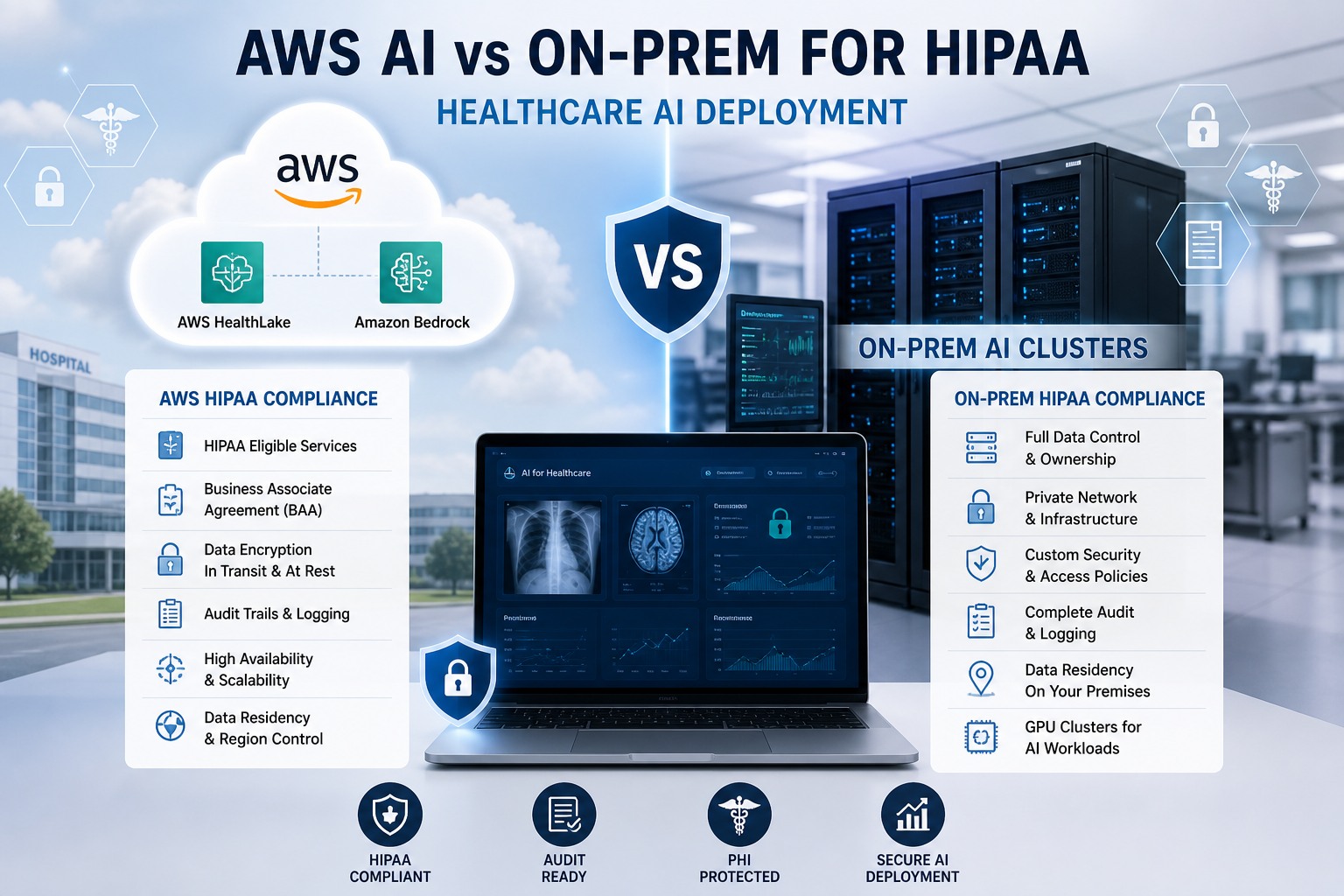
The compliance principle is straightforward: data that never leaves the facility is data the OCR investigator cannot find a breach in. Once PHI enters a GPU workload, HIPAA obligations extend to the hardware layer — and shared multi-tenant cloud GPU environments are fundamentally difficult to reconcile with HIPAA's Security Rule requirements. Book a demo to walk through your hospital's specific HIPAA compute architecture.
01
No PHI ever crosses the WAN
Patient data, model weights, and audit logs all stay inside the hospital network. No Business Associate Agreement with an AI vendor. No cross-border transfer questions. No "shared responsibility" gaps where customer config errors create breach exposure.
02
Tenancy isolation is physical
In multi-tenant cloud GPU environments, data moves across nodes, memory, and interconnects in milliseconds — making consistent access control, immutable logging, and strict tenancy isolation difficult to guarantee. On-prem makes the isolation a building, not a config file.
03
ECC memory protects inference integrity
RTX PRO 6000 Blackwell ships with 96GB ECC GDDR7 memory protection. Silent bit-flip corruption during inference is undetectable on consumer GPUs — and unacceptable when the inference output drives a clinical decision.
04
No per-token billing on PHI inference
A clinical LLM running constantly across documentation, summarization, prior auth, and coding workflows generates millions of inferences per month. Cloud per-token billing scales unfavorably above ~100K clinical inferences/month. On-prem inference costs collapse to electricity.
The Hospital AI Stack — From GPU to Bedside
An on-prem hospital AI deployment is a layered stack where each layer answers a specific clinical question. Understanding the stack tells you what you're actually buying when you procure "hospital AI infrastructure" — and what every layer must do for the clinician to trust the output. Book a demo to see the full stack running on a real hospital workload.
L5
Clinical Workflow Layer
Radiologist worklist, ED triage, clinical documentation UI
↑
L4
EHR Integration Layer
FHIR / HL7 — Epic, Cerner, MEDITECH, Allscripts
↑
L3
Imaging Pipeline (DICOM / PACS)
Study ingestion, anonymization, model routing, result writeback
↑
L2
AI Framework Layer
MONAI for imaging · NVIDIA BioNeMo for genomics · vLLM for clinical LLMs · CUDA + PyTorch base
↑
L1
GPU Compute Hardware
RTX PRO 6000 Blackwell · 96GB ECC GDDR7 · Behind your firewall
Pre-Configured · HIPAA-Aligned · Ships in 6–12 Weeks
Order the Complete Hospital AI Stack as One SKU
OxMaint's hospital AI server arrives with all five layers pre-installed: GPU hardware, MONAI/CUDA framework, DICOM connectors, EHR integration scaffolding, and clinical workflow UI — pre-configured, pre-tested, ready to plug into your network and run within days. Perpetual license, full source access, all PHI stays on your premises.
Clinical Use Cases That Are Already Delivering ROI
The 2026 NVIDIA "State of AI in Healthcare and Life Sciences" survey found that 85% of healthcare organizations are increasing AI budgets this year, with 46% increasing significantly (more than 10%). 82% say open-source models are moderately to extremely important to their AI strategy. Here's where the ROI is actually landing. Sign up free to start with one ROI use case and expand from there.
57%
Medical Imaging AI
of medical technology respondents report ROI from medical imaging AI deployments. Top use case across the entire industry alongside clinical decision support and workflow optimization.
45min→3min
CT Reconstruction Speedup
GPU-accelerated iterative reconstruction reduces CT processing from 45 minutes to 2-3 minutes. 4D cardiac imaging now achieves 30 fps real-time. 512×512×300 noise reduction in under 10 seconds.
39%
Admin Workflow ROI
of payers and providers cite administrative tasks and workflow optimization as their top AI ROI area. Scheduling, documentation, coding, utilization management, care coordination.
15K+
Siemens MONAI Devices
MONAI is now deployed across 15,000+ Siemens Healthineers clinical devices. The framework has become the de facto standard for medical imaging AI development and clinical production.
10B
Mass General Image Database
Mass General's Clinical Data Science Center processes a database of 10 billion medical images on NVIDIA infrastructure for radiology, pathology, and genomics — the gold-standard reference architecture.
Seconds
Stroke Triage Latency
AI triage models for acute stroke and pulmonary embolism must return results within the clinical window of relevance — often within seconds of scan acquisition. Cloud round-trip latency is the bottleneck.
What a Hospital On-Prem AI Deployment Actually Costs
Most hospital AI vendors hide pricing behind a sales call. Here are the real numbers for an OxMaint hospital deployment — per-site totals, multi-hospital rollout, and the 4-month delivery model. Includes the AI server hardware (GPU + ECC compute), perpetual software license, MONAI/clinical framework configuration, and the EHR/PACS integration work. Sign up free to start your hospital deployment with full pricing transparency.
Swipe to see breakdown
Component
Unit Cost
Per Hospital (4 mo)
Notes
AI server (RTX PRO 6000 Blackwell, 96GB ECC)
$19,000
$19,000
Clinical LLM + medical imaging inference
Edge inference unit
$4,000
$4,000
EHR connector — FHIR / HL7 ingestion
Network + install
$10,500–$14,500
~$12,500
Hospital VLAN, Cat6A, rack, electrical
OxMaint AI software + MONAI/PACS integration
$35,000–$55,000
$45,000 avg
Perpetual license, AI models, EHR/PACS integration
Per-Hospital Total
$72,500–$94,500
~$84,500 avg
4-month delivery per hospital
4-Hospital Health System Rollout
~$420,000–$520,000
Total programme
Parallel deployment across health system
$84.5K
Avg per hospital
4 mo
Delivery
$0
Recurring fees
∞
Perpetual
Expert Perspective — From "Which Models?" to "What Infrastructure?"
The hospital AI conversation has fundamentally shifted in 2026. At RSNA 2025 it became hard to ignore: buyers are no longer asking "which collection of AI models should we buy?" — they're asking "what infrastructure do we need to run AI safely at scale across time?" That distinction matters because it changes the procurement question from a multi-vendor model bake-off to a single architectural decision: are we building an owned platform, or are we renting clinical inference from someone else's data center? For HIPAA workloads, the answer is increasingly the same. The OCR's January 2025 proposal to overhaul the HIPAA Security Rule for the first time in 20 years was specifically aimed at dynamic AI compute environments — and the resulting compliance burden falls hardest on shared multi-tenant cloud setups where data moves across nodes and memory containers in milliseconds. The hospitals that get this right architect the GPU, the framework, the PACS bridge, and the EHR integration as one stack from day one, behind their own firewall, on hardware they own.
85%
Increasing AI Budgets
Per NVIDIA's 2026 healthcare survey, 85% of healthcare orgs are increasing AI budgets this year, with 46% increasing significantly (more than 10%).
82%
Open Source Strategy
82% of healthcare orgs say open-source models are moderately to extremely important to their AI strategy — making owned-platform deployment the natural fit.
20yr
First HIPAA Overhaul
HHS OCR's January 2025 proposal is the first major HIPAA Security Rule overhaul in 20 years — explicitly addressing dynamic AI compute environments.
Perpetual · HIPAA-Aligned · One Hospital or Health System
Stop Renting Clinical Inference From Someone Else's Data Center
A complete hospital AI platform on enterprise-grade RTX PRO 6000 Blackwell hardware at your premises, with MONAI, PACS bridge, EHR integration, and clinical workflow UI all pre-installed. No SaaS lock-in. No PHI ever leaves the network. Source code and modification rights included.
What's the difference between hospital on-prem AI and a HIPAA-eligible cloud AI service?
A HIPAA-eligible cloud AI service (AWS Bedrock, Azure OpenAI under BAA) means the cloud provider has signed a Business Associate Agreement and committed to the technical safeguards that HIPAA requires. PHI still transits the public internet to the cloud provider's data center for inference, where it's processed in shared multi-tenant GPU infrastructure. Hospital on-prem AI keeps PHI entirely inside the hospital network — patient data, model weights, audit logs, and inference results never cross the WAN. There's no Business Associate Agreement to negotiate with an AI vendor, no shared-responsibility configuration matrix, and no question about which jurisdiction the data is technically subject to. For workloads where PHI volume is high (clinical LLM serving the entire staff, real-time imaging triage, record summarization across the patient population), on-prem becomes both the simpler compliance posture and the more cost-effective architecture once monthly inference volume crosses ~100K requests.
Why does ECC GPU memory matter for clinical AI specifically?
A consumer GPU can experience silent bit-flip errors during long inference runs — a single bit changes in GPU memory because of cosmic rays, electrical noise, or thermal stress, and the model output is subtly wrong without any error message. In gaming or research workloads this is a curiosity. In clinical inference where the output drives a radiology read, a triage decision, or a clinical note, an undetected corruption is a patient safety event. ECC (Error-Correcting Code) memory detects and corrects single-bit errors and detects multi-bit errors so they fail loudly instead of corrupting silently. The RTX PRO 6000 Blackwell ships with 96GB ECC GDDR7 memory by default, and the rest of the hospital AI server (system RAM, storage, network buffers) should be ECC-protected end-to-end. This is the kind of detail that separates "I built an AI server" from "I built a clinical AI server."
How does the hospital AI stack integrate with our existing PACS and EHR?
The hospital AI stack connects to your PACS via DICOM (the standard imaging protocol every PACS system speaks) and to your EHR via FHIR or HL7 (the standard clinical data exchange protocols supported by Epic, Cerner, MEDITECH, Allscripts, and every major EHR vendor). On the imaging side, the AI server appears to your PACS as another DICOM node — studies route to it for AI processing, the model writes results back to the PACS as a structured DICOM Secondary Capture or DICOM Structured Report, and the radiologist sees the AI output in their existing reading worklist with no workflow disruption. On the EHR side, FHIR/HL7 connectors pull patient context for the clinical LLM (medication lists, problem lists, prior notes) and write AI-generated documentation back to the chart for clinician review and signoff. The OxMaint hospital AI server ships with both DICOM and FHIR connectors pre-configured — what's left is connecting credentials and confirming routing rules, typically a 2–3 day integration window.
What's MONAI and why does every hospital AI deployment use it?
MONAI is the open-source medical imaging AI framework developed by NVIDIA and the medical imaging community, built on PyTorch. It includes pre-trained foundation models for medical imaging (segmentation, classification, registration, generation), domain-specific data loaders that handle DICOM and NIfTI natively, image transforms designed for medical data (Hounsfield units, modality-specific augmentation), and a model zoo of validated clinical models. MONAI is now deployed across 15,000+ Siemens Healthineers clinical devices and has become the de facto standard for medical imaging AI development and clinical production. Building a hospital AI deployment without MONAI in 2026 is roughly equivalent to building a web application without a web framework — technically possible, dramatically slower, and you end up reimplementing badly what already exists. The OxMaint hospital AI server ships with MONAI configured, validated CUDA toolkit versions, and PyTorch configurations known to work correctly with MONAI's medical imaging transforms.
How fast can an on-prem hospital AI deployment go live?
Six to twelve weeks from sign-up to live clinical operation is typical for OxMaint's pre-installed hospital AI server. The compressed timeline works because the server is configured, integrated, and pre-tested in the OxMaint factory before shipping — GPU, MONAI framework, DICOM connectors, FHIR/HL7 EHR scaffolding, audit logging, encryption, and clinical workflow UI are all installed and validated against synthetic patient data before the unit leaves the assembly line. On-site work then collapses to plugging the server into power and the hospital network, running the connect-systems wizard against your specific PACS and EHR endpoints, and configuring your AD/SSO integration. For health systems doing multi-hospital rollouts, parallel deployment lands 3–4 hospitals simultaneously inside a 4-month window with the enterprise tier package — total programme cost ~$420K–$520K for a 4-hospital rollout, perpetual license, no recurring fees.