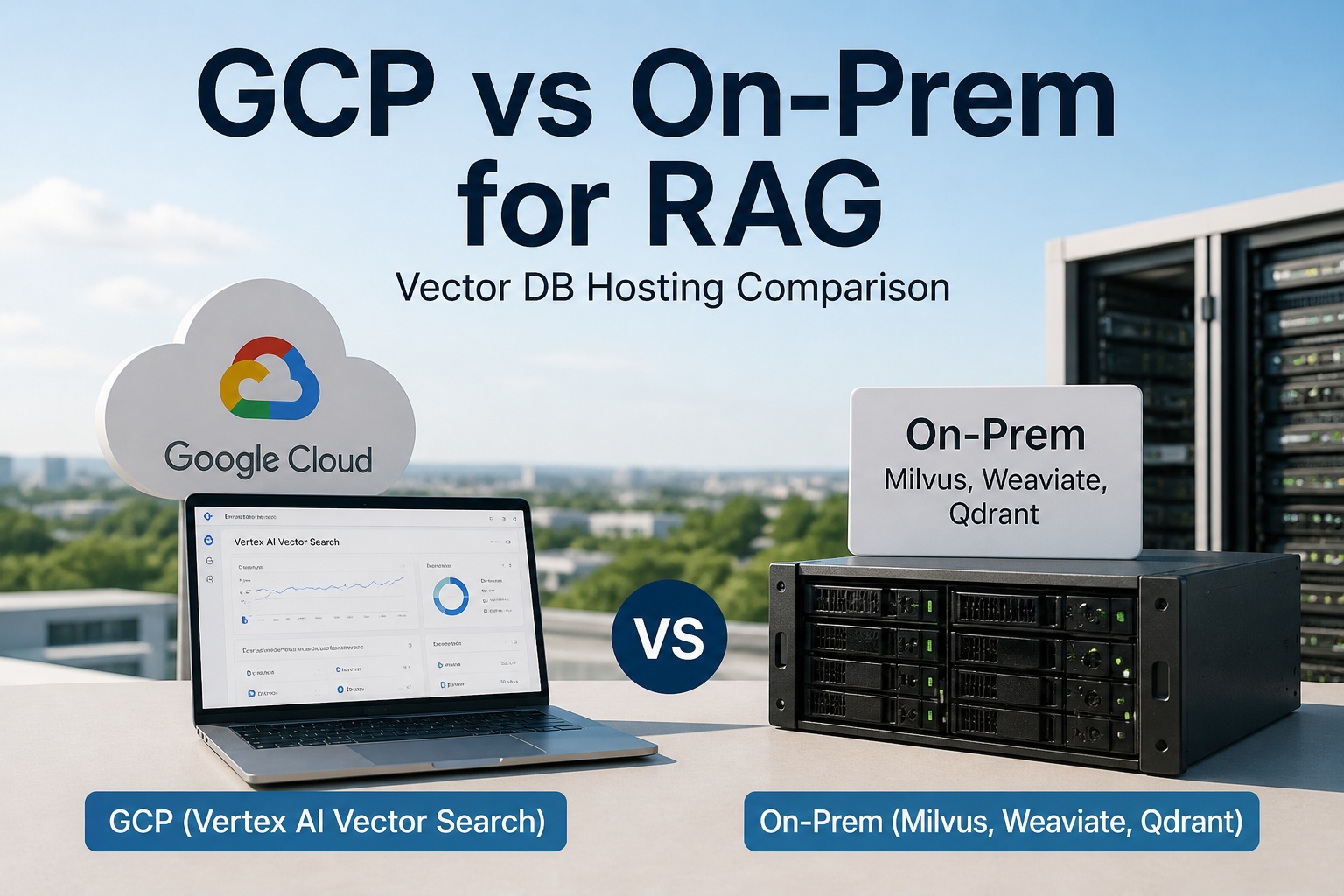
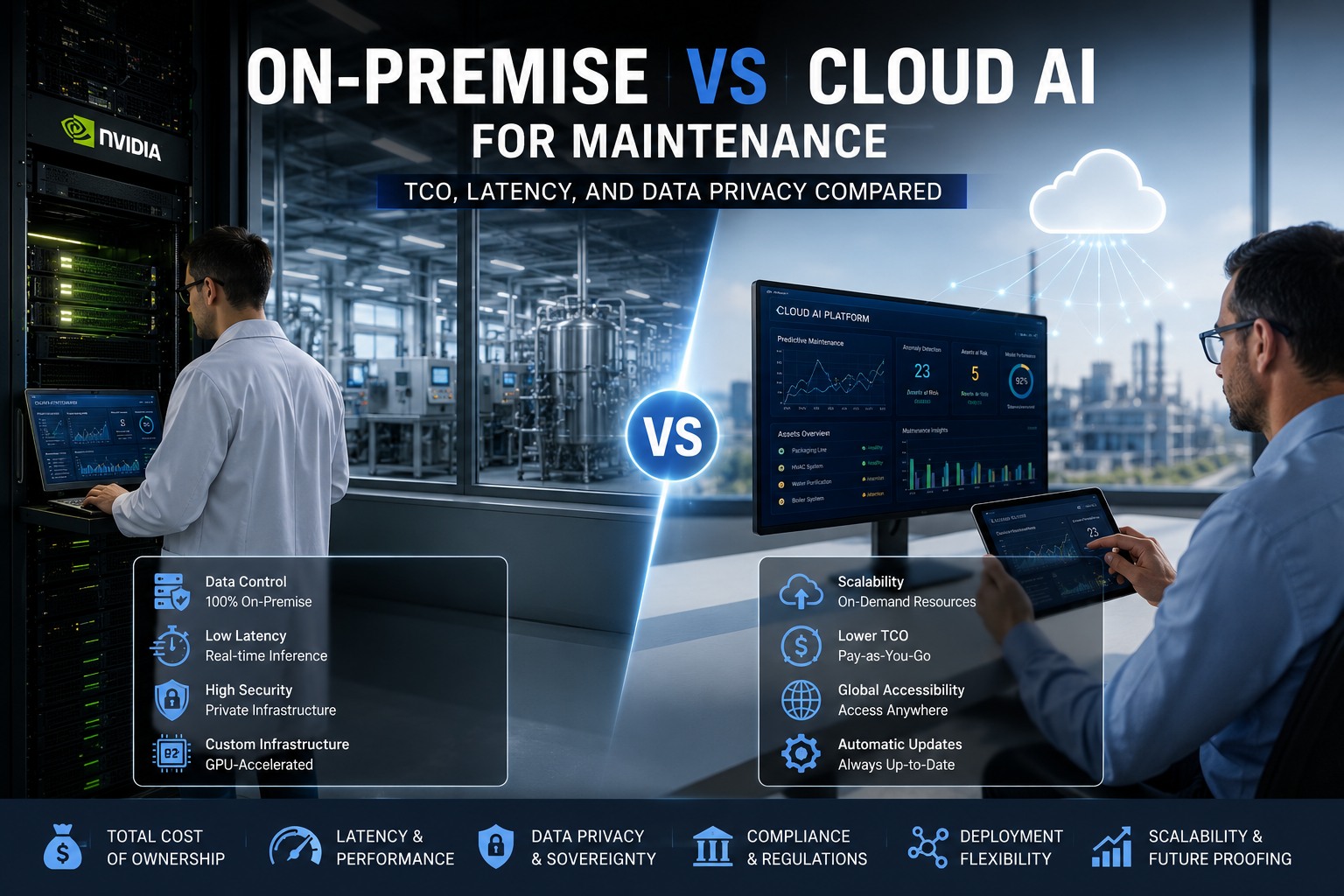
GCP vs On-Prem for RAG: Vector DB Hosting Comparison
By Riley Quinn on May 1, 2026
Every engineering team deploying RAG in 2026 hits the same fork in the road: spin up Vertex AI Vector Search on GCP and ship in days, or self-host Milvus, Weaviate, or Qdrant on-prem and own the stack completely. The wrong choice costs you six months of re-architecture or a cloud bill that triples as your document corpus grows. This guide gives you the real comparison — latency numbers, cost curves, data privacy tradeoffs and the hybrid patterns that most production RAG systems land on. See how OxMaint uses RAG-powered AI to surface maintenance intelligence from your asset documents — start free.
MAY 12, 2026 5:30 pm est, Orlando
Upcoming Oxmaint AI Live Webinar — Live RAG Architecture Demo for Manufacturing AI
See how OxMaint deploys retrieval-augmented generation on top of your asset manuals, maintenance histories, and equipment specs — cloud, hybrid, or on-prem. Walk in with your data privacy constraints; walk out with a working RAG architecture plan.
GCP Vertex AI vs. on-prem vector DB live cost comparison
RAG pipeline architecture for manufacturing asset intelligence
Milvus vs. Weaviate vs. Qdrant — which fits your use case
Data sovereignty and compliance for enterprise RAG deployments
The RAG Reality Check: 63% of enterprise RAG deployments that started on GCP in 2024 have since moved at least one vector DB workload on-prem — not because GCP failed, but because retrieval latency requirements and document corpus sizes weren't modeled correctly at design time. This guide shows you how to model them correctly before you commit.
What a Production RAG Pipeline Actually Looks Like
PDFs, manuals, maintenance logs chunked and pre-processed
Either
02
Embedding Generation
text-embedding-004, Gecko, or open-source sentence transformers
GCP wins here
03
Vector Storage & Index
Vertex AI Vector Search, Milvus, Weaviate, or Qdrant
THE KEY DECISION
04
Retrieval & Reranking
ANN search, top-k retrieval, optional cross-encoder rerank
On-prem wins on latency
05
LLM Generation
Gemini 1.5, Claude, GPT-4o with retrieved context injected
GCP / Cloud
Stage 3 — vector storage and indexing — is where 80% of the GCP vs. on-prem decision lives. Stages 1, 2, and 5 have less architectural lock-in than most teams assume.
GCP Vertex AI Vector Search vs. On-Prem: The Honest Scorecard
Namespace + restricts; no complex SQL-style queries
Full expression support
Milvus/Qdrant support complex boolean + range filters
On-Prem
Ops Burden
Team required
Zero infra ops
GCP manages availability, patching, backups
0.5–1 DevOps FTE
Kubernetes management, upgrades, monitoring
GCP
Score: GCP 3 — On-Prem 4. On-prem wins where it matters most for enterprise RAG: latency, cost at scale, data privacy, and metadata filtering richness. GCP wins on speed-to-deploy, elastic scaling, and ops simplicity.
On-Prem Vector DB Showdown: Milvus vs. Weaviate vs. Qdrant
If on-prem wins your architecture decision, your next choice is which vector database to self-host. Each has a genuinely different performance profile and operational model.
Milvus
Best for: Billion-scale, production-grade
Index TypesHNSW, IVF_FLAT, DISKANN, GPU
Max ScaleBillions of vectors (distributed)
Language SDKsPython, Go, Java, Node.js
DeploymentKubernetes (Helm chart), Docker
LicenseApache 2.0
Strengths
Fastest ANN at billion-vector scale
GPU-accelerated indexing (NVIDIA)
Full distributed mode for HA
Tradeoffs
Heaviest Kubernetes footprint
Steeper learning curve
Choose Milvus when you have 50M+ vectors, a DevOps team, and need the fastest possible throughput at scale.
Weaviate
Best for: Multi-modal, hybrid search
Index TypesHNSW, flat (small corpus), BM25+vector
Max Scale~100M vectors (single node to cluster)
Language SDKsPython, TypeScript, Go, Java
DeploymentDocker, Kubernetes, managed cloud
LicenseBSD-3 / Enterprise
Strengths
Native BM25 + vector hybrid search
Built-in module system (rerankers, OCR)
GraphQL API — great for structured data
Tradeoffs
Higher memory footprint than Qdrant
Modules add complexity at scale
Choose Weaviate when your RAG pipeline needs hybrid keyword+semantic search, or you're indexing multi-modal content (images + text).
Qdrant
Best for: Low latency, resource-efficient
Index TypesHNSW (on-disk), scalar quantization
Max Scale~500M vectors (distributed)
Language SDKsPython, TypeScript, Rust, Go
DeploymentSingle binary, Docker, Kubernetes
LicenseApache 2.0
Strengths
Lowest RAM usage (disk-based HNSW)
Best filter performance (pre + post)
Simplest deployment — single Rust binary
Tradeoffs
Smaller community than Milvus
Fewer built-in integrations
Choose Qdrant when hardware is constrained, retrieval latency is critical, or you need rich payload filtering without a heavy ops burden.
Not Sure Which Vector DB Architecture Fits Your RAG Use Case?
OxMaint's AI maintenance layer runs RAG on top of your asset documentation — cloud, hybrid, or on-prem. Our engineers will map your document volume, latency requirements, and data privacy constraints to the right architecture in 30 minutes.
Monthly Cost Comparison — GCP Vertex AI Vector Search vs. Self-Hosted Qdrant (Kubernetes)
Vector Corpus Size
Query Volume / Day
GCP Vertex AI
On-Prem (Qdrant)
Crossover
1M vectors
< 10K queries
~$95/mo
~$180/mo
GCP cheaper
5M vectors
10K–100K queries
~$480/mo
~$210/mo
On-Prem cheaper
10M vectors
100K–500K queries
~$1,400/mo
~$280/mo
On-Prem 5x cheaper
50M vectors
500K+ queries
~$7,200/mo
~$640/mo
On-Prem 11x cheaper
100M vectors
1M+ queries
~$18,000/mo
~$1,100/mo
On-Prem 16x cheaper
The crossover point is approximately 3–5M vectors with >10K daily queries. Below that threshold, GCP's zero-ops advantage outweighs the cost difference. Above it, on-prem competes aggressively — especially for manufacturing RAG workloads where corpora include years of maintenance records, OEM manuals, and equipment specs.
The Hybrid RAG Pattern Most Production Systems Land On
After working through the pure-cloud vs. pure-on-prem tradeoffs, most enterprise RAG deployments end up somewhere in between. Here is the hybrid architecture that captures the best of both worlds.
Burst / spike workloads that exceed on-prem capacity
New document types during evaluation / pilot phase
Route On-Prem
Proprietary maintenance histories and failure records
OEM contracts and pricing data
High-frequency retrieval (>50K queries/day)
Any data with PHI, PII, or export-control classification
2026 RAG Deployment: What the Market Data Shows
41%
Of enterprise RAG deployments in 2026 use a hybrid cloud/on-prem vector DB architecture — up from 12% in 2024
Gartner AI Infrastructure 2026
11x
Cost difference between GCP Vertex AI Vector Search and self-hosted Qdrant at 50M+ vector corpus scale
Infrastructure benchmarks Q1 2026
68%
Of manufacturing AI teams cite retrieval latency — not generation quality — as the top RAG production bottleneck
MLOps Community Survey 2025
$4.1B
Projected enterprise vector database market size by 2028, growing at 24% CAGR from current $890M
MarketsandMarkets 2026
Expert Perspective: Where RAG Deployments Actually Fail
The GCP vs. on-prem debate for RAG distracts teams from the real failure modes. In my experience reviewing production RAG systems, the vector DB hosting decision accounts for maybe 20% of retrieval quality. The other 80% is chunking strategy, embedding model selection, and metadata schema design — all of which happen before a single vector hits your database. Teams that obsess over whether to use Vertex AI or Milvus and haven't spent serious time on their chunking pipeline end up with fast retrieval of irrelevant context. The second pattern I see consistently: teams choose GCP for speed-to-pilot, hit the 5M vector cost inflection point by Month 4, and panic-migrate to on-prem under pressure. If your document corpus will exceed 5M vectors within 12 months — and for any serious manufacturing operation it will — design for on-prem or hybrid from Day 1 rather than optimizing for pilot speed.
Chunking Is More Important Than the DB
Semantic chunking with 20% overlap at 512 tokens outperforms naive fixed-size chunking on recall by 30–45% — regardless of which vector database you use. Invest here first.
Model Your Corpus Size at 12 Months
If your document corpus will exceed 5M vectors within a year, design for on-prem or hybrid from the start. Migrating under cost pressure at Month 4 is far more expensive than building it right initially.
Metadata Schema Is a First-Class Decision
For manufacturing RAG, metadata (asset_id, equipment_type, document_date, failure_mode) enables precise pre-filtering that reduces retrieval noise by 60–80%. Design your schema before you ingest a single document.
Put RAG to Work on Your Asset Intelligence — Without Building the Infrastructure
OxMaint's AI maintenance platform includes a production RAG layer trained on your maintenance manuals, OEM docs, and failure histories — fully managed, CMMS-integrated, and deployable in days. No vector DB ops required.
Conclusion: The Right RAG Architecture Is the One You'll Still Be Running in Year 2
GCP Vertex AI Vector Search is the right call for teams that need to ship fast, have corpus sizes under 5M vectors, and don't have data sovereignty constraints. On-prem Milvus, Weaviate, or Qdrant wins decisively on cost at scale, retrieval latency, and data privacy — but requires a DevOps team that doesn't mind owning a Kubernetes workload. Most production manufacturing RAG deployments end up hybrid: GCP for embedding generation and LLM inference, on-prem for the high-frequency, sensitive-data vector index. That hybrid pattern captures 90% of the benefits of each model and avoids the worst failure modes of both. The vector DB decision matters — but it matters less than your chunking strategy, metadata schema, and the feedback loop that lets your retrieval system improve as your document corpus grows. Walk through your RAG architecture with an OxMaint engineer before you commit — book a 30-minute session. The teams winning with RAG in manufacturing are not the ones with the most sophisticated vector infrastructure. They're the ones whose AI actually knows what's in their maintenance manuals and can surface the right procedure when a technician needs it. Start your free OxMaint account and see RAG-powered maintenance intelligence on your own assets today.
Frequently Asked Questions
What is the real latency difference between GCP Vertex AI Vector Search and self-hosted Qdrant?
In production benchmarks at 1M–10M vectors, self-hosted Qdrant on NVMe storage with HNSW index delivers p50 query latency of 2–15ms and p99 of 20–60ms. GCP Vertex AI Vector Search delivers p50 of 25–80ms and p99 of 120–300ms — with an additional 15–40ms of network roundtrip if your application is not co-located in the same GCP region. For RAG use cases where the vector search is one step in a multi-stage pipeline (embed query → retrieve → generate), the absolute latency difference may be acceptable — a 50ms retrieval step in a 2–4 second end-to-end LLM pipeline is often not user-perceptible. However, for high-frequency autonomous maintenance decision-making or real-time asset health queries, sub-10ms retrieval is the requirement, and on-prem wins clearly.
When does GCP Vertex AI Vector Search become more expensive than self-hosted Milvus or Qdrant?
The crossover point is approximately 3–5M vectors combined with query volume above 10,000 queries per day. Below that threshold, GCP's zero-ops advantage (no Kubernetes management, no storage provisioning, no monitoring setup) typically outweighs the cost premium. Above it, GCP's per-query and per-GB-stored pricing compounds quickly: at 10M vectors with 100K daily queries, GCP costs approximately $1,200–$1,500/month vs. $250–$400/month for self-hosted Qdrant on a mid-range server. For manufacturing RAG applications indexing asset manuals, maintenance histories, and engineering documents, corpora of 10M+ vectors are typical within 12–18 months of deployment — plan your architecture accordingly.
How does data privacy work for RAG on GCP vs. on-prem?
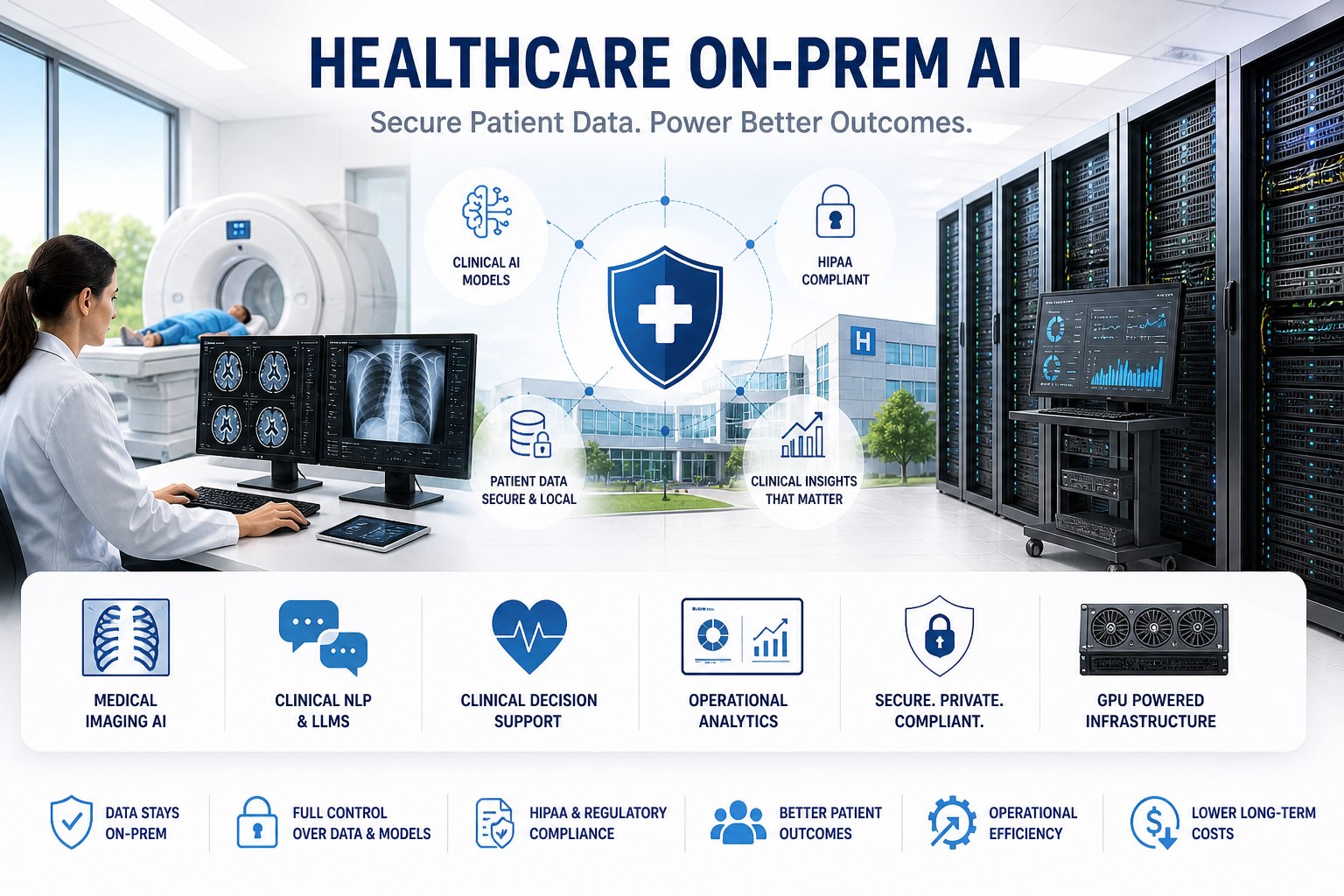
When you use GCP Vertex AI Vector Search, your document embeddings and associated metadata are stored on Google's infrastructure. GCP offers several privacy controls: Customer-Managed Encryption Keys (CMEK) so GCP cannot read your data at rest, VPC Service Controls to restrict data exfiltration, and regional data residency guarantees. However, the embeddings themselves are derived representations of your proprietary documents — a sufficiently sophisticated adversary with access to the embedding vectors can extract significant information about the original documents through inversion attacks. For trade secrets, PHI under HIPAA, defense/export-controlled documents, or highly proprietary maintenance IP, self-hosted on-prem vector databases provide the only architecture where raw embeddings never leave your network. The hybrid approach — on-prem vector storage with GCP for embedding generation (query-time only, not storage) — is the practical middle ground for most regulated manufacturers.
Which is better for manufacturing RAG: Milvus, Weaviate, or Qdrant?
For manufacturing asset intelligence RAG specifically, Qdrant is the recommended starting point for most plants. Its disk-based HNSW index handles large corpora without requiring proportionally large RAM (critical for on-prem hardware budgets), its payload filtering is the most expressive of the three (essential for filtering by asset_id, equipment_type, or document_date before semantic search), and its single-binary deployment is manageable without a dedicated DevOps team. Weaviate is the better choice if your RAG pipeline needs hybrid BM25+vector search — useful when maintenance documents contain very specific part numbers or procedure codes that benefit from keyword matching. Milvus is the right call at billion-vector scale (typically only reached by large multi-plant enterprises with years of digitized maintenance history) or when GPU-accelerated indexing is available.
What does a production-ready hybrid GCP + on-prem RAG architecture look like for an enterprise manufacturer?
A production hybrid RAG architecture for manufacturing separates workloads by sensitivity and query frequency. On GCP: embedding generation using Vertex AI text-embedding-004 or Gecko (query-time inference only — embeddings are computed but not stored in GCP), Gemini 1.5 Pro for LLM generation with retrieved context, and a small Vertex AI Vector Search index for public/non-sensitive documents. On-prem: a Qdrant or Milvus cluster hosted in your data center or private cloud indexing all proprietary documents (maintenance histories, OEM contracts, failure records, engineering specs), with an HNSW index tuned for sub-10ms retrieval. The routing layer — a lightweight API gateway with document classification logic — decides which index to query for each request. A secure mTLS connection between your on-prem retrieval layer and GCP's generation endpoint completes the pipeline. This architecture typically delivers 30–50% lower total cost than pure GCP at manufacturing corpus sizes, while maintaining full data sovereignty for sensitive documents.