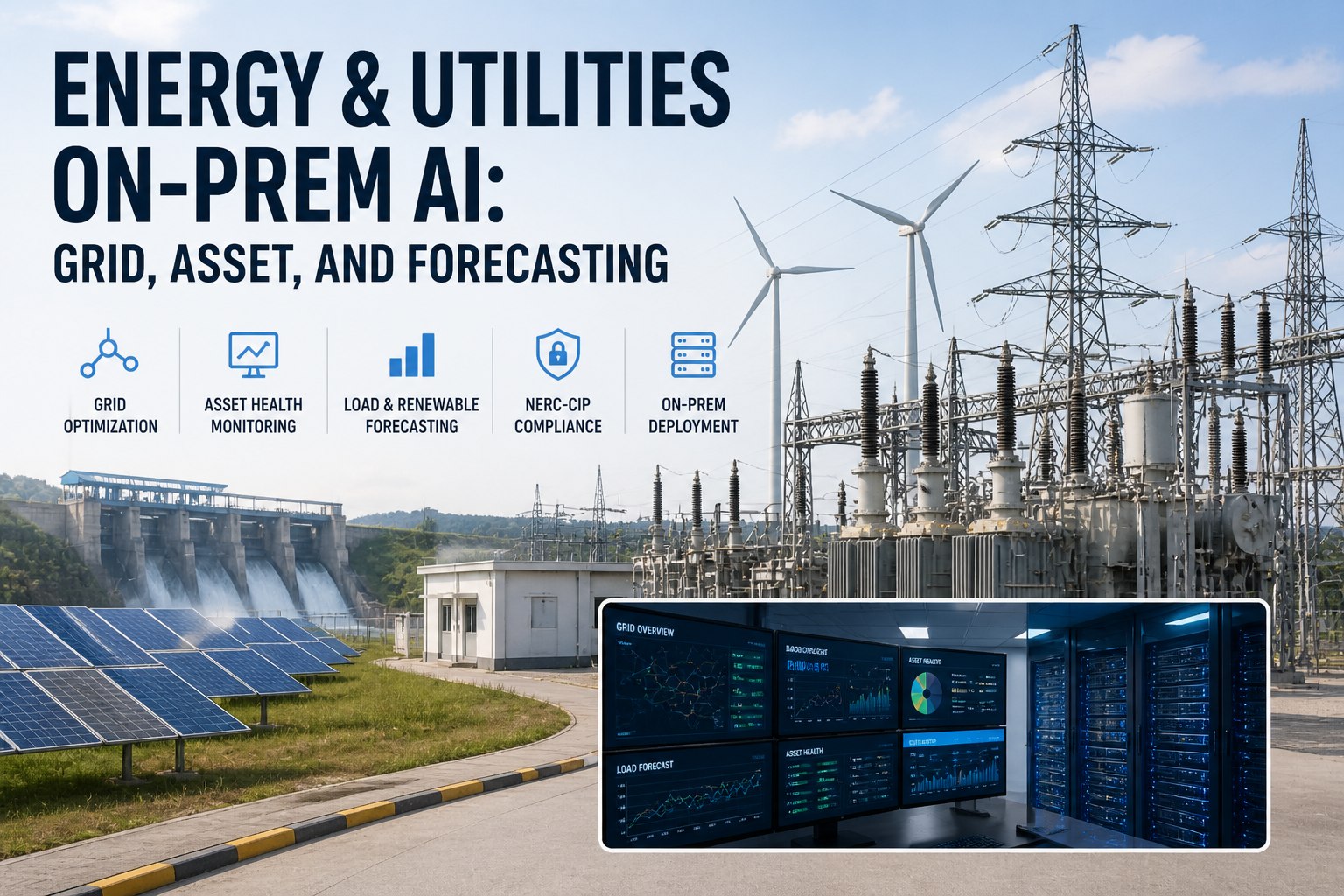
Energy & Utilities On-Prem AI: Grid, Asset, and Forecasting
By Riley Quinn on May 2, 2026
A coordinated attack on 50 "low impact" wind turbines now produces a "High Impact" grid event under NERC's 2026 framework. A control center losing visibility to substation telemetry for 4 hours is a CIP-012-2 violation. AI models making inferences on grid topology, load patterns, or asset health that route data to a public cloud are an evolving compliance question that's likely to land on the wrong side of every regulator. The energy sector has reached the point where "cloud-first AI" and "NERC-compliant operations" are increasingly incompatible. The path forward — confirmed by every utility CTO panel of 2025–2026 — is on-premise AI: models running inside the utility's data center, OT-safe, air-gap capable, with nothing leaving the perimeter. See how Oxmaint deploys NERC-CIP-aware on-prem AI for grid optimization, asset health, and load forecasting — start your free trial.
MAY 12, 2026 5:30 PM EST , Orlando
Upcoming Oxmaint AI Live Webinar— Build Your NERC-Compliant On-Prem AI Stack in One Session
Join the OxMaint team in Orlando to design an on-premise AI deployment for utilities — load forecasting, asset health, outage prediction — mapped to NERC CIP-012-2, CIP-013, and CIP-015 controls with OT-safe edge inference and full data sovereignty.
The compliance argument against cloud AI in utilities used to be theoretical. In 2026 it's structural. NERC's CIP-013 supply chain rules now treat AI vendor pathways the same way they treat OEM remote access on a generator — as Bulk Electric System attack surface. NERC's reference to the Salt Typhoon campaign in the 2026 Roadmap explicitly warns that utility traffic traversing unencrypted carrier links is a known nation-state target. Routing grid telemetry, load data, or asset signatures to a cloud datacenter creates the exact pathway regulators are now hardening against. Map your AI data flows against NERC CIP controls with Oxmaint's utility compliance team — book a 30-minute session.
Latency 200–800ms — too slow for real-time grid balancing decisions
✕
WAN outage = blind grid analytics; CIP-012-2 visibility risk
✕
Vendor cloud breach exposes load patterns & topology data
✕
Audit trails depend on cloud vendor cooperation timeline
On-Prem AI
✓
All grid data stays inside utility perimeter — no CIP-013 vendor pathway
✓
Sub-15ms inference for real-time grid optimization & protection
✓
Operates fully during WAN outage — CIP-012-2 visibility preserved
✓
Air-gap capable for High-Impact BES Cyber Systems
✓
Audit trails directly examinable by NERC inspectors
The 4 High-Value AI Use Cases for Utilities — All Deployable On-Prem
Utilities don't need every AI use case at once. Four high-leverage applications deliver 80%+ of the value and run cleanly on on-premise infrastructure with NERC-CIP-compatible architectures. Here's where to focus first.
01
Load Forecasting
Short-term (15-min to 24-hr) and day-ahead load prediction using weather, economic, and historical operational data. AI models hit 95%+ accuracy — versus 85–90% from traditional regression methods.
95%+forecast accuracy
02
Asset Health Monitoring
Predictive maintenance on transformers, breakers, switchgear, and substation equipment using DGA, partial discharge, vibration, and thermal data. Catches degradation 8–16 weeks before failure.
15%+outage reduction
03
Outage Prediction & OMS Optimization
AI fault localization, outage cause classification, and crew dispatch optimization integrated with Outage Management Systems. Reduces SAIDI/SAIFI/CAIDI metrics measurably.
25%+restoration faster
04
DER & Renewable Integration
Solar/wind generation forecasting, battery dispatch optimization, and DERMS coordination at the distribution level. Critical as Category 2 IBRs scale toward grid-stability dependence.
$520Kavoided env. fines/yr
Run Utility AI Without Putting NERC Compliance at Risk
Oxmaint's on-premise AI platform deploys inside your perimeter — load forecasting, asset health, and outage prediction running on NERC-CIP-aware infrastructure with OT-safe integration to your SCADA, EMS, and DMS systems. No cloud routing, no vendor pathway exposure.
Deploying AI in a utility OT environment isn't the same as deploying AI in a corporate IT environment. The architecture must respect the Purdue Enterprise Reference Architecture, maintain electronic security perimeters, and avoid creating any new ingress paths into the BES Cyber System. Here's the four-layer stack utilities should use.
Layer 4
IT Zone
Enterprise Analytics Layer
De-identified KPIs, fleet trends, and board reporting. Read-only export from L3 — never writes back to OT systems.
Corporate Network
Layer 3
DMZ
AI Inference & Decision Support
NVIDIA edge GPUs running TensorRT-optimized models. Load forecasting, asset health scoring, outage prediction — all locally, sub-15ms.
Inside ESP Perimeter
Layer 2
OT Zone
Process & Data Aggregation
SCADA, EMS, DMS, OMS, and AMI head-end systems. PI Historian aggregates time-series data; OPC-UA & ICCP feeds standardized.
Control Center
Layer 1
OT Zone
Field Devices & Substations
RTUs, IEDs, PLCs, smart meters, DER controllers, transformer monitors. Read-only data flows up; control commands flow only via approved EMS/DMS pathways.
Substation / Field
Data flows upward only from L1 → L4. The AI inference layer never issues control commands directly to field devices — control authority remains with operators via EMS/DMS, preserving CIP-005 Electronic Security Perimeter integrity.
Expert Review — What Utility CTOs Are Saying About On-Prem AI
The conversation I'm having with utility CTOs in 2026 has shifted decisively. Eighteen months ago, the default question was "how do we get AI workloads to the cloud safely?" Today, the default question is "what's the on-prem path that satisfies our CIP auditors and our IT department simultaneously?" Two things drove the shift. First, NERC's 2026 CIP roadmap explicitly named AI vendor pathways as supply chain attack surface — making cloud AI a CIP-013 question that didn't have a clean answer. Second, every utility CTO panel I've sat on this year has had at least one participant who'd been bitten by a cloud vendor incident or cloud latency issue affecting grid telemetry. The result is unambiguous: utilities want AI inside their data centers, under their access controls, with audit trails their NERC inspectors can examine on their own schedule. That's not a preference — it's a regulatory and operational reality. Vendors who can't deliver on-prem AI architectures are increasingly disqualified at the RFP stage.
95%+ Load Forecasting Accuracy
AI models incorporating weather, economic, and operational data routinely hit 95%+ load forecast accuracy when run on-premise with full SCADA/AMI data access — versus 85–90% from traditional regression methods.
15%+ Reduction in Unplanned Transmission Outages
Documented reduction in unplanned transmission outages from predictive maintenance AI compliant with NERC reliability standards — translates directly to SAIDI/SAIFI improvement and customer-impact reduction.
CIP-015 INSM Deadline Active in 2026
CIP-015 requires Internal Network Security Monitoring on High & Medium Impact BES Cyber Systems with External Routable Connectivity — making cloud AI integrations explicit audit targets in 2026.
Your 90-Day Utility AI Deployment Roadmap
On-premise utility AI doesn't have to be a multi-year program. A focused 90-day rollout — starting with one or two highest-leverage use cases on a single substation or control center — proves architecture, validates compliance, and establishes ROI before expanding to full fleet coverage.
Days 1–30
Architecture & Compliance Mapping
Map data flows against NERC CIP controls — identify ESP boundaries, INSM coverage, supply chain pathways
Deploy NVIDIA edge GPU infrastructure inside DMZ; configure read-only data feeds from SCADA/EMS/DMS
First documented avoided outage event or forecast-accuracy improvement validates ROI
Deploy Utility AI That NERC Inspectors Won't Flag
Oxmaint's on-premise AI platform integrates with your SCADA, EMS, DMS, and AMI systems via standard OT protocols — load forecasting, asset health, and outage prediction running inside your ESP with full data sovereignty and CIP-aware audit trails.
Why is on-premise AI becoming the preferred deployment for utilities in 2026?
Three structural drivers have shifted utility AI deployments decisively toward on-premise architectures in 2026. First, NERC's 2026 CIP roadmap now treats AI vendor pathways as Bulk Electric System supply chain attack surface under CIP-013 — explicitly referencing the Salt Typhoon nation-state campaign and warning that utility traffic crossing carrier networks creates known attack vectors. Second, CIP-015 requires Internal Network Security Monitoring on High and Medium Impact BES Cyber Systems with External Routable Connectivity, making cloud AI integrations explicit audit targets. Third, real-time grid balancing decisions need sub-15ms inference latency that cloud round-trips physically cannot deliver. The combined result: utilities want AI running inside their data centers, under their access controls, with audit trails NERC inspectors can examine on their own schedule. Vendors who can't deliver on-prem AI architectures are increasingly disqualified at the RFP stage.
What are the highest-value AI use cases for utilities to deploy first?
Four use cases deliver 80%+ of total AI value for utilities and run cleanly on on-premise infrastructure. Load forecasting using AI models trained on weather, economic, and historical operational data hits 95%+ accuracy — a meaningful improvement over the 85–90% achieved by traditional regression methods, with direct value in energy trading, demand response, and capacity planning. Asset health monitoring on transformers, breakers, switchgear, and substation equipment using DGA, partial discharge, vibration, and thermal data catches degradation 8–16 weeks before failure, reducing unplanned transmission outages by 15%+. Outage prediction and OMS optimization integrates AI fault localization and crew dispatch optimization into existing Outage Management Systems, improving SAIDI/SAIFI/CAIDI metrics. DER and renewable integration handles solar/wind forecasting and DERMS coordination — increasingly critical as Category 2 inverter-based resources scale toward grid-stability dependence. Most utilities deploy the first two use cases in their initial 90-day rollout.
How does on-premise AI integrate with existing SCADA, EMS, and DMS systems?
On-premise AI in utility environments uses a four-layer reference architecture aligned with the Purdue Enterprise Reference Architecture. Layer 1 (field devices and substations) provides RTU, IED, PLC, smart meter, and DER controller data. Layer 2 (process and data aggregation) handles SCADA, EMS, DMS, OMS, and AMI head-end systems with PI Historian aggregating time-series data and OPC-UA and ICCP feeds standardized. Layer 3 (AI inference and decision support) runs NVIDIA edge GPUs with TensorRT-optimized models for load forecasting, asset health scoring, and outage prediction — all locally with sub-15ms inference. Layer 4 (enterprise analytics) handles de-identified KPIs, fleet trends, and board reporting via read-only export from Layer 3. The critical architectural rule: data flows upward only from L1 to L4. The AI inference layer never issues control commands directly to field devices — control authority remains with operators via EMS/DMS, preserving CIP-005 Electronic Security Perimeter integrity.
Which NERC CIP standards apply specifically to utility AI deployments?
Four NERC CIP standards directly govern AI deployments in utility environments. CIP-005 (Electronic Security Perimeter) requires that any AI integration respect ESP boundaries — the inference layer runs inside the perimeter, control authority remains with operators, and no new ingress paths are created. CIP-013 (Supply Chain Risk Management) treats AI vendor pathways as Bulk Electric System attack surface, requiring vendor risk assessment and contractual security requirements for any AI vendor with logical access to BES Cyber Systems. CIP-012-2 (Control Center Communications) requires real-time visibility between control centers — AI-driven analytics that depend on cloud connectivity create direct CIP-012-2 risk during WAN outages. CIP-015 (Internal Network Security Monitoring) requires INSM on High and Medium Impact BES Cyber Systems with External Routable Connectivity, making cloud AI integrations explicit audit targets in 2026. CIP-003-9 covers low-impact governance — relevant because aggregated low-impact attacks (like coordinated compromise of 50 wind turbines) now constitute High-Impact events under the 2026 framework.
What's the realistic timeline and ROI for utility AI deployment?
A focused 90-day rollout starting with one or two highest-leverage use cases on a single substation or control center proves architecture, validates compliance, and establishes ROI before expanding to full fleet coverage. Days 1–30 cover architecture and compliance mapping — NERC CIP control alignment, NVIDIA edge GPU deployment inside the DMZ, read-only data feed configuration. Days 31–60 activate the first priority use case (typically load forecasting or substation transformer health) with the AI model training on 30 days of historical operational data. Days 61–90 expand to a second use case and configure the compliance evidence package with automated audit trails. Documented results from utility deployments include 15%+ reduction in unplanned transmission outages, 95%+ load forecasting accuracy, and avoided environmental fines averaging $520K annually from continuous emissions monitoring. The ROI math typically becomes definitive at the first prevented major outage event or the first audit cycle that completes without findings — both of which usually occur in the first 6–12 months of operation.