Logistics & 3PL On-Prem AI: Warehouse and Fleet Decisions
By Riley Quinn on May 2, 2026
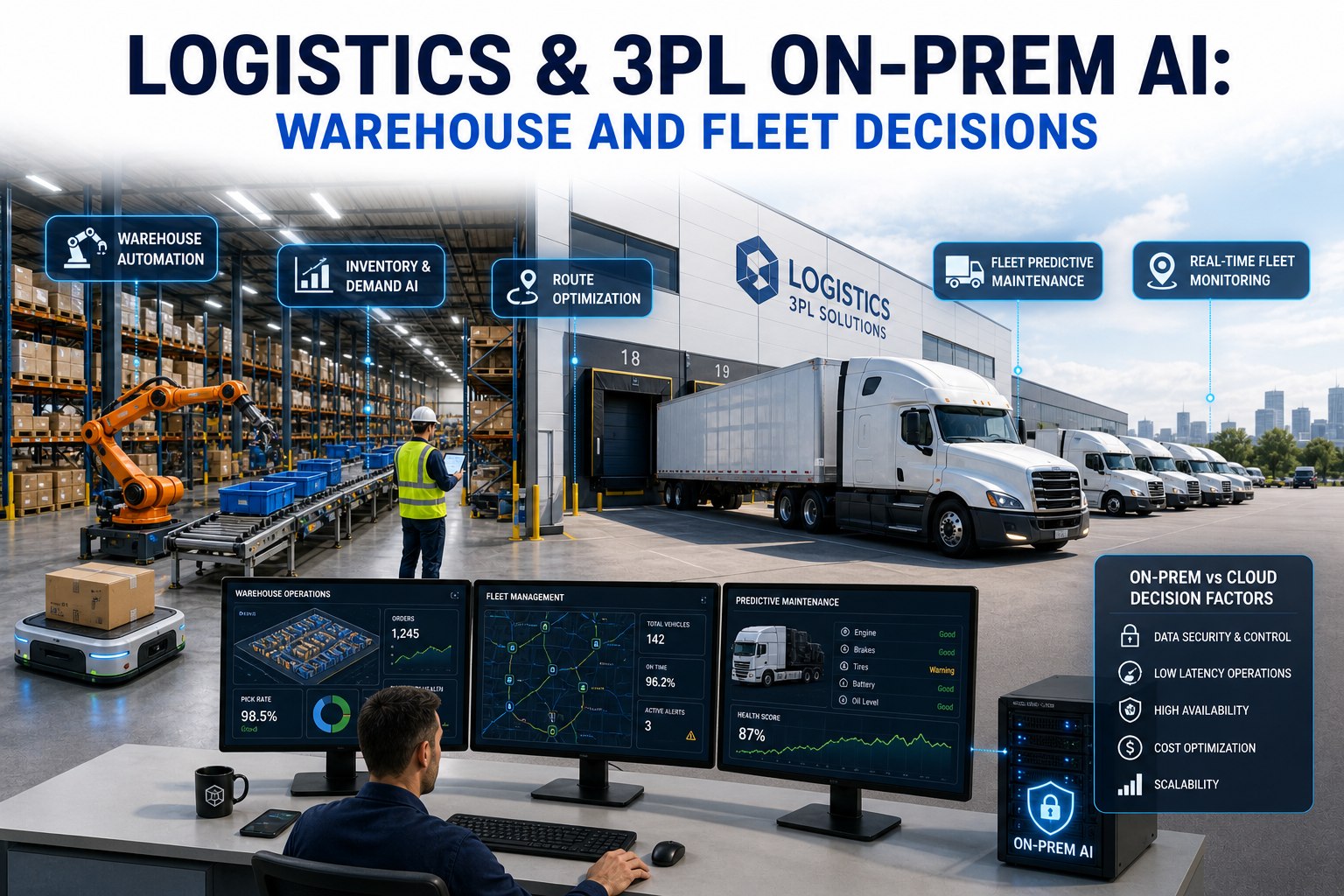
A 3PL operator running 6 distribution centers, 480 trucks, and 320 AMRs generates roughly 2.4 terabytes of operational data every single day — telematics streams, warehouse vision feeds, robot path logs, dock-scheduling events, route optimization recalculations, and predictive maintenance signals. The architectural question that determines whether that data becomes operational intelligence or sits as a $2M/year cloud bill is deceptively simple: where does the AI run? Push everything to the cloud and you will burn budget on bandwidth, hit unacceptable latency on robot orchestration, and lose data sovereignty on customer shipment patterns. Run everything on-prem and you'll lose the cross-site benchmarking, fleet-wide model improvements, and ESG analytics that come from aggregating data across DCs. The right answer for serious logistics operators in 2026 isn't either/or — it's a tiered architecture where each AI workload runs at the layer (edge, on-prem, hybrid, cloud) where its latency, sensitivity, and economics actually align. See how OxMaint's on-prem AI deploys across warehouses and fleets — start your free trial.
MAY 12, 2026 5:30 PM EST , Orlando
Upcoming OxMaint AI Live Webinar— Build Your 3PL On-Prem AI Architecture in One Session
Join the OxMaint team in Orlando to design a tiered logistics AI deployment — warehouse robotics orchestration, fleet predictive maintenance, route optimization, and data-sovereignty architecture mapped to your DC count, fleet size, and customer SLA requirements.
The Business Case for On-Prem Logistics AI in 2026
50%
of cost
Last-mile = 50% of total logistics spend
90%
accuracy
CV-based picking error reduction
3.8M
jobs gap
Logistics labor shortfall by 2033
15–50%
savings
OpEx cost reduction with AI
30–50%
throughput
Warehouse throughput increase
18–24mo
payback
AMR ROI at $28K–$45K/unit
The On-Prem Question — Why Cloud-Only AI Breaks for 3PL Operations
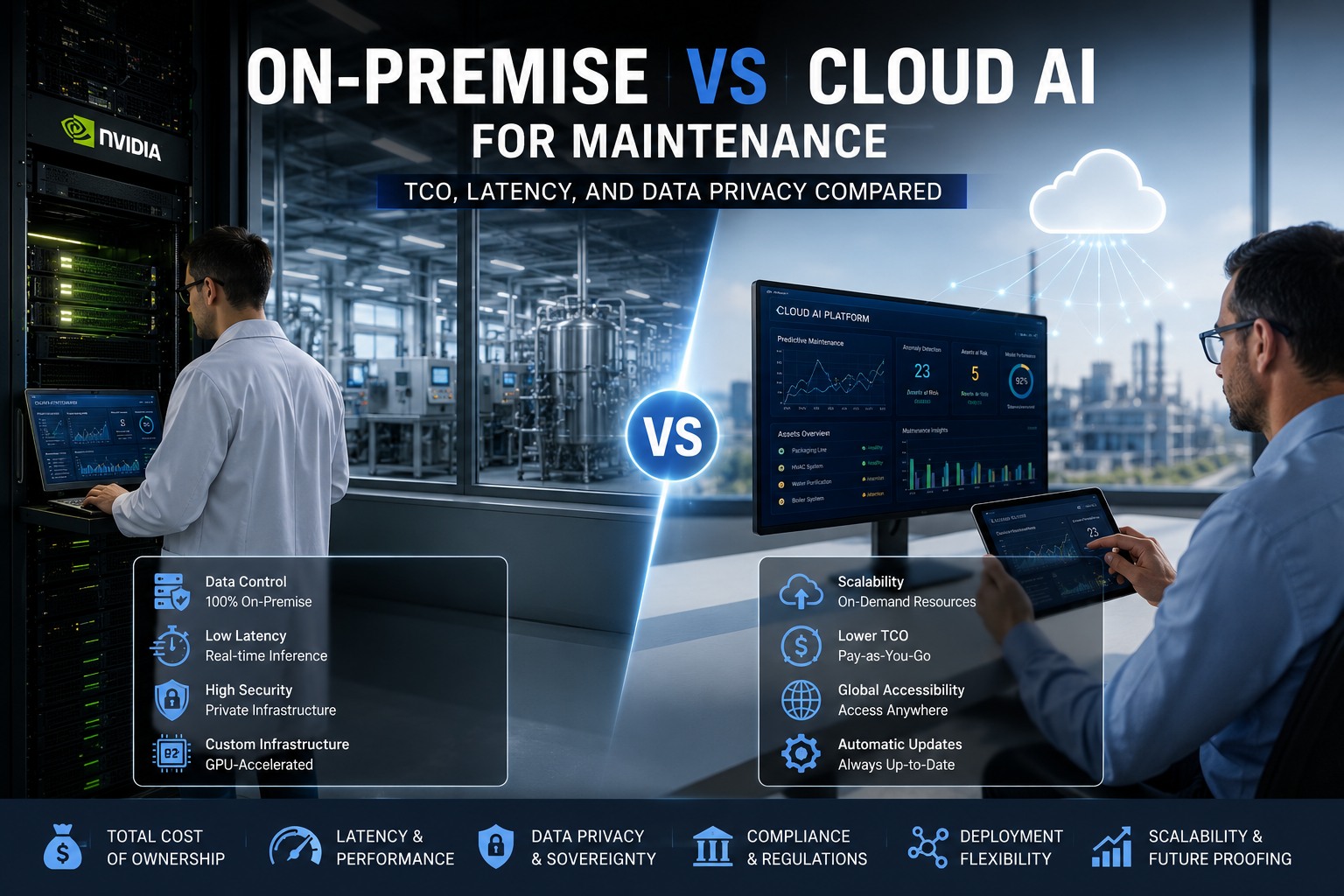
Logistics is a category where cloud-only AI architecture quietly fails — not because cloud platforms can't handle the workload, but because three structural constraints unique to 3PL operations make pure cloud deployment economically and operationally untenable at scale. Understanding these three constraints is the prerequisite to making the right architectural call for your operation.
Constraint 01
Latency-Critical Robot Orchestration
AMR fleet path replanning happens in milliseconds. When a tote falls or a forklift crosses a path, the AI orchestrator has under 50 ms to recalculate routes for 80+ robots simultaneously. Round-trip cloud latency starts at 80–200 ms — already too slow before you process anything.
Required: < 50 ms decision latency
Constraint 02
Customer Data Sovereignty
3PL contracts increasingly include data residency clauses — pharmaceutical, defense, government, and EU customers require their shipment patterns, inventory levels, and SLA performance data stay on infrastructure the 3PL controls. Cloud-only deployment makes these contracts harder to win and easier to lose.
Required: Per-customer data isolation
Constraint 03
Bandwidth Economics at Scale
A single 50,000 sq ft DC with 80 AMRs and 24 vision cameras generates 400+ GB/day of raw operational data. Pushing all of it to cloud for AI processing costs more in egress fees than the AI value created — and creates fragility when WAN links degrade.
Required: Local processing of bulk data
The 4-Tier Deployment Decision Tree — Where Each AI Workload Should Run
Decision rule: Cross-site aggregate analytics where 500ms latency is acceptable and data is already de-identified.
The 5 Highest-Value Logistics AI Use Cases
Across thousands of 3PL deployments, five use cases consistently produce the fastest payback and largest operational impact. Each maps to a specific tier in the decision tree above — not every use case belongs in the cloud, and not every use case belongs on-prem.
01
T2 · On-Prem
AMR/AGV Fleet Orchestration
Multi-agent AI orchestrates 80+ robots simultaneously — re-routing in milliseconds when traffic conditions change, avoiding congestion, learning bottlenecks. Multi-OEM fleet support critical for 3PLs running mixed AMR/AGV environments.
Throughput +30–50% · ROI 18–24 months
02
T3 · Hybrid
Fleet Predictive Maintenance
Telematics streams (vibration, oil temp, coolant pressure, brake wear) processed at the edge for in-cab alerts; model retraining runs cloud-side on aggregate fleet data. Catches truck failures 4–8 weeks before breakdown.
Repair cost −25–40% · Vehicle life +15–25%
03
T4 · Cloud
Dynamic Route Optimization
AI evaluates traffic, weather, dock availability, fuel cost, and delivery density in real time — dynamically re-routing entire fleets in 1.3 seconds. Last-mile cost reduction is the single largest spend optimization in logistics.
Last-mile cost −10–20% · Fuel −10–15%
04
T2 · On-Prem
Computer Vision Picking & QA
CV models inspect every pick at the station, validate SKUs, count inventory continuously, and catch damage before products ship. Inventory accuracy reaches 99%+ from the typical 92–95% of barcode-only systems.
Pick errors −90% · Accuracy 99%+
05
T2 · On-Prem
Dock Scheduling & Yard Management
AI predicts truck arrivals, sequences dock assignments, queues outbound orders, and synchronizes unloading equipment 30 minutes before vehicles arrive. Eliminates yard congestion and reduces driver detention time.
Detention −40–60% · Throughput +25%
Built for 3PL · Multi-Site Ready · 14-Day Deployment
Run AI Where It Should Actually Run — Edge, On-Prem, or Cloud
OxMaint's logistics AI platform supports the full 4-tier deployment architecture — edge inference, on-prem orchestration, hybrid fleet PdM, and cloud network analytics — with native WMS, TMS, and CMMS integration via standard APIs. Multi-OEM AMR support included.
The Cost-Benefit Reality — On-Prem vs Cloud at 3PL Scale
The architectural decision sounds abstract until you put numbers against it. For a typical mid-size 3PL operating 4–6 distribution centers and a 200–500 truck fleet, here's how the cost-benefit math actually plays out across the four most expensive AI workload categories.
Swipe to compare cloud vs on-prem costs
Workload
Cloud-Only
On-Prem / Hybrid
Annual Delta
CV Inventory Counting (per DC)
$84K/yrdata egress + compute
$22K/yrlocal GPU server
−$62K
AMR Fleet Orchestration (80 bots)
Not viablelatency > 200ms
$48K/yron-prem orchestrator
Required
Fleet PdM (300 trucks)
$96K/yrfull telematics upload
$54K/yredge filter + cloud retrain
−$42K
Network Route Optimization
$36K/yrcloud-native fits well
$72K/yrover-engineered on-prem
+$36K cloud
Net result: A blended 4-tier architecture saves $68K–$120K annually per DC versus pure cloud, while making latency-critical workloads operationally feasible at all.
Expert Perspective — The Architectural Mistake Most 3PLs Make
The pattern I keep seeing in 3PL AI procurement is binary thinking — operations leadership picks "all cloud" or "all on-prem" as if those were the only two options, when the right answer is almost always tiered. The 3PLs that get this wrong end up either burning $150K+/year per DC on cloud egress for workloads that should run locally, or building elaborate on-prem stacks for analytics that would happily run in a $4K/month SaaS tool.
The mature pattern in 2026 looks like this: edge inference on the device for safety-critical decisions, on-prem servers for warehouse orchestration and customer-sensitive data, hybrid edge-plus-cloud for fleet predictive maintenance, and cloud-only for cross-network analytics where data is already de-identified. The 3PLs winning the largest customers — pharma, defense, government — are the ones who can show this exact architecture diagram in the RFP response, because data sovereignty is now a contractual requirement, not a preference.
60%
RaaS Deal Structure (2025)
Over 60% of new AMR contracts in 2025 were structured as Robotics-as-a-Service rather than capex purchases — letting mid-market 3PLs deploy AI robotics without nine-figure investments.
35%
Inventory Reduction
3PLs deploying AI orchestration report 35% inventory level reductions while achieving 65% better service levels — driven by real-time CV-based stock counting and demand-sensing models.
$28K–$45K
AMR Unit Cost (2025)
Mid-size fulfillment center AMR deployment cost has dropped 35% from 2021 to $28K–$45K per unit, compressing typical ROI horizons to 18–24 months across 3PL deployment scenarios.
Multi-DC · Multi-OEM · Multi-Customer Ready
The 3PL AI Stack That Wins Pharma, Defense, and Government Contracts
OxMaint's tiered AI architecture spans edge, on-prem, hybrid, and cloud — letting you run latency-critical workloads locally, keep customer data sovereign, and still get cross-network intelligence. Pre-built WMS, TMS, and CMMS connectors. 30-day free trial.
The honest answer is "all four tiers, applied where each makes sense." Most mature 3PL operations achieving best results use a tiered architecture across edge, on-prem, hybrid, and cloud. Edge AI handles safety-critical decisions (collision avoidance, pick validation) where sub-10ms latency is non-negotiable. On-prem AI handles AMR fleet orchestration, WES execution, computer vision inventory counting, and any workload involving customer-sensitive data — this is where most 3PL workloads belong because of latency requirements and data sovereignty contracts. Hybrid edge-cloud handles fleet predictive maintenance with edge inference on the truck and cloud retraining on aggregate data. Cloud-only handles cross-network analytics like demand forecasting across multiple DCs and ESG/Scope 3 reporting where 500ms latency is fine and data is already aggregated. The 3PLs winning regulated customer contracts (pharma, defense, government) are the ones running this exact tiered architecture because data sovereignty is now a contractual requirement.
What's the realistic ROI for AMR/AGV deployment in a 3PL operation?
Mid-size fulfillment center AMR deployment cost has dropped 35% since 2021 to $28K–$45K per unit, compressing typical ROI horizons to 18–24 months. Industry research shows companies implementing logistics automation report 15–50% decreases in operational costs, 30–50% increases in warehouse throughput, and 90%+ reductions in pick errors when computer vision is layered on top of robotics. The Robotics-as-a-Service (RaaS) model has become dominant — over 60% of new AMR contracts in 2025 were structured as RaaS rather than capex purchases — letting mid-market 3PLs deploy AI robotics without major upfront investment. The compounding benefits stack: 3PLs deploying AMR orchestration plus CV inventory counting routinely report 35% inventory level reductions while achieving 65% better service levels, driven by real-time stock counting and demand-sensing models that go beyond what barcode-only systems can do.
How does logistics AI integrate with existing WMS, TMS, and ERP systems?
Modern logistics AI platforms are built on API-first architecture and integrate with existing WMS, TMS, ERP, and CMMS systems through standard REST APIs. Major WMS platforms (Manhattan, Blue Yonder, SAP EWM, Korber, Microsoft Dynamics, Oracle WMS) and TMS systems (Oracle, MercuryGate, Blue Yonder TMS) are supported via pre-built connectors. The deployment goal is augmentation, not replacement — the AI platform sits above existing infrastructure, ingesting operational data from your current systems, running ML models for orchestration and prediction, and pushing structured commands and work orders back to the underlying systems. This preserves prior technology investments while adding predictive intelligence and orchestration capability on top. The challenge in many 3PL environments is that WMS systems built 10–20 years ago can't handle modern AI workloads natively — but they don't need to, because the AI layer handles compute-intensive workloads itself and only sends structured outputs back to legacy systems.
What's the data sovereignty problem with cloud-only logistics AI?
3PL contracts in 2026 increasingly include data residency clauses driven by three customer categories. Pharmaceutical customers require shipment patterns, temperature logs, and inventory levels stay on infrastructure the 3PL controls because that data could reveal market-sensitive information about clinical trial logistics or product launch timing. Defense and government customers require data residency by federal acquisition regulations (FAR, DFARS) and similar frameworks internationally. EU customers under GDPR require specific data localization controls for personal data embedded in shipment records. Pure cloud-only deployment makes these contracts substantially harder to win, because the 3PL cannot demonstrate end-to-end data residency control when the AI processing happens on a hyperscaler's infrastructure shared with other customers. On-prem AI for customer-sensitive workloads solves this contractually and operationally — the 3PL can show exactly which servers process which customer's data and where those servers are physically located.
How fast can logistics AI realistically deploy across multiple DCs?
A single-DC pilot deploys in 14 days with modern logistics AI platforms — covering on-prem orchestrator setup, AMR/WMS/dock system API integration, and edge AI activation on safety-critical workloads. Network rollout across remaining DCs typically completes in 90 days for mid-size 3PL operations using a proven configuration template that compresses each subsequent DC deployment to 4–7 days. The compressed timeline depends on three factors. First, choosing platforms with pre-built WMS/TMS/CMMS connectors rather than custom integration projects. Second, starting with the highest-impact use cases at the flagship DC (AMR orchestration plus CV inventory counting typically self-fund the entire program) before expanding. Third, using proven on-prem reference architecture (NVIDIA Jetson edge devices, x86 GPU servers for orchestration, standard ethernet/wireless infrastructure) rather than building bespoke hardware stacks. The first documented prevented breakdown or efficiency improvement typically lands inside 30 days and pays back the annual program cost on a single event.