How Oxmaint Uses NVIDIA GPUs to Run AI Inside Your Plant
By Riley Quinn on May 6, 2026
The promise of "AI in your factory" sounds the same on every vendor pitch deck — until you ask which silicon actually runs the inference, where it physically sits, and what happens to your video footage when the WAN goes down. OxMaint runs on three NVIDIA tiers stacked from the camera up to the corporate AI factory: Jetson AGX Orin at the camera edge for sub-second motion analysis, RTX PRO 6000 Blackwell servers in the plant rack for fault classification and LLM-driven work orders, and DGX Station GB300 Ultra at the enterprise tier for cross-plant fleet learning and trillion-parameter simulation. Every layer is on-prem, every byte stays behind your firewall, and the whole stack is owned outright the day delivery completes — no subscription clock, no per-camera metering, no model-call billing. Sign up free to see the three-tier NVIDIA stack running on your own assets.
MAY 12, 2026 5:30 PM EST , Orlando
Upcoming OxMaint AI Live Webinar — How OxMaint Uses NVIDIA GPUs to Run AI Inside Your Plant
Live session for plant CIOs, IT directors, reliability managers, and operations leadership evaluating on-prem AI for predictive maintenance. We'll walk through the three-tier NVIDIA architecture (AGX Orin edge → RTX PRO 6000 plant server → DGX Station GB300 Ultra enterprise tier), the per-plant economics including a $19K Blackwell server and two $4K Orin appliances, multi-camera DeepStream pipelines, local LLM inference for work-order generation, and how the stack ships pre-loaded in 6–12 weeks ready to run on day one.
Cloud AI for industrial maintenance fights three structural problems: video bandwidth (high-frame-rate footage saturates WAN links), data sovereignty (process layouts and equipment signatures are competitive intelligence), and inference latency (operators expect answers in seconds, not minutes). OxMaint solves all three by anchoring inference on three NVIDIA tiers physically inside the plant — each tier sized to the workload that runs on it. The diagram below shows the complete data flow from camera to corporate, with every byte traveling local network paths.
TIER 1 · EDGE
NVIDIA Jetson AGX Orin
275 TOPS · 64GB · 60W
Lives next to the camera. Runs phase-based motion amplification, multi-camera DeepStream pipelines, and PLC sync. Sub-second inference, no network round-trip.
TIER 2 · PLANT
RTX PRO 6000 Blackwell Server
96GB GDDR7 · 24,064 CUDA · 752 Tensor
Plant rack server. Runs Synapse AI fault classification, FP4 LLM inference for work orders, fleet anomaly detection, and Omniverse digital twin synchronization.
TIER 3 · ENTERPRISE
DGX Station GB300 Ultra
748GB unified · 20,480 CUDA · 20 PFLOPS
Corporate HQ. Runs trillion-parameter physics simulations, fleet-wide pattern learning across all plants, custom model fine-tuning. Optional but transformative at scale.
Tier 1 — AGX Orin at the Camera Edge
The Jetson AGX Orin is the workhorse of every OxMaint deployment. Sized like a paperback book, drawing 60W at full tilt, it sits within meters of the camera it serves. The 2,048 CUDA cores plus dual NVDLA accelerators handle the phase-based motion amplification pipeline, DeepStream multi-camera ingest, and the PLC tag synchronization that ties video to real-time process state. Book a demo to see the AGX Orin processing pipeline running on your equipment footage.
EDGE TIER · SINGLE-PLANT EDGE COMPUTE
NVIDIA Jetson AGX Orin 64GB
275
TOPS
Sparse INT8 AI compute
2,048
cores
Ampere CUDA cores
64
GB
LPDDR5 unified memory
205
GB/s
Memory bandwidth
15–60
W
Configurable power envelope
8×
faster
vs. Jetson AGX Xavier
OxMaint workloads on AGX Orin
Phase-based motion amplification (cuFFT, ≤500 Hz frequency band)
DeepStream multi-camera pipeline — up to 8 simultaneous 1080p feeds
YOLO-based PPE compliance and intrusion detection on CCTV
OPC-UA tag sync between PLC state and video timestamp
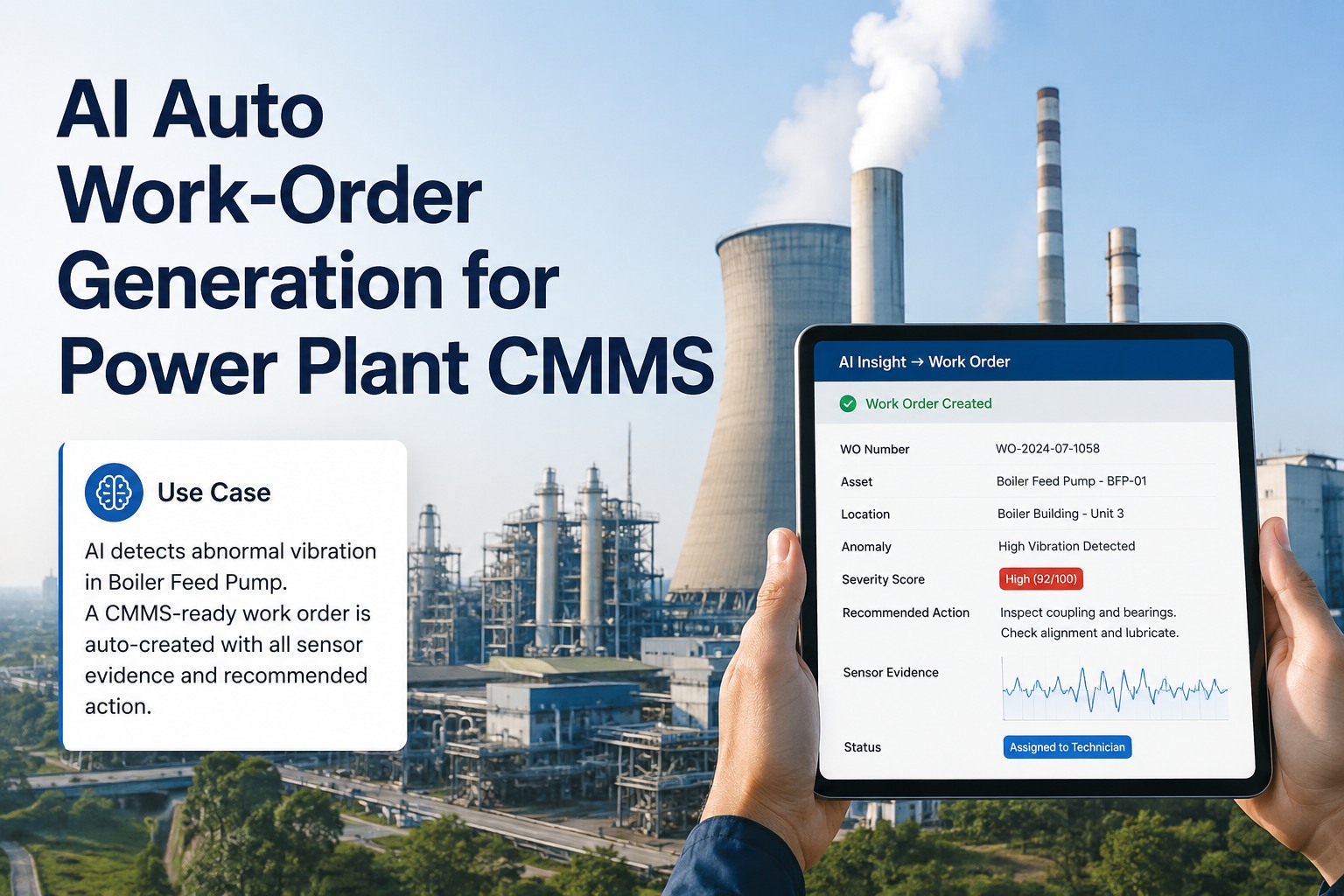
On-device anomaly pre-screening before upstream forward
Tier 2 — RTX PRO 6000 Blackwell in the Plant Rack
The plant-tier server is where the heavy AI lifting happens. RTX PRO 6000 Blackwell ships with 96GB of GDDR7 ECC memory, 24,064 CUDA cores, 752 fifth-gen Tensor Cores, and 188 fourth-gen RT Cores in a passively-cooled FHFL dual-slot card. With FP4 precision, NVIDIA documents 5× the LLM inference performance of the prior generation — the spec that makes local LLM-driven work-order generation actually practical. The Universal MIG capability slices the GPU into up to four isolated tenants, so a single card can simultaneously run Synapse AI fault classification on partition 1, the work-order LLM on partition 2, the Omniverse digital twin on partition 3, and reserved capacity for fleet anomaly detection on partition 4. Sign up free to evaluate the RTX PRO 6000 server in your plant network.
PLANT TIER · CENTRAL AI INFERENCE
NVIDIA RTX PRO 6000 Blackwell Server Edition
24,064
cores
Blackwell CUDA cores
752
tensor
5th-gen Tensor Cores
96
GB
GDDR7 ECC memory
5×
faster
LLM inference vs. prior gen (FP4)
4
MIG
Isolated GPU partitions
≤70B
params
Local LLM sweet spot
Universal MIG · Four Concurrent Workloads on One Card
Digital twin sync, RT Core ray-traced visualization
MIG 4
Anomaly
Fleet-wide pattern detection, asset health scoring
Tier 3 — DGX Station GB300 Ultra at Corporate HQ
The enterprise tier is optional but transformative once a customer hits three or more plants. NVIDIA's DGX Station GB300 Ultra packages a 72-core Grace CPU with a Blackwell Ultra GPU on a 900 GB/s NVLink-C2C interconnect, exposes 748 GB of unified coherent memory (252 GB HBM3e + 496 GB LPDDR5X), and delivers 20 petaFLOPS of FP4 AI compute — enough to train and run trillion-parameter models locally without ever touching the cloud. For OxMaint customers, this is where cross-plant fleet learning happens: pattern signatures discovered at Plant 1 propagate to Plants 2, 3, and 4 through a fine-tuned shared model, custom physics simulations validate proposed maintenance interventions before deployment, and corporate analytics run against unified data from every plant in the program.
ENTERPRISE TIER · CROSS-PLANT FLEET LEARNING
NVIDIA DGX Station with GB300 Grace Blackwell Ultra Superchip
20,480
cores
Blackwell Ultra CUDA cores
748
GB
Unified coherent memory
20
PFLOPS
FP4 AI compute
7.1
TB/s
HBM3e GPU memory bandwidth
900
GB/s
NVLink-C2C interconnect
1T
params
Trillion-parameter capacity
Why Local LLM Inference Changes the Maintenance Workflow
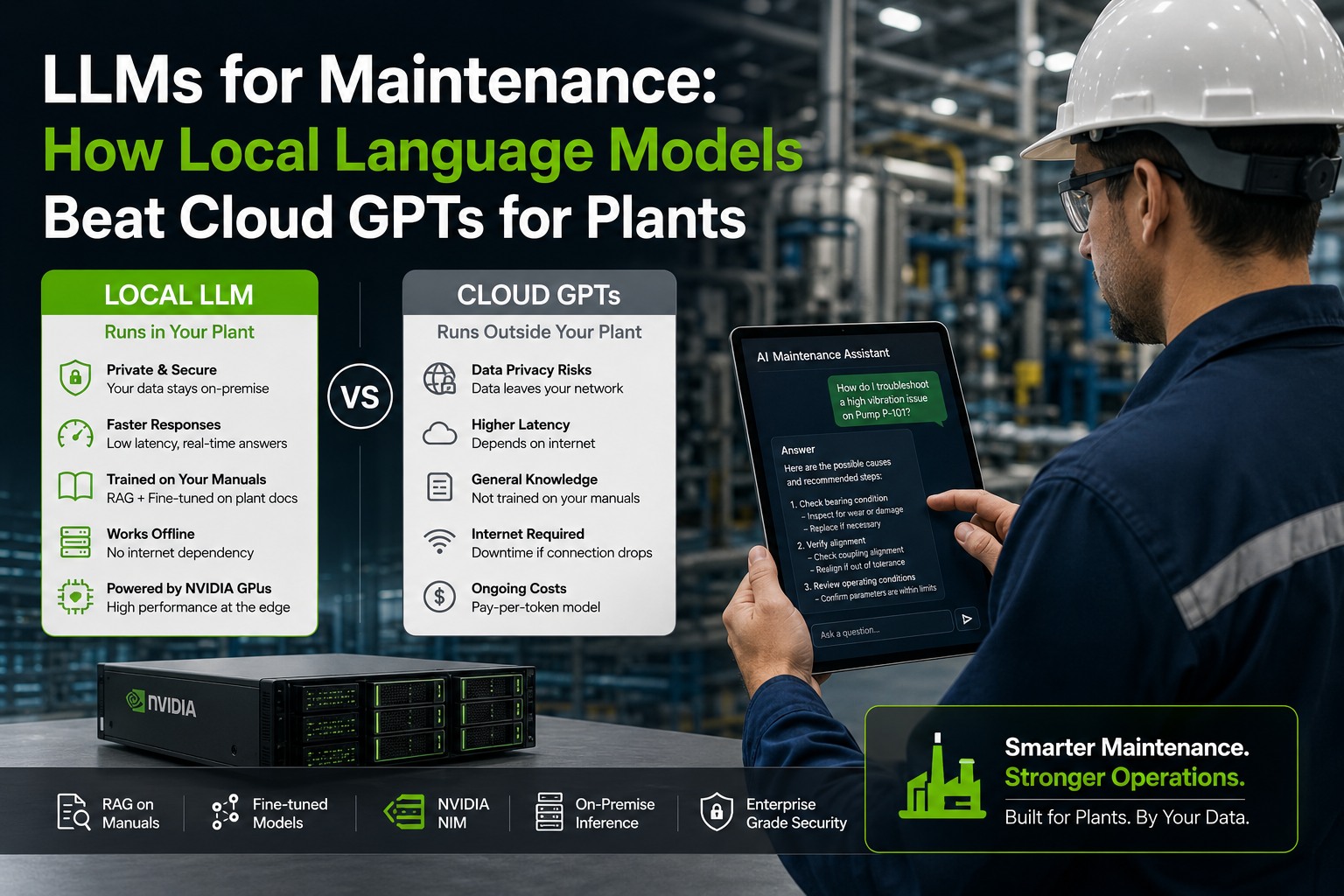
The most underappreciated capability of the plant-tier RTX PRO 6000 isn't motion analysis or fault classification — it's local large-language-model inference. With 96GB of GDDR7 and FP4 precision, the RTX PRO 6000 comfortably runs models in the 30-70B parameter range entirely on-prem. That single capability transforms several maintenance workflows that have historically been either manual or cloud-dependent. The four examples below are the highest-impact local-LLM use cases OxMaint customers deploy in their first ninety days. Book a demo to walk through local LLM workflows running on your maintenance data.
01
Auto Work-Order Drafting
Sensor fires anomaly → LLM drafts the work order with diagnosis narrative, recommended action, parts list, and target window. Technician reviews and approves — saves 8–15 min per order.
02
Technician Copilot Chat
"What was the last failure on Pump 7B and what fixed it?" Local LLM queries CMMS history, surfaces resolution patterns. Answers in seconds, no cloud round-trip, no data leakage.
03
Failure Mode Prediction
LLM ingests the last 90 days of vibration trends, oil analysis, run hours, ambient temp — predicts which assets cross failure thresholds in the next 30 days, ranks by criticality.
04
Shift Handoff Synthesis
End of shift, LLM reads every work order touched, every alarm acknowledged, every CMMS comment — drafts the handoff brief in the next supervisor's reading style. Two minutes, not twenty.
The Owned-Not-Rented Architecture — Get the Quote, Order the Hardware
The OxMaint deployment isn't a SaaS subscription you pay every month forever. It's an NVIDIA-powered AI server pre-loaded with the OxMaint platform, shipped to your premises in 6–12 weeks, installed on your network, and owned outright the day delivery completes. Get a quote and order it like the hardware it is — because that's exactly what it is. The four pillars below are the architectural commitments that make this deployment fundamentally different from cloud SaaS: perpetual license, data sovereignty, source access, AI-native core.
Perpetual License
No monthly fees, no per-seat charges, no per-camera or per-asset metering. Future costs are entirely optional and at your discretion.
Data Sovereignty
Video footage, model weights, fault classifications, work-order history all live on your server, behind your firewall. Footage never leaves unless you choose.
Source Access
Source code and modification rights included. Extend the inference pipeline, retrain models on your data, integrate proprietary connectors freely within your org.
AI-Native Core
Predictive maintenance, anomaly detection, NLP work orders, motion amplification, fault classification — built in, not bolted on. The AI is the platform.
Pre-Configured · NVIDIA-Powered · Ships in 6–12 Weeks
Order a Pre-Loaded OxMaint NVIDIA Stack for Your Plant
A complete on-prem AI deployment built on NVIDIA hardware: AGX Orin at the camera edge for motion amplification and DeepStream pipelines, RTX PRO 6000 Blackwell server in the plant rack for fault classification and local LLM inference, optional DGX Station GB300 Ultra at corporate HQ for cross-plant fleet learning. Pre-configured, pre-tested, ready to run within days. Perpetual license. Source code included. Data stays on your network.
The architecture maps directly to a per-plant bill of materials with predictable economics. Per plant: one RTX PRO 6000 Blackwell server, two AGX Orin appliances (vision edge plus PLC/CCTV edge), industrial Ethernet switching, electrical and instrumentation, and the OxMaint AI software stack with integration. Average per-plant total lands at $84,500 with 4-month delivery. Enterprise tier adds the optional DGX Station GB300 Ultra and 3-month corporate rollout. Sign up free to walk through a per-plant quote configurator with your asset footprint.
Order the NVIDIA-Powered OxMaint Stack — Pre-Loaded, Pre-Tested, Owned
A complete three-tier on-prem AI deployment for predictive maintenance and reliability. AGX Orin edge appliances, RTX PRO 6000 Blackwell plant server, optional DGX Station GB300 Ultra enterprise tier. Pre-configured with the full OxMaint software stack, fault libraries, and CMMS connectors. Your team owns the platform, the AI models, the fault libraries, and the source code outright the day delivery completes.
Why does OxMaint use three NVIDIA tiers instead of one big server?
Each tier is sized to a workload that breaks if you try to do it elsewhere. AGX Orin lives at the camera because high-frame-rate video can't traverse a plant network at scale — a single 1,300 fps 1080p camera generates 1–3 GB per 30-second capture, multiply that by eight cameras and you've saturated a gigabit link. The RTX PRO 6000 Blackwell sits in the plant rack because fault classification needs 96GB of GPU memory and FP4 LLM inference for work-order generation needs the fifth-gen Tensor Cores; nothing smaller runs production-grade local LLMs. The DGX Station GB300 Ultra at corporate handles cross-plant fleet learning where pattern signatures discovered at Plant 1 propagate to Plants 2-4 through a fine-tuned shared model — that workload requires the 748GB unified memory and 20 PFLOPS only the GB300 Grace Blackwell Ultra Superchip provides. Trying to do all three on one tier means either underprovisioning the plant edge (high latency, dropped frames) or overprovisioning the corporate tier (a six-figure server sitting idle 80% of the time). Three tiers, three workloads, predictable economics.
What models actually run on the local LLM tier?
The RTX PRO 6000 Blackwell with 96GB GDDR7 comfortably runs models in the 30-70B parameter range with FP4 quantization — NVIDIA's published sweet spot for the card. OxMaint customers typically deploy a fine-tuned variant of an open-weight model: Llama 3.1 70B, Qwen3 series, Mistral Large 3, or Nvidia's Nemotron family are all common starting points, depending on language requirements and licensing preference. The model is fine-tuned on the customer's CMMS history, work-order corpus, and equipment-specific terminology before deployment. Fine-tuning happens once at the corporate DGX Station tier and the resulting weights ship to each plant's RTX PRO 6000 server. Inference latency for typical work-order generation queries lands at 2-4 seconds end-to-end, which is fast enough to feel interactive in the technician's CMMS interface and fast enough to draft work orders in real-time as anomalies fire. No model weights ever leave the plant network.
How does multi-camera DeepStream actually work on a single AGX Orin?
DeepStream is NVIDIA's video analytics SDK that pipelines multiple camera feeds through hardware-accelerated decode (NVDEC), inference (Tensor Cores + DLA), and encode (NVENC) on a single Orin. A typical OxMaint vision-edge deployment runs 4-8 simultaneous 1080p streams at 30-60 fps each with neural network inference on every frame — the AGX Orin's dual NVDLA accelerators run YOLO-class object detection while the Ampere GPU simultaneously processes the phase-based motion amplification pipeline. The total throughput depends on which models are active: full motion amplification on one critical camera plus YOLO PPE detection on five others is the typical balanced configuration. When the plant requires more than 8 cameras at one location, the architecture scales by adding a second AGX Orin appliance — at $4,000 per appliance, multi-Orin scaling is significantly more economical than centralizing all video on a single beefy server, especially given the network bandwidth implications of moving raw video upstream.
What happens if the plant network goes offline?
Everything keeps running. The three-tier architecture is specifically designed so that each tier handles its own work locally without dependence on the tier above. AGX Orin continues capturing video, running motion amplification, and pushing alerts to the local CMMS even if the plant rack server is down. The RTX PRO 6000 plant server continues fault classification, work-order generation, and CMMS operation even if the corporate WAN to DGX Station is severed. Cross-plant fleet learning at the enterprise tier is the only workload that requires WAN connectivity, and that synchronization happens asynchronously in the background — when the link comes back, embeddings flow up and updated model weights flow down. This is a fundamental architectural advantage of on-prem deployment: the system degrades gracefully under network failures rather than going dark like cloud SaaS does. Air-gap mode is also fully supported for sites where outbound connectivity is prohibited entirely.
How does the perpetual-license model actually work compared to SaaS?
A SaaS subscription means renting access to the platform every month forever — typically $50-200 per asset per month for a comparable predictive maintenance product, scaling linearly as you connect more equipment. Over five years on a 1,000-asset plant that's $3M-$12M in subscription fees with nothing owned at the end. The OxMaint perpetual-license model means a one-time purchase of the full hardware-plus-software stack: ~$84,500 per plant including NVIDIA hardware, OxMaint software, source code, model weights, and integration. The day delivery completes, the customer owns the platform outright. No monthly fees, no per-seat charges, no per-asset metering, no model-call billing. Future costs are entirely optional: hardware refresh on the customer's own schedule, support contracts at the customer's discretion, professional services only if requested. Source code and modification rights are included so the customer's internal team can extend the platform without needing OxMaint involvement. Five-year TCO is typically 70-85% lower than equivalent SaaS for any plant beyond a few hundred assets.