NVIDIA Edge AI for Industrial Maintenance: On-Premise Inference Explained
By Riley Quinn on May 2, 2026
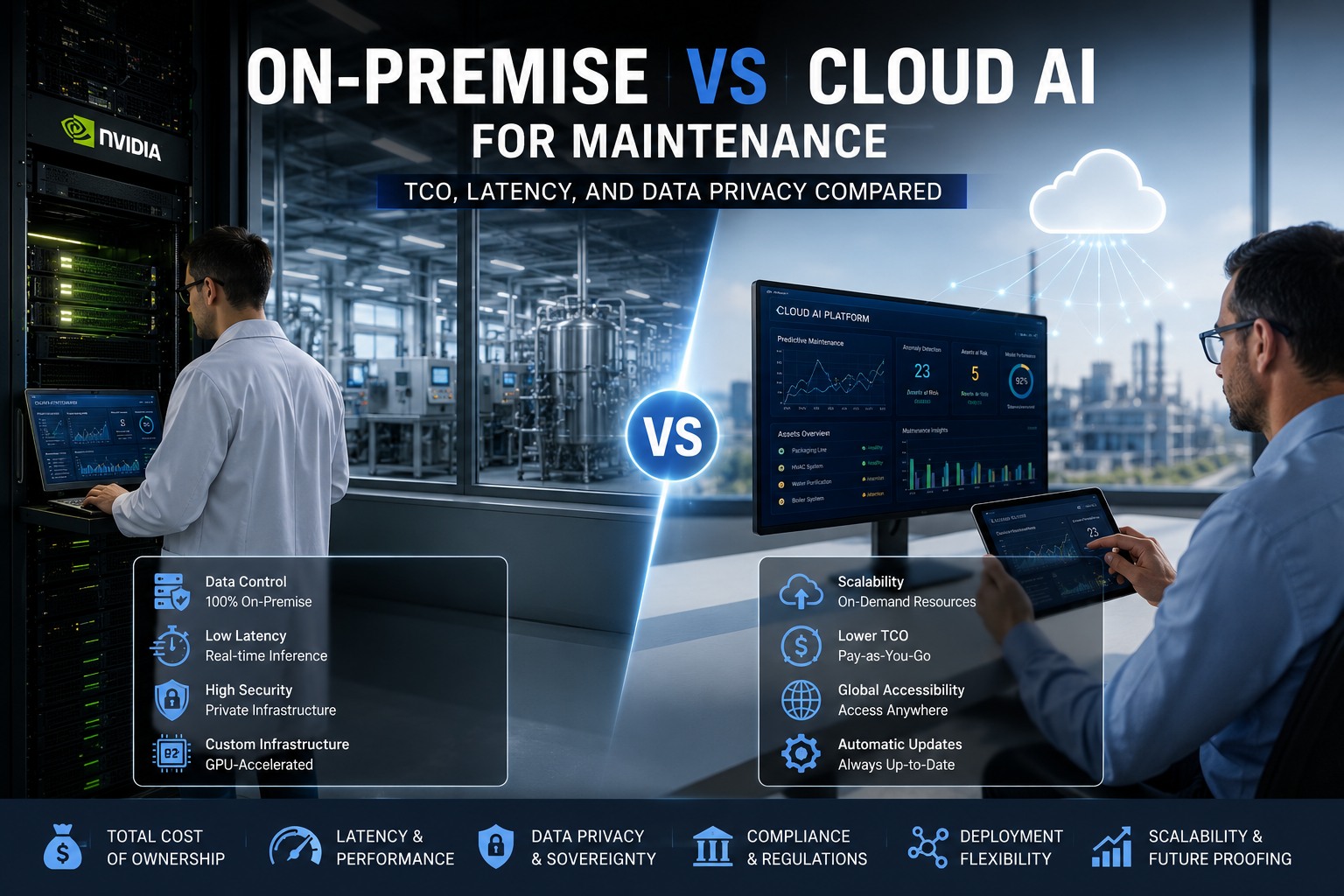
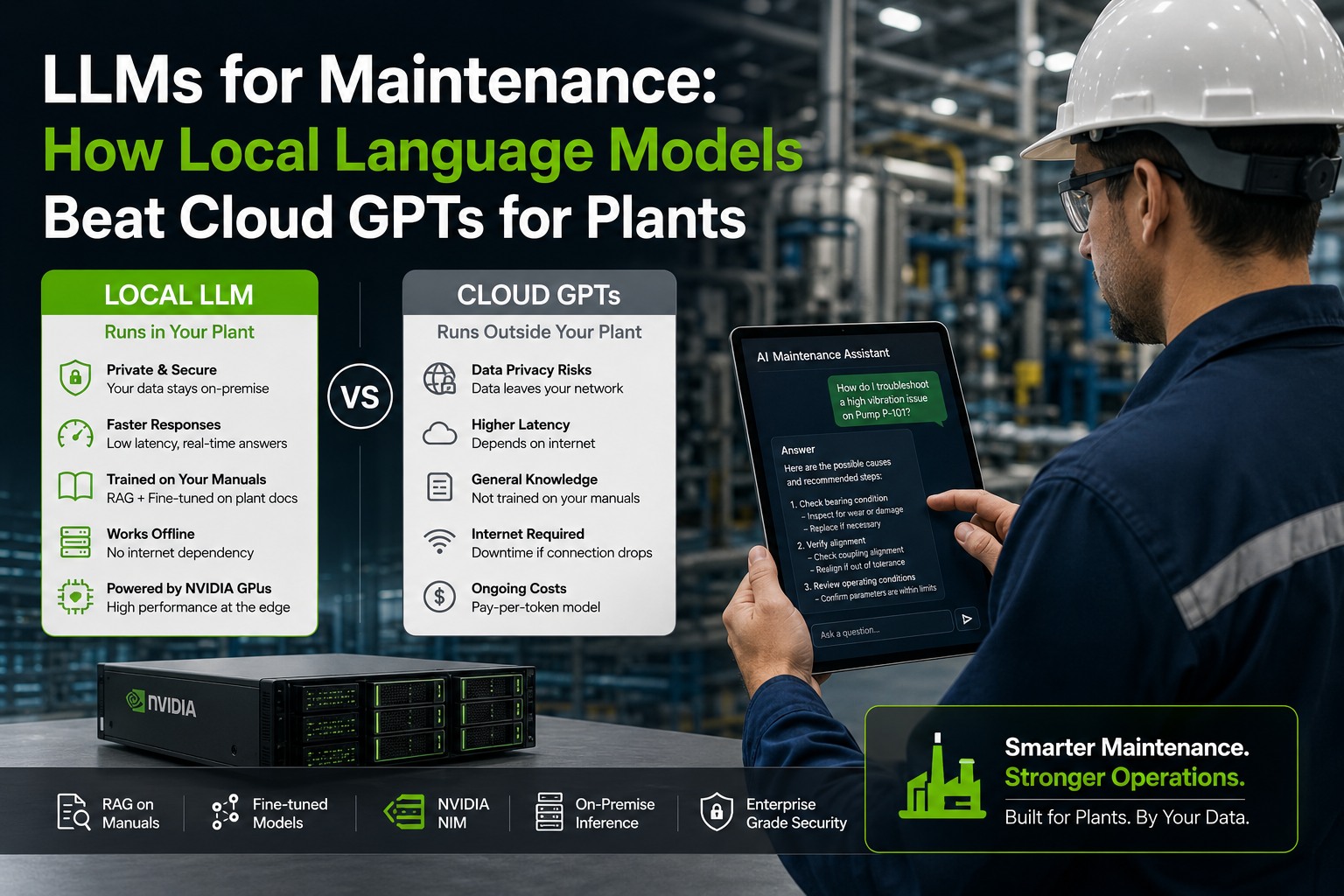
Your bearing seizes at 50,000 RPM. Your vibration sensor catches the harmonic shift in 3 milliseconds. By the time that signal travels to a cloud datacenter, gets processed, and the shutdown command travels back — 800 milliseconds, on a good day — your $250,000 spindle is already destroyed. Cloud-only AI maintenance has a structural problem industrial environments can't tolerate: round-trip latency, network dependency, and sensitive process data leaving your perimeter. The shift in 2026 is decisive — by year-end, 80% of industrial AI inference will run locally rather than in the cloud, and NVIDIA Jetson edge servers are the platform doing it. Sub-15-millisecond inference. -40°C to 85°C operation. Air-gapped capable. Full data sovereignty. See how Oxmaint runs AI predictive maintenance on NVIDIA edge infrastructure inside your perimeter — start your free trial. This guide breaks down what NVIDIA edge AI actually delivers for industrial maintenance, where it fits, and why cloud-first architectures are losing this fight.
MAY 12, 2026 5:30 PM EST , Orlando
Upcoming Oxmaint AI Live Webinar — Deploy NVIDIA Edge AI on Your Plant Floor in One Session
Join the OxMaint team in Orlando to design your on-prem AI maintenance stack — NVIDIA Jetson hardware sizing, TensorRT model deployment, OPC-UA integration, and air-gapped operation mapped to your asset infrastructure.
Jetson Nano vs Orin vs Thor — sizing walkthrough
TensorRT inference acceleration live demo
Air-gapped vs hybrid edge architecture trade-offs
Edge-to-CMMS pipeline with closed-loop work orders
TensorRT-optimized inference latency on Jetson AGX
5×
Faster than CPU inference for vibration FFT analysis
80%
of AI inference will run locally by end of 2026
$49.6B
Edge AI market projected by 2030 (38.5% CAGR)
100%
Data residency — nothing leaves your perimeter
Why Cloud-Only AI Fails for Industrial Maintenance
Cloud AI is excellent for retraining models, fleet analytics, and dashboard visualization. It's structurally wrong for the millisecond-window decisions that protect rotating equipment. Here are the four failure modes plants discover the hard way when they deploy cloud-first predictive maintenance — and why edge inference solves all four.
Round-Trip Latency
Cloud 800ms–2s round-trip
Edge Under 15ms inference
A bearing seizing at 50,000 RPM destroys itself in less than 1 second. Cloud round-trip means the shutdown signal arrives after the damage is done.
Network Dependency
Cloud Outage = blind plant
Edge Works offline indefinitely
Plants can't afford monitoring blackouts when WAN drops. Edge inference runs autonomously during network outages and syncs when connectivity resumes.
Data Sovereignty
Cloud Data leaves perimeter
Edge Stays on-premise
ITAR, GDPR, defense, pharma, and proprietary process data cannot legally leave the facility. Edge AI keeps every sensor reading inside your perimeter.
Bandwidth & Cost
Cloud 25K samples/sec/sensor
Edge Insights only, not raw
Streaming raw vibration to the cloud at 25,000 samples/sec per sensor is bandwidth-prohibitive. Edge inference sends only insights — typically 30–50% lower cloud cost.
The NVIDIA Jetson Family — Sizing Guide for Industrial Maintenance
NVIDIA's Jetson lineup spans five orders of magnitude in compute, from credit-card-size 5W modules to 130W edge servers running the latest generative AI models. The right hardware for a maintenance deployment depends on what's running on it: simple anomaly detection on a pump, full computer-vision defect inspection, or multi-camera thermal fusion across a turbine hall. Map your asset criticality to the right Jetson tier with Oxmaint's deployment engineers.
Jetson Orin Nano
5–15W
Compute:40 TOPS
Memory:4–8 GB
Best for:Single-asset anomaly detection
Pumps, fans, cooling tower drives, conveyor motors. One sensor stream, one model, fast inference.
Jetson Orin NX
10–25W
Compute:100 TOPS
Memory:8–16 GB
Best for:Multi-sensor fusion
Compressor trains, mid-size CNC cells, multiple bearings on one machine. Vibration + thermal + acoustic fusion.
Jetson AGX Orin
15–60W
Compute:275 TOPS
Memory:32–64 GB
Best for:Critical rotating equipment
Turbines, large generators, complete production cells. Multi-camera thermal + vision + acoustic in real time.
Jetson AGX Thor
130W
Compute:2070 FP4 TFLOPS
Memory:128 GB
Best for:Plant-wide AI hub
Generative AI maintenance copilots, foundation models, multi-asset orchestration. 7.5× more compute than AGX Orin.
Match the Right Jetson Hardware to Every Asset Tier
Oxmaint's NVIDIA-accelerated platform supports the entire Jetson family — Orin Nano on auxiliaries, AGX Orin on turbines and critical lines, all managed from a single dashboard. No vendor lock-in, no rip-and-replace.
The Edge AI Inference Pipeline — From Sensor to Work Order in 15ms
What actually happens when vibration data hits an NVIDIA Jetson edge node? Six stages, all running locally, with the full pipeline completing before the next sensor sample arrives. This is the architecture that makes sub-15-millisecond fault detection possible — and what separates real edge AI from "edge-flavored cloud."
0ms
Stage 01 — Sensor Capture
Triaxial vibration, thermal, and acoustic sensors stream raw readings to the edge node at up to 25,000 samples per second over OPC-UA, Modbus, or direct industrial Ethernet.
2ms
Stage 02 — GPU FFT Acceleration
NVIDIA CUDA cores execute Fast Fourier Transform across all bearing and gear-mesh frequency bands simultaneously — work that would serialize on a CPU runs in parallel here.
5ms
Stage 03 — TensorRT Model Inference
Oxmaint's fault detection models — compiled with NVIDIA TensorRT into GPU-optimized execution graphs — classify the live signature against the asset's baseline. 5× faster than CPU inference.
9ms
Stage 04 — Anomaly Score & RUL
Output: fault classification (bearing wear / misalignment / imbalance / cavitation) plus Remaining Useful Life estimate with confidence interval — all generated locally.
12ms
Stage 05 — Local Decision & Alert
If severity crosses threshold, the edge node triggers local action: alert to control room, PLC interlock signal for emergency stop, or direct work order generation in the CMMS.
15ms
Stage 06 — Cloud Sync (Async)
Insights — not raw data — sync to the central Oxmaint platform for fleet analytics, model retraining, and cross-plant benchmarking. Cloud is for learning, not real-time decisions.
Edge vs Cloud vs Hybrid — The Real-World Decision Matrix
"Edge or cloud" is the wrong question. The right question is which workload runs where. Some maintenance tasks belong on the edge. Some belong in the cloud. The winning architecture in 2026 is hybrid — and plants adopting it report 40% faster response times alongside 30–50% lower cloud costs. Here's the decision matrix.
Workload Placement Matrix — Where Each AI Task Belongs
Workload
Edge (NVIDIA Jetson)
Cloud
Why
Real-time fault detection
Yes
No
Sub-15ms latency required for emergency interlocks
Vibration FFT & harmonic analysis
Yes
No
25K samples/sec/sensor — bandwidth prohibitive to cloud
Data residency requirement — nothing leaves perimeter
Operation during network outage
Yes
No
Edge runs autonomously, syncs when WAN returns
Fleet-wide model retraining
No
Yes
Requires aggregated data across plants and time
Cross-plant benchmarking
No
Yes
Aggregation needs central historian and dashboards
Long-term trending & analytics
Partial
Yes
Edge keeps 90 days; cloud archives years for trending
Expert Review — The Strategic Shift Toward On-Premise AI
The architectural conversation in industrial AI has changed quietly but completely over the past 18 months. In 2023, the default deployment story was "stream everything to cloud, run the model there, push insights back to the plant." That model has structural cracks that don't show up until you try to put it in front of an actual production line. By 2026, the default story has flipped — sensor data lands on a Jetson edge node, the model runs locally on TensorRT-optimized GPU cores, and only the insights leave the building. This isn't a preference shift; it's a physics shift. You cannot beat the speed of light on a 1,500-mile cloud round-trip when your bearing has 800 milliseconds before it grenades. The plants winning right now are the ones that figured out edge isn't a downgrade from cloud — it's the only architecture that matches the reliability requirements of the equipment it's protecting.
91% Treat Local Processing as Competitive Edge
A recent industry survey found 91% of companies see local AI processing as a competitive advantage — driven by latency, regulatory compliance, and operational resilience requirements that cloud-only architectures cannot match.
Industrial-Rated From -40°C to 85°C
NVIDIA Jetson industrial modules operate from -40°C to 85°C, rated for shock and vibration, ISA/IEC 62443 cybersecurity certified — deployable inside turbine enclosures, switchgear rooms, and refinery zones without special housing.
Hybrid Wins — 92–98% Detection Coverage
Plants running hybrid edge-cloud architectures achieve 92–98% total failure detection coverage by addressing both rapid-onset and gradual degradation modes — versus 70–80% with cloud-only or edge-only deployments.
Deploy On-Premise AI Maintenance — In Your Perimeter, On Your Hardware
Oxmaint's NVIDIA-accelerated AI maintenance platform integrates with your existing sensors, SCADA, and CMMS — and runs on Jetson edge nodes inside your network. TensorRT-optimized models, air-gap capable, ISA/IEC 62443 secure.
Why is NVIDIA edge AI better than cloud AI for industrial predictive maintenance?
Three structural reasons make edge AI the winning architecture for real-time industrial maintenance. First, latency: cloud round-trips run 800 milliseconds to 2 seconds, while NVIDIA Jetson edge nodes deliver sub-15-millisecond inference using TensorRT-optimized models — fast enough to trigger emergency interlocks before a bearing seizure completes. Second, network independence: edge inference runs autonomously during WAN outages and syncs when connectivity resumes, while cloud-only systems go blind the moment the internet drops. Third, data sovereignty: NVIDIA Jetson keeps all sensor readings, vibration signatures, and proprietary process data inside the plant perimeter — required for ITAR, GDPR, defense, pharma, and any facility where data residency is a regulatory or competitive concern. Cloud AI still excels at fleet-wide model retraining and long-term trending, which is why most modern deployments are hybrid: edge handles real-time decisions, cloud handles aggregation and learning.
Which NVIDIA Jetson model should we deploy for our maintenance use case?
The right Jetson tier depends on what's running on the node and how many sensor streams it processes. Jetson Orin Nano (40 TOPS, 5–15W) handles single-asset anomaly detection on pumps, fans, and conveyor motors — one sensor stream, one model. Jetson Orin NX (100 TOPS, 10–25W) handles multi-sensor fusion across compressor trains and mid-size CNC cells where vibration, thermal, and acoustic data combine. Jetson AGX Orin (275 TOPS, 15–60W) handles critical rotating equipment like turbines and large generators, with multi-camera thermal and vision processing in real time. Jetson AGX Thor (2070 FP4 TFLOPS, 130W) handles plant-wide AI orchestration and generative AI maintenance copilots — 7.5× more compute than AGX Orin for workloads that involve foundation models. Most plants deploy a mix: Orin Nano on auxiliaries for cost-efficiency and AGX Orin on critical assets for compute headroom — all managed from a single Oxmaint dashboard.
Does on-premise AI mean we lose access to cloud-based fleet analytics?
No — modern edge AI deployments are hybrid by design. NVIDIA Jetson edge nodes run real-time inference locally — sub-15-millisecond fault detection, FFT analysis, and anomaly scoring — while syncing only the insights (not raw sensor data) to a central cloud platform for fleet-wide analytics, model retraining, and cross-plant benchmarking. This split delivers both the latency and data sovereignty benefits of edge with the aggregation and learning benefits of cloud. Plants running hybrid architectures report 40% faster response times alongside 30–50% reductions in cloud costs because they're transmitting insights rather than 25,000-samples-per-second raw vibration streams. Hybrid edge-cloud systems achieve 92–98% total failure detection coverage versus 70–80% for either edge-only or cloud-only deployments.
How does TensorRT actually accelerate AI maintenance models on Jetson hardware?
NVIDIA TensorRT compiles trained AI models into GPU-optimized execution graphs that exploit the parallel structure of CUDA cores, kernel fusion, and reduced-precision arithmetic. The practical result is up to 5× faster inference compared to standard CPU-based frameworks while maintaining 90%+ prediction accuracy on industrial datasets. Concretely: an AI model that takes 75 milliseconds on a CPU runs in under 15 milliseconds on a TensorRT-optimized Jetson node — fast enough to detect transient fault signatures that occur in millisecond windows, like a bearing harmonic shift or a sudden cavitation event in a pump. TensorRT also handles dynamic batching and mixed-precision execution (FP16, INT8, FP4 on newer hardware), letting the same Jetson process more sensor streams in parallel without proportional power increase. For Oxmaint deployments, models are pre-compiled with TensorRT for each asset class so plants get production-ready inference performance from day one.
Can NVIDIA Jetson edge nodes operate in harsh industrial environments and during network outages?
Yes to both — and this is precisely why NVIDIA built the industrial Jetson product line. Industrial-rated Jetson modules operate from -40°C to 85°C, are rated for shock and vibration per industrial standards, and are ISA/IEC 62443-4-2 cybersecurity certified for critical infrastructure. They can be deployed inside turbine enclosures, substation switchgear rooms, refinery zones, and outdoor cabinets without special housing or cooling. On the network side, edge nodes run Oxmaint's inference engine completely locally — fault detections, health scores, and work order generation all happen on-device. During any network outage, the Jetson keeps detecting faults and storing results locally; when connectivity resumes, accumulated insights sync to the central Oxmaint platform automatically. This is why edge-first AI is the only architecture that matches the always-on reliability requirements of the equipment it protects.