For pharma Maintenance heads, the FDA inspection arrives the same way every time. Auditor walks the line, points at a tablet press, and asks when was this last PMed, who did it, was the calibration current at batch start, and where is the signed work order. If your team has to open SAP PM, a calibration spreadsheet, a paper logbook, and call the shift supervisor, the inspection is already going badly. The maintenance team owns the PM compliance number, the calibration audit trail, the spare parts ledger, and the work order signatures — and every one of those records has to land in the eBR at batch release. This guide walks through how a SAP-integrated CMMS turns four disconnected maintenance systems into one defensible chain of evidence, raises PM compliance from the 60s into the high 90s, and cuts MTTR on validated equipment in half.
SAP-Integrated CMMS for Pharma: Calibration, Compliance, and eBR Workflows
A maintenance-first guide for pharma reliability and validation teams. PM compliance, calibration audit trails, work order signatures, spare parts ledger — connected to SAP and queryable from the eBR, without forcing your planners to reconcile four systems before every release.
The maintenance problem the inspector will find
A typical pharma site runs SAP PM for the asset master and PM plan, a calibration tool for instruments, paper logbooks for breakdowns and cleaning, and a separate eBR or MES for batch documentation. The maintenance team sits at the centre — every system holds evidence the auditor will ask for, and the seams between them are where reliability and compliance both fail.
The numbers are concrete. Industry assessments find 40 to 60 percent of FDA-regulated pharma manufacturers have significant Part 11 compliance gaps. FDA 483s for inadequate maintenance records have risen 34 percent since 2022. Plants typically operate at 68 to 82 percent PM compliance on GMP-critical equipment, with dozens of calibration overdue events per year. The maintenance team carries the load on both sides.
Four record systems the Maintenance head has to defend
Where OxMaint sits in the maintenance stack
OxMaint deploys as the validated maintenance execution layer between SAP and the eBR. SAP keeps the asset master, the PM plan, and the financials. The eBR keeps the batch record. OxMaint becomes the system of evidence for every PM, calibration, breakdown repair, spare part change, and cleaning verification — each carrying the 21 CFR Part 11 audit trail and authenticated signature the inspector will ask for.
Reference architecture: SAP ↔ OxMaint ↔ eBR
The integration runs on standard web services. SAP pushes the asset master and PM plan into OxMaint. OxMaint pushes back work order completion, cost, parts consumption, and labour hours for financial close. The eBR queries OxMaint directly — for any asset, any timestamp, return calibration status, open work orders, qualified technician, parts changed, and electronic signature. Batch release no longer waits on a planner pulling four reports.
Maintenance work order execution: closing the human reliability gap
FDA 211.67 and 211.68 require complete records for equipment cleaning and maintenance — written procedures, schedules, and records for every piece of equipment used in drug manufacturing. The most common failure mode is not the absence of a procedure. It is the gap between the SOP on paper and what the technician actually did at 02:14 on a Saturday shift. Mobile work order execution is what closes that gap.
Calibration: the maintenance team's highest-volume Part 11 workload
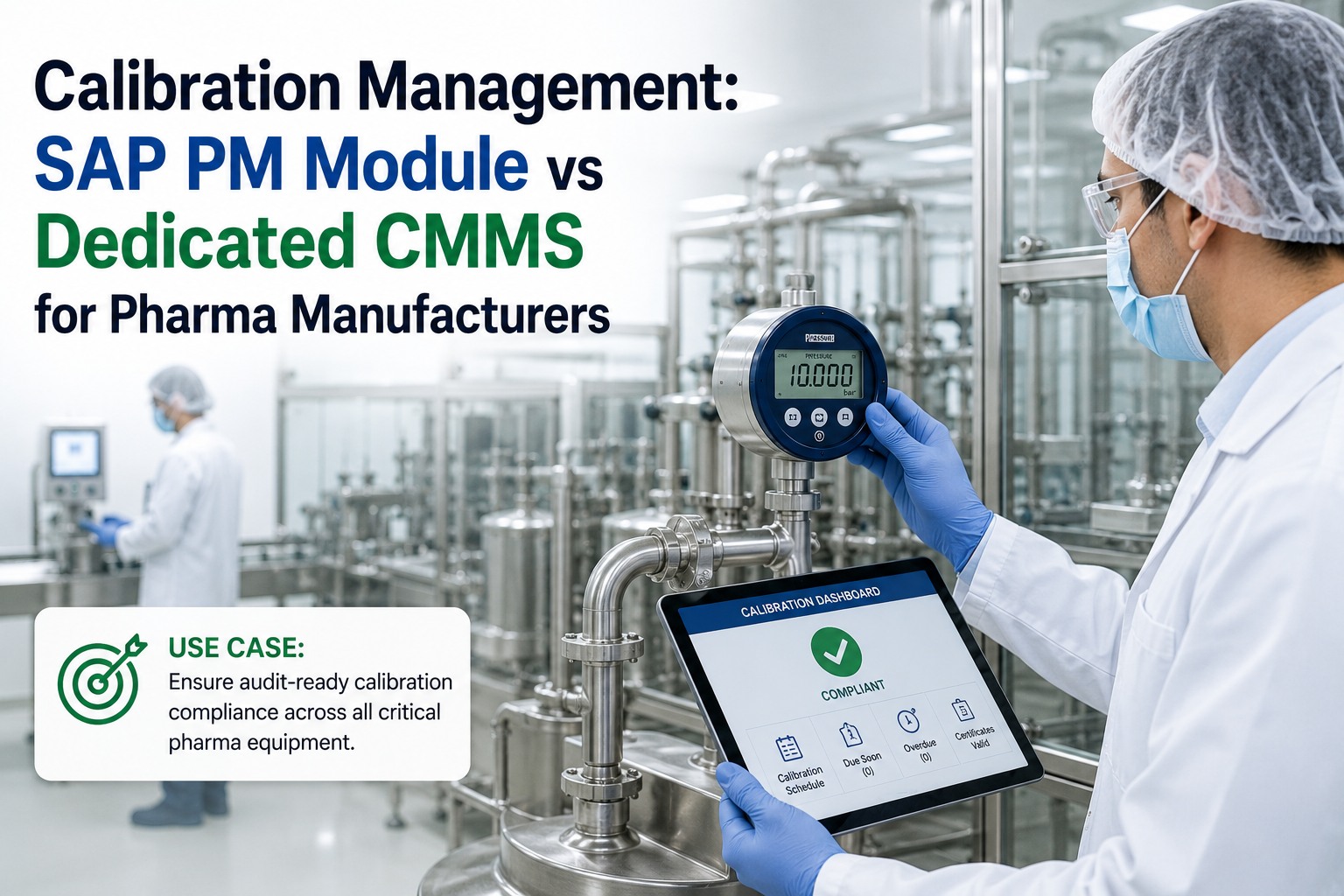
Calibration is the single highest-frequency Part 11 record a maintenance team produces. A mid-sized oral solid dose facility runs 1,800 to 4,500 calibration events per year across pH probes, balances, thermocouples, flow meters, and HVAC instrumentation. Every event needs as-found and as-left readings, the standard used, the technician's qualification, the supervisor's countersign, and a tamper-evident audit trail. A spreadsheet cannot do this. SAP PM was never designed for it. A standalone calibration tool can — but only if your planners are willing to run two work order systems in parallel.
The OxMaint calibration workflow, owned by maintenance
21 CFR Part 11: what the maintenance team has to deliver
21 CFR Part 11 sets the requirements for electronic records and signatures in FDA-regulated environments. The maintenance team is responsible for the technical evidence on four pillars — each with a concrete daily implication for how PMs, calibrations, and breakdown repairs get executed.
A non-validated CMMS shifts the burden of proof onto your maintenance and QA teams during inspection. A pre-validated CMMS reduces that burden — but only if validation is current, change control is enforced, and the audit trail is genuinely immutable. Ask the vendor for the validation summary report before you sign, not after the first audit finding.
What the eBR pulls from the maintenance system, per batch
SAP's new eBR capability in SAP Digital Manufacturing consolidates execution data into a single, document-based, e-signature-driven record. Whether your eBR is SAP DM, Werum PAS-X, Siemens Opcenter, or custom MES, it asks the maintenance system one recurring question at every batch review: was this asset in a qualified, calibrated, maintained state when the step ran?
Maintenance evidence the eBR requires
| Maintenance data point | Source in OxMaint | Why the eBR needs it |
|---|---|---|
| Calibration status at step start | Calibration certificate, asset record | Proves every measurement instrument was within tolerance during execution |
| Open work orders against the asset | Work order ledger | Flags any unresolved maintenance issue at the moment the batch ran |
| Last completed PM & technician ID | PM history, signed work order | Demonstrates qualified personnel performed the most recent service |
| Spare parts changed in last 30 days | Parts consumption log | Supports investigations into batch deviations linked to equipment changes |
| Cleaning verification log | Cleaning work order, e-signature | Cross-contamination control under 21 CFR 211.67 |
| Breakdown events & root cause | Reactive work order, RCA notes | Feeds CAPA workflows in the eQMS |
| Technician qualification record | Training matrix linked to asset class | Confirms personnel signing off were authorised to do so |
In a review-by-exception model — the standard for modern pharma batch release — the eBR only surfaces what is anomalous. If every asset was calibrated, every PM current, no work order open, no qualification expired, the QA reviewer never sees a maintenance record at all. The integration removes the manual reconstruction step before review. Industry coverage of EBR transformations describes review cycles cut by 40 to 60 percent when documents are digitised properly.
Maintenance KPIs: what changes when you connect the layers
Compliance is the floor, not the ceiling. The same CMMS that produces Part 11 audit trails also produces the operational evidence the Maintenance head uses to defend the budget. A pharma plant with poor PM compliance does not just risk a 483 — it loses batches to unplanned downtime on the hardest-to-replace equipment. The KPI shift below is what a connected layer typically produces.
Maintenance KPI shift after SAP-integrated CMMS rollout
| Maintenance KPI | Typical before-state | After SAP-integrated CMMS |
|---|---|---|
| PM compliance (GMP-critical) | 61 to 82 percent | 96 to 99 percent |
| Schedule compliance, weekly | 55 to 70 percent | 85 to 92 percent |
| Calibration overdue events / year | 40 to 120 | Under 5 |
| MTTR, critical validated assets | 14 to 32 hours | 6 to 14 hours |
| MTBF, packaging & granulation | 72 to 180 hours | 240 to 480 hours |
| Unplanned downtime | 4 to 8 percent | 1 to 3 percent |
| Maintenance backlog, weeks of crew capacity | 6 to 12 | 3 to 5 |
| Audit preparation time | 3 to 6 weeks per inspection | Same-day evidence retrieval |
| Batch release cycle | 5 to 14 days | 2 to 5 days, review-by-exception |
A rising MTTR almost always has one of three causes — parts unavailability, technician skill gaps, or inadequate diagnostic data. The dashboard surfaces which. The same is true for falling PM compliance: chronic emergency interruptions, planner overload, or unrealistic intervals. Without a connected CMMS, the maintenance head guesses. With one, the data points to the answer.
Where the maintenance head's spare parts ledger fits
Spare parts is the maintenance KPI that quietly drives every other one. A PM deferred because a bearing is on backorder shows up two months later as a breakdown, then a deviation, then a delayed batch release. SAP MM holds the parts master and financial value. OxMaint holds the consumption against the work order, the reservation at planning, and the criticality flag for single-source parts on validated assets.
A practical rollout for the maintenance team, not a rip-and-replace
No pharma site is going to take SAP PM offline to roll in a new CMMS. The migration is layered. SAP keeps the asset master, financials, and ERP reporting. OxMaint owns mobile execution, calibration, and records that need Part 11 governance. The eBR gets a clean API to query both. The maintenance team runs through this in 90 days with no production interruption.
90-day maintenance rollout, validated
A note on what the vendor does and does not do
Validation is the manufacturer's responsibility, not the vendor's. The vendor can shorten the cycle by shipping a pre-qualified product with documented IQ/OQ/PQ protocols and a change control mechanism that does not invalidate your qualified state every quarter. OxMaint's validation package is structured for life sciences sites. Running PQ in your environment, signing protocols, and maintaining periodic review still sits with your maintenance, QA, and validation teams.
Frequently asked questions
Does OxMaint replace SAP PM?
How quickly does PM compliance actually improve?
Is OxMaint 21 CFR Part 11 compliant out of the box?
How does the eBR pull data from OxMaint?
What if our eBR is Werum PAS-X or Siemens Opcenter, not SAP DM?
Can we phase calibration migration separately from PM migration?
How long is a validation cycle?
What about EU GMP Annex 11?
See the maintenance workflow for your pharma operation
Walk through PM execution, calibration, work order signatures, and the eBR query workflow on a 30-minute call. Bring your current PM compliance and MTTR numbers — we will show you the specific integration pattern that closes the gap and the KPI lift to expect in the first 60 days.