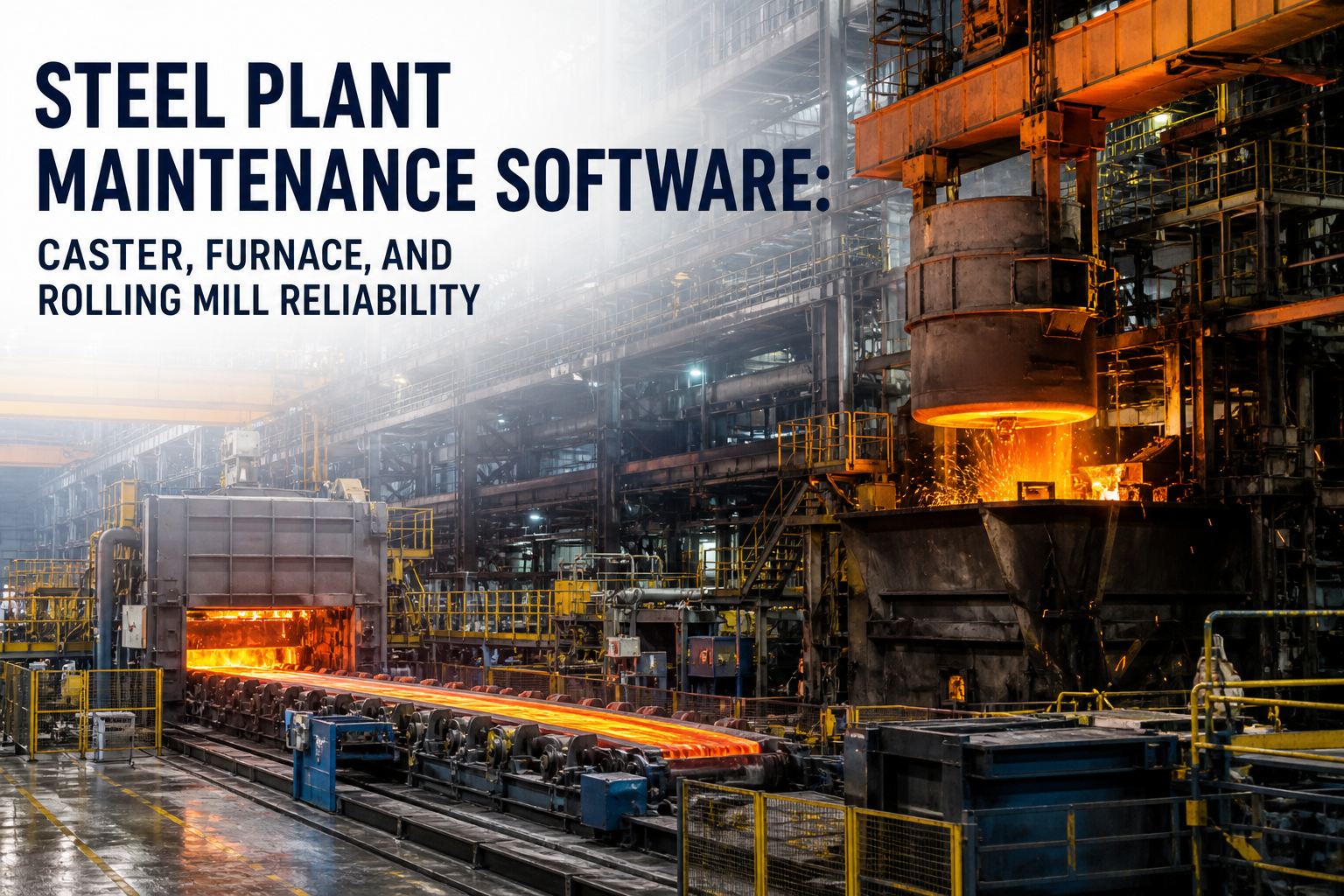
Steel Plant Maintenance Software: Caster, Furnace, and Rolling Mill Reliability
By Riley Quinn on May 2, 2026
A breakout on your continuous caster doesn't just stop the caster. It stops the BOF shop with nowhere to send liquid steel, the hot strip mill with no slabs to roll, and the order book commitments that just became impossible to meet. Steel plant downtime cascades — that's what makes it the most expensive failure mode in heavy industry, with documented losses of $125,000–$260,000 per hour and single events running $500K to $8M in emergency repairs and lost production. Most integrated mills experience 25–40 major unplanned failures per year. The plants pulling ahead in 2026 aren't the ones with newer equipment. They're the ones running a CMMS that knows what an EAF is, what a caster mold heat flux signature looks like, and how to trigger PMs against tonnage and heat counts rather than calendar dates. See how Oxmaint's steel-specific CMMS lifts plant uptime and cuts cost-per-tonne 30%+ — start your free trial.
MAY 12, 2026 5:30 PM EST , Orlando
Upcoming Oxmaint AI Live Webinar— Build Your Steel Plant CMMS Strategy in One Session
Join the OxMaint team in Orlando to design a steel-specific maintenance program — EAF monitoring, caster reliability, rolling mill vibration, and refractory tracking — mapped to your asset hierarchy on a unified CMMS platform built for the punishing realities of integrated and mini-mill steel operations.
The Cascade Effect — Why Steel Plant Downtime Is Different
In most industries, a single equipment failure stops a single line. In a steel plant, one failure stops the entire chain because every stage feeds the next. A caster stop doesn't just cost the caster — it idles the BOF that has nowhere to send liquid steel, freezes the hot strip mill with no slabs to roll, and triggers customer penalty clauses on commitments you can no longer meet. This cascade is what makes steel plant maintenance economics fundamentally different.
When the Caster Stops, Everything Stops
BOF / EAF
Liquid steel with nowhere to go — vessel must hold or dump
Continuous Caster — STOP
Failure point: breakout, mold cooling loss, or segment seizure
Hot Strip Mill
Idle within hours — no slabs to roll, crew on standby
Finishing & Coiling
Order delays · customer penalty clauses · contract risk
$125K–$260Kper hour cascading downtime
$500K–$8Mper major failure event
25–40major events per year (avg.)
The 5 Critical Asset Zones — And the Failure Modes That Define Each
A steel plant CMMS that treats every asset the same will fail in the first quarter. The five critical zones — ironmaking, steelmaking, casting, rolling, and finishing — operate under fundamentally different conditions and demand different monitoring strategies. Here's how to think about each.
Why Calendar PMs Fail in Steel — And What to Use Instead
The single most common CMMS configuration mistake in steel plants is using calendar-based PM triggers. A PM that says "inspect caster segment every 90 days" ignores the reality that a segment running a high-grade campaign wears 3× faster than one running construction-grade billet. Steel-specific CMMS aligns maintenance intervals to actual production variables. See how Oxmaint configures production-variable PM triggers on your asset register — book a 30-minute session.
Calendar-Based (Generic CMMS)
Example: Inspect caster segment every 90 days
Problem: Ignores grade mix, casting speed, and tonnage variations. Plants either over-maintain healthy assets (wasted spend) or under-maintain hard-running assets (failure risk).
Production-Variable (Steel CMMS)
Heat CountBF cooling stave inspections trigger after defined heat count
TonnageCaster segment maintenance triggers after defined tonnage processed
Operating HoursRolling mill stand rebuilds trigger against actual rolling hours
Campaign CyclesBOF lining campaigns triggered by heat count, not calendar quarters
Cut Maintenance Cost-Per-Tonne by 30%+ Without Replacing Equipment
Oxmaint's steel-specific CMMS uses production-variable PM triggers, IoT condition monitoring on critical rotating assets, and predictive analytics for refractory, caster, and roll wear — proven in integrated mills cutting cost-per-tonne from $31.40 to $20.70 in 11 months.
The Cost Math — One Prevented Event Pays for the Year
Steel plant CMMS ROI doesn't require sophisticated modeling. It requires counting how many unplanned events your plant experiences in a year, multiplying by the typical cost, and comparing to the platform investment. The math is rarely close.
Single BF Outage
$1.2M–$2.8M / day
Caster Breakout Event
$1.5M–$6M total
Hot Strip Mill Cobble
$1.6M typical
EAF Major Failure
$800K–$2M
Refractory Breach Event
$3M–$6M cascade
Crane / Material Handling
$300K–$1M
The Math
A typical integrated mill experiences 25–40 major unplanned failures per year. Even a 30% reduction prevents 8–12 events annually — recovering $8M–$30M against a CMMS investment that's a small fraction of a single prevented event.
Expert Review — The 4 Configurations That Separate Steel CMMS From Generic CMMS
I see the same pattern across integrated mills and mini-mills: leadership buys a generic CMMS expecting it to work for steel, then spends 18 months trying to retrofit steel-specific logic onto a platform that was never designed for it. The four configurations that distinguish a real steel CMMS from a generic one are deceptively simple — production-variable PM triggers (heat count, tonnage, rolling hours), an asset hierarchy deep enough to track 15,000–50,000 maintainable assets across five process zones, condition monitoring tied to specific failure modes that matter in steel (refractory wear, caster mold heat flux, roll bearing vibration at 900°C), and emergency-event cost capture that includes the cascade impact, not just the single-asset repair bill. Plants that get those four things right routinely cut cost-per-tonne by 30% or more inside 12 months. Plants that don't get those configurations right end up with a CMMS that mostly logs work orders after they happen — useful for reporting, but not for changing the failure trajectory.
52% Reduction in Emergency Work Orders
Documented case from a 3.5 MTPA integrated mill: 58% drop in emergency work orders, $1.8M dead stock rationalized, full CMMS payback at month 11. Wrench time doubled from 26% to 54% on the same workforce.
Emergency Repairs Cost 3–5× Planned
Emergency labor at 1.5–2× standard rate. Emergency procurement at 3–5× standard price plus courier freight. Plus ancillary damage from running components to failure. Shifting 20–25% of reactive to planned eliminates most of this premium.
9–14 Month Payback for Integrated Mills
Documented average payback for steel-specific CMMS deployment in integrated mills runs 9–14 months from go-live. Mini-mills typically achieve payback at the lower end of that range due to shorter implementation cycles.
Your 90-Day Steel Plant CMMS Rollout
Steel plant CMMS deployment doesn't have to be an 18-month enterprise project. A focused 90-day program covers the 500–1,000 most critical assets, delivers measurable results in the first quarter, and proves payback typically within the first prevented event.
Days 1–30
Foundation & Asset Hierarchy
Build hierarchy: Plant → Area → System → Equipment → Component for top 500 critical assets
Document failure history for Tier 1 assets (BF, EAF, BOF, casters, mill stands)
Outcome: Reactive work drops 20–35% from documentation discipline alone
Days 31–60
Condition Monitoring & Mobile Workforce
Connect IoT sensors on 100–150 critical rotating assets — vibration, temperature, current
Deploy mobile work orders to technicians with offline capability for low-connectivity zones
Pre-stage parts kits linked to PM work orders, digital job instructions per work type
Outcome: First condition-driven alerts; PM compliance climbs to 75%+
Days 61–90
Predictive AI & Cost Capture
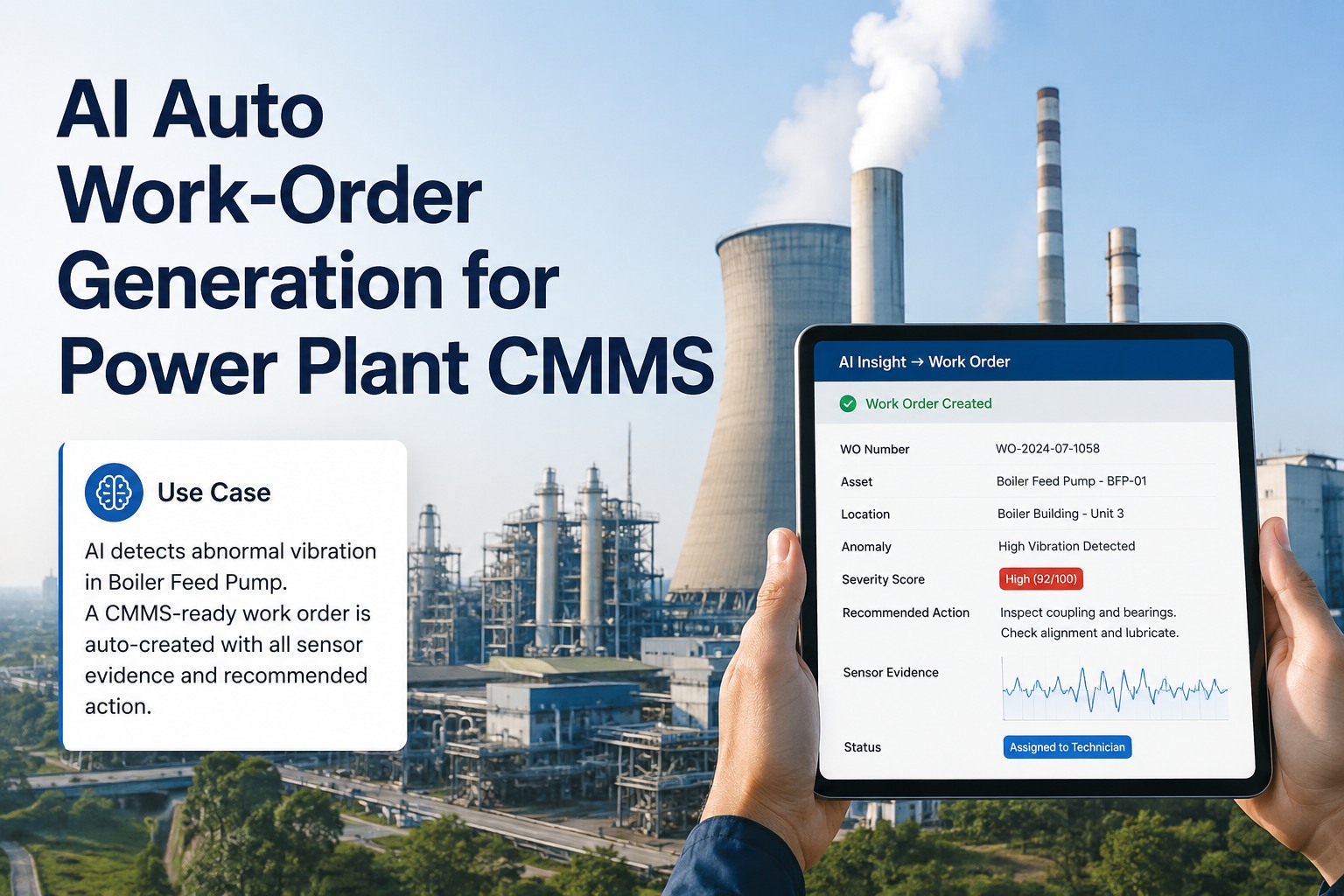
Activate AI predictive models on caster, EAF, and rolling mill critical paths
Configure 4-category cost capture: production loss + repair + collateral + customer penalty
First documented prevented event — typically pays back full year's CMMS investment
Outcome: Cost-per-tonne tracking live; benchmark established for ongoing improvement
Run Your Steel Plant Like a 96% Uptime Producer
Oxmaint's steel-specific CMMS deploys without rip-and-replace, integrates with SAP PM and Oracle EAM via standard APIs, and runs steel-trained AI models for refractory wear, caster mold cooling, and rolling mill bearing degradation. Live in 90 days.
What makes steel plant maintenance different from general industrial maintenance?
Steel plants combine three structural conditions you almost never see together. First, extreme thermal loading — blast furnaces operate at 1,500°C, EAFs draw 85+ MW pulses, and rolling stands process steel at 900°C+ surface temperatures, all of which destroy standard industrial sensors and instrumentation in months. Second, cascading failure economics — every stage feeds the next, so a single caster stop idles the BOF upstream and the rolling mill downstream simultaneously, multiplying the cost of any single failure by 3–5×. Third, production-variable wear — equipment degrades against tonnage, heat counts, and grade mix rather than calendar time, making calendar-based PM triggers structurally wrong for the equipment they're supposed to protect. A steel-specific CMMS understands all three conditions and applies maintenance logic calibrated for steel-typical wear patterns rather than generic industrial benchmarks.
What does a continuous caster breakout actually cost?
A continuous caster breakout is among the most expensive single failure events in heavy industry. Direct costs include destroyed mold plates ($150K–$400K), damaged strand guide rolls ($200K–$800K), contamination of the secondary cooling zone requiring full cleanout, and emergency safety response. Cascade costs are typically larger than direct repair: the BOF or EAF upstream must hold or dump liquid steel (50–280 tons depending on heat size), the hot strip mill downstream goes idle for the duration, and customer order commitments may trigger penalty clauses. Total event cost typically runs $1.5M–$6M, with the largest events involving collateral damage to multiple casting strands reaching $8M+. The detection time required to prevent a breakout — typically 12–16 days of advance warning from mold heat flux trending — is well within the capability of a properly configured steel CMMS with caster mold monitoring integration.
Why are calendar-based PM schedules wrong for steel plant equipment?
Calendar-based PM schedules assume that asset wear correlates with elapsed time. In steel plants, that assumption breaks down immediately. A blast furnace cooling stave wears against heat count — the metallurgical events that consume refractory and stress cooling circuits — not against calendar months. A caster segment wears against tonnage processed and the steel grade mix, not against fiscal quarters. A rolling mill stand wears against actual rolling hours under load, not against the day count since last inspection. Calendar PM triggers either over-maintain healthy assets (wasted labor and parts spend) or under-maintain hard-running assets (failure risk). Steel-specific CMMS aligns PM triggers to production variables: heat count for furnaces, tonnage for casters, operating hours for rolling equipment, and campaign cycles for refractory-bound assets. This alignment alone typically reduces total PM labor by 20–30% while improving reliability outcomes — because maintenance happens when equipment actually needs it, not when the calendar says.
How does steel plant CMMS integrate with existing SAP PM, Oracle, or Maximo systems?
Modern steel-specific CMMS platforms integrate with enterprise systems through standard APIs rather than replacing them. SAP PM, Oracle EAM, and IBM Maximo continue to handle financial consolidation, supply chain integration, and enterprise reporting at the corporate level. The steel-specific CMMS handles operational maintenance execution — work order creation, mobile dispatch, condition monitoring integration, and production-variable PM scheduling — at the plant floor level. Cost data flows from work-order-level capture in the CMMS to ERP for financial roll-up. Sensor and SCADA data flows in via OPC-UA, MQTT, and Modbus TCP. Asset hierarchy can be synchronized in either direction depending on which system is the system of record. This split architecture lets steel plants get the operational benefits of a steel-specific CMMS without disrupting the corporate ERP integration that finance and supply chain depend on.
What's the realistic ROI timeline for steel plant CMMS deployment?
Documented results across integrated mills and mini-mills show a typical payback period of 9–14 months from go-live. The first 90 days deliver measurable improvements: PM compliance climbs from baseline (typically 40–60%) to 75%+, emergency work orders drop 20–35%, and the first condition-based alert typically prevents a failure that pays back the full annual CMMS cost. By month 12, plants commonly document 50%+ reduction in emergency work orders, 30%+ reduction in maintenance cost-per-tonne, doubled wrench time on the same workforce, and full CMMS payback. A real-world case from a 3.5 MTPA integrated mill: cost-per-tonne dropped from $31.40 to $20.70 (a 34% reduction), emergency work orders fell 58%, and full payback was confirmed at month 11. The math becomes definitive when you account for prevented cascade events: a single avoided continuous caster outage typically exceeds the entire annual CMMS license cost by an order of magnitude or more.