Power Plant Maintenance: Boiler, Turbine, and Generator Reliability Strategy
By Riley Quinn on May 2, 2026
A power plant runs 8,760 hours a year — and every one of those hours hangs on three assets staying alive: the boiler, the turbine, and the generator. Drop any one of them, and you're looking at $200,000 to $500,000 per day in lost generation, emergency contractor premiums, expedited parts at 2.4× normal cost, and grid penalty exposure. The hard truth: most U.S. thermal plants experience 5 to 8 forced outages per year, and 68% of those failures sent detectable warning signals 2 to 8 weeks before they happened. The plants running at peak availability aren't the ones with newer equipment — they're the ones running an integrated maintenance strategy that connects boiler tube monitoring, turbine vibration analytics, and generator condition data into a single CMMS workflow with AI in the loop. See how Oxmaint's AI-powered predictive maintenance platform unifies your plant's reliability strategy — start your free trial. This guide breaks down what a modern power plant maintenance strategy actually looks like in 2026, asset by asset.
MAY 12, 2026 5:30 PM EST , Orlando
Upcoming Oxmaint AI Live Webinar — Build Your Plant-Wide Reliability Strategy in One Session
Join the OxMaint team in Orlando to map your boiler, turbine, and generator maintenance strategy on a single CMMS platform — predictive analytics, outage planning, and KPI dashboards built for thermal and combined-cycle plants.
Lost generation revenue per hour of forced outage on a 500 MW unit
68%
Of major failures send detectable signals 2–8 weeks before damage
5–8
Forced outages per year at the average U.S. thermal plant
70–75%
Of breakdowns eliminated by properly deployed predictive maintenance (DOE)
The Three Pillars of Power Plant Maintenance — A Unified View
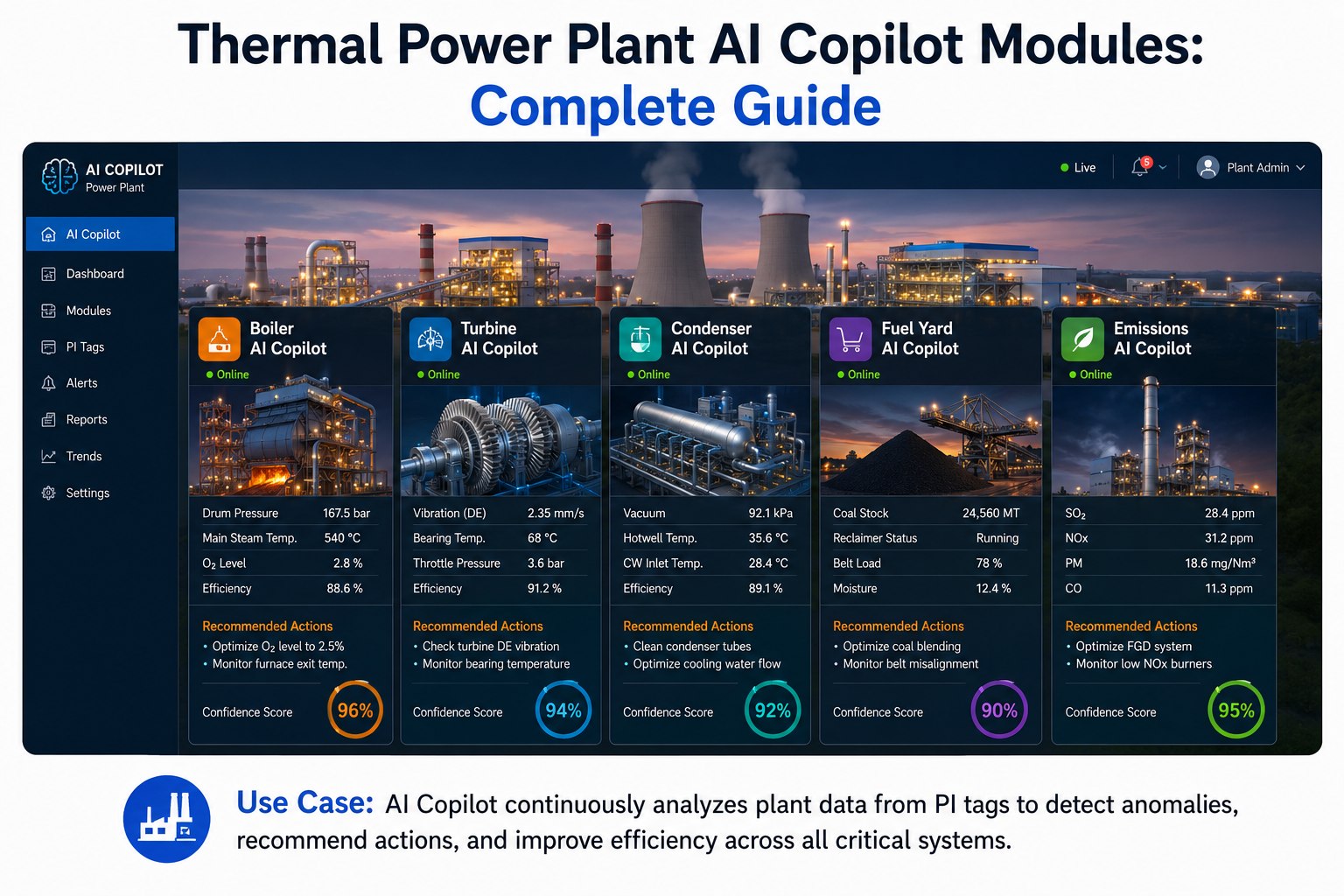
Plant directors who treat boiler, turbine, and generator maintenance as separate silos pay for it in heat rate degradation, outage overruns, and surprise failures. The plants delivering 95%+ availability run all three under one strategy — same CMMS, same KPI dashboard, same predictive feed — because failure modes in one asset cascade into the others. A boiler tube leak forces a turbine trip. A turbine vibration excursion stresses generator bearings. Here's how the three pillars connect.
Rotor balance and shaft alignment — vibration-trended degradation
Bearing temperature trending — thermography + IIoT sensors
Proactive rewind planning — co-scheduled with major turbine outage
Replacement parts have 6–18 month lead times. Plan rewinds proactively, not reactively.
The Four Maintenance Strategies — And What Each Actually Costs
Most plants live somewhere between reactive and time-based preventive — and both approaches carry enormous hidden costs. Reactive maintenance triggers emergency labor premiums, expedited parts at 2.4× normal cost, and unplanned generation loss. Time-based maintenance wastes budget on assets that don't need service while missing the ones that do. Here's how the four strategies compare in real plant economics. Map your current strategy mix and ROI potential with Oxmaint's reliability engineers — book a 30-minute session.
01
Worst
Reactive (Run-to-Failure)
$17–$18 / HP / yr
Fix it when it breaks. Emergency labor 2–3× standard rate. Expedited parts at 2.4× cost. Unplanned generation loss compounds the bill.
Best for: Non-critical, low-cost assets only.
02
Common
Time-Based Preventive
$13–$14 / HP / yr
Service on calendar or operating-hour intervals. Reduces some failures but wastes 20–30% of budget on healthy assets while still missing condition-based events.
Best for: Lubrication, filter changes, regulatory PMs.
03
Better
Condition-Based (CBM)
$8–$10 / HP / yr
Vibration, thermography, and oil analysis trigger work orders when asset condition crosses thresholds. 30–40% reduction in unplanned outages.
Best for: Rotating equipment, transformers, motors.
04
Best
AI-Driven Predictive (PdM)
$7–$9 / HP / yr
Multi-sensor AI fusion catches degradation 2–8 weeks ahead. Auto-generates work orders into CMMS. 70–75% breakdown elimination per DOE data.
Best for: Boilers, turbines, generators, critical pumps.
For a 500 MW plant, moving from reactive to predictive maintenance saves up to 45% on annual maintenance spend before counting avoided downtime — typically hundreds of thousands of dollars per year per unit.
Cut Forced Outages by 50% — Without Replacing Your Existing Sensors
Oxmaint's AI predictive maintenance platform integrates directly with your DCS, SCADA, PI Historian, and existing IoT sensors via OPC-UA, Modbus, and standard connectors. No rip-and-replace. Most plants see their first prevented outage within 60 days of deployment.
The KPIs That Define Whether Your Strategy Is Working
Maintenance transformation without measurement is change without accountability. The plants delivering top-quartile availability track these six KPIs from day one — because each one connects directly to revenue, cost, or safety. If you can't pull these numbers in under 10 minutes, your CMMS isn't carrying its weight.
MTBF (Mean Time Between Failures)
Target: ↑ trending
Tracks reliability improvement on rotating equipment. A boiler feed pump going from 8 to 24 months between failures triples your asset life and cuts outage frequency by 67%.
MTTR (Mean Time To Repair)
Target: ↓ trending
A turbine taking 18 hours to repair vs 6 costs 12 extra hours of lost generation at $15K–$40K per hour. MTTR improvement directly converts to revenue.
PM Compliance %
Target: ≥ 95%
Percentage of scheduled PMs completed on time. The single most predictive leading indicator of unplanned outage risk in the next quarter.
Heat Rate Deviation
Target: ≤ baseline +1%
Tracks fuel-to-electricity efficiency drift. A 1% improvement saves millions annually and reveals fouled condensers, scaled tubes, or worn turbine blades early.
Planned vs Unplanned Ratio
Target: ≥ 80% planned
The clearest single measure of maintenance maturity. Top-quartile plants run 85%+ planned work; struggling plants live below 60%.
Equivalent Availability Factor
Target: ≥ 92%
The headline reliability number tracked by NERC. Combines forced and planned outage hours into a single availability percentage benchmarked across the fleet.
Expert Review — What Separates Top-Quartile Plants From the Rest
The single most consistent finding across the 500-plus power plant maintenance audits I've seen is this: top-quartile plants don't have better equipment, more staff, or larger budgets than the bottom quartile. They have better data discipline. Every work order is linked to a specific asset. Every PM completion is photo-documented. Every condition-monitoring reading is trended against an asset-specific baseline. When a tube starts thinning or a turbine bearing starts heating, the data is there — usually weeks in advance — but in struggling plants, that signal is buried in spreadsheets, paper logs, or a vendor portal nobody opens. The shift from a bottom-quartile plant to a top-quartile plant rarely takes new hardware. It takes a CMMS architecture that makes the right data visible at the right moment, and a culture that treats prevented failures as the headline metric, not just repair speed.
10–15% of Failures Are Self-Inflicted
Industry data shows 10–15% of power plant failures are caused by maintenance itself — overtorqued fasteners, contamination during oil changes, incorrect reassembly. Tracking MTBF immediately after each PM exposes which procedures need rework.
Cycling Operation Changes the Failure Curve
Coal and combined-cycle plants increasingly cycle between baseload and load-following to balance renewables. This accelerates fatigue, creep, and thermal stress on tubes and hot-gas-path components never designed for that duty.
A Single Prevented Outage Pays Back the Program
Turbines, generators, and transformers deliver the fastest predictive maintenance ROI. A single prevented failure on any of these — typically $200K to $2M+ — recovers the entire CMMS and predictive investment in one event.
Your 90-Day Reliability Roadmap — From Reactive to Predictive
Building a predictive maintenance program doesn't require a year-long capital project or replacing your existing instrumentation. The roadmap below delivers measurable value in every 30-day window, starting with structured work order capture before any AI is even deployed. Start your free Oxmaint trial and follow this exact roadmap on your plant's asset register.
1
Days 1–30
Foundation — Asset Register & Work Order Discipline
Tag every reactive event from previous 90 days to its named asset — reveals top 10 fault concentrators
Build PM schedules for top 5 risk categories using OEM hours and start-counts
Outcome: Reactive work typically drops 20–35% in this stage alone
2
Days 31–60
Condition Monitoring on Critical Assets
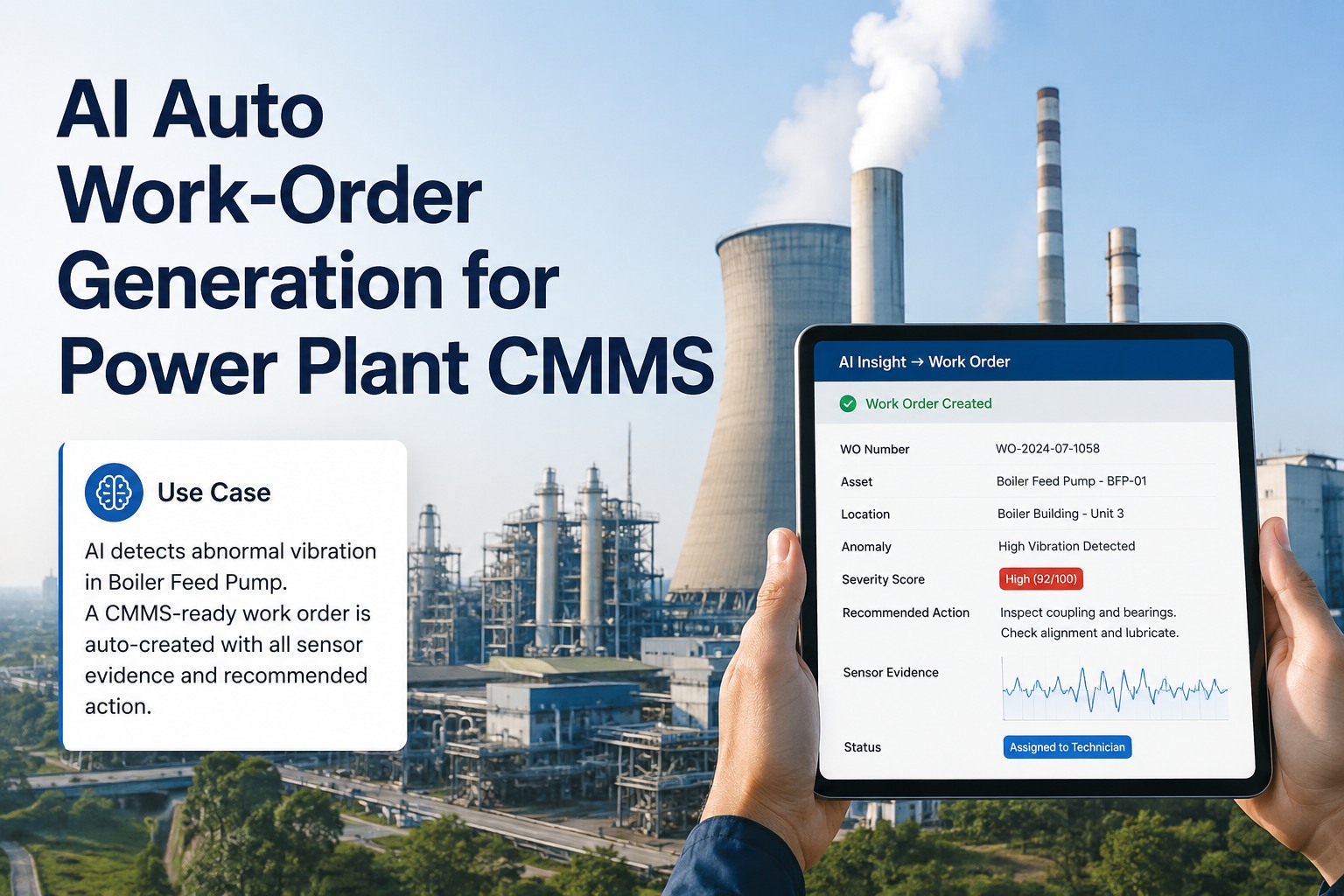
Connect existing vibration sensors, thermography, and oil analysis to CMMS via OPC-UA / Modbus / PI
Establish per-asset healthy baselines for turbines, generators, and boiler critical zones
Configure condition-triggered work orders to supplement (not replace) calendar PMs
Outcome: First condition-driven preventive interventions documented, MTBF baseline established
3
Days 61–90
AI-Driven Predictive on Top 3 Asset Classes
Activate AI anomaly models on turbines, generators, and boiler tube zones
Run first compliance and reliability dashboard — KPIs visible to plant director and board
Recurring fault detection auto-generates root-cause inspection work orders
Outcome: First prevented forced outage typically documented in this window — recovers full program cost
Run Your Plant on the Same Strategy as Top-Quartile Generators
Oxmaint's AI predictive maintenance and CMMS platform unifies boiler, turbine, and generator reliability under one workflow — with KPI dashboards, outage planning, and condition-based work order automation built for U.S. thermal and combined-cycle plants.
Which assets should a power plant prioritize for predictive maintenance investment?
Three asset categories deliver the fastest predictive maintenance ROI in U.S. thermal and combined-cycle plants: turbines (responsible for 43% of all power plant equipment failures), boiler tube systems (52% of forced outages at coal-fired plants), and generators (longest replacement lead times at 6–18 months). Together these three classes account for roughly 77% of all mechanical forced outages, and a single prevented failure on any one of them typically costs $200,000 to $2 million — enough to recover the entire predictive maintenance program investment in one event. Boilers, cooling systems, and main step-up transformers are strong second-tier priorities. Pumps and non-critical auxiliaries can remain on preventive schedules until the predictive program is established on the high-value rotating equipment.
Does a power plant need new IoT sensors to start an AI maintenance strategy?
No. Most U.S. thermal and combined-cycle plants already have 200 to 500 condition-monitoring data points feeding their DCS, SCADA, or PI Historian — vibration probes on turbines, bearing temperature RTDs, oil sample lab feeds, transformer dissolved-gas analyzers. The gap isn't sensor density; it's that this data sits in silos that don't talk to the work order system. A modern AI-driven CMMS like Oxmaint connects to existing instrumentation through standard OPC-UA, Modbus, and PI connectors with no DCS or SCADA changes required. The first 30 to 60 days of any reliability program focus on structured work order capture and PM scheduling — which alone typically cuts unplanned reactive work by 20–35% before any new sensor is installed. Sensor expansion comes in stage three, focused on filling specific blind spots identified by the failure-pattern data.
How does AI predictive maintenance handle planned outage scope and OEM warranty requirements?
AI predictive maintenance complements OEM outage scopes rather than replacing them. Major turbine OEMs — GE, Siemens, MHI — publish detailed inspection scopes that most plants follow verbatim because deviation risks both warranty and reliability. AI's role is to inform what gets added to the contingency scope (typically 15–20% of any outage) based on actual asset condition trends, and to confirm whether scheduled OEM scope items are still required at this cycle or can be deferred to the next outage. For example, a generator stator with a stable partial discharge trend may not require a planned rewind that would otherwise be calendar-triggered, while a turbine showing rising vibration anomalies may warrant additional NDE inspection beyond the OEM minimum. The CMMS becomes the documentation backbone proving compliance with OEM scope while integrating condition-based decisions into the planning record.
What KPIs should plant directors track first when launching a maintenance transformation?
Six KPIs cover the full picture from day one. Track PM compliance percentage (the single most predictive leading indicator of unplanned outage risk — target ≥95%), planned-to-unplanned work ratio (the clearest single measure of maintenance maturity — target ≥80% planned), MTBF on rotating equipment (reliability improvement quantified), MTTR (recovery speed quantified), heat rate deviation (efficiency degradation that connects directly to fuel cost), and equivalent availability factor (the headline number NERC uses). Top-quartile plants pull all six in under 10 minutes from a single dashboard. If your current CMMS can't do that, that's the first thing to fix — because maintenance transformation without measurement is change without accountability.
What's the realistic timeline and ROI for moving a plant from reactive to predictive maintenance?
A structured 90-day roadmap delivers measurable value in every 30-day window. The first 30 days focus on asset register cleanup and PM scheduling discipline — this alone typically cuts unplanned reactive work by 20–35% before any AI is deployed. Days 31–60 connect existing condition-monitoring data and establish per-asset baselines. Days 61–90 activate AI anomaly detection on the top three asset classes (turbines, generators, boilers), and most plants document their first prevented forced outage in this window — which alone recovers the entire program investment. Across the full 12-month deployment, plants typically achieve 12–22× ROI in the first year, with 95% of adopters reporting positive returns within 18 months and roughly 30% achieving full payback inside 12 months. The DOE estimates that properly implemented predictive maintenance eliminates 70–75% of equipment breakdowns entirely.