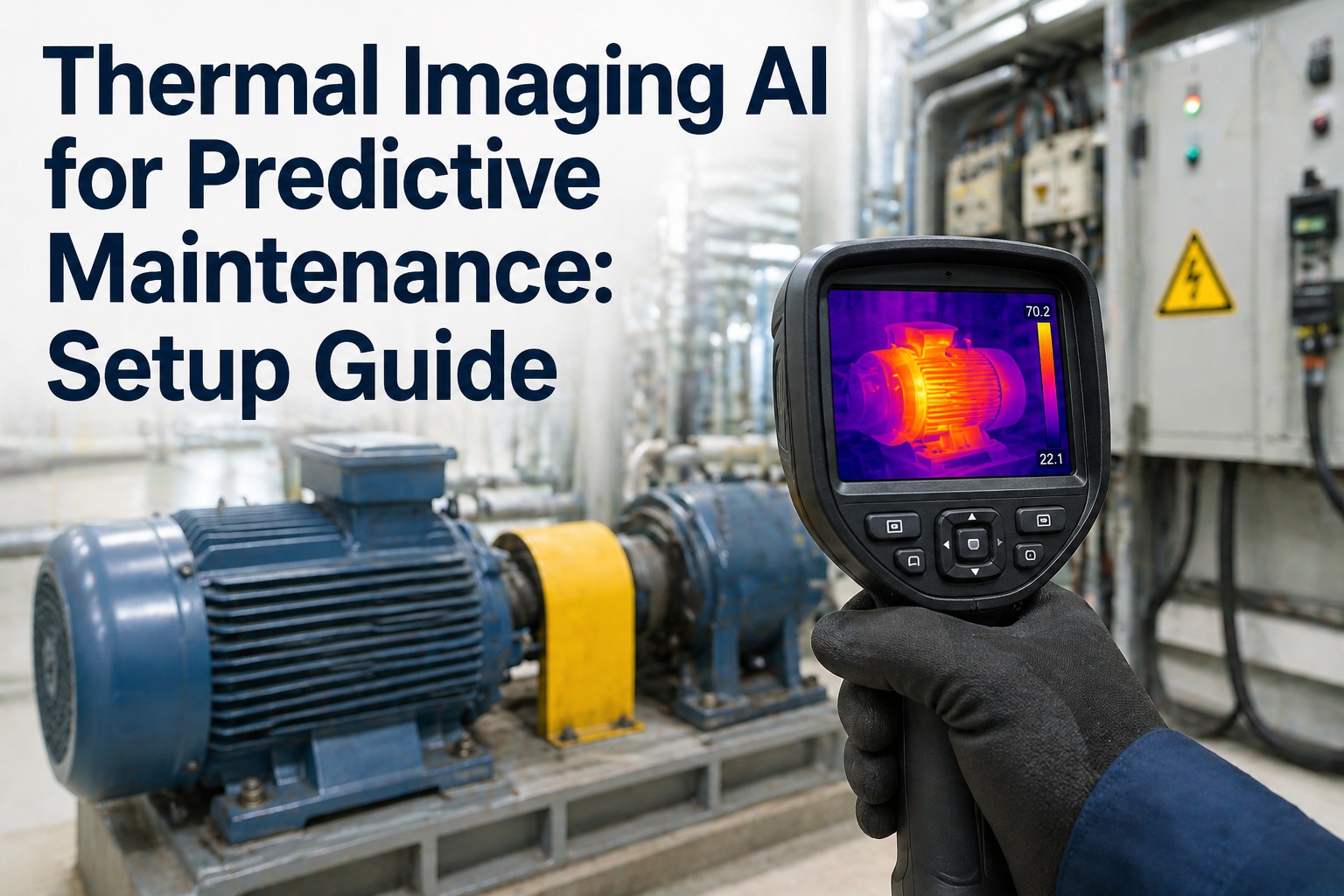
Predict Equipment Failure 72 Hours Ahead with On-Prem AI
By Riley Quinn on May 8, 2026
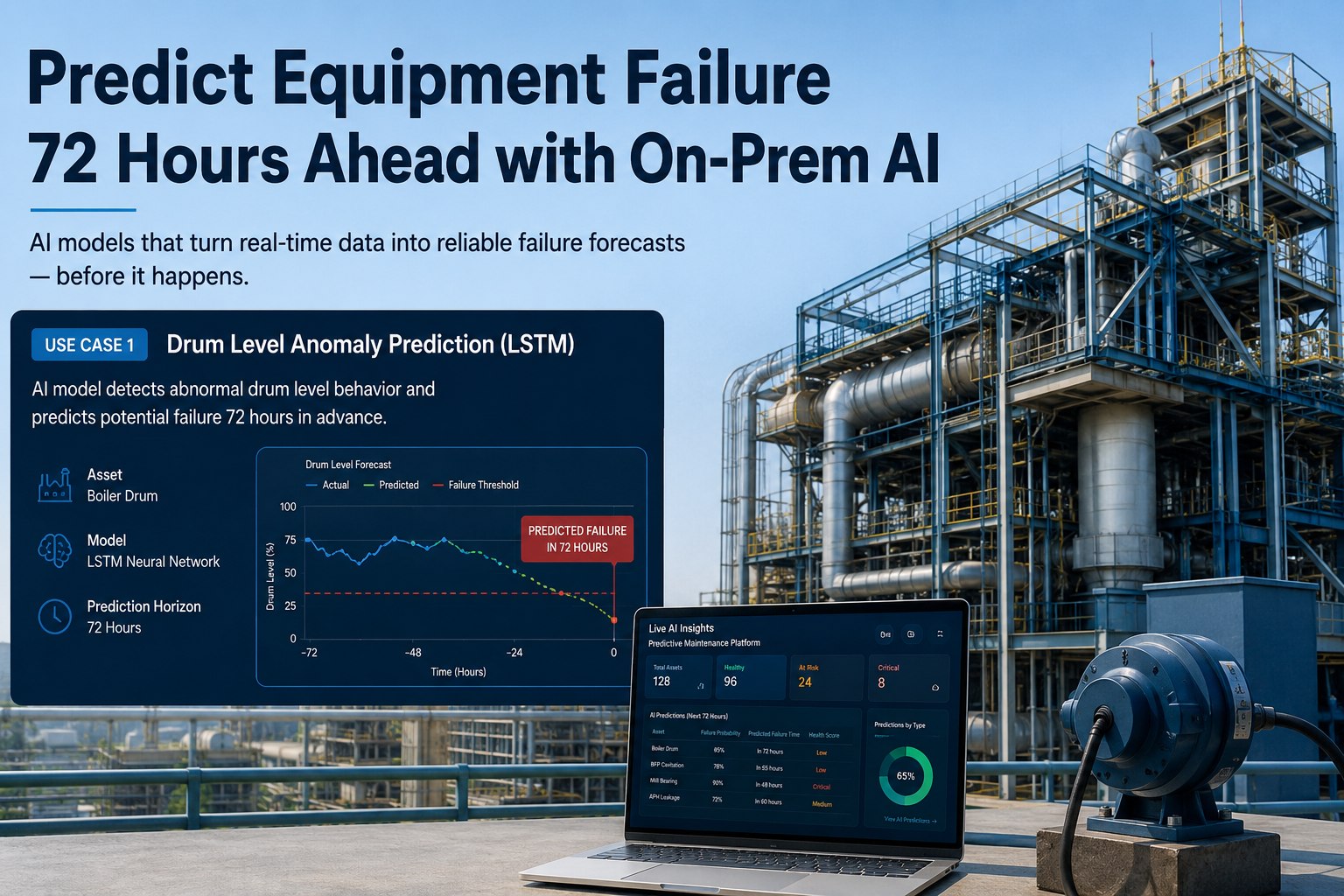
Three days before a bearing seizes. Sixty-eight hours before a coal mill stalls. Seventy-two hours before a boiler feed pump cavitates. The math has been peer-reviewed for years — LSTM autoencoders for drum drift, FFT plus a bearing classifier for mill vibration, physics-informed neural networks for economizer fouling. The hard part is running these four models on-prem against your live PI tags so the operator gets the alert before the alarm. All four go live at the OxMaint webinar on May 12. Register for the event to see the 72-hour forecast on real plant data.
MAY 12, 2026 5:30 PM EST , Orlando
Upcoming OxMaint AI Live Webinar — 72-Hour Failure Forecast Live Demo
Live session for reliability directors, maintenance heads, plant managers, and I&C engineers running coal-fired thermal plants and rotating-equipment-heavy operations. We'll have all four predictive models running live on the actual on-prem stack — RTX PRO 6000 Blackwell central server plus dual Jetson AGX edge boxes — streaming the Live AI Insights feed with hours-to-failure countdowns, sample alerts, and confidence scores updating in real time. Hands-on time at the screens, walkthrough of the 6–12 week pilot-to-full-deployment timeline, and on-the-spot quotes.
Why On-Prem 72-Hour Forecasting Matters More Than Cloud AI
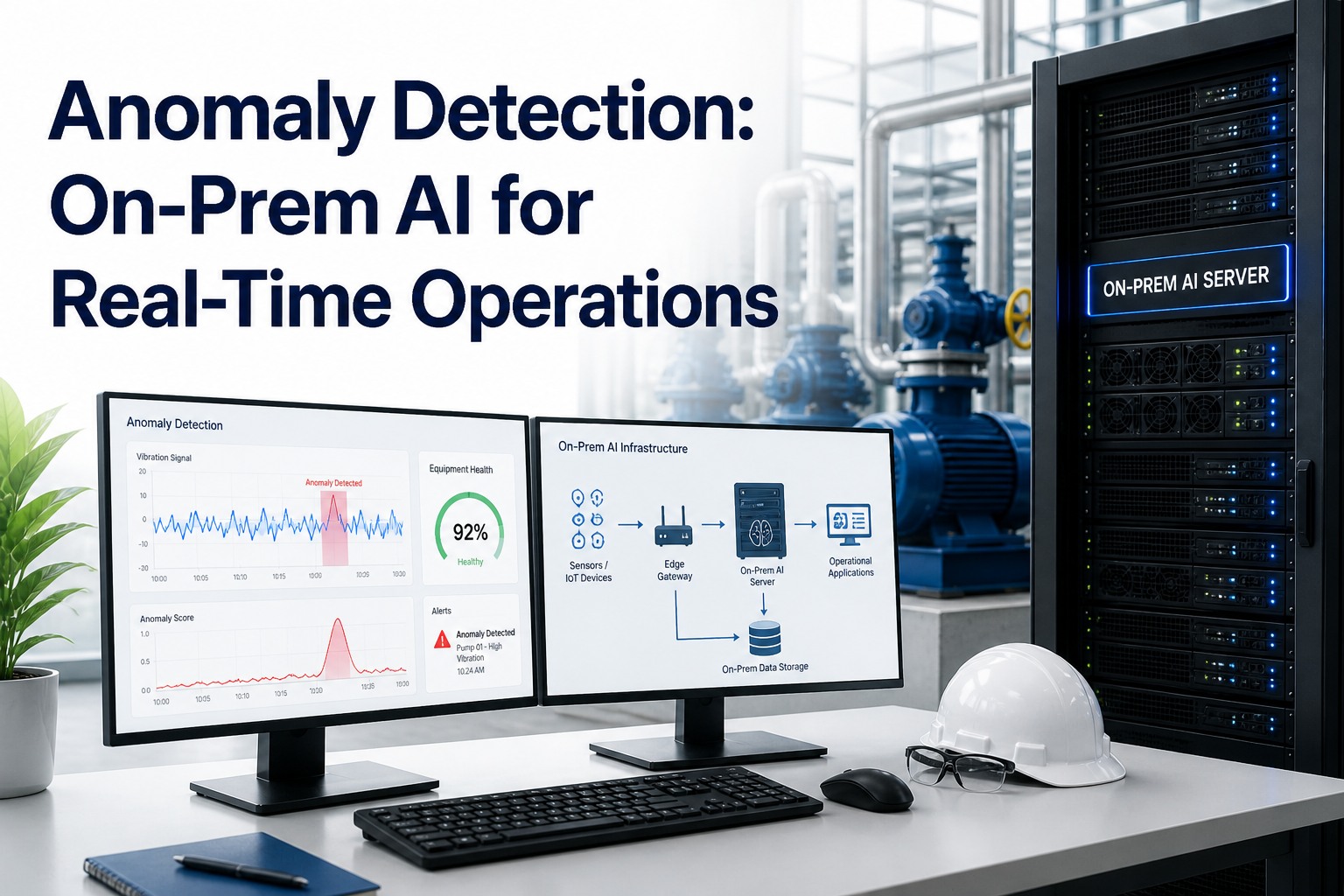
A bearing failure spectrum is roughly 4 KB. A coal mill vibration FFT is 2 KB per second. A drum-level time-series window is 12 KB. Cloud AI takes 200–400 ms to round-trip a single inference to a hyperscaler region — and your DCS produces tens of thousands of those windows per hour. Latency kills the early-warning signal long before the model's accuracy matters. The OxMaint forecast stack runs the LSTM autoencoder, the FFT bearing classifier, the DEM-signal cavitation detector, and the physics-informed neural network entirely on-prem on a single RTX PRO 6000 Blackwell server, with two Jetson AGX edge boxes pre-processing PI tags and vibration spectra in under 50 ms. Your DCS data never leaves the plant. Register for the event to see the on-prem stack streaming live alerts.
72h
average advance warning across the four model patterns deployed in coal-fired plants
<50ms
on-prem inference latency — fast enough to react inside a single FFT window
99%
confidence interval used by LSTM-AE residual scoring (KDE-based threshold)
0%
of your PI tags, vibration spectra, or operator decisions leave the plant
The Live AI Insights Feed — What the Operator Actually Sees
Below is exactly what streams onto the operator's screen the moment one of the four models flags a deviation. Each card shows the model used, the math behind it, the live PI tags it watches, the alert text that pops up, and the dollar save when the operator catches the failure 72 hours out instead of in the middle of a forced outage. Register for the event to see the feed streaming on the actual webinar screens.
LIVE AI INSIGHTS · STREAMING FROM RTX PRO 6000
T-72:00:00 → T-00:00:00
MODEL 01 · LSTM AUTOENCODER
Boiler Drum Level Drift
THE MATH
Lt = LSTM-AE(xt-n, ..., xt) · MD > KDE99%
Reconstruction residual via Mahalanobis distance against a 99% kernel-density confidence interval
"BFP-2A: NPSH margin collapsed 0.6 m below operating envelope while HF vibration energy doubled in the 8–14 kHz band. Cavitation onset predicted 68 hours out. Reduce flow demand 12% or switch to BFP-2B."
Confidence: 91%
~$280K
Saved per prevented impeller-erosion outage on a 660 MW supercritical unit.
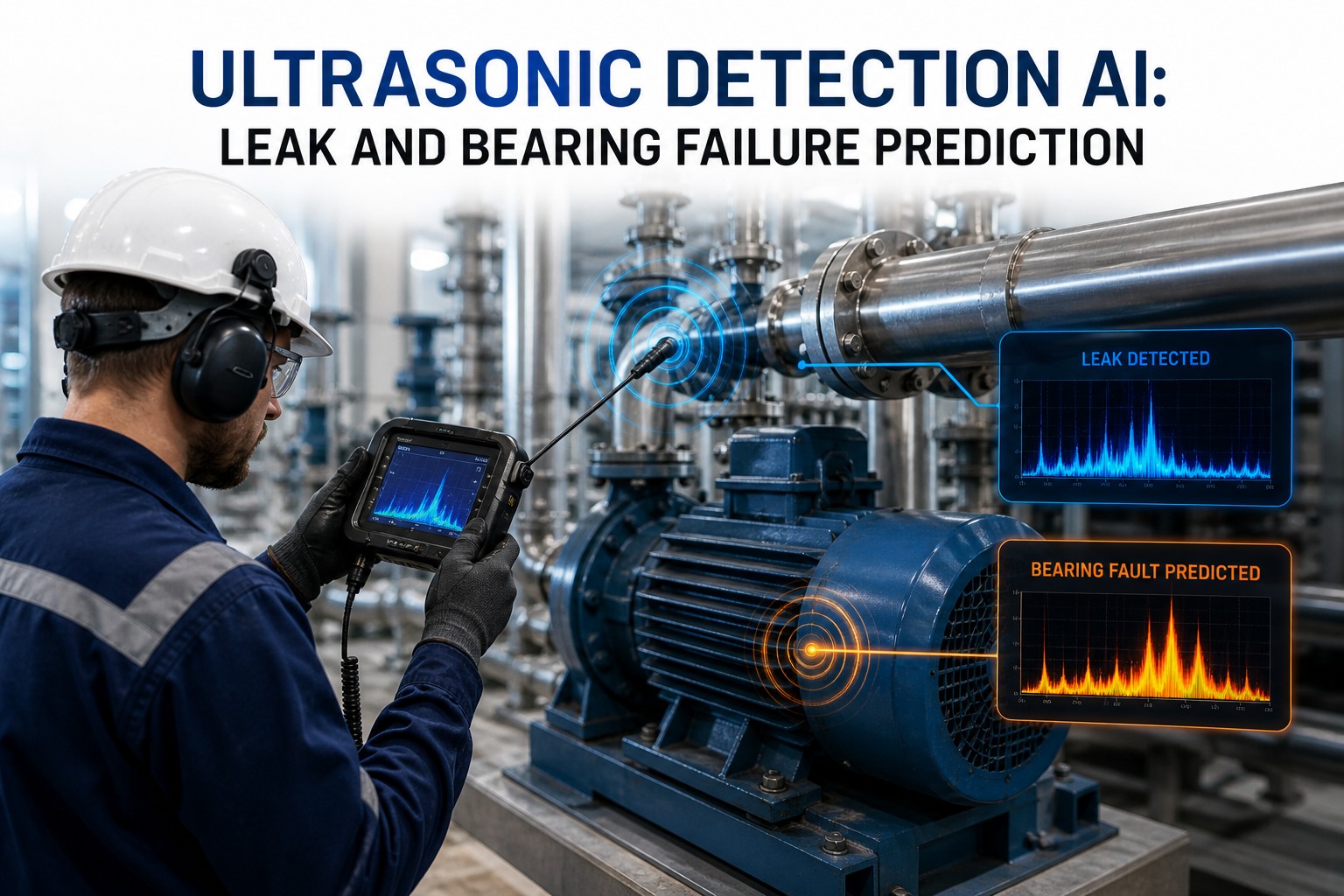
Spectrogram-image classifier matches outer race, inner race, ball, and cage frequency signatures against a labeled bearing-fault library
Bearing vibration1× / 2× RPMHigh-freq envelopeMill differential pressureMotor current
PRIORITY 2T-69:48
"Mill 4 outboard bearing: BPFO peak detected at 218 Hz with 2× harmonic. Outer race spalling consistent with Stage 2 wear. Failure window 65–80 hours. Schedule replacement during planned outage Friday morning."
Confidence: 96%
~$340K
Avoided emergency outage cost when bearing is replaced during scheduled window.
MODEL 04 · PHYSICS-INFORMED NN
Economizer / APH Leakage & Fouling
THE MATH
L = Ldata + λ · ‖∂T/∂t − α∇²T − S‖²
Loss function combines data fit with conservation-of-energy residual — the network can't violate the heat equation, so it generalizes from sparse plant data
Flue gas inlet/outlet tempAir pre-heater ΔPCleanliness factorFeedwater temp riseO₂ leakage
PRIORITY 3T-72:00
"APH cleanliness factor predicted to drop below 0.78 in 72 hours — heat-rate impact +0.21%. Air-side leakage trending up. Schedule sootblower cycle within 48 hours; flag APH for inspection at next outage."
Confidence: 93%
~$610K/yr
Recovered fuel cost on a 500 MW unit by holding APH cleanliness near design.
The 72-Hour Detection Window — When Each Model Fires
From the moment the first deviation is detectable to the moment the asset would have failed. Each model has a different lead time depending on the failure mode it tracks — but all four sit comfortably in the 65–72 hour window, well past the threshold a maintenance team needs to schedule the work without overtime, expedited freight, or production impact.
T-72hT-48hT-24hT-0 FAILURE
LSTM-AE · Drum
Detected at T-71h 34m
DEM+Signal · BFP
Detected at T-68h 12m
FFT+CNN · Mill
Detected at T-69h 48m
PINN · APH
Detected at T-72h 00m
The detection window is what separates a $400K planned repair from a $1.2M forced outage. Every hour past T-24h is overtime, expedited parts, and lost generation.
LIVE AT THE WEBINAR · MAY 12 ORLANDO
Watch the Feed Stream. See the 72-Hour Clock Tick Down.
No slides. No marketing pitch. Real PI tag streams flowing into the RTX PRO 6000 server, the four models firing alerts on the Live AI Insights feed, hours-to-failure clocks ticking in real time. Walk away with a quote you can take to your CFO and an order date you can put on the calendar. Pilot to fully running in 6–12 weeks.
A Coal Mill Stalls at 3 AM and Forces a 25 MW Load Cut
PROBLEM
Mill 4 outboard bearing seizes at 3:14 AM. The mill trips, the unit drops 25 MW of capacity, and dispatch demands to know how long. The bearing replacement takes 14 hours plus the cool-down window. Lost generation, weekend overtime, and emergency freight push the total impact past $340,000 before the unit is back at full load.
FORECAST SOLUTION
Model 03 · FFT + Bearing Classifier (96%) reads the mill vibration spectrum every second from the Jetson AGX edge box. The CNN classifier picks up the BPFO peak at 218 Hz with a 2× harmonic — outer race spalling — and flags it 69 hours 48 minutes before failure. The recommendation is plain: schedule the bearing replacement for Friday's planned outage.
RESULT
Bearing replacement done during the scheduled window, no overtime, parts on standard freight. Mill runs through the next operating cycle. The $340K emergency outage simply doesn't happen. Reliability KPI improves the following quarter.
~$340K saved per prevented mill bearing seizure
02
Boiler Feed Pump Cavitation Eats an Impeller in Three Months
PROBLEM
BFP-2A is running fine on every dashboard. Three months later the impeller is destroyed by cavitation erosion that nobody saw building up. Replacement cost: $180K for parts, $100K in lost generation, plus the unit running on the backup pump for two weeks while the spare is rebuilt. Total impact: north of $280,000.
FORECAST SOLUTION
Model 02 · DEM + Signal Analysis (91%) tracks the gap between available and required NPSH against the high-frequency vibration energy band. The day NPSH margin drops 0.6 m below the operating envelope and HF energy doubles in the 8–14 kHz band, the model fires: cavitation onset in 68 hours. Reduce flow 12% or switch to BFP-2B.
RESULT
Operator switches to the standby pump. Maintenance pulls BFP-2A during the next planned outage and replaces the worn wear rings before the impeller is gone. Same equipment, three more years of life. Pump rebuild cost stays under $40K instead of $180K.
~$280K saved per cavitation event caught early
03
Heat Rate Drifts +0.21% and Nobody Can Pin Down the Source
PROBLEM
The performance engineer sees heat rate creeping up by 0.21% over six weeks. Three teams suspect three different culprits. Meanwhile the unit is burning an extra $610,000 a year in fuel. Nobody has a model that can attribute heat-rate loss to a specific heat-transfer surface in real time.
FORECAST SOLUTION
Model 04 · Physics-Informed NN (93%) can't violate the heat equation by design — its loss function penalizes any prediction that breaks conservation of energy. So when APH cleanliness drifts below 0.78 and air-side leakage starts trending, the PINN attributes the heat-rate loss to the air pre-heater 72 hours before the next sootblowing cycle would have caught it.
RESULT
Sootblower cycle scheduled within 48 hours. APH flagged for full inspection at the next outage. Heat rate recovers within two shifts. The $610K/year fuel bleed stops. CFO has a defensible attribution number for the next budget cycle.
~$610K/yr recovered fuel cost on a 500 MW unit
~$1.2M+
Combined yearly savings on a typical 500 MW unit across the three use cases — against a one-time on-prem hardware capex of around $84,500 and zero monthly subscription fees. Pays for itself the first time the bearing classifier catches a mill failure 69 hours out.
Why Reliability Directors Buy This Stack Instead of Anything Else
Four reasons a reliability director picks the OxMaint forecast stack over cloud-only AI vendors, vibration-only specialty boxes, or DCS-vendor add-ons. Plain English. Real outcomes. Book a 1-on-1 demo if you can't make the event.
01
Four model patterns, one platform.
LSTM autoencoder for time-series drift, FFT + classifier for rotating-equipment faults, DEM + signal fusion for cavitation and similar fluid faults, physics-informed NN for heat-transfer surfaces. Most reliability programs need all four — running on one stack means one license, one integration, one team.
All four models · single on-prem stack
02
72-hour lead time, not 72-second alerts.
Conventional fixed-threshold alarms tell you about a failure roughly when it's happening. The four-model stack catches drift days before alarm thresholds are reached — turning emergency outages into Friday-morning planned work, every time.
~72 hours lead · vs ~72 seconds for fixed-threshold
03
Math you can defend in front of an audit.
Every alert ships with the model used, the residual or confidence score, the input window, and the recommended action. When the auditor asks why you replaced a bearing two days early, you have the spectrum image, the BPFO peak, and the classifier output on file.
Audit-ready · every alert traced to math
04
Your data never leaves the plant.
PI tags, FFT spectra, fuel data, operator decisions — all stay on your on-prem RTX PRO 6000 server, behind your firewall. No cloud egress. No hyperscaler. Compliance and security teams approve in days, not months.
100% on-prem · zero data egress
Expert Review — The Math Has Been Peer-Reviewed for Years
The four model patterns in the Live AI Insights feed aren't novel research. Each has been validated in published studies on coal-fired and supercritical thermal plants. The OxMaint stack is the engineering work of running them on-prem at production-grade reliability — not the model invention itself.
"LSTM-autoencoder networks established normal-behavior models on power-plant equipment with average root mean square errors of 0.026 on training data and 0.035 on test data — accurate enough to flag induced-draft fan and coal-pulverizer abnormalities well before fixed-threshold alarms. Adaptive-threshold variants on coal mill blockage achieved early warnings of 18.3 minutes and 6.6 minutes ahead of conventional alarms, with up to 108-second lead even against tuned thresholds. Physics-informed LSTM networks for heat-exchanger fouling held RMSE under 0.267 and MAE under 0.221 even on sparse plant data."
— Peer-reviewed results from MDPI Sensors (2020), Frontiers in Energy Research (2022), and ScienceDirect heat-transfer studies (2024)
Boiler tube leaks = 60%+ of boiler outages
Bidirectional LSTM on acoustic emission signals catches tube-wall thinning weeks before the leak — directly addresses the single largest cause of unplanned coal-plant downtime.
FFT + cosine similarity outperforms generic ML for bearings
Spectrum-image classifiers with similarity scoring hit very high accuracy at moderate compute — exactly what fits a Jetson AGX edge box without a hyperscaler in the loop.
PINN beats data-only models on sparse plant data
By baking the heat equation into the loss function, the network can't make physically impossible predictions. Generalizes from far less labeled data than a vanilla neural net.
Implementation — Pilot to Full Deployment in 6–12 Weeks
RTX PRO 6000 Blackwell server racks in your IT room. Two Jetson AGX edge boxes mount near the rotating equipment cabinet. PI Historian / OPC-UA connection live. Vibration spectra and tags flowing in.
WEEKS 3–5
Baseline Capture · NBM Training
LSTM autoencoder learns the normal-behavior model for drum, fans, mills. PINN initializes against your specific economizer and APH geometry. FFT classifier loads pre-trained bearing library and tunes to your asset speeds.
WEEKS 6–9
Shadow Mode + Operator Validation
All four models run silently against live PI tags. Operators see alerts on a parallel screen. Your reliability team validates each prediction against ground truth. Confidence scores stabilize as KDE thresholds tune to your plant.
WEEKS 10–12
Live Insights Feed Goes Operational
Feed publishes to operator screens, mobile, and CMMS work-order automation. Selected actions auto-generate work orders with attached spectrum images, residual scores, and recommended fixes. ROI starts compounding.
About the Stack — Built for Plants That Can't Tolerate Cloud
The OxMaint forecast stack runs on the same on-prem hardware the rest of the OxMaint platform uses — RTX PRO 6000 Blackwell central server plus dual Jetson AGX edge boxes, around $84,500 per plant including hardware, software, and integration. For multi-plant reliability fleets, an optional NVIDIA DGX Station GB300 Ultra sits at the corporate level for fleet-wide model training and benchmarking. Source code, perpetual license, and modification rights included. Sign up free to spec the right deployment for your reliability program.
Perpetual License
Pay once, owned outright forever. No per-tag billing, no annual renewals.
Data Sovereignty
PI tags, vibration spectra, model outputs — all stay inside your plant boundary.
Source Access
Model code and modification rights included. Tune the residual thresholds to your unit.
AI-Native Core
Four model patterns purpose-built for thermal plant reliability — not bolted onto a generic CMMS.
What You Get When You Walk Into the Webinar
Hands-on time at every screen. Real plant data flowing. The engineers who built the models, ready to answer anything you can throw at them. Walk in curious, walk out with a quote and an order date. Register for the event to lock your seat.
Live walkthrough of all four model patterns on the actual on-prem hardware — LSTM-AE, DEM+signal, FFT+classifier, PINN — with the math, the math residuals, and the alerts streaming in real time.
Hands-on at the RTX PRO 6000 server with both Jetson AGX edge boxes connected — touch the hardware, ask anything.
1:1 architect time for your specific plant — supercritical, subcritical, single-unit, fleet-wide rollout.
On-the-spot price quote tailored to your plant size, with deployment timeline (6–12 weeks pilot to full).
DCS & PI integration walkthrough for ABB, Emerson, Siemens, Yokogawa via PI Historian, OPC-UA, or direct API.
Why This Matters Right Now
The reliability programs pulling ahead in 2026 aren't running newer alarm systems. They're running production-grade AI forecasting on every layer of rotating and heat-transfer equipment. The plants that delay are paying for forced outages they could have caught 72 hours out — and burning fuel they could have saved with a sootblower run scheduled three days early. Sign up free to start a 72-hour-forecast pilot trial.
Fixed-Threshold Alarms Aren't Enough
Threshold alarms tell you a failure is happening. Residual-based AI tells you a failure will happen 72 hours from now — the only way to convert emergency outages into scheduled work.
Spectra Are Too Big to Send to Cloud
A coal mill produces FFT data faster than most plants can upload to a hyperscaler. On-prem inference at sub-50 ms is the only way to keep up with rotating-equipment data rates.
Audit Trails Are Now a Buy-Side Demand
Insurers, regulators, and offtakers ask reliability teams to defend every early replacement. The four-model feed records the math, the residual, and the input window for every alert.
The Senior Reliability Engineers Are Retiring
The engineers who could spot a BPFO peak by ear are leaving. AI captures their decision patterns and runs them at 3 AM on every mill bearing in the plant.
SEATS LIMITED · MAY 12 ORLANDO
See the 72-Hour Clock Tick Down on Real Plant Data
Walk into the webinar. See the LSTM autoencoder, FFT bearing classifier, DEM-signal cavitation detector, and physics-informed NN running live. Touch the RTX PRO 6000 server. Ask the engineers who built the models anything you want. Leave with a quote and an order date. Pilot to fully running in 6–12 weeks. You buy it once, you own it forever.
How does an LSTM autoencoder actually predict 72 hours ahead?
The LSTM-AE learns a normal-behavior model from your healthy plant operating windows. At inference, it tries to reconstruct the current PI tag window — drum level, feedwater flow, steam flow, pressure, temperature — from its compressed encoding. When the reconstruction residual (measured by Mahalanobis distance against a 99% kernel-density confidence interval) crosses threshold for several consecutive minutes, that's the early warning. The drift accumulates slowly enough that you typically see the residual cross threshold 60–72 hours before the operator alarm fires.
Is the FFT bearing classifier reliable enough to schedule replacements on?
Yes — and the math has been peer-reviewed for years. Spectrum-image classifiers using FFT plus a CNN match outer race (BPFO), inner race (BPFI), ball (BSF), and cage (FTF) frequency signatures against labeled bearing-fault libraries with very high accuracy. The classifier output ships with the spectrum image and the matched fault frequency, so your reliability team can verify the call before scheduling the work. Most plants see Stage 2 wear flagged 65–80 hours before progression to Stage 3.
What does "physics-informed neural network" actually mean for the operator?
It means the network can't make physically impossible predictions. The loss function combines a normal data-fit term with a physics-residual term that penalizes any output violating the underlying conservation laws — for the economizer and air pre-heater, that's the heat equation. The practical benefit: the PINN generalizes from far less labeled plant data than a vanilla neural net, which matters because nobody has years of clean failure-state data on every heat-transfer surface.
Does any of our plant data leave the perimeter?
No. The reference deployment runs entirely on-prem on the RTX PRO 6000 Blackwell server inside your plant network. PI tags, vibration spectra, FFT data, model outputs, and operator decisions never leave your firewall. There is no hyperscaler involvement. There is no cloud dependency. The system can run completely cut off from the internet if your security team requires it. This is the architectural pattern thermal plants under regulatory scrutiny default to in 2026.
What's the total cost and what's actually included?
A typical per-plant deployment is around $84,500 — including the RTX PRO 6000 Blackwell server (~$19K), two Jetson AGX edge boxes (~$8K), industrial Ethernet switch and cabling (~$2.5K), local electrical work (~$10K), and the OxMaint AI software stack with all four model patterns, integration, and 6–12 week pilot-to-production deployment (~$45K). For multi-plant reliability programs, an optional NVIDIA DGX Station GB300 Ultra at the corporate level adds $85K–$100K shared across plants for fleet-wide model training. No monthly subscriptions. No per-tag billing. Source code and modification rights included. You buy once, you own forever.