A Joint Commission surveyor walks into your hospital on a Tuesday morning. They are not interested in your clinical outcomes today. They want to see the maintenance record for the medical gas zone valve in OR-3, the last load test on the ICU's emergency generator, the PM history on every ventilator on the third floor, and the HVAC differential pressure log for the compounding pharmacy — and they want it in 60 seconds, not 60 minutes. Effective January 1, 2026, the Joint Commission consolidated the Environment of Care and Life Safety chapters into a single Physical Environment chapter under the Accreditation 360 initiative, and the underlying compliance work did not get easier. This guide is for Facilities Directors and Biomedical Engineering Heads running both clinical and building infrastructure under SAP IS-H — and looking at a CMMS that handles biomed devices, HVAC, life safety, and medical gas in one platform, deployable on-premise behind your HIPAA firewall or in the cloud with a signed BAA.
Healthcare · SAP IS-H Integration · Joint Commission & NFPA 99
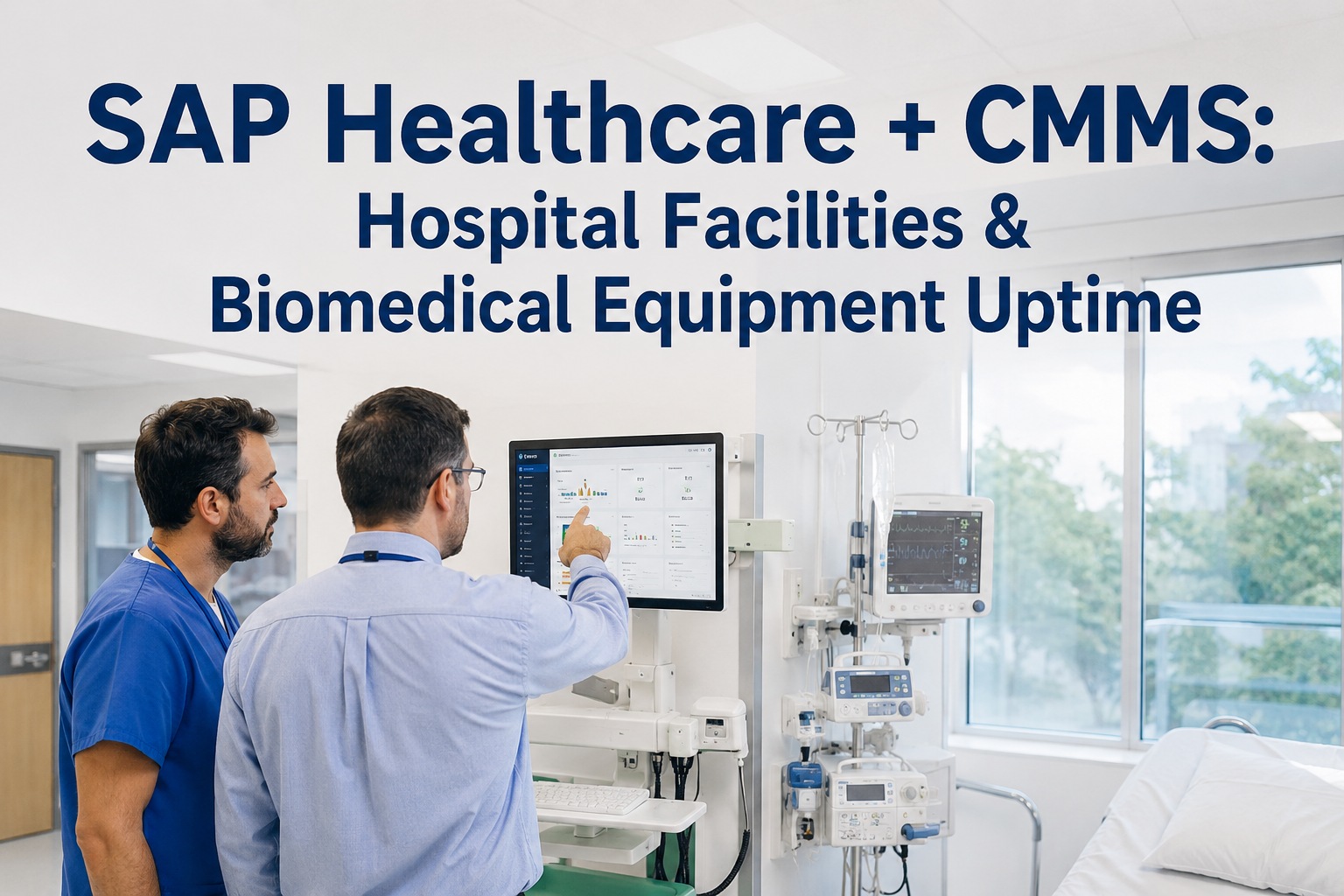
SAP Healthcare + CMMS: Hospital Facilities and Biomedical Equipment Uptime
SAP IS-H runs your clinical and billing systems. Your CMMS has to run everything keeping the building open — HVAC, biomed devices, life safety, medical gas, emergency power — with the documentation a Joint Commission, CMS, and NFPA inspector will demand on arrival. Available on-premise or cloud.
Where SAP IS-H ends and the CMMS begins
SAP IS-H is the system of record for your clinical operations — patient admissions, encounters, orders, billing, and the clinical workflow tied to revenue cycle. It is not a maintenance system, and it was never meant to be one. The facility infrastructure that keeps IS-H usable — power, HVAC, sterilizers, imaging systems, medical gas, fire suppression, the network closet's UPS — sits outside the clinical record entirely. So does every biomedical device that arrives on a loading dock and gets put into service. The CMMS is the system of record for everything from that loading dock onward: the asset registry, the PM schedule, the technician signature, the calibration certificate, the work order audit trail that a surveyor will ask to see.
SAP IS-H
Clinical, financial, administrative
- Patient admissions & encounters
- Clinical orders & documentation
- Billing & revenue cycle
- Insurance & payer integration
- Departmental cost centres
- HR & staff scheduling
Connected via OData V4 / RFC
OxMaint CMMS
Biomedical, facility, life safety
- Biomedical device registry & PM
- HVAC, BMS, building infrastructure
- Medical gas & vacuum systems
- Emergency power & fire protection
- Joint Commission PE documentation
- NFPA 99 / 70 / 101 audit trails
The integration runs on standard SAP S/4HANA OData V4 APIs and RFC function modules — no custom ABAP development. Asset cost centres, capital depreciation tags, and parts financials flow into SAP for accounting close. Work order completion data and biomed device service histories stay in the CMMS where the technician signature, photo evidence, and Part 11-grade audit trail belong. Two systems, two roles, one connected operational picture.
The 2026 Joint Commission shift you have to account for
The Accreditation 360 initiative effective January 1, 2026 consolidated the Environment of Care and Life Safety chapters into a single Physical Environment chapter. The Joint Commission reduced the total Elements of Performance by 48 percent for hospitals — but the underlying work did not change, only the way you are expected to demonstrate it during survey. Facilities running paper logs or spreadsheets now have to remap their entire documentation structure to the new PE code framework. Facilities running a CMMS with PE code mapping in the asset registry produce the same evidence in seconds.
Compliance code library, mapped to assets at the work-order level
TJC PE
Joint Commission Physical Environment
2026 consolidated PE chapter replacing EC and LS. Every work order tagged with PE code references for instant survey traceability.
CMS CoP
42 CFR §482.41
Physical Environment Condition of Participation. The single most-cited deficiency area in CMS hospital surveys. K-Tag references attached to every life-safety inspection.
NFPA 99
Health Care Facilities Code
Risk category mapping (1 to 4) for every space and system. Medical gas, isolated power, emergency power scheduled per the 2026 edition's tighter Category 1 verification intervals.
NFPA 70
National Electrical Code
Article 517 for healthcare facilities. Isolated power panel inspections in wet procedure locations, line isolation monitor testing.
NFPA 101
Life Safety Code
Fire-rated barrier inspection, smoke damper testing, egress path verification. Each test linked to the asset, technician, and timestamp.
OSHA
Workplace safety
Lockout/tagout, bloodborne pathogens, hazard communication for biomed and facilities staff. Willful violations reach $161,323 per incident.
FDA
Device IFU compliance
Manufacturer Instructions For Use bound to the device record. PM intervals derived from IFU, not arbitrary calendar dates. Recall tracking included.
HIPAA
Privacy & Security Rules
Technical safeguards on every record where ePHI may be referenced. BAA signed for cloud deployment; vendor data access eliminated on-premise.
On-premise or cloud — your security perimeter, your call
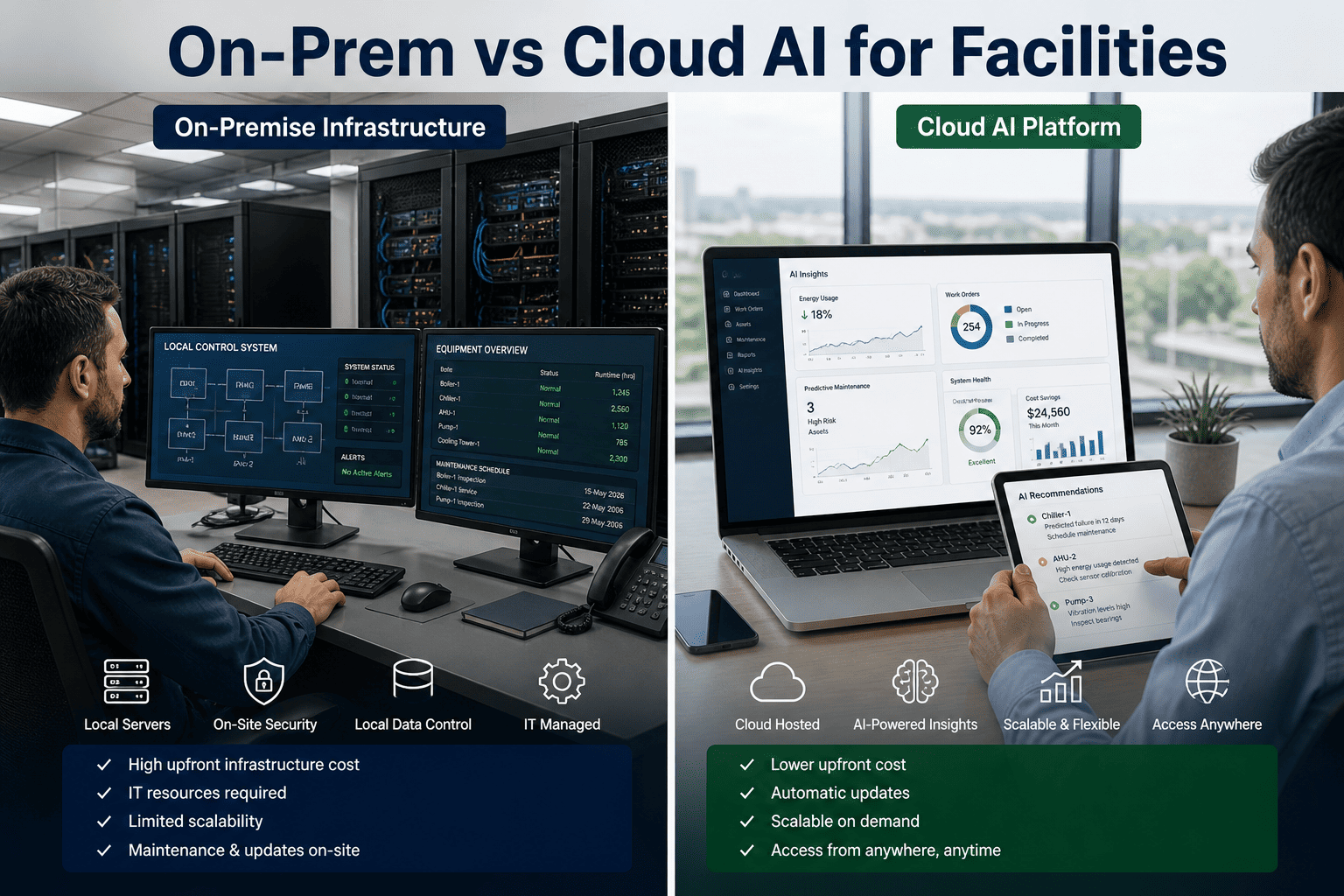
Healthcare IT teams ask one question before anything else: where does the data live, and who can touch it. OxMaint deploys both ways, with the same product surface, the same compliance feature set, and the same SAP integration patterns. The choice is a security and IT operations decision, not a feature trade-off.
Hosted byYour data centre or private cloud
Data locationInside your security perimeter
HIPAABAA covers absence of vendor data access
AuthYour Active Directory / SSO / SAML
SAP linkInternal network, no public traversal
PatchingScheduled by your IT change control
Best forMulti-campus systems, strict data-sovereignty environments, deep SAP ECC integration
Hosted byOxMaint SOC 2 / HITRUST environment
Data locationRegional, with data residency controls
HIPAASigned BAA, encrypted in transit and at rest
AuthSSO / SAML / OIDC against your IdP
SAP linkOData V4 over TLS, IP-allowlisted
PatchingManaged releases, change notifications
Best forSingle-campus to mid-size systems, ambulatory networks, faster time-to-value
The deployment choice does not change what the platform does. PM scheduling, mobile work orders, biomed device taxonomy, NFPA 99 risk categorisation, Joint Commission PE code mapping, and SAP integration are identical on both. What changes is where the data sits and how your security team manages it. HIPAA Tier 3 to 4 penalties reach $1.9 million per violation category, so this decision matters — and it is yours to make, not the vendor's.
Two asset hierarchies, one platform
A 300-bed hospital manages somewhere between 5,000 and 15,000 individual medical devices alongside HVAC, sterilizers, generators, fire suppression, elevators, and medical gas systems. Generic CMMS platforms treat a ventilator the same as a chiller. Hospital-grade systems separate the two asset hierarchies — clinical devices with FDA IFU-driven PM intervals and recall tracking; facility infrastructure with NFPA-driven inspection intervals and life-safety documentation — while keeping them in a single registry with shared spare parts, technician pools, and compliance reporting.
Biomedical device hierarchy
Owned by Biomed / HTM
ImagingMRI, CT, X-ray, ultrasound, fluoroscopy
Life supportVentilators, anaesthesia machines, defibrillators
MonitoringPatient monitors, telemetry, infusion pumps
SterilizationAutoclaves, washer-disinfectors, sterile processing
SurgicalElectrosurgical, OR tables, surgical lights, lasers
DiagnosticECG, EEG, point-of-care analysers, lab instruments
Facility infrastructure hierarchy
Owned by Facilities / Plant Ops
HVACAHUs, chillers, cooling towers, OR pressure cascades
Medical gasOxygen, medical air, vacuum, nitrous, zone valves
Emergency powerGenerators, ATS, isolated power panels, UPS
Fire protectionSprinklers, suppression, alarms, smoke dampers
Vertical transportElevators, dumbwaiters, pneumatic tube systems
UtilitiesBoilers, water systems, plumbing, electrical distribution
Critical care areas, ranked by maintenance risk
Not every space in a hospital carries equal compliance weight. NFPA 99 classifies care areas from Category 1 (life-critical, like operating rooms and ICUs) through Category 4 (no patient impact). The CMMS asset registry should mirror that classification — and the PM schedule, escalation cascade, and audit retention should all flow from it.
Category 1
OR, ICU, ED, Cath Lab, NICU, L&D
Isolated power, redundant medical gas, emergency power within 10 seconds, redundant HVAC, line isolation monitoring
Tightest inspection intervals, monthly to quarterly on Cat 1 systems
Category 2
Med-surg, step-down, procedure rooms, dialysis
Standard medical gas, normal HVAC with controlled pressure, emergency power within 10 seconds
Quarterly to semi-annual inspections, full documentation retention
Category 3
Outpatient, ambulatory, exam rooms, imaging
Basic medical gas where used, standard HVAC, normal power with backup lighting
Annual inspections sufficient on most systems
Category 4
Admin offices, conference rooms, non-clinical
Standard building systems, no special medical infrastructure
Building code intervals, no clinical override
Workflows the CMMS has to run, end to end
A working hospital CMMS does not just hold records. It runs the daily work of biomed and facilities — every PM dispatched, every breakdown logged, every compliance task signed off, every spare part consumed, every alarm from the BMS converted into a work order on the right technician's mobile device. The workflows below are the operational backbone.
1
Risk-classified PM scheduling
Every asset inherits its PM interval from its risk category, manufacturer IFU, and condition data. Cat 1 medical gas zone valves, isolated power panels, and generator load tests fall on a non-negotiable schedule with automatic escalation if overdue.
2
BMS alarm to work order
BACnet, Modbus, and API connections to the Building Management System turn HVAC and infrastructure alarms into work orders automatically — pressure deviations in compounding rooms, ATS failures during a generator test, chiller faults during a heat wave.
3
Mobile execution at the asset
Technician scans the asset tag, sees the SOP, captures readings and photos, signs electronically. ALCOA+ contemporaneous data capture, no paper transcription, qualification gating against the asset class.
4
Parts reservation and SAP write-back
Parts reserved against the work order at the point of planning. Consumption posts back to SAP with the technician signature attached. Spare parts ledger reflects actual floor consumption, not estimated.
5
Compliance documentation generation
Every signed work order populates the Joint Commission PE evidence package, the NFPA 99 12-month audit trail, the CMS K-Tag record, the FDA device service history. Survey-ready in under 90 minutes, not three weeks.
6
Recall and IFU monitoring
ECRI and FDA recall feeds matched against the device registry. Any biomed device affected by an active recall surfaces immediately with a hold flag and a corrective action work order.
The KPI shift after a connected CMMS rollout
The same platform that produces the compliance evidence also produces the operational outcomes the Facilities Director and Biomed Head defend at the next budget review. The numbers below are what hospitals typically see in the first 6 to 12 months after replacing paper, spreadsheets, or a legacy CMMS with a connected platform.
| Operational metric |
Before |
After |
| PM completion rate, Cat 1 biomed | 61 to 70 percent | 96 to 100 percent |
| NFPA 99 inspection compliance | 58 to 75 percent | 95 to 99 percent |
| Critical medical equipment uptime | 96 to 98 percent | 99.8 to 99.9 percent |
| Device-related patient incidents | Baseline | 50 to 70 percent reduction |
| Maintenance cost as percent of budget | Baseline | 25 to 40 percent reduction |
| Joint Commission survey preparation | 3 to 6 weeks per cycle | Same-day evidence retrieval |
| Biomed manager admin hours / week | 15 to 20 hours | 3 to 5 hours |
| EC.02.04 series citations | Recurring findings | Zero documented in field deployments |
A 90-day rollout that does not interrupt clinical care
No hospital takes SAP IS-H offline to roll in a CMMS, and no Facilities Director can interrupt the OR schedule for a software deployment. The rollout is parallel, additive, and clinically transparent.
Phase 1 · Weeks 1-3
Discovery, deployment decision, baseline KPIs
Choose on-premise or cloud. Sign BAA. Baseline PM compliance, NFPA 99 inspection rate, and critical equipment uptime. Map existing assets to PE codes and NFPA risk categories.
Phase 2 · Weeks 4-6
Asset import & SAP integration
Biomed device inventory and facility infrastructure imported. SAP IS-H connection configured via OData V4. BMS link to BACnet / Modbus established. Active Directory / SSO integration completed.
Phase 3 · Weeks 7-9
Pilot rollout, one department + one infrastructure system
Biomed: full PM migration on one floor's life-support devices. Facilities: medical gas system end-to-end on mobile. Technician training, qualification matrix loaded.
Phase 4 · Weeks 10-12
Hospital-wide go-live & survey preparation
Full cutover across biomed and facilities. PE evidence package configured. NFPA 99 12-month audit trail begins capture. First compliance reports generated for internal review.
Frequently asked questions
Does OxMaint replace SAP IS-H?
No. SAP IS-H stays the system of record for clinical, billing, and patient-facing operations. OxMaint owns biomedical device, facility infrastructure, and compliance documentation. The two integrate via standard OData V4 and RFC.
On-premise or cloud — which do most hospitals choose?
Roughly split. Large multi-campus systems with strict data-sovereignty mandates pick on-premise. Single-campus hospitals, ambulatory networks, and faster rollouts pick cloud. Both deployments carry the same feature set and the same BAA.
How does OxMaint handle the 2026 Joint Commission PE chapter changes?
Pre-loaded PE codes are mapped against assets and inspection tasks. Existing EC and LS records remap automatically. Survey evidence packages generate against the new PE structure without re-doing the documentation work.
Can OxMaint manage both biomedical devices and HVAC in one system?
Yes — that is a core requirement of the platform. A 5-level asset hierarchy (Portfolio, Property, System, Asset, Component) accommodates both clinical device inventories and building infrastructure with distinct PM logic and compliance mapping for each.
Does OxMaint integrate with our Building Management System?
Yes. Standard protocols include BACnet, Modbus, and API connections with leading BMS platforms. Alarms generate work orders automatically with full asset context and historical sensor trends.
What about HIPAA compliance for on-premise deployment?
The on-premise BAA documents the absence of vendor data access, providing the compliance team with the documentation required for HIPAA risk assessment. All access controls, audit logs, and encryption stay inside your security perimeter.
How quickly can we be inspection-ready?
Most hospitals capture compliant NFPA 99 documentation within 5 to 10 business days of onboarding. Full SAP integration and hospital-wide cutover typically completes inside 90 days.
Does OxMaint track FDA recalls on biomedical devices?
Yes. ECRI and FDA recall feeds match against the device registry. Affected devices surface immediately with hold flags and corrective action work orders generated automatically.
See the hospital workflow for your facility
Walk through biomed device PM, NFPA 99 medical gas inspections, BMS alarm-to-work-order, and the SAP IS-H integration on a 30-minute call. Choose on-premise or cloud — same product, your security perimeter, your decision.