Thermal Power Plant AI Copilot Modules: Complete Guide
By Riley Quinn on May 8, 2026
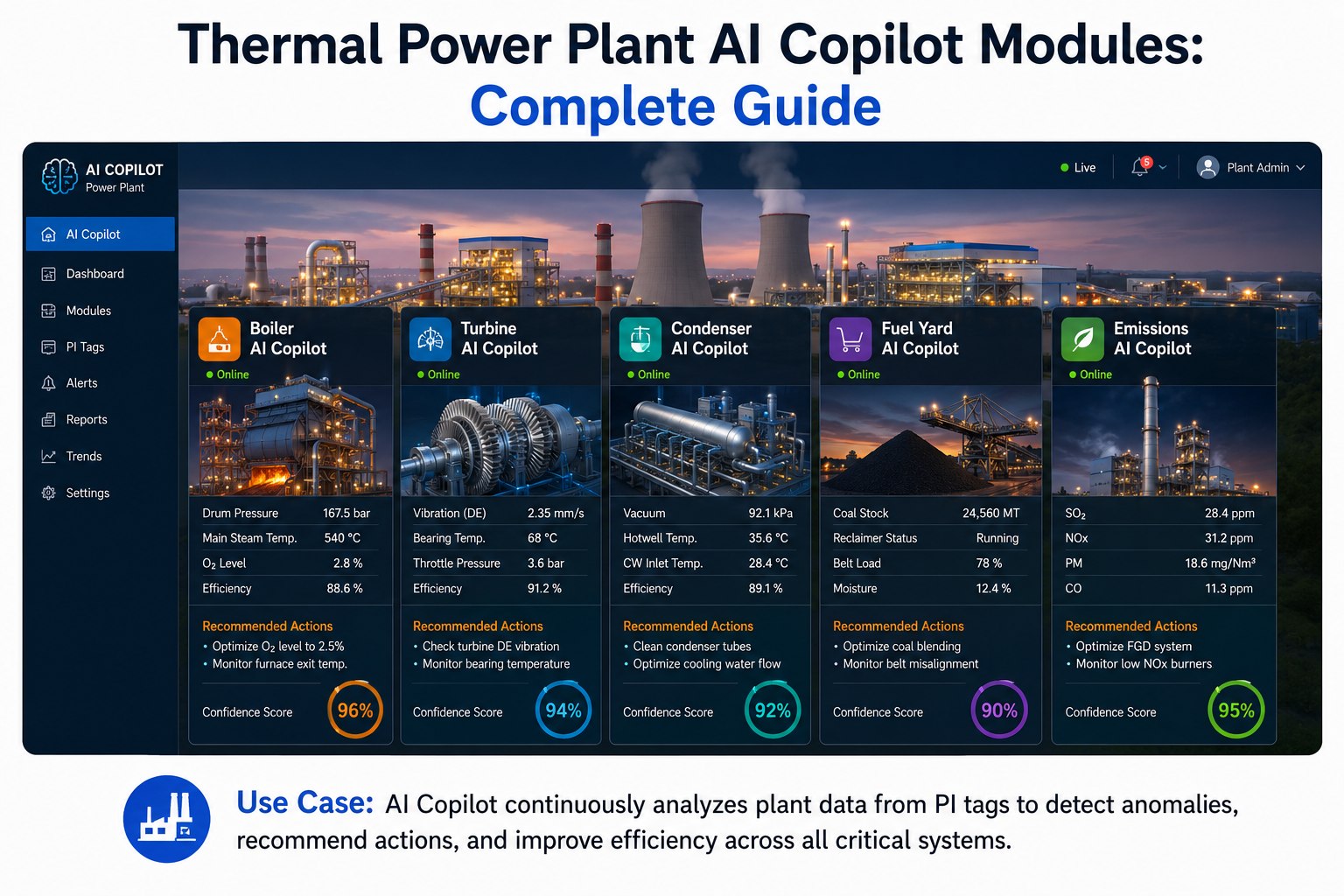
Five AI agents quietly running inside your thermal power plant, each one watching a different part of the cycle — Boiler, Turbine, Condenser, Fuel Yard, Emissions. Each agent reads live PI tags, spots trouble before alarms go off, and tells your operator exactly what to do — with a confidence score attached. We'll have all five running on real plant data at the OxMaint webinar on May 12. Walk up, see the live screens, ask any question. Pilot to fully running in 6–12 weeks. Register for the event to see all five copilot modules running live.
MAY 12, 2026 5:30 PM EST , Orlando
Upcoming OxMaint AI Live Webinar — Thermal Power Plant Copilot Live Demo
Live session for plant managers, operations VPs, maintenance directors, and reliability engineers running coal-fired and combined-cycle thermal plants. We'll have all five copilot modules running live on the actual on-prem stack — RTX PRO 6000 Blackwell central server plus dual Jetson AGX edge boxes — showing real PI tag inputs, recommended operator actions, and confidence scores in real time. Hands-on time at the screens, walkthrough of the 6–12 week pilot-to-full-deployment timeline, and on-the-spot quotes.
Why On-Prem AI for a Thermal Power Plant Is Non-Negotiable
Thermal plants generate roughly 60% of the world's electricity, run on supercritical pressures, push 1,300°C inside the boiler furnace, and operate under tighter emission caps every year. The data your control room produces — DCS tags, fuel contracts, emission readings, vibration spectra — is the most sensitive operational data your company owns. Sending it to a hyperscaler cloud is not just a latency problem. It's a sovereignty problem, a compliance problem, and a security problem all at once. The OxMaint thermal copilot runs entirely inside your plant boundary on a single on-prem server, so your operators get sub-50 ms vibration inference and your data never leaves the perimeter. Register for the event to see the on-prem stack running live.
60%
of the world's electricity comes from thermal plants in 2026
<50ms
on-prem inference catches a bearing failure Tuesday vs forced outage Friday
$300K
per hour cost of unplanned downtime at a thermal plant
0%
of your data leaves the plant — full sovereignty
The Five Copilot Modules — One Picker, Live Confidence Scores
Click through the five agents below. Each one is a real module in the OxMaint thermal copilot, each reading live PI tags from your historian, each running on the RTX PRO 6000 Blackwell central server. The confidence score next to each agent name is what the model itself reports — not marketing language. Register for the event to see all five running on actual plant data.
"Bearing 3 vibration trending up — schedule inspection within 21 days. Failure window predicted at 45–60 days. Order replacement bearing now to avoid expedited freight."
DOLLAR IMPACT
~$500K avoided per prevented forced outage · 4–8 weeks of advance warning
03
Condenser Copilot
92% confidence
LIVE PI TAGS WATCHED
Condenser backpressureCW inlet/outlet tempTube pluggage estimateVacuum loss rateHotwell levelAir ingress
"Today's blend has high ash from Stockpile B. Switch primary feed to Stockpile A for 6 hours, then return. Avoids slagging and reduces unburned carbon by an estimated 0.6%."
DOLLAR IMPACT
~$280K/yr from blend optimization · prevents slagging and over-burning
"Soft-sensor predicts stack NOx will exceed limit in 18 minutes if current load ramp continues. Reduce ramp by 30% or increase NH₃ injection rate to 1.4× current setpoint."
DOLLAR IMPACT
Avoids regulatory violations · 10–15% NH₃ reagent savings per year
LIVE AT THE WEBINAR · MAY 12 ORLANDO
Walk Up to the Screens. See All Five Copilots Running.
No slides. No marketing pitch. Real PI tag streams flowing into the RTX PRO 6000 server, real recommended actions appearing on the operator screens, real confidence scores updating live. Walk away with a quote you can take to your CFO and an order date you can put on the calendar. Pilot to fully running in 6–12 weeks.
A Bearing Lets Go on Tuesday Night and Trips a 500 MW Unit
PROBLEM
It's 2 AM. The HP turbine bearing seizes. The unit trips. Grid dispatch calls demanding to know how long. Replacement bearing has to come in by emergency freight. The plant is offline for 36 hours. Lost generation, expedited parts, overtime crews — the whole thing costs north of $500,000 before the unit is back on the grid.
COPILOT SOLUTION
Turbine Copilot (94%) reads bearing 3 vibration spectrum from your PI historian every second. The Jetson AGX edge box pre-processes the spectrum; the RTX PRO 6000 server runs the failure-pattern model. 6–8 weeks before the seizure, the copilot tells your operator: "Bearing 3 trending toward failure window 45–60 days out. Order replacement now."
RESULT
Replacement bearing arrives on standard freight. Outage planned for the next maintenance window. Unit stays online. The $500K forced outage simply doesn't happen. Pays for the entire copilot stack the first time it works.
~$500K saved per prevented forced outage
02
Heat Rate Drifts 0.8% Below Design and No One Knows Why
PROBLEM
The control room sees heat rate sitting 0.8% below design. The performance engineer suspects condenser fouling, the boiler engineer suspects combustion drift, the I&C team suspects sensor calibration. Three months pass. Nobody can isolate the root cause. The plant is bleeding $1,800,000 a year in extra fuel cost — and the loss compounds because nobody has the tooling to attribute it.
COPILOT SOLUTION
Boiler Copilot (96%) + Condenser Copilot (92%) work together. The boiler agent runs continuous combustion tuning. The condenser agent tracks backpressure trend. Within 4–8 weeks of go-live, the system attributes the 0.8% loss to specific systems — 0.5% from combustion drift, 0.3% from condenser tube fouling — and recommends the exact fixes.
RESULT
Heat rate recovers within one quarter. The combustion agent delivers continuous tuning that keeps the gain from drifting back. CFO has defensible numbers — every 1% improvement at 500 MW = $1.2M–$2.4M/yr in fuel savings. Mitsubishi MHPS-TOMONI proved $1M/yr at the Linkou Thermal Power Plant on a single 800 MW boiler.
~$1.5M/yr recovered fuel cost on a 500 MW unit
03
Stack NOx Spikes During a Load Ramp and Trips a Compliance Limit
PROBLEM
Renewable-driven dispatch forces the unit to ramp from 50% to 90% load in 15 minutes. The CEMS catches a NOx excursion 2 minutes after it happens. By the time anyone reacts, the violation is on record. The fine is six figures, the compliance officer files a corrective action plan, and the plant operates under a NOx watch for the next quarter.
COPILOT SOLUTION
Emissions Copilot (95%) runs a soft-sensor model that predicts stack NOx 18 minutes before the CEMS reads it. As the ramp begins, the agent tells the operator: "NOx will exceed limit in 14 minutes if current ramp continues. Slow the ramp by 30% or boost NH₃ injection 1.4×."
RESULT
Operator slows the ramp slightly. NOx stays inside the limit. No violation. No fine. No compliance watch. Over a year, the same agent saves 10–15% on NH₃ reagent because the injection is dosed on prediction instead of overdose-by-default.
Zero violations · 10–15% NH₃ reagent saved per year
~$2.3M+
Combined yearly savings on a typical 500 MW unit across the three use cases — against a one-time on-prem hardware capex of around $84,500 and zero monthly subscription fees. Pays for itself the first quarter. Keeps paying every quarter after.
Why Plants Buy This Copilot Stack Instead of Anything Else
Four reasons a thermal plant manager picks the OxMaint copilot over cloud-only AI vendors, generic CMMS bolt-ons, or DCS-vendor add-ons. Plain English. Real outcomes. Book a 1-on-1 demo if you can't make the event.
01
Your DCS data never leaves the plant.
PI tags, fuel contracts, emission readings, vibration spectra — all stay on your on-prem RTX PRO 6000 server, behind your firewall. No cloud egress. No hyperscaler. Compliance and security teams approve in days, not months.
100% on-prem · zero data egress
02
Sub-50 ms inference catches what cloud AI misses.
Cloud AI takes 200–400 ms to round-trip a vibration spectrum to a hyperscaler region. Bearing failures don't wait. The on-prem GPU stack runs every model in under 50 ms — fast enough to catch a bearing failure on Tuesday instead of finding out on Friday during a forced outage.
~6× faster than typical cloud AI
03
Talks to every DCS and historian you already own.
No DCS reprogramming. The copilot connects to ABB, Emerson, Siemens, Yokogawa through standard PI Historian, OPC-UA, and direct DCS APIs. Existing AVEVA PI installation? It plugs straight in. Your control system stays exactly as it is.
Works with every major DCS · zero rework
04
You own it. Forever. No subscription.
Pay once. Hardware, software, and copilot models are yours. No per-tag billing. No annual renewals that creep up 8–12% every year. The maintenance budget stops growing every Q4.
Perpetual license · zero recurring fees
Expert Review — What the Industry Already Confirmed
The thermal AI copilot pattern isn't theoretical anymore. Industry deployments at supercritical plants have already proved out the numbers — and the OxMaint stack is built on the same architectural principles. Here's the evidence.
"Combustion tuning AI delivered approximately $1 million in annual fuel savings on a single 800 MW boiler at the Linkou Thermal Power Plant. Self-tuning AI controllers raised steam turbine inlet temperatures by 4.8°C and improved ramp rates by 60% without any hardware changes. AI recovers 0.5–2% heat rate from combustion alone — and every 1% improvement at a 500 MW plant is worth $1.2M–$2.4M per year in fuel."
— Industry results from Mitsubishi MHPS-TOMONI deployments and peer-reviewed AI combustion studies, 2024–2026
Boiler tube leaks cause 52% of forced outages in coal plants
The Boiler Copilot's tube-temperature anomaly model is purpose-built for exactly this failure mode — the single largest cause of unplanned coal-plant downtime.
Turbines = 43% of all power plant equipment failures
The Turbine Copilot detects 73% of mechanical failures 2–6 weeks before breakdown — turning catastrophic forced outages into scheduled maintenance windows.
Plants see measurable improvement in 4–8 weeks
After closed-loop activation, the copilot models learn each unit's specific characteristics across the load envelope. Full ROI typically lands in the first quarter.
Implementation — Pilot to Full Deployment in 6–12 Weeks
RTX PRO 6000 Blackwell server racks in your IT room. Two Jetson AGX edge boxes mount in the control room and CCTV aggregation point. PI Historian connection live. Tags flowing.
WEEKS 3–5
All Five Copilots in Shadow Mode
Boiler, Turbine, Condenser, Fuel Yard, Emissions agents run silently against live PI tags. Operators see recommendations on a parallel screen. Nothing is sent to the DCS yet.
WEEKS 6–9
Operator Validation + Tuning
Operators validate every recommendation against their experience. The models learn your unit's specific characteristics across the load envelope. Confidence scores stabilize.
WEEKS 10–12
Closed-Loop Activation
Selected setpoint moves flow back to the DCS, constrained by hard physical limits and a safety envelope your engineer signs off on. ROI starts compounding.
About the Stack — Built for Plants That Can't Tolerate Cloud
The OxMaint thermal copilot runs on the same on-prem stack the rest of the OxMaint platform uses — RTX PRO 6000 Blackwell central server plus dual Jetson AGX edge boxes, $84,500 per plant including hardware, software, and integration. For multi-plant fleets running shared corporate-tier AI, an optional NVIDIA DGX Station GB300 Ultra sits at the corporate level. Source code, perpetual license, and modification rights included. Sign up free to spec the right deployment for your fleet.
Perpetual License
Pay once, owned outright forever. No per-tag billing, no annual renewals.
Data Sovereignty
PI tags, fuel data, emission readings — all stay inside your plant boundary.
Source Access
Code and modification rights included. No vendor lock-in.
AI-Native Core
Five copilots purpose-built for thermal cycle — not bolted onto a generic CMMS.
What You Get When You Walk Into the Webinar
Hands-on time at every screen. Real plant data flowing. Real engineers who built the system, ready to answer anything. Walk in curious, walk out with a quote and an order date. Register for the event to lock your seat.
Live walkthrough of all five copilot modules on the actual on-prem hardware — Boiler, Turbine, Condenser, Fuel Yard, Emissions, with confidence scores updating in real time.
Hands-on at the RTX PRO 6000 server with both Jetson AGX edge boxes connected — touch the hardware, ask anything.
1:1 architect time for your specific plant — supercritical, subcritical, single-unit, fleet-wide rollout.
On-the-spot price quote tailored to your plant size, with deployment timeline (6–12 weeks pilot to full).
DCS integration walkthrough for ABB, Emerson, Siemens, Yokogawa via PI Historian, OPC-UA, or direct API.
Why This Matters Right Now
The thermal plants pulling ahead in 2026 aren't the ones running the newest control systems. They're the ones running production-grade AI on every layer of the cycle. The plants that delay are leaving 0.5–2% heat rate on the table, paying compliance fines, and burning 4–16 weeks of failure lead time they could have caught. Sign up free for a thermal plant copilot trial.
Ultra-Low Load Operation
Boilers now run at 40–50% load far more often. Static control logic was never tuned for this regime — combustion atmosphere worsens, NOx spikes. Only AI copilots adapt per load band.
Tighter Emission Caps Every Year
Mercury, NOx, PM2.5 limits keep dropping. You need real-time soft sensors that predict stack concentrations before the CEMS reads — not after the violation is on record.
Fuel Quality Variability
Imported, domestic, washery blends arrive with wildly different GCV, ash, and sulphur content. Without AI blend optimization, plants over-burn, slag, and pay more for the same MW.
The Senior Operators Are Retiring
The engineers who could "feel" a boiler are leaving. AI captures their decision patterns from years of DCS history — turning tribal knowledge into a model that runs at 3 AM.
SEATS LIMITED · MAY 12 ORLANDO
See All Five Copilots Running on Real Plant Data
Walk into the webinar. See the Boiler, Turbine, Condenser, Fuel Yard, and Emissions agents running live. Touch the RTX PRO 6000 server. Ask the engineers who built it anything you want. Leave with a quote and an order date. Pilot to fully running in 6–12 weeks. You buy it once, you own it forever.
Do we need to replace our existing DCS or PI Historian?
No. The OxMaint thermal copilot is an add-on layer that connects through standard interfaces — PI Historian, OPC-UA, or direct DCS APIs. ABB, Emerson, Siemens, Yokogawa are all supported. Your existing AVEVA PI installation stays exactly as it is. The copilot reads tags, runs models, and writes recommendations back. No DCS reprogramming required. Most plants have the connection live within the first two weeks of deployment.
How fast does the copilot start delivering measurable improvement?
Most plants see measurable improvement within 4–8 weeks of closed-loop activation. The models need that time to learn each unit's specific characteristics across the full load envelope — different load points, different fuel qualities, different ambient conditions. The Mitsubishi MHPS-TOMONI deployment at the Linkou Thermal Power Plant required a similar learning period before delivering its full $1M annual fuel savings on the No.2 boiler. This is normal and expected.
Will the AI move setpoints on my DCS without operator approval?
No. Every setpoint move is constrained by hard physical limits and a safety envelope your operating engineer signs off on before closed-loop activation. The first three to five weeks run in shadow mode — recommendations appear on a parallel operator screen but nothing is sent to the DCS. After validation, closed-loop is enabled only for the moves your team approves. Operators retain full override authority at every moment.
Does any of our plant data leave the perimeter?
No. The reference deployment runs entirely on-prem on the RTX PRO 6000 Blackwell server inside your plant network. PI tags, fuel contracts, emission readings, vibration spectra, and operator decisions never leave your firewall. There is no hyperscaler involvement. There is no cloud dependency. The system can run completely cut off from the internet if your security team requires it. This is the architectural pattern thermal plants under regulatory scrutiny default to in 2026.
What's the total cost and what's actually included?
A typical per-plant deployment is around $84,500 — including the RTX PRO 6000 Blackwell server (~$19K), two Jetson AGX edge boxes (~$8K), industrial Ethernet switch and cabling (~$2.5K), local electrical work (~$10K), and the OxMaint AI software stack with all five copilot modules, integration, and 6–12 week pilot-to-production deployment (~$45K). For multi-plant fleets, an optional NVIDIA DGX Station GB300 Ultra at the corporate level adds $85K–$100K shared across plants. No monthly subscriptions. No per-tag billing. Source code and modification rights included. You buy once, you own forever.