Vibration Analysis AI: On-Prem, Cloud, and Edge Deployment
By Riley Quinn on May 2, 2026
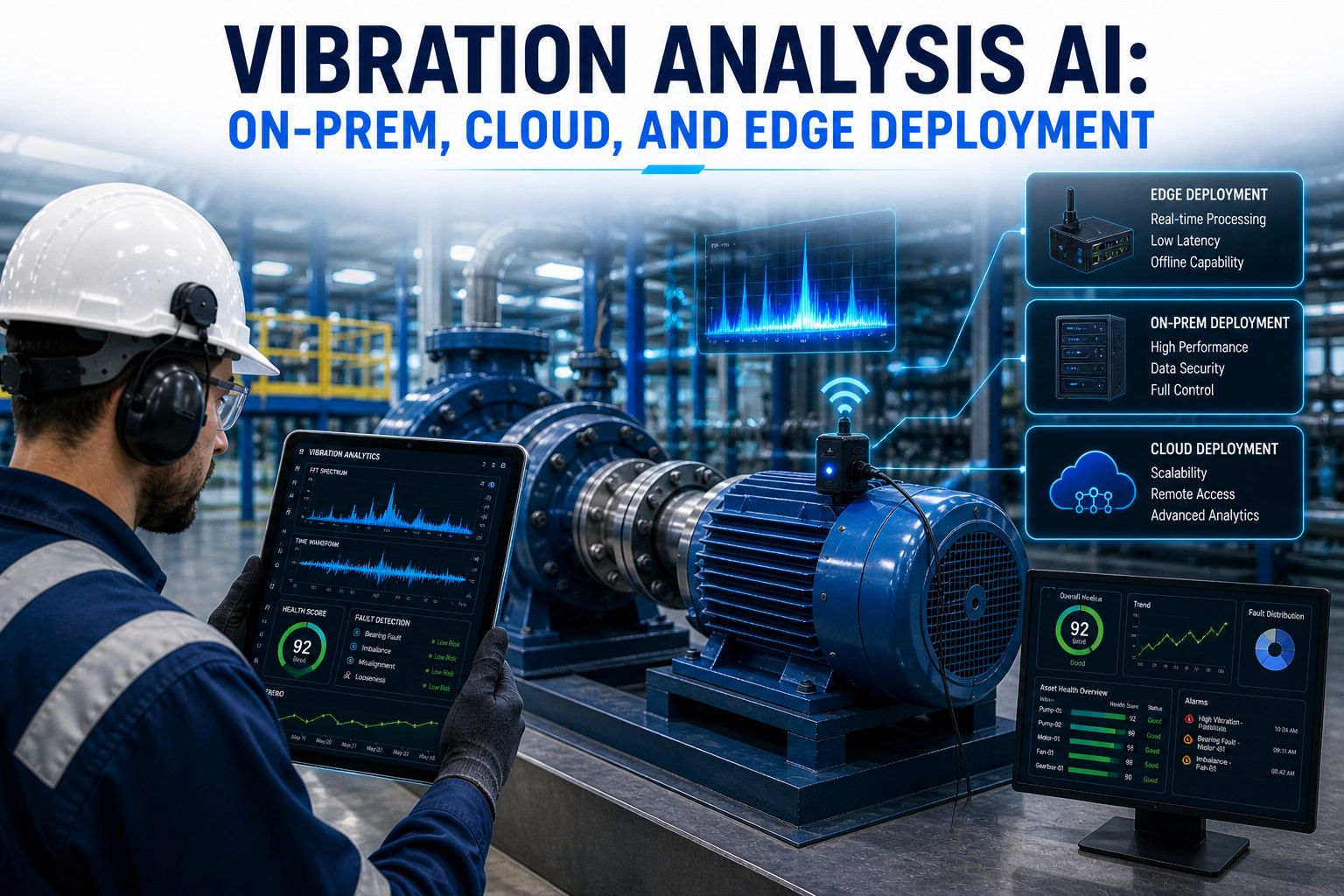
A bearing developing pitting damage emits its first frequency anomaly at 0.4× running speed — about 12 weeks before the same fault becomes audible to a human, and 3–6 months before thermal sensors detect it. Vibration analysis offers the longest lead time of any condition monitoring technology in industrial maintenance. The catch: the lead time is only useful if you can capture, process, and act on the signature in time. That's where AI changes the equation. The question for every plant in 2026 isn't whether to use AI for vibration analysis — 70% of unplanned downtime traces directly to mechanical faults that vibration AI catches months ahead — it's where to run the AI: on the sensor itself (edge), inside a plant gateway, on an on-prem GPU server, or in the cloud. Each architecture has different latency, cost, security, and bandwidth tradeoffs. Get the deployment pattern wrong and you'll either burn budget on bandwidth or miss the very anomalies you deployed sensors to catch. See how Oxmaint's deployment-flexible vibration AI fits your plant — start your free trial.
Choose the Right Vibration AI Architecture in One Session
Join the OxMaint team to design your vibration AI deployment — edge gateway vs on-prem GPU vs cloud — mapped to your asset count, latency requirements, and security posture, with FFT signal processing and deep learning fault classification walkthrough.
4 deployment patterns — when to use each
FFT spectrum reading walkthrough — bearings vs imbalance
The P-F Curve — Why Vibration AI Catches Failures First
Vibration analysis sits at the very top of the P-F curve — catching faults the moment metallic surfaces start changing their impulse signature, long before any other technology can sense the developing problem.
How AI Reads a Vibration Signal — From Waveform to Work Order
Raw vibration data is chaotic — a continuous stream of acceleration values that mean nothing until processed. Modern vibration AI runs a five-stage transformation pipeline that converts a noisy waveform into a classified fault with confidence score and recommended action.
01
Raw Capture
Accelerometer (MEMS or piezoelectric IEPE) captures acceleration vs time at 3.2–25.6 kHz sampling rates. 1-second window = 3,200–25,600 data points.
Time Waveform
02
FFT Transform
Fast Fourier Transform converts time domain → frequency domain. The "fingerprint" of the machine emerges as discrete peaks at running speed and harmonics.
FFT · Spectral
03
Feature Extraction
RMS, kurtosis, crest factor, peak amplitudes, sideband energy, harmonic ratios — combined into a feature vector the ML model can classify against.
RMS · Kurtosis
04
AI Classification
CNN, SVM, or Random Forest model classifies fault type — bearing inner race, outer race, cage, ball, imbalance, misalignment, looseness, gear mesh.
CNN · ML Model
05
CMMS Action
Auto-generated work order with diagnosed fault, severity score, recommended action, and parts pre-reserved. Mobile push to assigned technician.
Auto WO
The 4 Deployment Patterns — Where Should the AI Actually Run?
Best for: Multi-site fleets · low-criticality assets
Latency: 200–800 ms
Bandwidth: WAN-heavy — metadata only typical
Tradeoff: Compliance & data sovereignty constraints
Ideal for: Cross-site fleet trending and benchmarking
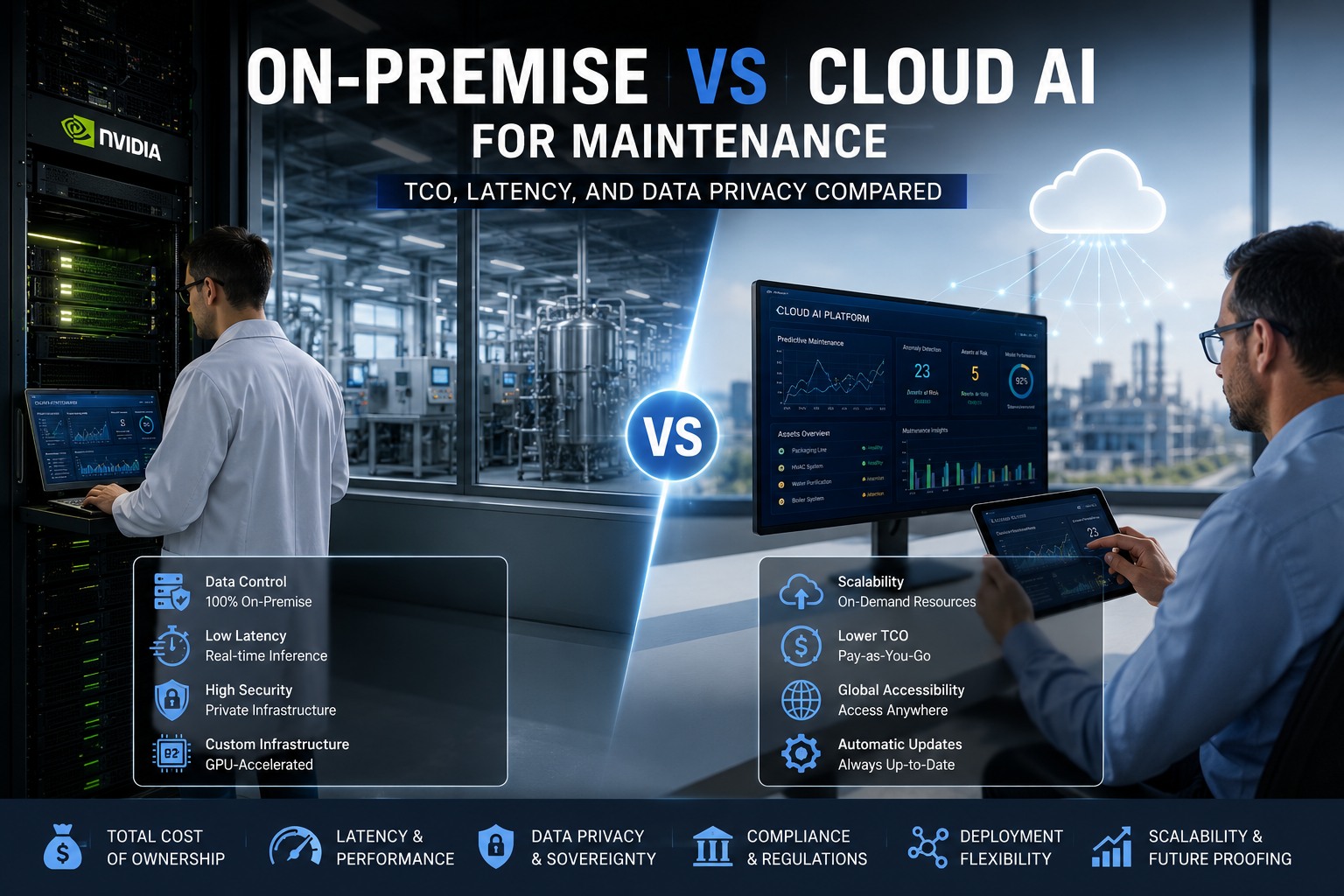
Edge vs Cloud — The Decision Matrix
The deployment pattern decision usually comes down to three questions: how fast does the AI need to act, how sensitive is the data, and how many sensors will scale? This decision matrix simplifies the architectural call.
Edge AI
Edge Gateway
On-Prem GPU
Cloud
Latency
<1 ms
10–50 ms
50–200 ms
200–800 ms
Bandwidth Cost
Lowest
Low
Low
High
Data Sovereignty
Full
Full
Full
Vendor
Model Complexity
Simple
Moderate
Deep
Deep
Setup Cost
Lowest
Moderate
Highest
Low
Best For
Wireless fleets
Most plants
Regulated
Multi-site
Pick the Right Architecture — Deploy in 14 Days, Not 6 Months
Oxmaint is sensor-agnostic and deployment-flexible — supporting MEMS, IEPE, and wireless vibration sensors across edge, gateway, on-prem GPU, and cloud architectures with FFT-based ML and CNN deep learning models running where it makes sense for your plant.
Different mechanical faults produce different frequency signatures in the FFT spectrum. AI doesn't just detect that vibration is "high" — it classifies which fault is producing the signature, with confidence scores per fault type. Here are the four fault classes that vibration AI catches with the highest accuracy.
01
Bearing Defects
Non-synchronous peaks at BPFO, BPFI, BSF, FTF frequencies
Inner race (BPFI), outer race (BPFO), ball (BSF), and cage (FTF) frequencies appear as the bearing degrades. AI separates these from running speed harmonics with 95%+ accuracy.
Lead time: 12–16 weeks
02
Imbalance
High peak at 1× running speed, radial direction
Mass imbalance produces a dominant 1× spike with phase consistency. AI distinguishes static, couple, and dynamic imbalance from misalignment patterns automatically.
Lead time: weeks to months
03
Misalignment
2× running speed dominant + axial vibration high
Coupling misalignment produces 2× and 3× peaks with high axial readings. AI separates parallel, angular, and combined misalignment from looseness patterns.
Lead time: 6–12 weeks
04
Looseness & Resonance
Multiple harmonics + sub-harmonics + resonance peaks
Mechanical looseness shows running speed harmonics up to 10× plus 0.5× sub-harmonics. AI catches this signature where threshold-based systems trip false alarms.
Lead time: 4–8 weeks
Expert Review — Why FFT + ML Beats Threshold-Based Monitoring
The vibration monitoring industry spent 30 years building threshold-based alerting — pick a vibration RMS limit, alert when it's exceeded. The problem with this approach is that it tells you something is wrong without telling you what is wrong, when it actually became wrong, or how much time you have. Modern vibration AI inverts the entire model. The system learns what each specific machine looks like under different load conditions, builds a dynamic baseline, runs FFT to extract the spectrum, and applies CNN or SVM models trained on labeled fault signatures to classify exactly which failure mode is developing — bearing inner race, outer race, cage, imbalance, misalignment, looseness, or gear mesh defect — with confidence scores per fault. The plants getting this right aren't choosing between edge AI and cloud. They're using both: edge for the real-time alerting that has to act in milliseconds, cloud for the cross-site fleet trending that benefits from aggregate data, and on-prem GPU for the deep learning models on regulated equipment where data sovereignty matters. Sensor-agnostic, deployment-flexible architectures win because no plant fits one pattern across every asset class.
70% Reduction in Unplanned Downtime
Documented results from AI-driven condition monitoring deployments: 70% reduction in unplanned downtime and 25% reduction in maintenance costs, with 14-day deployment versus the 3–6 month industry standard for traditional systems.
3–6 Months Earlier Than Audible
Vibration analysis offers the longest lead time of any condition monitoring technology — detecting defects 3–6 months before they become audible or thermal. Sits at the very top of the P-F curve.
500 Sensors Deployable in 1 Week
Modern wireless MEMS sensors with peel-and-stick installation and Bluetooth/LoRaWAN connectivity scale to 500+ sensors in under a week — versus months for wired piezo deployments. Battery life 3–5 years.
Your 14-Day Vibration AI Rollout
The era of 6-month vibration monitoring deployments is over. Modern AI-driven platforms with sensor-agnostic architecture deploy in 14 days from PO to first actionable alert. Here's the realistic phased rollout.
Install wireless MEMS or wired IEPE sensors per asset criticality (peel-and-stick or stud mount)
Connect via Bluetooth/LoRaWAN/wired to chosen architecture (edge gateway or on-prem)
Days 5–10
Baseline & Model Training
Capture 5–7 days of normal operation data — establishes per-asset dynamic baseline
FFT processing and feature extraction live; ML model trains on plant-specific signatures
Threshold tuning per asset — eliminates false positives from load variations
Days 11–14
CMMS Integration & Go-Live
Auto work order pipeline live — fault classification triggers CMMS work orders directly
Mobile alerts to maintenance team; reliability engineer dashboards configured
First documented bearing defect or misalignment caught — typically inside 30 days
Catch Mechanical Failures 3–6 Months Before They Happen
Oxmaint's vibration AI platform supports edge, gateway, on-prem GPU, and cloud deployments — sensor-agnostic, FFT-driven, with CNN/SVM/Random Forest fault classification and CMMS work order automation. Live in 14 days, not 6 months.
Should I run vibration AI on the edge, on-prem, or in the cloud?
The honest answer is "all three, applied where each makes sense." Most plants achieving best results use a hybrid architecture. Edge AI on the sensor (Pattern A) is the right choice for wireless MEMS sensor fleets where battery life matters and the basic FFT/RMS calculations can run on-chip — typical use case is 500+ wireless sensors on auxiliary equipment with 3–5 year battery life requirements. Edge gateway (Pattern B) handles wired piezoelectric sensors on critical assets where you need raw waveform access for deep root cause analysis but want internal-network-only data flow — best balance for most plants. On-prem GPU (Pattern C) is the right choice for regulated industries (pharma, utilities, defense, oil & gas) where data sovereignty matters and you need deep learning models running locally with air-gap capability. Cloud (Pattern D) is best for cross-site fleet trending, benchmarking across multiple facilities, and low-criticality assets where 200–800ms latency and vendor data handling are acceptable. Sensor-agnostic platforms let you mix architectures across asset classes without forcing a single deployment pattern on everything.
What's the difference between threshold-based and AI-based vibration monitoring?
Threshold-based monitoring sets a static vibration RMS limit (e.g., "alert if velocity exceeds 7.1 mm/s") and pings when crossed. This approach tells you something is wrong without telling you what's wrong, when it actually became wrong, or how much time you have. False alarms are common because static thresholds don't account for normal load variations. AI-based monitoring inverts the entire model. The system learns what each specific machine looks like under different load conditions, builds a dynamic baseline, runs FFT to extract the frequency spectrum, applies machine learning models (CNN, SVM, Random Forest) trained on labeled fault signatures, and classifies exactly which failure mode is developing — bearing inner race, outer race, cage, imbalance, misalignment, looseness, or gear mesh defect — with confidence scores per fault type. The output is "Bearing inner race fault, severity 3 of 5, confidence 94%, recommended action: replace bearing within 4–6 weeks" instead of "vibration high." This level of diagnostic specificity is what enables work order automation and accurate parts staging.
How accurate is AI vibration analysis for fault classification?
Modern CNN and SVM-based vibration AI models routinely achieve 95%+ classification accuracy across the major fault classes — bearing defects (inner race, outer race, ball, cage), imbalance, misalignment, looseness, and gear mesh defects. Accuracy depends on three factors. First, training data quality — models trained on labeled fault datasets specific to your equipment class outperform generic models by 10–15 percentage points. Second, feature engineering — combining time-domain features (RMS, kurtosis, crest factor) with frequency-domain features (FFT peaks, sideband energy, harmonic ratios) yields better classification than either domain alone. Third, baseline establishment — 5–7 days of normal operation data is sufficient to build per-asset dynamic baselines that eliminate false positives from load variations. Plants typically see classification accuracy climb from 85–90% in the first week to 95%+ within 30 days as the model continuously learns from production data.
Can wireless MEMS sensors replace traditional piezoelectric sensors?
For most general-purpose machinery, yes — MEMS technology has matured to the point where high-end capacitive MEMS accelerometers rival piezoelectric sensors in 2026. The advantages of wireless MEMS are significant: peel-and-stick installation eliminates conduit and cable trays, deployment scales to 500+ sensors in a week, and battery life runs 3–5 years on a single coin cell. Bluetooth, LoRaWAN, or 5G connectivity moves data to the gateway or cloud without wiring. However, wired piezoelectric sensors still have important use cases: ultra-high-frequency applications above 10 kHz where MEMS sensitivity drops, very high-temperature environments above 125°C, applications requiring continuous high-bandwidth raw waveform streaming, and safety-critical assets where wireless reliability is unacceptable. Most modern plants use both — wired piezo on Tier 1 critical equipment, wireless MEMS on Tier 2 and Tier 3 assets where the deployment economics dominate.
How fast can vibration AI actually deploy in a real plant?
14 days from PO signing to first actionable alert is realistic with modern sensor-agnostic AI platforms — versus 3–6 months for traditional vibration monitoring deployments. The compressed timeline depends on choosing wireless MEMS sensors for fast installation (peel-and-stick eliminates the 60–80% of project time historically spent on conduit and wiring), platforms with pre-trained baseline models that adapt quickly rather than requiring full custom training from scratch, and direct CMMS integration via API so work orders flow automatically without separate integration projects. Realistic 14-day breakdown: Days 1–4 cover asset selection and sensor installation on 50–100 critical rotating assets. Days 5–10 cover baseline establishment with 5–7 days of normal operation data and ML model training on plant-specific signatures. Days 11–14 cover CMMS integration, mobile alert configuration, dashboard setup, and go-live. The first documented bearing defect or misalignment is typically caught inside 30 days — usually paying back the entire program cost on the first prevented event.