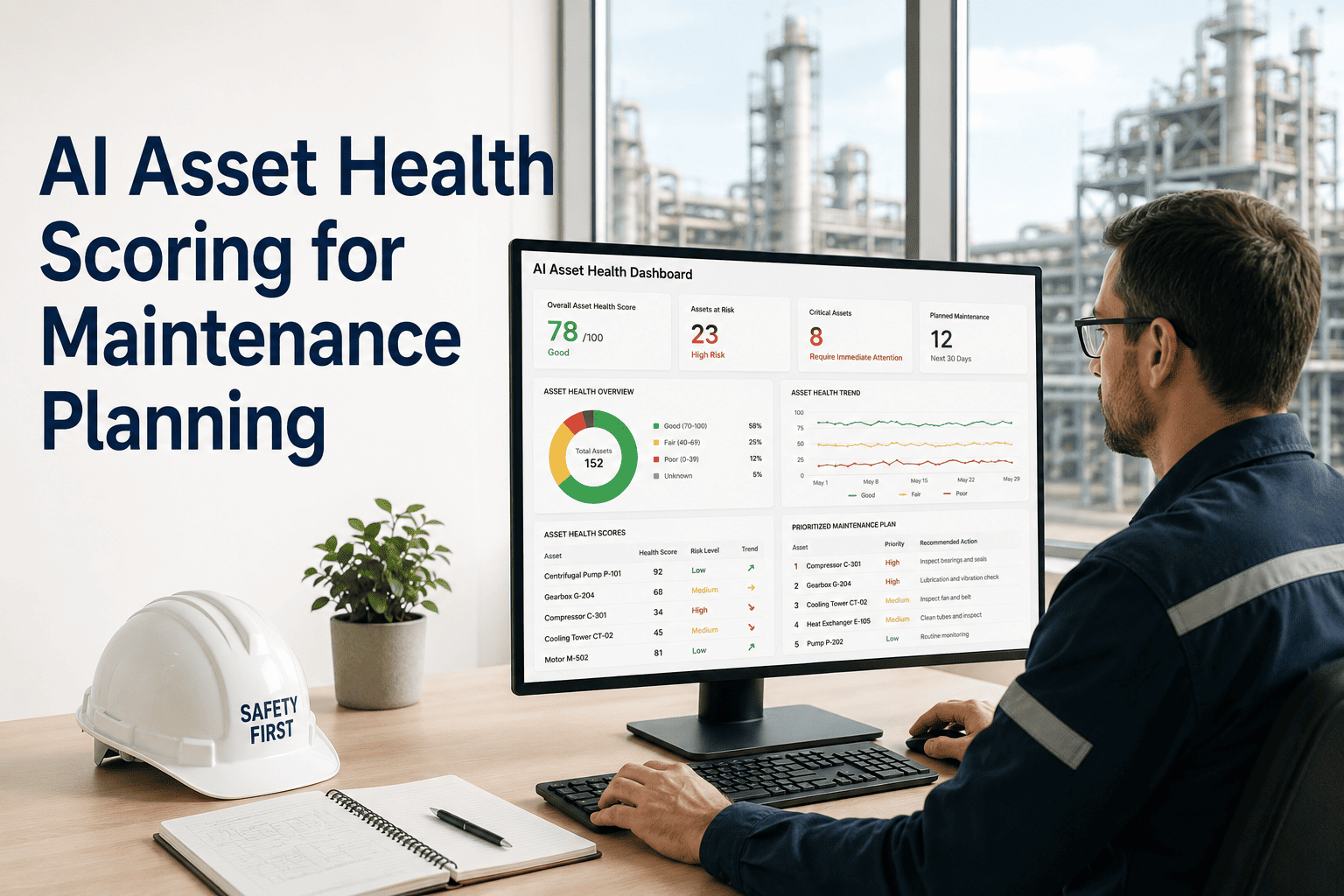
Maintenance planning without asset health data is guesswork. Teams that rely on fixed-interval PM schedules spend money maintaining assets that don't need it while missing early degradation signals on assets that do. OxMaint's AI Asset Health Scoring gives every asset in your portfolio a live, dynamic health score based on sensor readings, maintenance history, age, and failure risk — turning your maintenance plan from a calendar exercise into a data-driven prioritization system. This page covers how asset health scoring works, the benchmarks that matter, and how leading maintenance teams use it to reduce costs and prevent failures.
AI ASSET HEALTH MONITORING
Know Which Assets Need Attention Before They Tell You
OxMaint scores every asset 0–100 in real time — combining sensor data, maintenance history, and failure risk — so your planning decisions are driven by data, not assumptions.
Live Asset Health Dashboard
Compressor A-12
92 — Healthy
Pump Station 4
74 — Monitor
HVAC Unit 7-B
51 — Alert
Conveyor Drive 3
28 — Critical
25–30%
Maintenance cost reduction from optimized PM intervals based on health scores
4.2x
Faster identification of high-risk assets compared to calendar-only PM programs
87%
Of critical failures preceded by detectable health score decline 2+ weeks prior
WHAT GOES INTO AN ASSET HEALTH SCORE
OxMaint calculates each asset's health score by combining five data inputs, weighted by asset type and criticality class. The score updates continuously as new data arrives.
Condition Sensor Data 30%
Real-time vibration, temperature, pressure, current draw, and flow rate readings compared to established baseline ranges for the specific asset.
Maintenance History Score 25%
Frequency of corrective work orders, repair cost trend, mean time between failures, and PM compliance rate over the trailing 12 months.
Age vs. Useful Life 20%
Asset age as a percentage of manufacturer useful life expectancy, adjusted for actual operating hours and load intensity compared to design specification.
Inspection Finding Score 15%
Results from scheduled inspection work orders — visual condition ratings, measured tolerances, and technician-recorded anomalies that don't yet trigger sensor alerts.
Environmental Exposure 10%
Operating environment conditions — corrosive atmospheres, extreme temperatures, high-humidity zones — that accelerate degradation beyond design life projections.
HEALTH SCORE THRESHOLDS AND PLANNING ACTIONS
| Score Band | Health Status | Failure Probability (90-day) | Recommended Planning Action | OxMaint Trigger |
|---|---|---|---|---|
| 85–100 | Healthy | Under 5% | Maintain current PM schedule — no change needed | Standard PM work orders |
| 70–84 | Monitor | 5–15% | Increase inspection frequency, review PM interval | Inspection alert to supervisor |
| 50–69 | Alert | 15–35% | Schedule corrective work order within 72 hours | Priority corrective WO auto-created |
| 30–49 | High Risk | 35–65% | Immediate corrective action + capital planning flag | P2 alert + management notification |
| Below 30 | Critical | Above 65% | Emergency intervention or controlled shutdown | P1 emergency alert + escalation |
EXPERT REVIEW
Catherine Mwangi-Odhiambo
Asset Management Director — 21 Years Utilities, Water Treatment & Infrastructure
Asset health scoring transformed how we allocate our maintenance budget across a 2,400-asset infrastructure portfolio. Before OxMaint, every budget cycle turned into a political negotiation between department heads arguing for their equipment. With live health scores on every asset, budget allocation became an analytical exercise — sort by score, fund the highest-risk assets first, defer the healthy ones. We reduced our emergency repair spend by 38% in the first year simply by directing maintenance dollars to assets whose scores showed they needed it, rather than guessing based on age or historical preference. The capital planning application alone — using score trends to project replacement timelines — justified the platform cost in the first quarter.
How Healthy Is Your Asset Portfolio Right Now?
Book a demo and let OxMaint score your critical assets live — no data migration required to start.
FREQUENTLY ASKED QUESTIONS
Can OxMaint calculate asset health scores for assets without IoT sensors using only maintenance history data?
Yes. OxMaint operates in two modes: sensor-augmented health scoring for connected assets and history-based health scoring for non-connected assets. In history-based mode, the scoring engine uses work order frequency, repair costs, PM compliance, inspection ratings, and asset age to calculate a health score without any sensor input. This allows facilities in early stages of IoT adoption to access health scoring across their entire asset portfolio immediately, then progressively improve score accuracy as sensors are added to higher-criticality assets. Sign up free and start health scoring your assets using existing maintenance history today.
How does OxMaint use asset health scores to optimize preventive maintenance intervals?
OxMaint's PM interval optimization engine analyzes health score trends over time for each asset and recommends adjustments to PM frequencies based on observed degradation rates. An asset consistently holding a score above 85 with no deterioration trend may warrant extending its PM interval to reduce unnecessary maintenance labor, while an asset with a steepening score decline suggests the current interval is too long. These interval optimization recommendations are presented as suggestions for maintenance manager review rather than automatic changes, ensuring engineering judgment remains part of the process. Book a demo to review the interval optimization workflow for your PM program.
How can asset health scores be used to support capital planning and asset replacement decisions?
OxMaint's capital planning dashboard uses health score trajectories — the rate at which scores are declining over time — to project when assets will cross the critical threshold requiring replacement. This gives capital planners a data-backed basis for prioritizing equipment replacement requests in the annual budget cycle, ranked by projected time to failure and replacement cost. Maintenance teams can also filter their full asset portfolio by health score trend to identify the highest-replacement-risk assets for 3–5 year capital planning windows, making budget justifications to finance and leadership objective rather than anecdotal.
How does OxMaint handle assets where health scores fluctuate widely due to variable operating conditions?
OxMaint's health scoring model accounts for operating condition variability by applying load-normalized baselines for assets that operate under variable conditions — batch processes, seasonal HVAC loads, or variable production speeds. When an asset's sensor readings are expected to vary significantly with operating load, the scoring model adjusts the expected parameter ranges dynamically based on current operating conditions rather than applying static thresholds. This prevents false health score drops during legitimate high-load periods while still detecting genuine anomalies that exceed load-normalized expectations. Start free to configure load-normalized health scoring for your variable-operation assets.