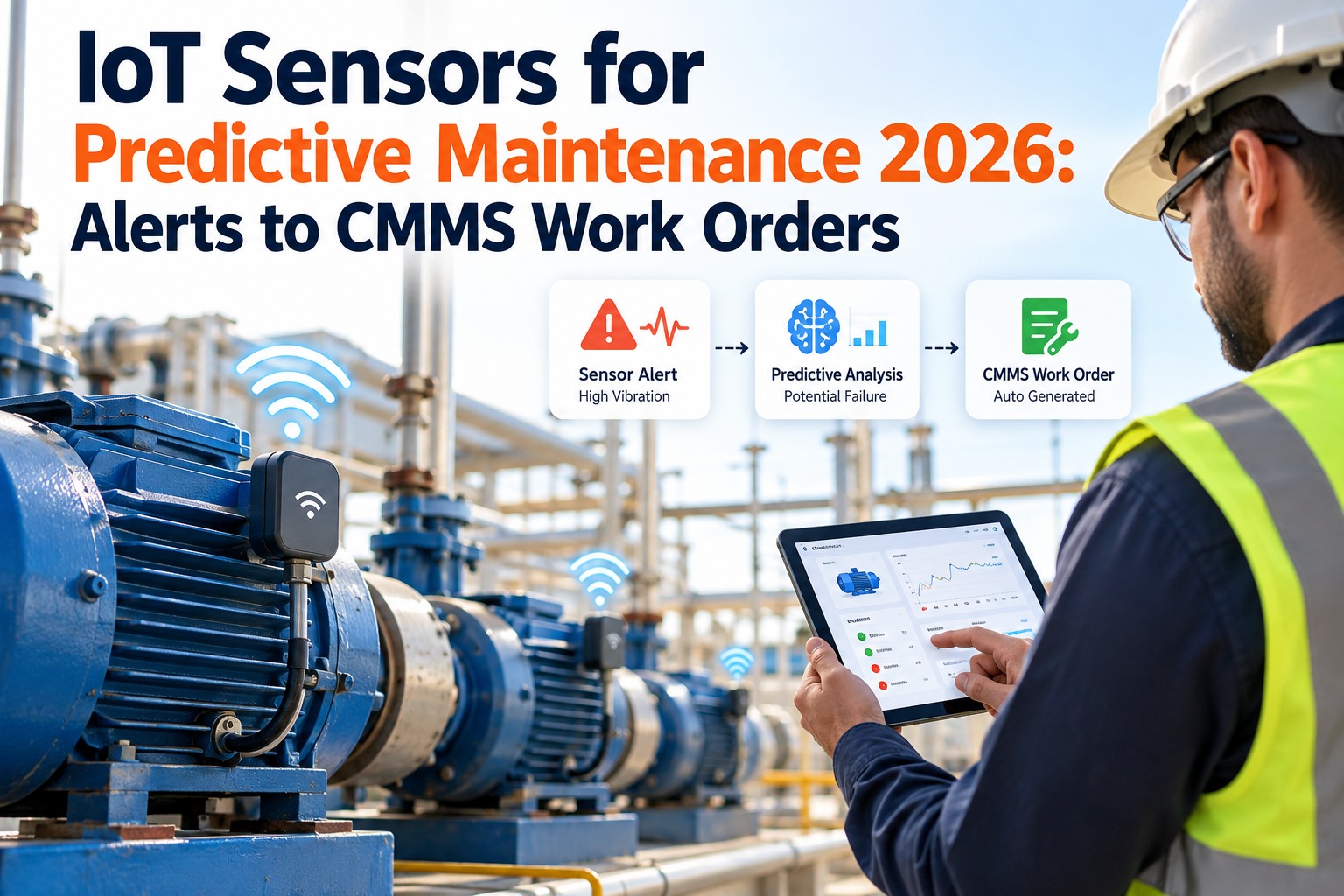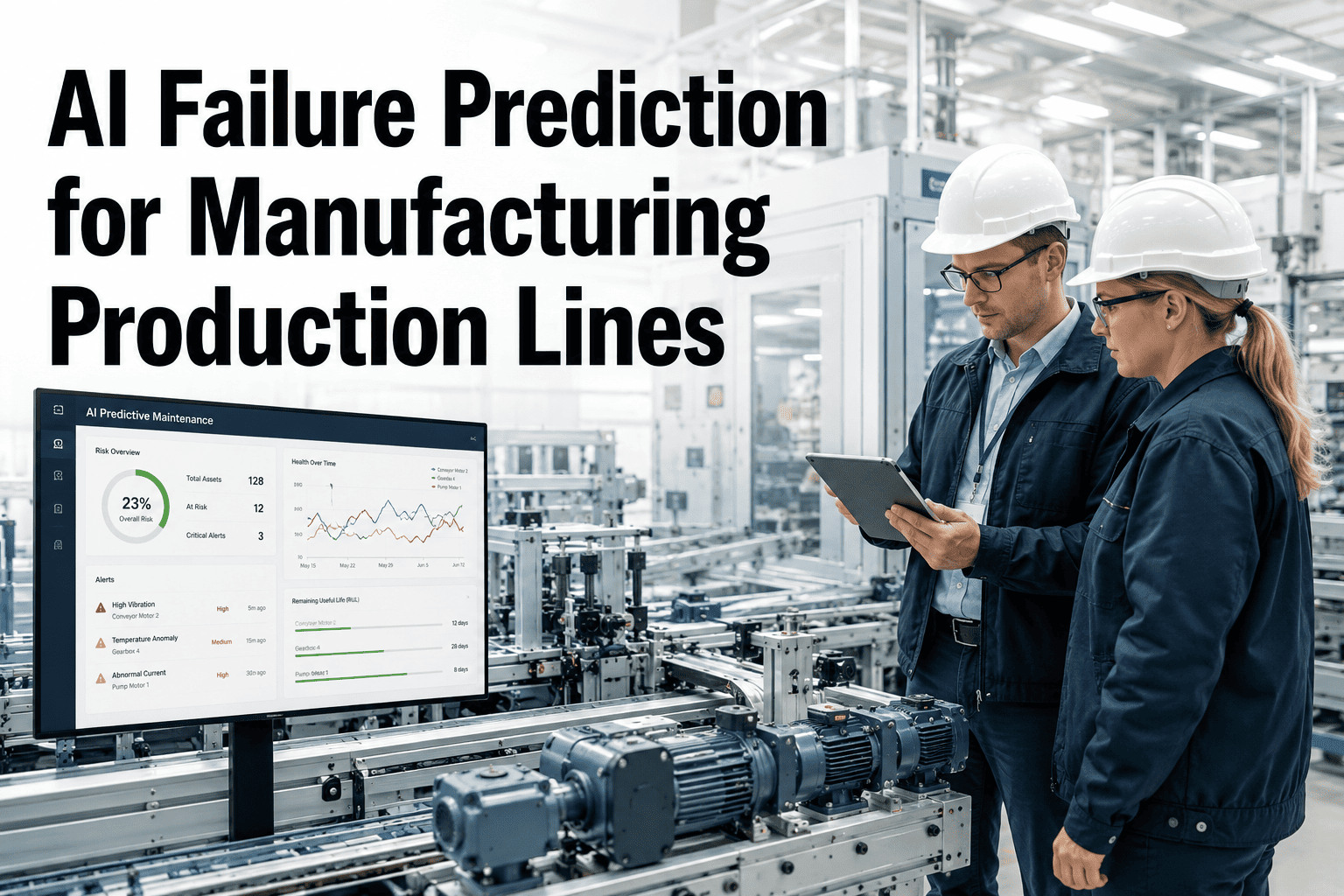
Manufacturing production lines operate on a single, unforgiving rule: every unplanned stop costs money. A stalled assembly line at a tier-1 auto supplier costs an average of $1.3 million per hour when downstream penalties and idle labor are included. OxMaint uses AI failure prediction to monitor machine health continuously across your production floor, flag early failure signals, and dispatch corrective work orders before stoppages interrupt your output. This page covers the data, detection methods, and real industry outcomes.
MANUFACTURING AI
Catch Machine Failures Before They Kill Your Line
OxMaint analyzes hundreds of sensor signals per asset, flags failure precursors weeks in advance, and auto-generates work orders for your maintenance team.
$1.3M
Avg. cost per hour of auto assembly line downtime
23 days
Average AI failure prediction lead time
70%
Reduction in unplanned stoppages reported by OxMaint users
Where Production Line Failures Really Come From
34%
Bearing & mechanical wear
22%
Electrical component failure
18%
Lubrication issues
14%
Misalignment & imbalance
12%
Thermal overload
Source: Plant Engineering Maintenance Survey, Deloitte Manufacturing Industry Report 2024
| Production Line Asset | Early Warning Signal | AI Detection Window | Without Prediction | With OxMaint |
|---|---|---|---|---|
| CNC Machining Centers | Spindle vibration drift | 14–21 days | Full spindle replacement + 3-day shutdown | Bearing swap during shift change |
| Injection Molding Machines | Hydraulic pressure variance | 7–14 days | Emergency seal replacement + scrap surge | Planned seal kit install, zero scrap |
| Robotic Welding Arms | Servo current anomaly | 10–28 days | Robot offline, production rerouting | Motor service during weekend PM window |
| Conveyor Drive Systems | Belt tension deviation | 5–10 days | Line stoppage, belt replacement under pressure | Tensioner adjustment during next PM |
| Cooling & Chiller Units | Refrigerant charge decline | 21–45 days | Compressor failure, product loss | Refrigerant recharge, no thermal event |
See How OxMaint Monitors Your Production Assets
30-minute demo — bring your asset list and we will show you live failure prediction in action.
OxMaint Failure Prediction: 4-Layer Detection Model
Layer 1
Threshold Monitoring
Instantaneous breach of absolute limits — temperature over 85°C, pressure above 120 PSI. Fires immediate critical alerts with no AI inference required.
Layer 2
Trend Deviation
Statistical detection of gradual parameter drift — a motor drawing 3% more current each week signals impending insulation breakdown weeks before threshold breach.
Layer 3
Pattern Recognition
ML models trained on your specific equipment's operational history identify unique failure signatures — multi-variable patterns that no single sensor threshold can catch.
Layer 4
Cross-Asset Correlation
Identifies cascade failure risks — a degrading chiller affecting downstream packaging line temperatures before either machine crosses an individual alert threshold.
EXPERT REVIEW
James Thornton
Director of Plant Reliability — 22 Years Automotive & Discrete Manufacturing
Production line maintenance is a different problem from general facility maintenance. When your line runs at 98% efficiency, every 0.5% OEE improvement is a meaningful revenue gain. AI failure prediction changes that calculus entirely because it converts unplanned stops into planned micro-interventions that happen between shifts, not during peak production. In our deployment, we reduced unplanned line stoppages by 68% in the first year by acting on OxMaint's early warning scores. The ROI was never in question — the question was always how fast we could get adoption from the maintenance team, and that happened faster than we expected because the work orders came pre-loaded with the failure context they needed.
Frequently Asked Questions
How does OxMaint handle high-speed production lines with thousands of sensor readings per minute?
OxMaint's edge processing architecture handles high-frequency sensor data by applying initial filtering and anomaly flagging at the edge before transmitting condensed event data to the cloud CMMS layer. This means even production lines generating tens of thousands of sensor readings per minute can be monitored without network bandwidth bottlenecks or data storage issues. The platform is designed to scale from 10-asset pilot deployments to enterprise production environments with thousands of monitored assets. Book a demo to review your production line architecture with our team.
Can OxMaint prediction models account for shift patterns and production schedule changes?
Yes. OxMaint's AI models are production-schedule-aware, meaning they adjust baseline behavior expectations based on whether a machine is running at full capacity, reduced speed, or idle. When you run overtime shifts, switch product SKUs, or change production volumes, the system accounts for corresponding changes in vibration, temperature, and current draw patterns rather than triggering false alerts from legitimate operational changes. Shift calendars and production schedules are configurable directly within the platform. Sign up free to explore schedule-aware monitoring settings.
How does OxMaint integrate AI failure prediction with existing MES or ERP systems?
OxMaint provides REST API endpoints and pre-built connectors for major MES platforms including SAP PM, Oracle EAM, and Infor EAM. When a failure prediction triggers a work order in OxMaint, the event data — asset ID, failure mode, urgency score, and recommended action — can be pushed automatically to your ERP or MES for production scheduling adjustment. This closes the loop between maintenance prediction and production planning, ensuring that scheduled corrective actions are coordinated with production supervisors rather than creating separate maintenance and operations siloes.
What is the typical deployment timeline to get AI failure prediction running on a production line?
Most production line deployments complete initial sensor integration and asset configuration within 2–4 weeks. The AI baseline learning phase runs for an additional 3–6 weeks depending on equipment cycle times and production variability. During the learning period, the system operates in monitoring mode — tracking patterns without generating predictive alerts — then transitions to active prediction mode once baseline confidence thresholds are met. OxMaint's onboarding team guides every step of the deployment, from sensor connectivity through first alert validation. Book a demo to discuss your specific production line timeline.
Your Next Line Stoppage Is Predictable. Let's Prevent It.
OxMaint AI failure prediction gives manufacturing maintenance teams 14–45 days of advance warning before critical equipment fails.