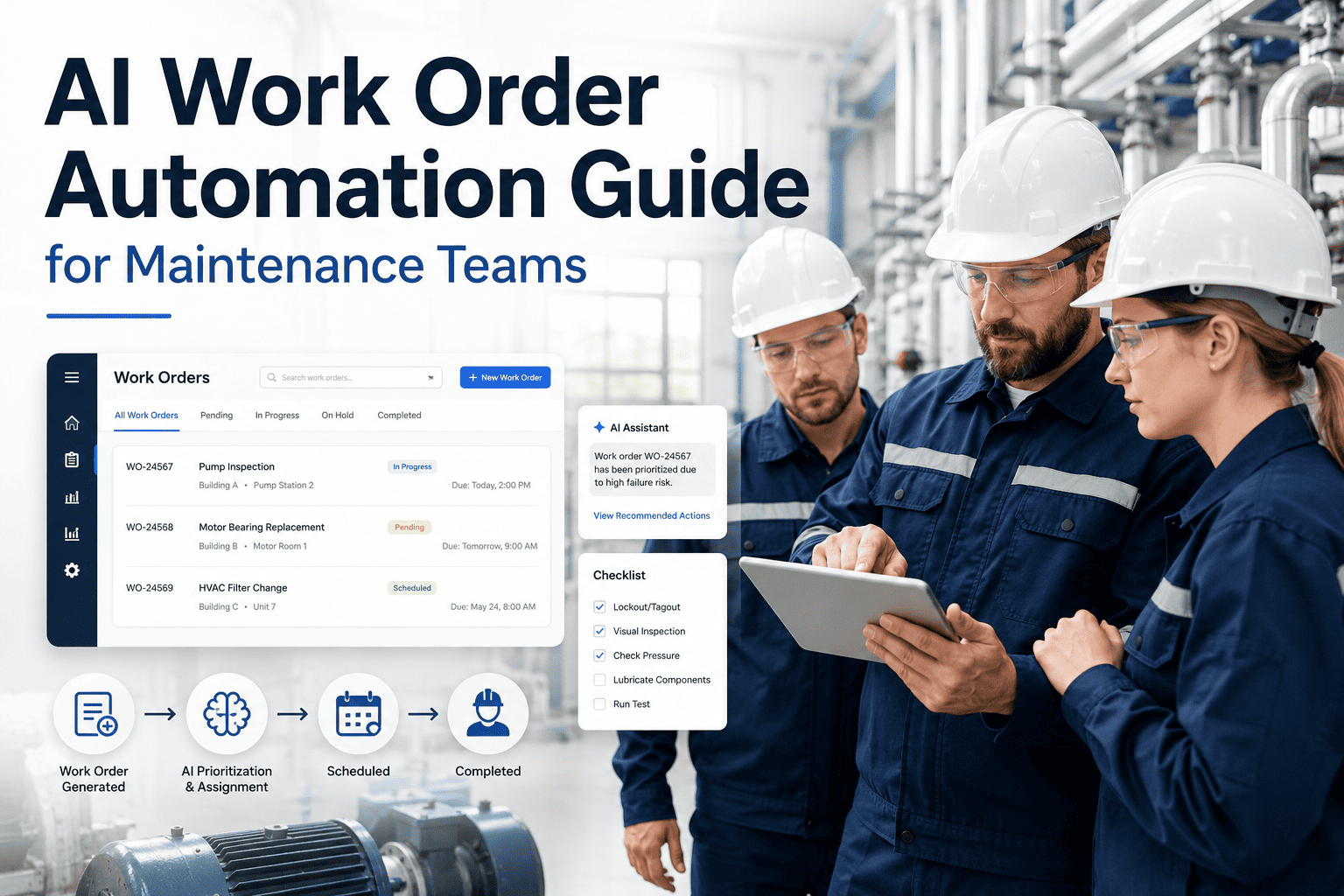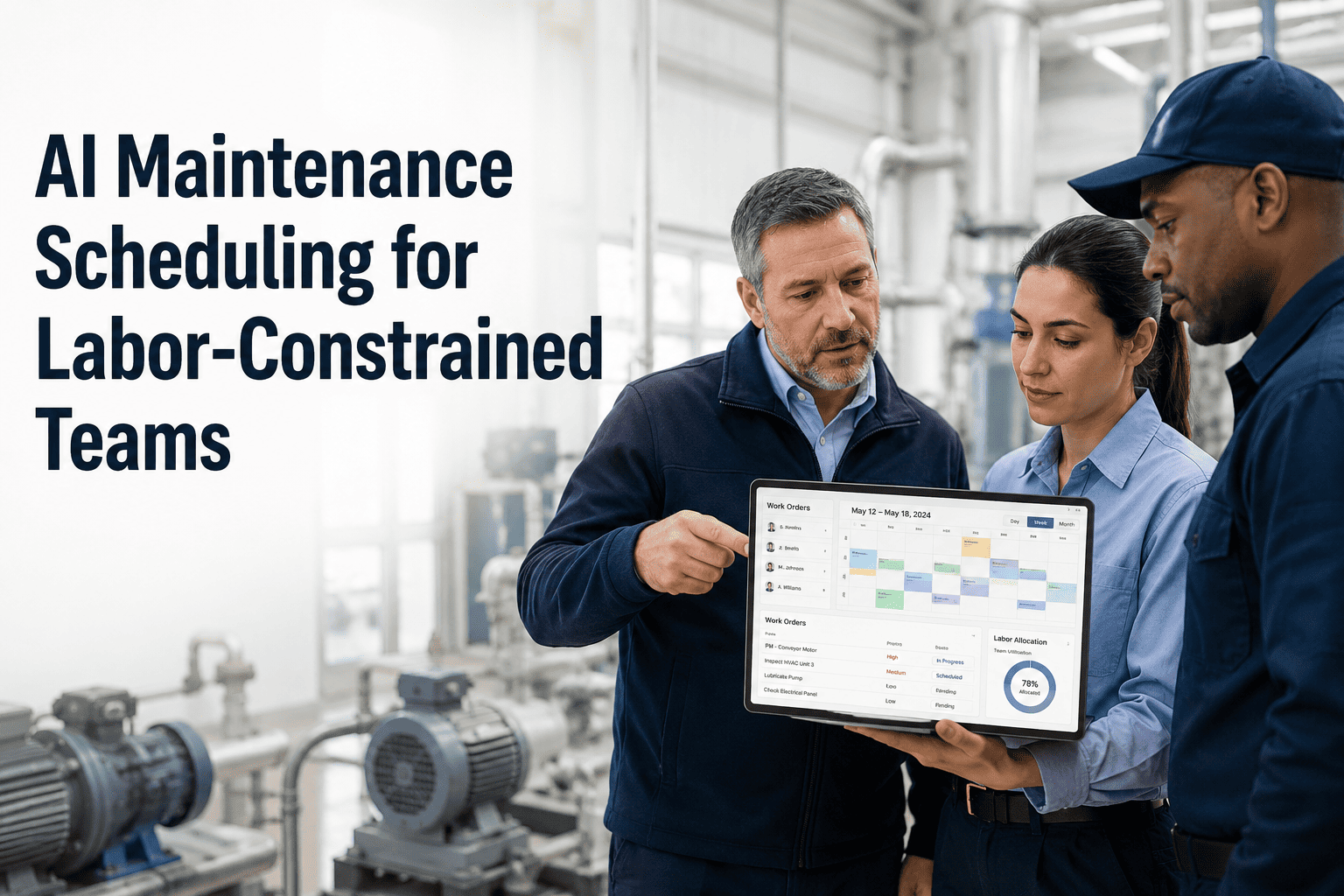
Maintenance teams are shrinking. The U.S. Bureau of Labor Statistics reports a 25% projected shortfall in skilled maintenance technicians by 2028, and most facilities are already operating with 15–20% fewer technicians than their PM schedules were designed for. When every hour of technician time is precious, scheduling decisions can no longer rely on spreadsheets and supervisory intuition. OxMaint's AI Maintenance Scheduling matches PM tasks to technician availability, certifications, location, and asset priority — building optimized daily schedules that do more work with the team you actually have.
AI SCHEDULING FOR LEAN MAINTENANCE TEAMS
Schedule Smarter When You're Running Lean
OxMaint's AI fills your technicians' schedules with the right work in the right order — balancing PM compliance, asset criticality, and labor availability without a scheduling coordinator.
25%
Projected technician shortage by 2028 (US BLS)
35%
More PM tasks completed per technician with AI scheduling
18%
Average wasted labor from poor scheduling and travel time
WHERE LABOR-CONSTRAINED TEAMS LOSE TIME
23 min
Average per-shift time wasted on schedule coordination calls between technicians and supervisors
18%
Of PM tasks skipped due to poor scheduling, creating backlog and compliance gaps
2.1 hrs
Average daily technician travel time when routes are not optimized by asset location
31%
Of work orders require a second trip because parts or access were not confirmed before dispatch
HOW AI SCHEDULING WORKS IN OXMAINT
1
Technician Capacity Input
OxMaint reads real-time technician availability — shifts, leave, certifications, and current assignment load — and calculates available capacity for the scheduling window (day, week, or sprint).
2
Priority-Weighted Task Pool
The AI pulls from the prioritized work order queue — PM due dates, corrective urgency, asset health scores — and ranks the task pool against available technician capacity for the period.
3
Route and Skill Optimization
Tasks are grouped by physical location and matched to technicians with the right trade certification. Routes are optimized to minimize travel time between assets, recovering up to 90 minutes of productive labor per technician per day.
4
Parts & Access Pre-Check
Before finalizing the schedule, OxMaint confirms that required parts are in storeroom inventory and any access permits or lockout windows are available — eliminating the most common cause of "trip wasted" work orders.
5
Live Schedule Push to Mobile
Optimized daily schedules are pushed to each technician's mobile device with ordered task lists, asset locations, work instructions, and estimated durations — no coordinator required to communicate the day's plan.
| Scheduling Scenario | Without AI Scheduling | With OxMaint AI | Outcome |
|---|---|---|---|
| Technician calls out sick | Supervisor manually reassigns — 45–90 min disruption | AI auto-redistributes affected WOs in under 2 minutes | Zero planning delay |
| Emergency P1 work order arrives | Supervisor pulls technician, schedule collapses | AI reschedules remaining tasks around the P1 insertion | PM compliance maintained |
| End-of-quarter PM compliance crunch | Overtime surge, burnout, compliance gaps | AI distributes PM load evenly across the quarter window | No overtime spike needed |
| Multi-site technician deployment | Manual cross-site coordination by phone and email | AI optimizes cross-site dispatch by skill and proximity | 30–40% travel time reduction |
Stop Losing Labor to Poor Scheduling
OxMaint recovers 30–90 minutes of productive technician time per shift through AI-optimized scheduling. See it in a live demo.
EXPERT REVIEW
Linda Osei-Bonsu
VP Facilities Operations — 16 Years Healthcare & Multi-Site Commercial Real Estate
Labor constraints are the defining challenge of maintenance management right now. Retirement is accelerating, skilled trades are expensive, and organizations are not approving headcount at the rate work is growing. The only viable path is squeezing more productive output from the team you have — and that means scheduling must become a science, not a gut call. OxMaint's AI scheduling rebuilt how we plan each shift. We eliminated the morning coordination meeting, cut wasted travel by 34%, and improved our PM compliance rate from 71% to 94% without adding a single technician. The ROI case was closed in the first quarter.
FREQUENTLY ASKED QUESTIONS
How does OxMaint's AI scheduling handle technicians with different trade certifications and skill levels?
OxMaint maintains a detailed technician profile for each team member including trade certifications (electrical, plumbing, HVAC, mechanical), specialized equipment qualifications, and skill tier ratings. When the AI builds a schedule, it matches work order requirements against these profiles — ensuring that electrically-classified work only gets assigned to certified electricians, and that complex repairs requiring senior-level competency are not dispatched to apprentice-level technicians. Certification expiry dates are tracked automatically, and the system flags technicians whose certifications are approaching renewal deadlines. Sign up free to configure your technician skill profiles.
Can OxMaint scheduling accommodate shift-based operations with rotating maintenance crews?
Yes. OxMaint's scheduling engine supports rotating shift patterns including 8-hour, 10-hour, and 12-hour shift configurations, continental rotating schedules, and split-shift maintenance teams. Work orders can be configured to pass seamlessly between shift handoffs, with the incoming shift's schedule pre-loaded and any open items from the previous shift automatically carried forward with their original priority scores. Supervisors can also configure blackout windows for critical production periods where maintenance activities are restricted. Book a demo to walk through your specific shift configuration.
How does OxMaint prevent AI scheduling from over-scheduling technicians and causing burnout or quality issues?
OxMaint's AI scheduling model applies a configurable utilization cap — typically set between 75–85% of available shift time — that reserves buffer for travel variance, safety checks, and unexpected task complexity. The system tracks actual versus estimated task completion times over time and automatically adjusts time estimates upward for consistently under-estimated task types. Supervisors receive a utilization dashboard that flags any technician whose scheduled hours regularly exceed their productive output, allowing workload rebalancing before fatigue impacts repair quality or safety performance.
What happens to the AI-generated schedule when a high-priority emergency work order comes in mid-shift?
When a P1 or P2 emergency work order is created during an active shift, OxMaint's scheduler runs an instant re-optimization of the affected technician's remaining daily task queue. Lower-priority tasks are rescheduled to the next available slot, deferred to other available technicians if capacity permits, or flagged to the supervisor if they cannot be accommodated without compliance risk. The emergency insertion and all rescheduled tasks are logged automatically, creating an audit trail that explains any PM tasks deferred due to emergency response. Start free and test the emergency insertion workflow with your team's schedule.