Twelve percent of manufacturers have deployed AI-powered predictive maintenance. They report 50% less unplanned downtime, 25% lower maintenance costs, 25% longer equipment lifespan, and 70% fewer catastrophic failures. The other 88% are still running reactive maintenance — fixing things after they break — at a cost that the U.S. Department of Energy estimates consumes $60 billion annually in unnecessary industrial losses. The gap between these two groups is widening every quarter as sensor costs drop below $1 per unit, edge AI chips enable real-time inference on the factory floor, and the global predictive maintenance market accelerates toward $91.04 billion by 2033. This is no longer an emerging technology — it's a documented competitive advantage with 10:1 to 30:1 ROI ratios within 12-18 months. This guide covers how AI predictive maintenance works, what it costs, what realistic ROI looks like, and how to implement it without the vendor hype. OxMaint includes AI predictive maintenance at all paid tiers — not as an enterprise add-on. To see it working on your asset data, you can start a free trial or book a demo with an AI maintenance specialist.
AI Predictive Maintenance 2026Complete Implementation GuideROI Data Included
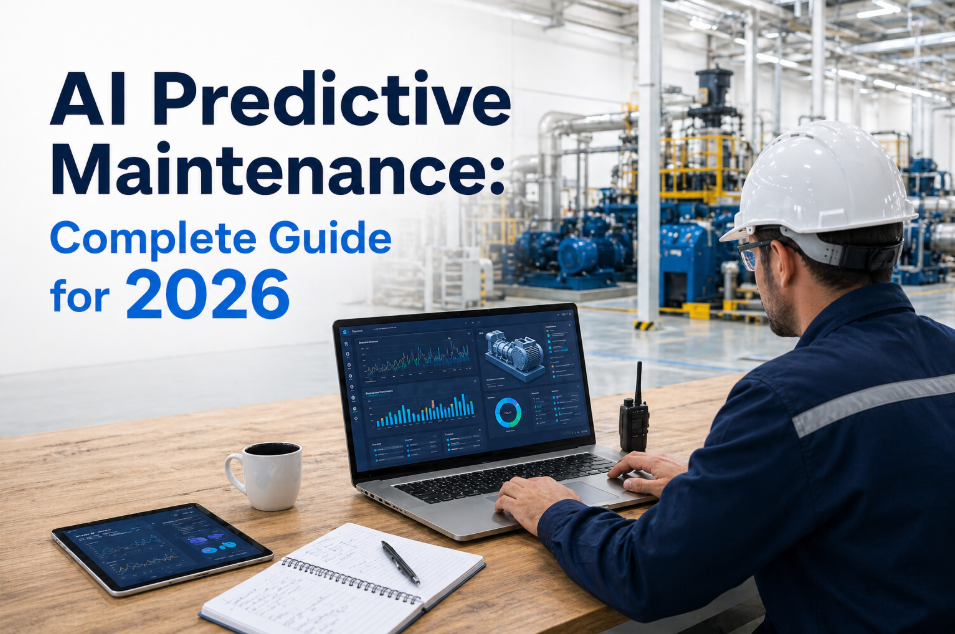
AI Predictive Maintenance: The Complete Guide for 2026
How AI predicts equipment failures before they happen, what it costs to implement, what realistic ROI looks like for mid-market plants, and the 4-phase deployment roadmap that delivers 3-6x returns consistently — with the marketing claims separated from documented results.
50%
Unplanned downtime reduction (documented)
10-30x
ROI within 12-18 months (McKinsey)
$91B
Global PdM market by 2033
12%
Manufacturers currently using AI PdM
The Three Maintenance Paradigms — and Why AI Changes Everything
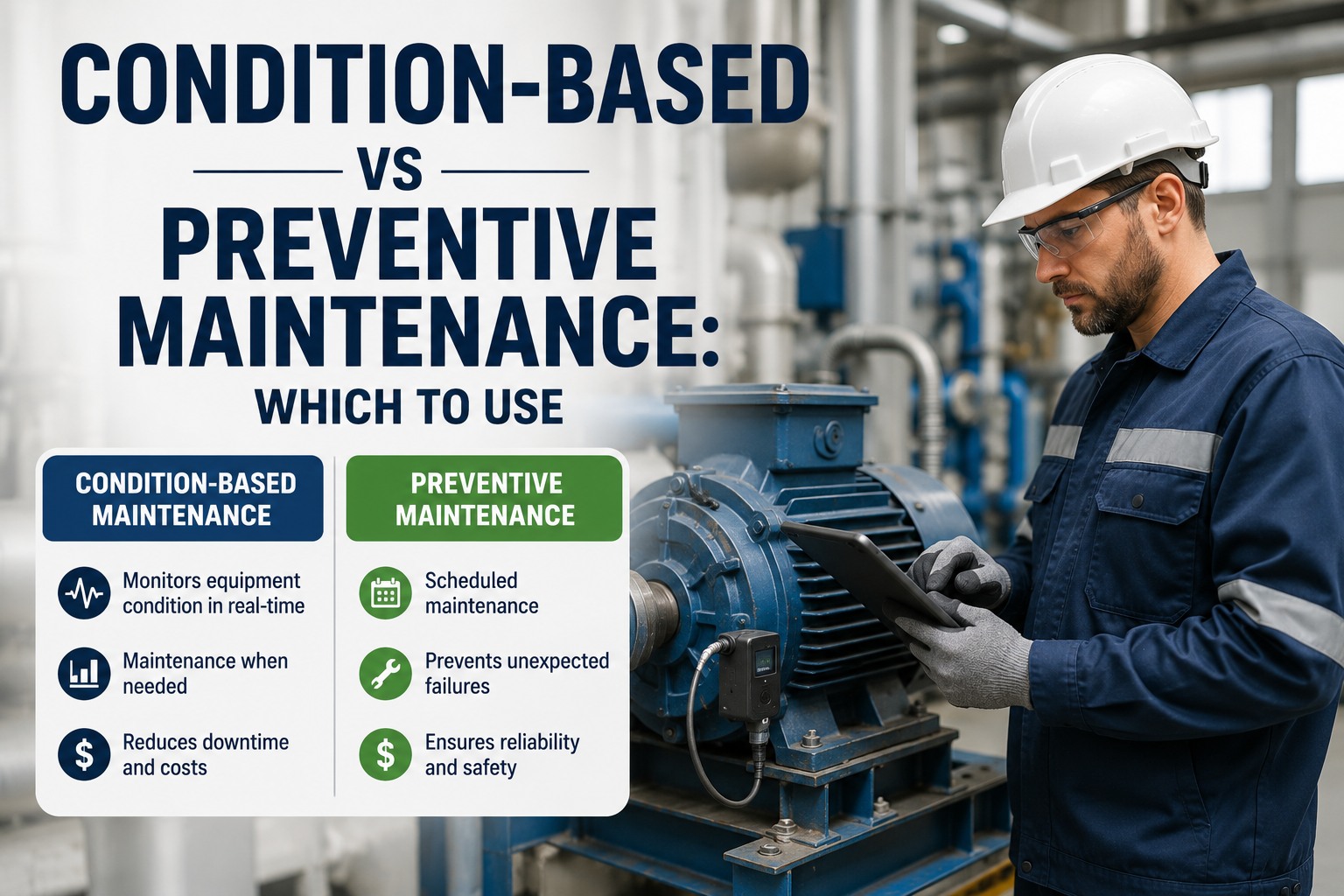
Understanding what AI predictive maintenance replaces clarifies what it delivers. Most plants run a mix of all three paradigms — and the economics of each are well documented.
01
Reactive Maintenance (Fix After Failure)
Equipment runs until it breaks. Zero upfront monitoring cost — but emergency repairs cost 3-10x more than planned work, unplanned downtime averages $260,000/hour across manufacturing, and secondary damage often exceeds the original failure cost. Still the default for 60%+ of industrial operations.
02
Preventive Maintenance (Calendar-Based)
Equipment serviced on fixed schedules regardless of actual condition. Reduces catastrophic failures by 30-40% vs reactive. Creates unnecessary maintenance on healthy equipment (estimated 30% of PM tasks are unnecessary). Calendar-based scheduling misses condition-driven failures that don't follow time patterns.
03
Predictive Maintenance (Condition-Based + AI)
Real-time sensor data + machine learning predicts failures 14-90 days before they occur. Maintenance performed only when data indicates a developing problem. Saves 8-12% over preventive, 25-40% over reactive. Equipment runs to actual condition limits — not arbitrary calendar dates — extending lifespan 20-40%.
04
Prescriptive Maintenance (AI + Actions)
The next evolution: AI not only predicts the failure but recommends the optimal intervention — which part to replace, which technician to assign, when to schedule the work, and what inventory to pre-position. OxMaint's AI generates work orders with specific corrective actions automatically from anomaly detection.
How AI Predictive Maintenance Actually Works — The Data Pipeline
AI predictive maintenance isn't magic — it's a structured data pipeline with four stages. Each stage has specific technology requirements, data quality thresholds, and implementation considerations. Understanding this pipeline helps teams avoid the most common deployment mistakes. To see how OxMaint handles this pipeline from sensor to work order, start a free trial or book a walkthrough of the AI architecture.
OxMaint Includes AI Predictive Maintenance at All Paid Tiers — $8/User
Not an enterprise add-on. Not a separate subscription. AI anomaly detection, automated work order generation, and sensor integration included from the entry tier. Most AI PdM platforms charge $45-$75/user for the same capability.
Realistic ROI Numbers — Not Marketing Claims
The marketing says 50% downtime reduction and 30:1 ROI. The field data from TeepTrak, Deloitte, McKinsey, and DOE is more nuanced — and still overwhelmingly positive. Here's what the documented evidence shows for mid-market plants with 10-30 critical assets. Want to calculate your specific plant's AI PdM ROI? Start a free trial — OxMaint calculates ROI projections from your actual asset data and maintenance spend.
| ROI Metric | Conservative (Year 1) | Typical (Year 2) | Source |
| Unplanned downtime reduction |
20-35% |
35-50% |
Deloitte, McKinsey |
| Maintenance cost reduction |
18-25% |
25-40% |
DOE, TeepTrak |
| Equipment lifespan extension |
15-20% |
20-40% |
McKinsey |
| Spare parts inventory reduction |
10-15% |
15-30% |
Oracle, Deloitte |
| Maintenance overtime reduction |
10-20% |
20-35% |
TeepTrak |
| Catastrophic failure reduction |
50-60% |
70-75% |
DOE |
| Overall ROI ratio |
3-6x |
10-30x |
McKinsey, DOE |
| Payback period |
8-18 months |
Compounding annually |
TeepTrak, OxMaint field data |
Note: "Conservative" reflects mid-market plants (10-30 critical assets, $80K-$250K initial investment). "Typical" reflects Year 2+ results as AI models mature and expand to more equipment. Cherry-picked vendor case studies showing 50x ROI exist but are not representative of typical deployments.
The 4-Phase Implementation Roadmap
Plants that follow this measured approach typically realize 3-6x ROI consistently. Plants that deploy broadly across all equipment in Year 1 often see lower ROI due to false-positive fatigue and operational overload.
Phase 1: Months 1-3
Identify and Instrument
Identify the 3-5 most expensive equipment failures historically. Focus predictive maintenance investment where historical impact justifies it. Install sensors on these specific machines. Begin baseline data collection. Cost: $5K-$25K for pilot. Skip the broad-deployment temptation.
Phase 2: Months 4-6
Learn and Alert
AI learns equipment baselines from 3+ months of operational data. First anomaly alerts begin. One avoided unplanned outage ($50K-$500K saved) typically covers 1-3 years of platform cost. 60-70% of projected savings realized by end of this phase. Most plants hit breakeven here.
Phase 3: Months 7-12
Validate and Refine
AI accuracy exceeds 90%. Predictive work orders become routine. Downtime drops 35-45%. Maintenance costs drop 25-30%. Full payback confirmed. False positive rates drop below 5% as models tune to your specific equipment behavior patterns.
Phase 4: Year 2+
Scale and Compound
Expand to full plant. AI models improve continuously with every additional month of data. Equipment life extends 20-40%. Inventory drops 15-30%. Returns compound annually with zero additional capital investment. Year-two ROI typically runs 30-40% higher than year one.
Frequently Asked Questions
How much does AI predictive maintenance cost to implement?+
For a mid-market plant with 10-30 critical assets: $80K-$250K including sensors ($15-$50/unit), AI platform license, and integration. OxMaint's approach is lower-cost: $8/user/month includes AI predictive maintenance at all paid tiers, with IoT sensor integration via REST API. The sensor hardware investment ($5K-$25K for a focused pilot on 3-5 critical machines) is the same regardless of platform. Most plants start with a 3-5 machine pilot that costs $10K-$30K total and proves ROI within 6 months before expanding.
Start free to begin the pilot on OxMaint.
How accurate is AI at predicting equipment failures?+
For well-characterized equipment types (bearings, motors, compressors, pumps, fans), prediction accuracy reaches 88-97% after 6-12 months of operational data. Digital twin models achieve the high end of this range. The prediction window is typically 14-90 days before failure, depending on degradation speed. False positive rates start at 10-15% in the first 3 months and drop below 5% as models tune to specific equipment behavior. Accuracy continues improving indefinitely as more operational data accumulates.
Does AI predictive maintenance work on older equipment without sensors?+
Yes — retrofit sensors install in 15-30 minutes per asset. Industrial-grade vibration/temperature sensors cost $15-$50 per unit. For older vehicles, a $50-$150 OBD-II dongle provides the necessary data connectivity. Over 90% of equipment manufactured since 2020 already has factory-installed monitoring capability. The key requirement is 6-12 months of operational data before prediction models reach optimal accuracy — so the sooner sensors are installed, the sooner predictions begin.
Book a demo to discuss your specific equipment types.
What's the difference between AI PdM from a CMMS vs a standalone platform?+
A standalone AI PdM platform (Augury, Samsara) generates predictions and alerts. A CMMS with integrated AI PdM (OxMaint) generates predictions AND automatically creates work orders with assigned technicians, maintenance history, recommended parts, and tracked completion. The difference: predictions without work orders are dashboard alerts that get ignored. OxMaint closes the loop from sensor → AI → work order → technician → completion — all documented in the asset record.
Is OxMaint's AI predictive maintenance different from competitors?+
Three key differences: (1) AI included at all paid tiers ($8/user) — not an enterprise add-on. Most competitors gate AI behind $45-$75/user tiers. (2) Sensor-to-work-order automation — OxMaint converts AI predictions into assigned, tracked work orders automatically, not just dashboard alerts. (3) CMMS-native — the AI is built into the maintenance workflow, not bolted onto it. Historical work order data, asset condition scores, and parts inventory all inform the AI model.
Start free — the AI activates from day one on the paid tier.
AI Predictive Maintenance · OxMaint 2026
Predict Failures Before They Happen. At $8/User, Not $75.
AI predictive maintenance delivers 10-30x ROI within 12-18 months — documented by McKinsey, Deloitte, and the U.S. Department of Energy. OxMaint makes it accessible to every plant, not just Fortune 500 operations, by including AI anomaly detection, sensor integration, and automated work order generation at all paid tiers. Start a free trial to instrument your first 3-5 critical assets and see predictions within 90 days.
50%
Downtime reduction documented
$8/u
AI included — not an add-on
3-6 mo
Typical payback period
88-97%
Prediction accuracy achieved