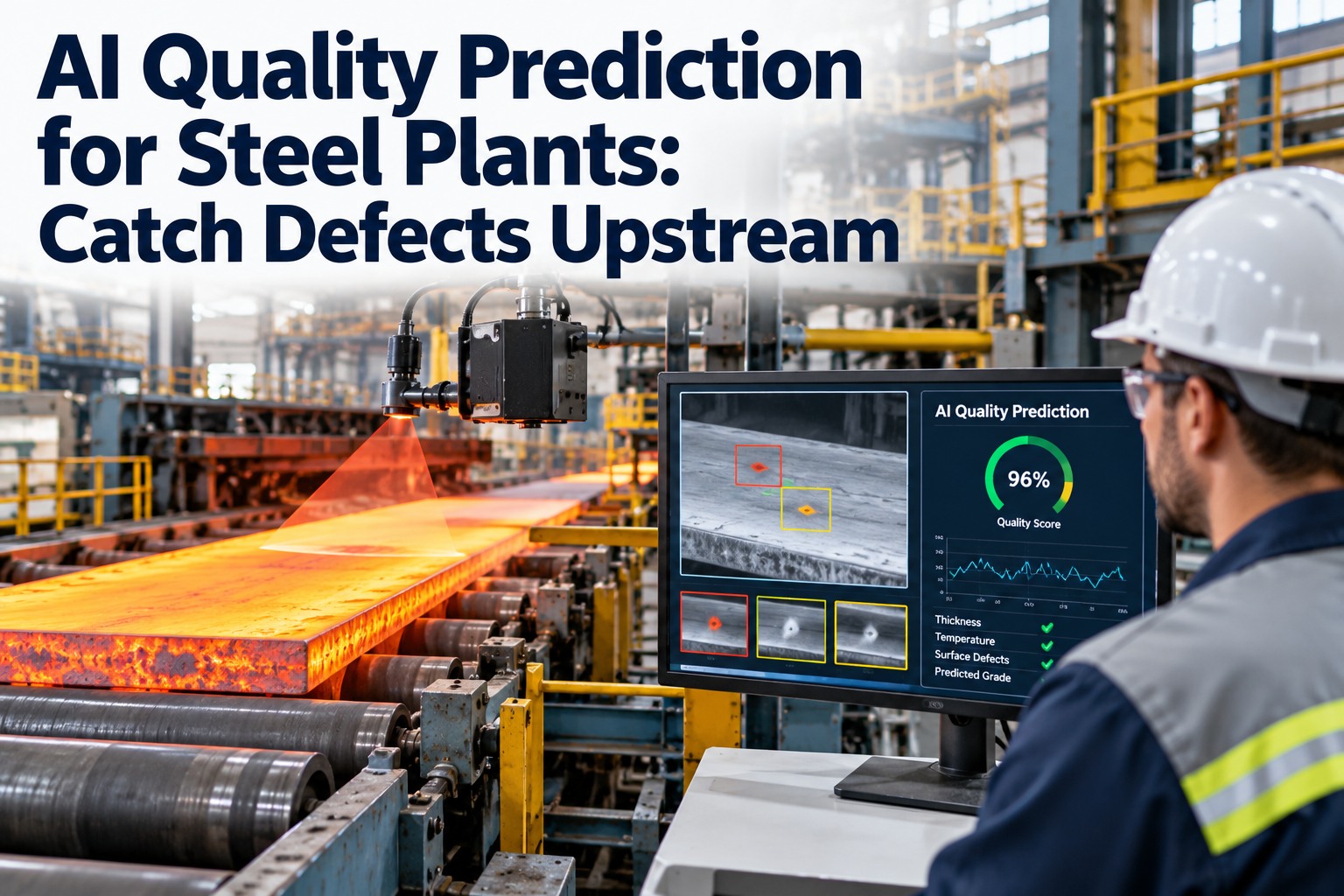
By the time a surface crack shows up on the inspection line, the steel is already made and the cost is already sunk. The signals that it was coming were there hours earlier, in the caster mould temperatures, the roll-force trend, a bearing starting to run warm. AI quality prediction reads those process, equipment and maintenance signals together and flags the defect risk before the cast or the pass that would produce it — so the fix happens upstream, on the equipment, not downstream in the scrap yard. This guide shows how that works and how to run it in OXMAINT AI, or book a demo of predictive quality for steel.
AI QUALITY PREDICTION · STEEL PLANTS · 2027
AI Quality Prediction for Steel Plants: Catch Defects Upstream
Detection tells you the coil is scrap. Prediction tells you a scrap coil is about to be made — while there is still time to act on the equipment. OXMAINT AI links process data, equipment condition and maintenance history into one model that flags a rising defect risk and raises the work order before the cast or the pass that would cause it.
UPSTREAM · PREDICT
Fix the equipment
Signal flags the risk → work order on the mould, roll or bearing → the defect is never cast.
vs
DOWNSTREAM · DETECT
Scrap the coil
Camera finds the crack after rolling → the steel, energy and time are already lost.
Detection Is Too Late. Prediction Is the Point.
Vision systems that catch a defect on the finished strip are valuable — but they catch it after the money is spent. The defect was set in motion upstream, by a process drifting out of control or a piece of equipment degrading. Quality prediction moves the catch point back to where the cause actually lives, so the response is a maintenance action, not a downgrade. Start free and move your catch point upstream with OXMAINT AI.
Detect (Downstream)
Finds the defect after it exists
Output is a reject or downgrade
Material, energy and time already spent
Root cause investigated later, if ever
Predict (Upstream)
Flags the risk before the defect forms
Output is a work order on the asset
Bad steel is never made
Cause fixed at the equipment that drove it
Three Data Streams, One Prediction
A quality defect in steel is rarely a single cause — it is a process condition meeting an equipment condition at the wrong moment. AI quality prediction works because it reads all three streams together, something no single system watching one of them can do.
01
Process Data (SQC)
Caster mould level and temperature, roll force, speed, tension, cooling rates — tracked against statistical control limits so drift is caught as a signal, not a surprise.
02
Equipment Condition
Bearing vibration, roll wear, hydraulic pressure, motor current, alignment — the sensor baselines that say an asset is starting to make bad product before it fails.
03
Maintenance History
Time since last roll change, overdue PMs, past defects tied to this asset — the context that turns a raw reading into a real risk score.
OXMAINT AI already holds two of those three — equipment condition and maintenance history — and links them to the process data, so the prediction has the full picture. Book a demo and see the three streams combined in OXMAINT AI.
Where Defects Start: the Upstream Signals
Most steel defects trace back to a handful of equipment and process conditions that leave a signature long before the defect appears. These are the links a prediction model learns.
Upstream Signal
Likely Defect
Upstream Fix
Caster mould level instability
Surface cracks, breakouts
Mould oscillation / level control service
Worn or eccentric work rolls
Roll marks, thickness variation
Roll change before the risk window
Bearing vibration rising
Chatter marks, gauge defects
Bearing work order raised early
Cooling / descaling pressure drift
Scale, surface quality loss
Nozzle and pump maintenance
Hydraulic pressure out of band
Shape and flatness defects
Hydraulic system check
This grid scrolls sideways on a phone. Each row is a learned link between an equipment signal and a quality outcome — the heart of what the model predicts.
From Prediction to Work Order
A prediction that only raises an alarm changes nothing. The value is in closing the loop — turning the risk signal into a maintenance action on the exact asset that would have caused the defect. OXMAINT AI runs that loop end to end.
1
Watch
Process, condition and history data streamed against baselines and control limits.
→
2
Predict
Model scores the rising defect risk and names the asset behind it.
→
3
Act
A work order is raised automatically on that asset, before the bad product is made.
→
4
Learn
The outcome feeds back, so the model and the PM plan both get sharper.
Why Steel Plants Keep Making the Same Defect
A defect that recurs is almost always a link nobody connected — the quality team and the maintenance team looking at different screens. These are the gaps prediction closes.
×
Quality Blind to Equipment
Defects logged without ever linking them to the asset condition that caused them.
×
Detect-Only Mindset
All the spend on catching defects, none on predicting and preventing them.
×
Baselines Never Set
Condition data collected but never tied to a normal band, so drift goes unseen.
×
Siloed Data
Process, condition and maintenance history living in three systems that never meet.
×
No Feedback Loop
Defect outcomes never fed back, so the same root cause repeats campaign after campaign.
×
Reactive Roll Changes
Rolls run to defect instead of changed inside the predicted risk window.
Stop Inspecting Scrap. Start Predicting It Away.
First-time-right steel is not an inspection outcome — it is a prediction outcome. When the model links equipment condition to quality and raises the work order upstream, the defect never reaches the camera. OXMAINT AI is where those links live.
3
data streams linked into one risk score
Up
stream — the fix moves to the asset, not the scrap yard
Auto
work order raised before the defect is cast
How OXMAINT AI Delivers Quality Prediction
OXMAINT AI is the AI-powered CMMS that already lives where the equipment and maintenance data are — so it is the natural place to link them to quality and predict the defect before it forms. Start free and build quality prediction on OXMAINT AI.
Condition Baselines
Vibration, roll wear, pressure and current tracked against a known-good band on every critical asset.
SQC Control Limits
Process parameters watched against statistical limits, so drift surfaces as an early signal.
Defect-to-Asset Links
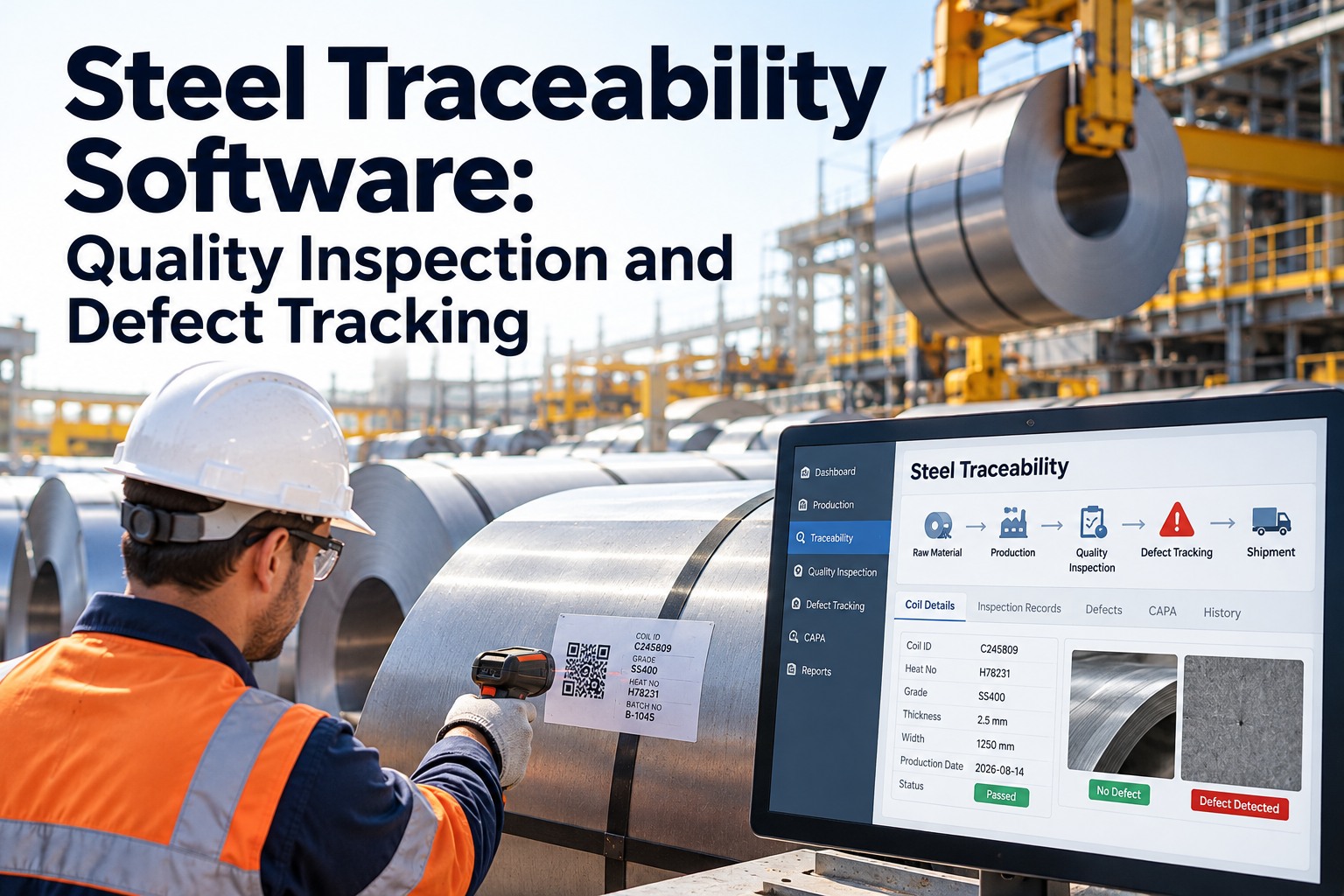
Every logged defect tied back to the asset and condition behind it, building the model's memory.
Auto Work Orders
A rising risk score raises a maintenance work order on the right asset, before the bad cast or pass.
Analytics & Trending
Defect and condition trends across campaigns, so recurring root causes get a permanent fix.
One Record per Asset
Process, condition, maintenance and quality history on one asset record, ready for the model and the audit.
EXPERT REVIEW
Written for quality, process and maintenance teams in integrated and mini-mill steel plants. The defect-to-signal links, control limits and prediction workflow here are a general framework drawn from standard steel quality and reliability practice — the real relationships in your plant come from your own process data, your grades and your equipment, and a prediction model must be trained and validated on them before it is trusted. Quality disposition remains a decision for your quality function. OXMAINT AI is a maintenance management and analytics platform that links equipment condition and maintenance history to quality signals and raises the work order; it is not a metallurgical quality system of record, a vision inspection system, or a substitute for your quality team's judgement.
Frequently Asked Questions
What is AI quality prediction for steel plants?
It is the use of a model that links process data, equipment condition and maintenance history to forecast a quality defect before it is produced — rather than detecting it afterward. Instead of a camera flagging a crack on the finished coil, the model flags the rising risk from the caster, roll or bearing signals and raises a maintenance action while the defect can still be prevented. That moves the response upstream, to the equipment that would cause it.
Start free and set up quality prediction in OXMAINT AI.
How is prediction different from AI defect detection?
Detection is downstream — a vision system finds a defect that already exists, so the output is a reject or downgrade and the material is already lost. Prediction is upstream — it uses process and equipment signals to flag the defect risk before the steel is made, so the output is a work order on an asset. Both have a place, but only prediction prevents the loss rather than recording it.
Book a demo and compare prediction and detection in OXMAINT AI.
What data does a steel quality prediction model need?
Three streams working together: process data under statistical control (mould level, roll force, speed, temperatures), equipment condition from sensor baselines (vibration, roll wear, hydraulic pressure, motor current), and maintenance history (time since roll change, overdue PMs, past defects per asset). The process data alone shows drift; the equipment and maintenance data explain why — and a CMMS is where the last two already live.
Book a demo of the data model in OXMAINT AI.
How does maintenance data improve quality prediction?
Equipment condition is often the missing link that turns a process signal into a confident prediction. A mould level wobble matters more on an oscillator that is overdue for service; a gauge variation matters more on a roll near the end of its campaign. Tying each defect back to the asset condition behind it is what lets the model learn the real cause — and lets the fix be a work order, not a downgrade.
Can a CMMS deliver quality prediction, or do I need a separate system?
A CMMS is the natural home for it, because it already holds the equipment condition and maintenance history a prediction model depends on, and it is where the resulting work order has to land. Linking the process data to that foundation keeps prediction and action in one place, rather than bolting a standalone model onto a plant that cannot act on its output.
Start free and build it on your maintenance data in OXMAINT AI.
Catch the Defect Before the Cast.
Run quality prediction on OXMAINT AI: process, condition and maintenance data linked into one risk score, the defect flagged upstream, and the work order raised on the asset that would have caused it — so the bad coil is prevented, not inspected.