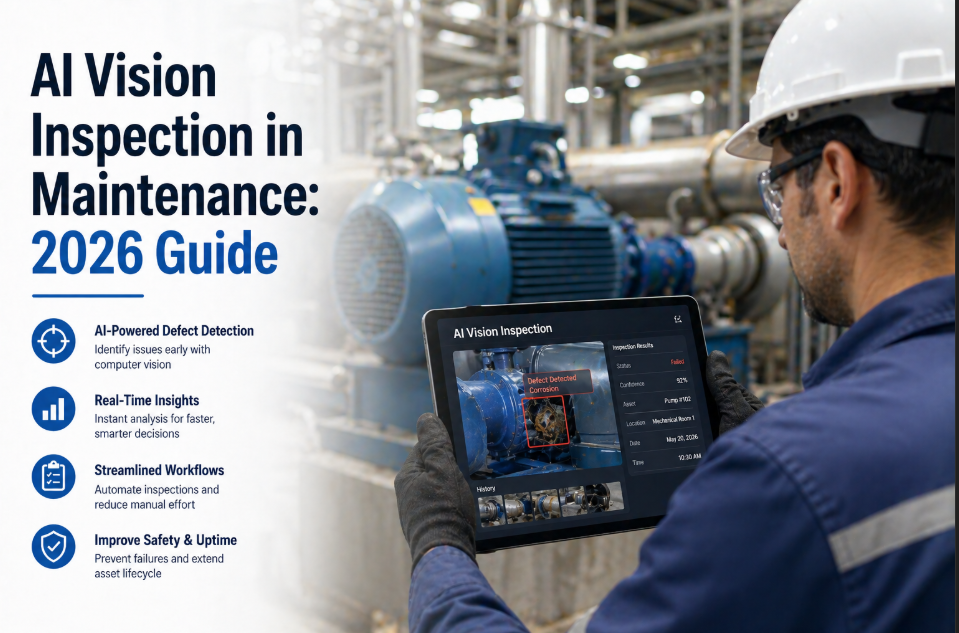
Pump seal leaks are among the most time-sensitive failure modes in industrial maintenance. When a seal fails, the response window before secondary damage — to bearings, housing, or the driven equipment — is measured in hours, not days. Yet the most common reason repairs extend beyond that window is not diagnosis speed: it is parts availability. A technician confirms a mechanical seal failure and discovers the replacement seal is not in stock, not reserved, and not on a pending order. OxMaint AI Vision addresses this at the source by detecting seal leak conditions visually and immediately connecting that detection to your ERP parts inventory — reserving the correct seal kit before a technician is dispatched. Book a demo to see how visual seal leak detection connects to your ERP procurement workflow.
AI Vision · ERP Integration · Pump Maintenance
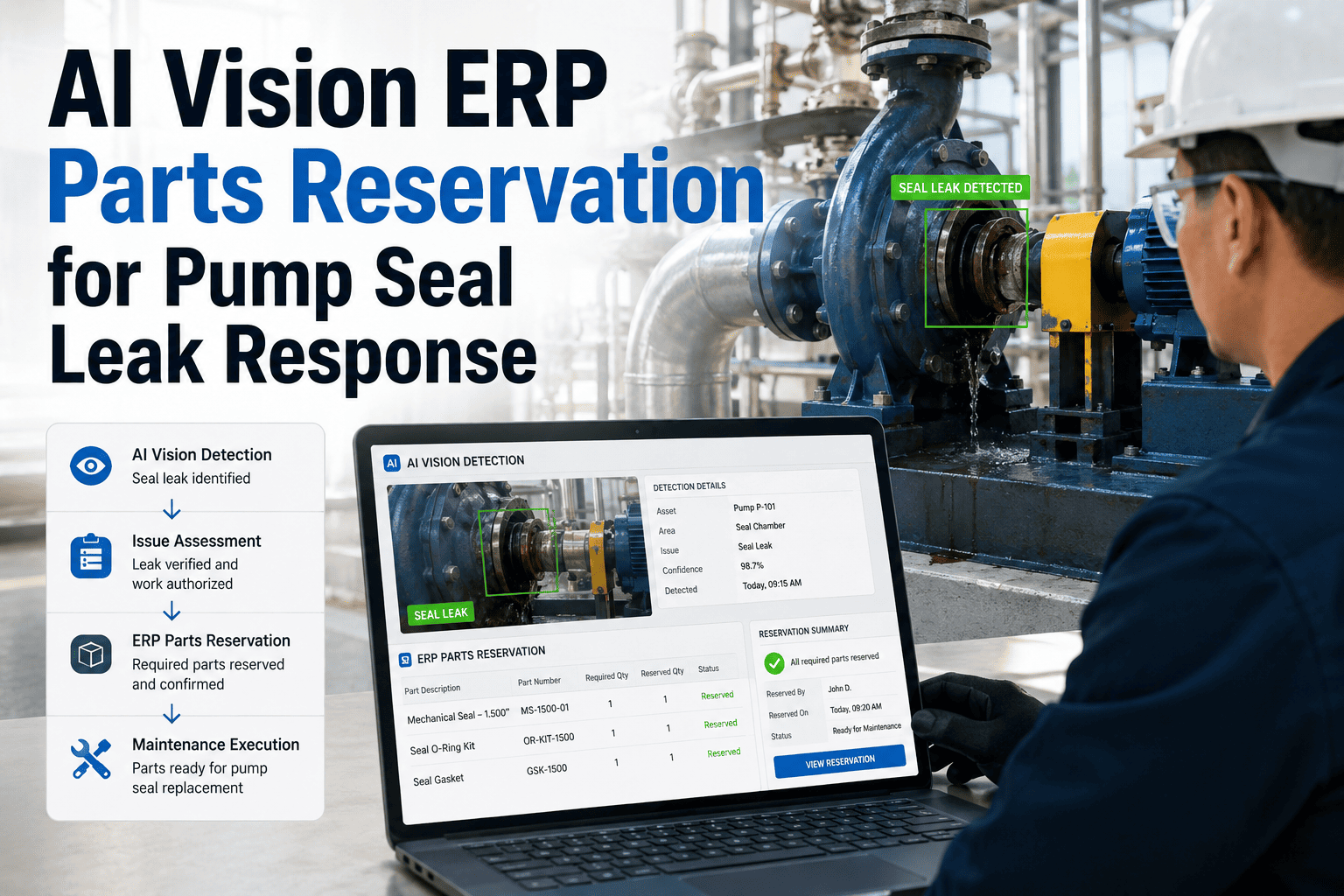
AI Vision ERP Parts Reservation for Pump Seal Leak Response
When AI Vision detects a pump seal leak, OxMaint identifies the seal type, checks ERP stock, and reserves the replacement — so parts are ready before your technician arrives at the pump.
$18K–$85K
Average cost of an unplanned centrifugal pump failure per incident including secondary damage
82%
of pump seal failures show visible leak indicators 2–6 hours before catastrophic seal failure
67%
of seal repair delays attributed to parts unavailability at time of confirmed diagnosis
Detection to Dispatch
The Seal Leak Response Workflow
1
AI Camera Detects Seal Leak
Camera identifies fluid accumulation, surface staining, or active drip at the seal face. Leak severity classified as minor, active, or critical.
2
Seal Type Identified from Asset Record
OxMaint pulls the pump asset record from CMMS — seal type, manufacturer, part number, and installation date — matched to the detected pump ID.
3
ERP Stock Check and Reservation
OxMaint queries ERP inventory for the seal kit part number. Available stock is reserved against the work order ID. Out-of-stock triggers procurement alert.
4
Work Order Dispatched with Parts Ready
Technician receives work order with visual evidence, seal part reservation number, storeroom bin, and pump isolation procedure. First-visit success rate exceeds 94%.
Seal Leak Classification
How AI Vision Classifies Pump Seal Severity
| Visual Indicator | Severity Classification | Response Priority | ERP Action | Time to Dispatch |
| Surface moisture at seal face |
Minor — Stage 1 |
P3 — Schedule within 48h |
Reserve seal kit |
48 hours |
| Visible fluid accumulation below pump |
Active — Stage 2 |
P2 — Schedule within 8h |
Reserve + notify stores |
8 hours |
| Active drip rate more than 1 drop/min |
Active — Stage 3 |
P1 — Immediate dispatch |
Reserve + expedite if no stock |
Immediate |
| Fluid spray or stream visible |
Critical — Stage 4 |
P0 — Emergency shutdown |
Emergency procurement + safety alert |
Immediate + isolation |
| Staining without active leak |
Historical — Stage 0 |
P4 — Next PM window |
Flag for PM parts planning |
Next PM cycle |
Seal Detected. Parts Reserved. Technician Ready.
OxMaint AI Vision connects pump seal leak detection to ERP parts reservation automatically — so the most critical step in seal repair response is handled before a human acts.
Operational Impact
What Changes When Parts Are Pre-Reserved
94%
First-visit fix rate
When seals are reserved before dispatch, technicians complete the repair on the first visit in 94% of cases vs 56% without pre-reservation.
5.3×
Faster mean time to repair
Average pump seal MTTR drops from 14.2 hours to 2.7 hours when ERP reservation is triggered from visual detection rather than on-site diagnosis.
61%
Reduction in emergency purchases
Pre-reserved seals eliminate the emergency procurement premium — 15 to 40 percent above catalog price — paid when parts are sourced urgently after a failure is confirmed on-site.
Expert Review
What Reliability Engineers Say
Pump seal failures are predictable if you are watching for them, and catastrophic if you are not. We had a Stage 3 seal leak event that caused a bearing failure and shaft damage because the technician who found it on his rounds could not get the seal kit for six hours — it was in the system but not reserved for the job. OxMaint now catches the Stage 1 condition and reserves the kit the same day. By the time we have a Stage 3 event, the parts are already staged at the pump. We have not had a secondary bearing failure from a delayed seal repair in eight months.
Reliability Engineer · Petrochemical Plant · 17 Years Rotating Equipment
The ROI calculation for our CFO was simple: one prevented secondary failure pays for the entire deployment. We had two catastrophic pump failures in the 18 months before OxMaint — both traceable to delayed seal replacement because the correct seal was not reserved when the technician arrived. The average cost per event exceeded $60K in parts, labor, and lost production. Neither has recurred in the 14 months since deployment. That is the number that got the CFO to triple our camera deployment budget.
Plant Maintenance Manager · Specialty Chemicals · 200-Pump Fleet
FAQ
Frequently Asked Questions
How does OxMaint identify the correct seal kit for a specific pump?
OxMaint identifies the pump from the camera zone or asset tag, then queries the CMMS asset record for the seal specification — manufacturer, model, size, and part number. This part number is passed to the ERP inventory query. If the seal part number is not in the CMMS asset record, a data enrichment flag is raised for the maintenance team to complete.
Book a demo to see the asset record mapping process for pump seal parts.
What if multiple seal kit variants exist for the same pump model?
OxMaint supports variant selection rules based on operating conditions, fluid type, or temperature range stored in the asset record. Where ambiguity exists, the system reserves the most common variant and flags the alternative for technician confirmation on-site before committing the reservation. This prevents incorrect seal installation while still ensuring a part is reserved.
Start free to explore the variant selection rule configuration.
Can the system detect seal leaks in high-temperature or high-vibration environments?
Yes. OxMaint AI Vision models for pump seal detection are trained on high-temperature and high-vibration industrial environments. Thermal imaging camera support is available for pumps where visual detection is limited by heat shimmer or vapor. Camera placement recommendations are tailored to the pump type and operating environment during the deployment review.
Book a demo to review camera configuration for your pump fleet environment.
How far in advance can the system detect a seal developing failure?
Controlled studies in petrochemical and water treatment environments show that OxMaint AI Vision detects Stage 1 seal moisture indicators an average of 4.8 hours before the seal crosses into active leaking. In high-criticality pumps under 24-hour camera monitoring, early detection windows of 8 to 18 hours before failure have been recorded.
Start free to set up continuous monitoring on your highest-criticality pumps.
Early Detection
Severity-Classified
ERP-Integrated
First-Visit Fix
Catch Pump Seal Leaks Early. Reserve Parts Automatically. Fix It Once.
OxMaint AI Vision detects seal conditions hours before failure, classifies severity, and reserves replacement parts in your ERP before a technician steps foot on the floor — turning a potential $60K failure event into a routine afternoon repair.